Bible Stories
Cain and Abel
Worship, Jealousy, Violence, and the Wound of Sin
Site Admin | April 28, 2026 | 1180 views
The story of Cain and Abel is short, severe, and unforgettable. Coming immediately after the expulsion from Eden, it shows how quickly the wound of sin spreads through the human family. Adam and Eve's disobedience was directed against God. In Cain and Abel, sin turns violently outward against a brother. The story is therefore not only about jealousy or anger in the abstract. It is about worship, conscience, envy, violence, and the mystery of how close human beings can stand to God while still resisting conversion.
Genesis 4 presents Cain and Abel as the sons of Adam and Eve, born east of Eden in a world already marked by toil, pain, and exile. Cain becomes a worker of the ground. Abel becomes a keeper of sheep. In time, both bring offerings to the Lord. The drama that follows is the first explicit act of worship recorded after the Fall, and that detail matters. The Bible is not merely concerned with bad behavior erupting at random. It is concerned with the condition of the heart even in the presence of sacred things.
Two brothers and two offerings
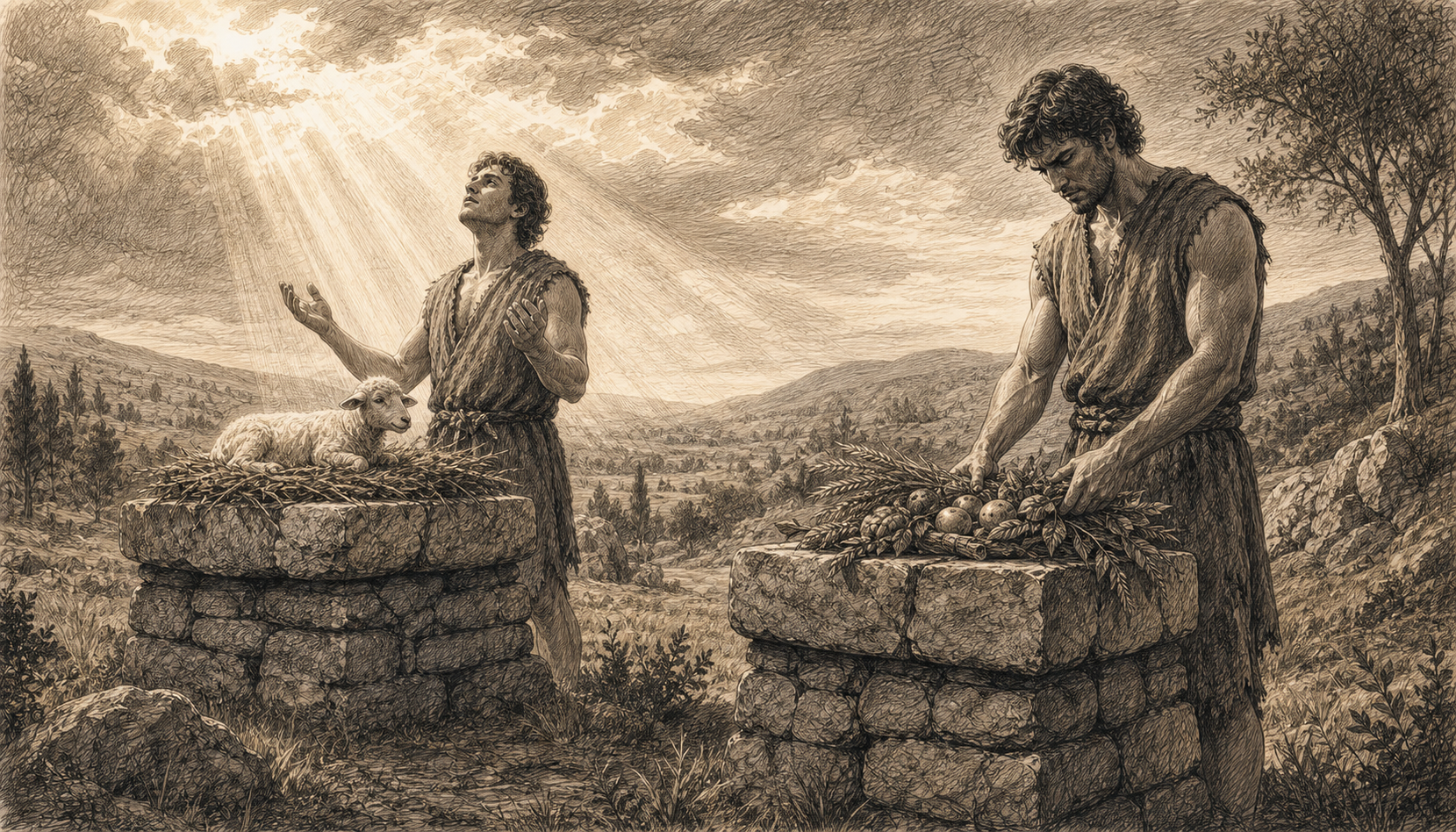
Cain brings an offering from the fruit of the ground. Abel brings from the firstlings of his flock and from their fat portions. The Lord has regard for Abel and his offering, but not for Cain and his offering. Genesis does not spell out every reason in this moment, but the narrative gives strong hints. Abel's offering is presented as first and best. It is marked by generosity and reverence. Cain's offering is described more flatly. The difference appears not merely in material type, but in disposition.
This is important for Catholic reflection on worship. God is not impressed by outward religious action considered in isolation from the heart. Sacrifice, prayer, and devotion are meant to arise from faith, gratitude, and sincere offering of self. The problem with Cain is not that he approaches God. The problem is that he does not allow the encounter with God to transform him when correction becomes necessary.
The mystery of accepted and rejected offerings also humbles us. God sees what others do not. Human beings can compare externals, but the Lord judges truthfully. This should lead not to anxious scrupulosity, but to sincerity. Worship is not performance. It is relationship.
Anger at the door
Cain becomes very angry, and his countenance falls. Here the story turns from sacrifice to conscience. God speaks to Cain with remarkable patience: why are you angry, and why has your countenance fallen? If you do well, will you not be accepted? But if you do not do well, sin is crouching at the door; its desire is for you, but you must master it.
These words are among the most penetrating in the early chapters of Genesis. Before violence erupts, God warns Cain. Sin is pictured as a beast close by, ready to spring. The image is powerful because it shows both danger and responsibility. Temptation is real. Its pull is strong. But Cain is not helpless machinery. He is addressed as a moral agent who can respond, repent, and refuse the path unfolding before him.
That warning is a great act of mercy. God does not abandon Cain to his darkening mood. He confronts him while the sin is still interior and offers a path back through humility. Many people know this moment in ordinary life - the tightening of resentment, the humiliation that becomes bitterness, the inward conversation that justifies anger. Cain is tragic because he receives warning and hardens anyway.
The first murder
Cain speaks to Abel, and when they are in the field he rises against his brother and kills him. Scripture tells the act with frightening economy. There is no dramatic speech, no elaboration, no attempt to soften the horror. One brother kills another. The first generation born outside Eden already bears fruit worthy of the Fall. Human freedom turned from God now turns against kin.
The field, a place associated with Cain's labor, becomes the place of bloodshed. The brother who should have been a companion becomes the victim. This is the first murder in Scripture, and it sets the pattern for much that follows in human history. Violence is rarely only about the immediate victim. It springs from a heart unwilling to accept truth, correction, or the blessing given to another.
Catholic tradition often places this moment in conversation with later sacrificial imagery. Abel's blood cries out from the ground. The New Testament will later contrast the blood of Abel with the blood of Christ. Abel's blood cries for justice. Christ's blood speaks a better word, the word of redeeming mercy. Already in Cain and Abel, Scripture is preparing a language of blood, sacrifice, and moral responsibility that will culminate in the Gospel.
"Where is your brother?"
After the murder, God asks Cain, "Where is your brother Abel?" The question echoes the divine question to Adam in Eden: "Where are you?" Once again, God is not lacking information. He is summoning the sinner to truth. Cain responds with evasion and defiance: "I do not know. Am I my brother's keeper?"
That line has echoed through history because it expresses the logic of moral refusal so clearly. Cain wants to separate himself from responsibility. He rejects not only guilt for murder but duty toward his brother. Yet the entire biblical vision of human life answers him: yes, in a real sense, you are your brother's keeper. Human beings are bound to one another in responsibility, charity, justice, and reverence for life.
God then names the crime. Abel's blood cries out from the ground. The earth that once received seed now receives innocent blood. Creation itself becomes witness. This is one of the deepest features of biblical morality: sin is not a private opinion. It marks the world. The cry of the victim matters before God, even when human justice is absent or delayed.
Judgment and mercy intertwined
Cain is judged. The ground will no longer yield strength to him as before. He becomes restless, a wanderer on the earth. The punishment fits the spiritual disorder that his sin has deepened. The man who refused fraternity now experiences estrangement. Violence isolates. The one who would not receive correction must now carry the burden of exile more deeply.
Yet, astonishingly, the story does not end with annihilation. Cain fears that others will kill him, and God places a mark upon him so that he will not be slain. This is one of the most sobering combinations in Scripture: serious judgment paired with restraining mercy. God does not call the murder small. But neither does he surrender the sinner to unlimited vengeance.
The Catholic imagination should linger here. Divine justice and mercy are never enemies. Mercy does not mean pretending Cain's act is acceptable. Justice does not mean delighting in endless retaliation. The Lord judges, protects, restrains, and leaves space for history to continue. This pattern prepares the way for later biblical teaching about vengeance, forgiveness, and the state's limited role in justice.
The roots of envy and wounded worship
What drove Cain to murder? Envy sits near the center. He cannot bear that Abel is regarded favorably. Rather than learn, repent, or offer more deeply, he turns against the brother whose faithfulness reveals his own resistance. Envy is especially dangerous because it grieves another's good as though it were a personal injury. It cannot rejoice. It wants the other diminished.
The story also suggests something about wounded worship. Cain does not begin as someone outside religious life. He begins by bringing an offering. His tragedy lies in the refusal to be purified through worship. When sacrifice does not yield humility, religion can become one more place where pride hides. This is why the saints insist so strongly on purity of heart, examination of conscience, and repentance. Sacred things do not automatically heal a resistant heart.
Many later biblical warnings stand under the shadow of Cain. Anger, hatred of brother, false worship, and violence all belong to this pattern. The First Letter of John even explicitly says that those who hate their brother are acting in the spirit of Cain. The Church reads this not as exaggeration, but as diagnosis. The roots of great sin are often present in ordinary resentments left unchallenged.
Cain and Abel in the light of Christ
The New Testament does not forget Abel. He appears among the righteous, and his blood becomes part of a larger biblical pattern fulfilled in Christ. Hebrews says that believers come to Jesus, the mediator of a new covenant, and to the sprinkled blood that speaks better than the blood of Abel. This does not mean Abel's blood was unimportant. It means Christ's sacrifice surpasses it. Abel's blood cries out because injustice must be answered. Christ's blood answers injustice while also opening mercy for the guilty.
There is also a moral contrast. Cain kills his brother in the field. Christ dies for his brothers on the Cross. Cain refuses responsibility. Christ takes responsibility for sinners though he is innocent. Cain's sin deepens exile. Christ's sacrifice opens the road home. The dark early story of Genesis is therefore not left closed upon itself. It becomes one more way the Bible teaches us to hunger for a Redeemer.
In Catholic life, this contrast becomes practical wherever resentment is confessed, envy is renounced, reconciliation is sought, and innocent life is defended. The Gospel does not erase the seriousness of Cain's act. It reveals the only power strong enough to heal hearts shaped like Cain's.
What the story asks of us
Cain and Abel asks searching questions. How do we respond when another is favored, honored, or blessed? Do we allow correction to soften us, or do we brood in silent anger? Do we treat worship as self-offering, or as a way of managing appearances? Do we remember that our brother's life is our concern? The story is short because its questions are perennial and direct.
It also teaches that sins of the heart must be faced early. God addressed Cain before the murder. There was still time. Much human sorrow might be prevented if anger, envy, bitterness, and contempt were brought into the light at the beginning. This is one reason the Church values examination of conscience, spiritual direction, fasting, confession, and prayer for enemies. Grace seeks to meet sin while it is still crouching at the door.
Cain and Abel teaches that envy can turn worship cold and brotherhood violent, but it also teaches that God sees, God judges, and God does not cease to call sinners back to truth. The cry of innocent blood rises to heaven, and in the fullness of time the blood of Christ answers it with both justice and mercy.