Saints and Witnesses
A Quiet Flame: The Life and Witness of St. John of the Cross
A brief life, a hard road, and a doctrine of love purified by the Cross
Site Admin | May 8, 2026 | 104 views
A life shaped by poverty, prayer, and reform
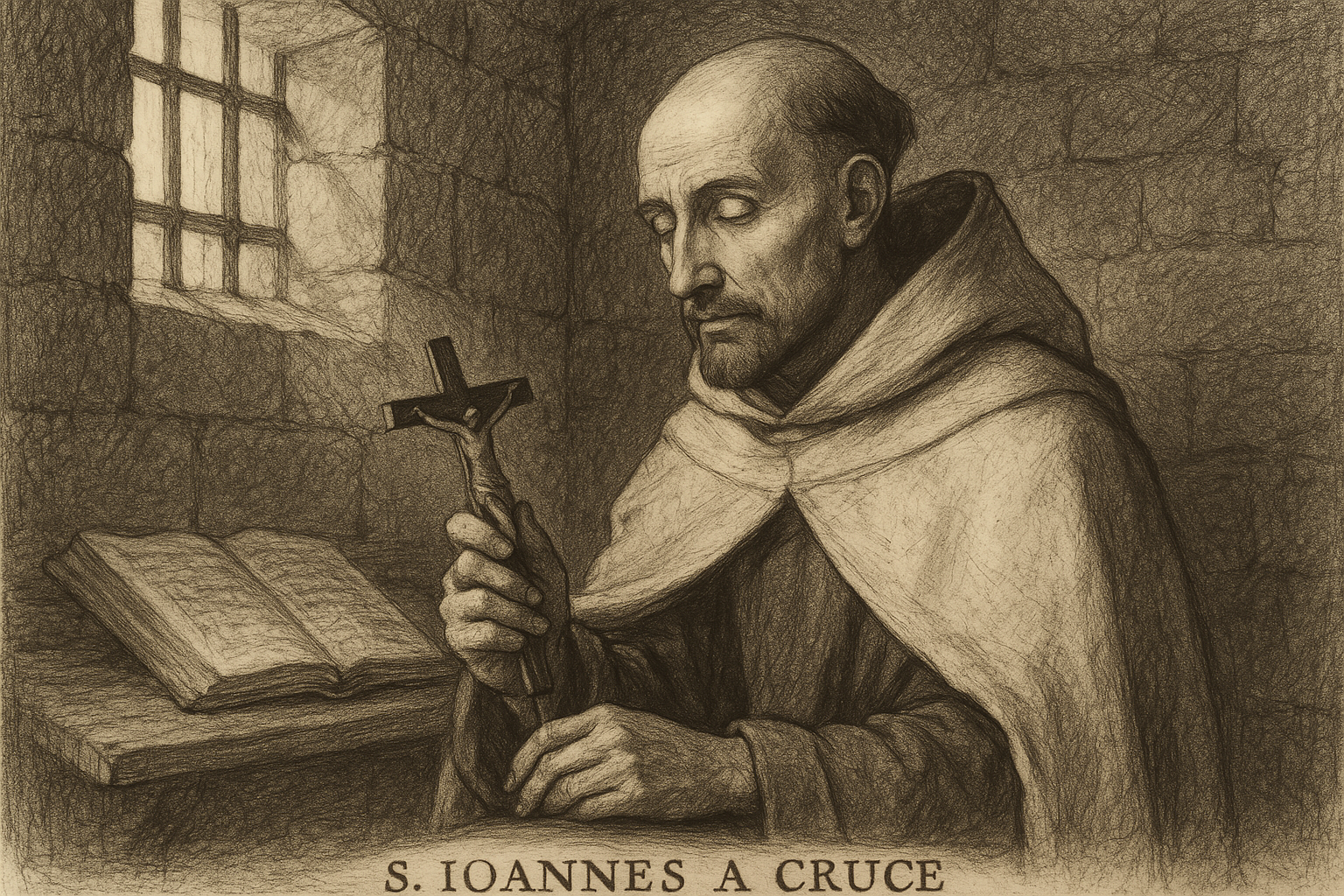
St. John of the Cross is one of the great Catholic witnesses to the hidden life of prayer. His St. John of the Cross life was not long, and it was far from easy, yet it became a strong testimony that God can purify the soul through trial and lead it toward deeper union with Himself. Born Juan de Yepes in 1542 in Spain, he grew up in modest circumstances. After serving in a hospital and studying with care, he entered the Carmelites and was ordained a priest in 1567.
That same year he met St. Teresa of Avila, whose desire to renew Carmelite life would shape his own vocation. He soon joined her reform movement, which sought greater poverty, discipline, and prayer. Their shared work did not begin as a public triumph. It involved misunderstanding, resistance, and sacrifice. Yet this reform gave the Church one of her most penetrating writers on the spiritual life.
John did not seek attention, and his holiness was not built on outward success. He was a priest, confessor, teacher, reformer, and contemplative. He also knew what it meant to be opposed by fellow religious, and to suffer not for scandal or error, but for fidelity to a difficult calling. That tension between hiddenness and fruitfulness runs through his whole witness.
From reform to imprisonment
The Carmelite reform was not received peacefully by everyone. In 1577, John was seized by members of the older branch of the order and held in a narrow cell in Toledo. He endured harsh conditions for months. Humanly speaking, this was a dark and humiliating episode. Spiritually, it became a place where his interior life was deepened in ways few would ever see.
It is not necessary to romanticize suffering to understand its place in his life. Prison was an injustice. Hunger, isolation, and fear are real evils. Yet John later showed that even such suffering cannot separate a soul from God when it is united to Christ. The mystery of the Cross is not that pain is good in itself, but that God can meet the faithful soul within it and transform it from within.
John eventually escaped. He continued his reform work with perseverance, though not without further opposition. He held several offices, served his brothers, and remained committed to the path he believed the Lord had asked of him. He died in 1591, having lived only forty nine years. The Church later recognized in him a doctor of the Church, not because he escaped hardship, but because he learned how grace works in the soul under hardship.
The teaching that made him lasting
St. John of the Cross is remembered especially for his spiritual writings, including The Dark Night of the Soul and Ascent of Mount Carmel. These works are sometimes read in a purely literary way, but they were written for the Christian life. John was trying to help souls detach from what is lesser so that they can cling more fully to God.
His language is demanding because the spiritual life is demanding. He teaches that the soul must be purified of disordered attachments, not because created things are bad, but because they become obstacles when the heart rests in them more than in God. In this sense, his work is deeply biblical. Scripture constantly calls believers to trust the Lord above gifts, consolations, and visible signs. Jesus says,
Peace I leave with you; my peace I give to youand John the Cross helps explain why that peace often comes after surrender, not before it.
He also insists that God leads many souls through darkness that is not punishment but purification. This is one reason Catholics return to him when prayer feels dry. He is not telling the faithful that God is absent. He is teaching that God may be more present than the emotions can detect. The spiritual senses can fail while faith remains alive.
The dark night is not despair
Many people hear the phrase dark night and imagine only sadness. John meant something more exact. A dark night can describe a stage in which God withdraws sensible comfort so that faith may grow more pure. The soul learns not to use prayer as a search for spiritual sweetness, but as an act of love and surrender.
This is a hard teaching, but it is also a hopeful one. In the biblical pattern, God often forms His servants in hiddenness. Abraham waits. Israel walks through the wilderness. Elijah hears the Lord in a gentle whisper. Christ Himself prays in anguish in Gethsemane and enters the Cross before the Resurrection. John of the Cross reads the Christian life in that same key. Union with God is not shallow sentiment. It is costly love.
For Catholics today, this matters because many lose heart when prayer seems ordinary, dry, or slow. John offers a disciplined patience. If we remain faithful, keep the sacraments, and pray as best we can, God is still at work. The soul does not have to feel progress in order to be growing.
He also shows that detachment is not the same as indifference. Rather, it is freedom. A person who clings less to comfort can love more deeply. A person who is less ruled by self can become more available to God and neighbor. This is not a flight from the world, but a purification of desire.
What his life teaches ordinary Catholics
St. John of the Cross is often associated with advanced mystical theology, but his witness is not only for contemplatives in cloistered settings. His life speaks to ordinary Catholics who are trying to remain faithful amid confusion, disappointment, or interior dryness.
- Be patient with hidden growth. Not all grace is visible. Some of the deepest work happens quietly.
- Accept that prayer can be difficult. Dryness does not automatically mean failure. It can be an invitation to purer faith.
- Hold created goods lightly. Family, work, success, and consolation are gifts, but they are not God.
- Do not flee the Cross. Suffering is not sought for its own sake, but united to Christ it can become fruitful.
- Stay close to the Church. John was a reformer, yet always within Catholic faith, sacramental life, and obedience.
There is also a lesson in his humility. He did not build a movement around himself. He did not seek to be admired. He served, suffered, wrote, and prayed. The Church remembers him not because he made religion more impressive, but because he made it more true. In his life, we see that holiness is not a matter of spiritual display. It is a matter of being conformed to Christ.
Mary, faith, and the way of interior silence
John of the Cross belonged to a Marian, sacramental, and deeply ecclesial world. His teaching is not about emptying the soul into blankness. It is about clearing away noise so that God can speak. That interior silence is very close to the spirit of Christian recollection, where the heart becomes attentive to the Lord.
He would likely recognize the wisdom in Marys response at the Annunciation: let it be to me according to your word. Her fiat shows the posture that his writings repeatedly commend. The soul does not force God, manipulate grace, or demand immediate clarity. It yields. It trusts. It allows God to lead.
That is why his work remains so useful for Catholics facing unanswered questions. Whether the trial is spiritual dryness, family struggle, or a sense of being misunderstood, John points back to trust in the God who purifies love. He does not deny pain. He places pain within the larger drama of redemption.
In a noisy age, his witness is especially sober. He reminds us that not every experience must be interpreted at once, and not every consolation is a sign of maturity. Sometimes the most faithful thing a Christian can do is remain steady, pray the Psalms, receive the sacraments, and ask God for the grace to love Him in the dark.
Why his witness still speaks with force
There is a reason St. John of the Cross continues to be read by those seeking depth in prayer. He speaks to the real condition of the human heart. We want God, but we often want Him on our terms. We want peace, but not purification. We want light, but not the night that strips away our false securities. John tells the truth more gently than that summary sounds, but no less firmly.
His own life gives weight to his teaching. He knew reform from the inside. He knew misunderstanding. He knew imprisonment. He knew the ache of serving a cause larger than himself. And through it all he stayed near Christ. That nearness is what matters most. The saint is not a man who avoided darkness. He is a man who learned how to walk through it with faith.
For Catholics today, that is both challenging and comforting. If the road of prayer feels slow, St. John of the Cross can help us keep going. If suffering has made us question whether God is near, he can remind us that the Lord often works most deeply where we feel least able to measure Him. And if we are tempted to settle for a thin spirituality, his life invites us back to the strong, quiet center of the Gospel: love the Lord with your whole heart, and let Him purify that heart until it rests in Him alone.
Keep Reading on Lets Read The Bible
Frequently Asked Questions
Who was St. John of the Cross?
St. John of the Cross was a 16th century Carmelite priest, reformer, mystical theologian, and doctor of the Church. He is known for his writings on prayer, detachment, and the soul's journey toward union with God.
What is St. John of the Cross best known for?
He is best known for The Dark Night of the Soul and Ascent of Mount Carmel, where he explains how God purifies the soul through prayer, detachment, and faithful endurance in spiritual dryness.
How can ordinary Catholics apply St. John of the Cross today?
Catholics can apply his teaching by remaining faithful in prayer, accepting seasons of dryness without panic, detaching from unhealthy attachments, and trusting that God is at work even when spiritual progress feels hidden.