Saints and Witnesses
St. Monica and the Long Faithfulness of a Mother's Prayer
A close look at the life of St. Monica, whose steady prayer, patience, and tears became a quiet witness to God's mercy.
Site Admin | April 24, 2026 | 111 views
St. Monica life is one of the most beloved witness stories in the Church because it does not depend on public success, dramatic talent, or a life free from sorrow. It is the story of a Christian woman who prayed, waited, suffered, and trusted God when her family seemed to be slipping beyond her reach. Her son, Augustine, would become one of the great saints and teachers of the Church, but Monica herself deserves to be remembered not only as his mother. She stands before Catholics as a model of steadfast faith, especially for those who carry hidden burdens and long unanswered petitions.
Monica was born in North Africa in the fourth century, in a Christian family. She lived in a time when the Church was still growing in a world shaped by Roman culture and by many competing beliefs. As a young woman, she married Patricius, a pagan official with a difficult temper. The marriage brought strain, and Monica had to practice patience in ordinary, daily ways. Tradition remembers that she did not answer harshness with bitterness. Instead, she held to prayer, discipline, and charity. In a home marked by tension, that witness mattered.
Her marriage was not easy, but Monica did not let suffering close her heart to God. She also had to bear sorrow for the spiritual direction of those she loved. Augustine, gifted in intellect but restless in soul, wandered for years before his conversion. He pursued ambition, teaching, philosophy, pleasure, and the approval of others. Monica did not have the power to force his conversion, and that is part of what makes her life so moving. She could only pray, speak, suffer, and trust. The Church has always known that such hidden work can be holy work.
A mother who prayed when she could do little else
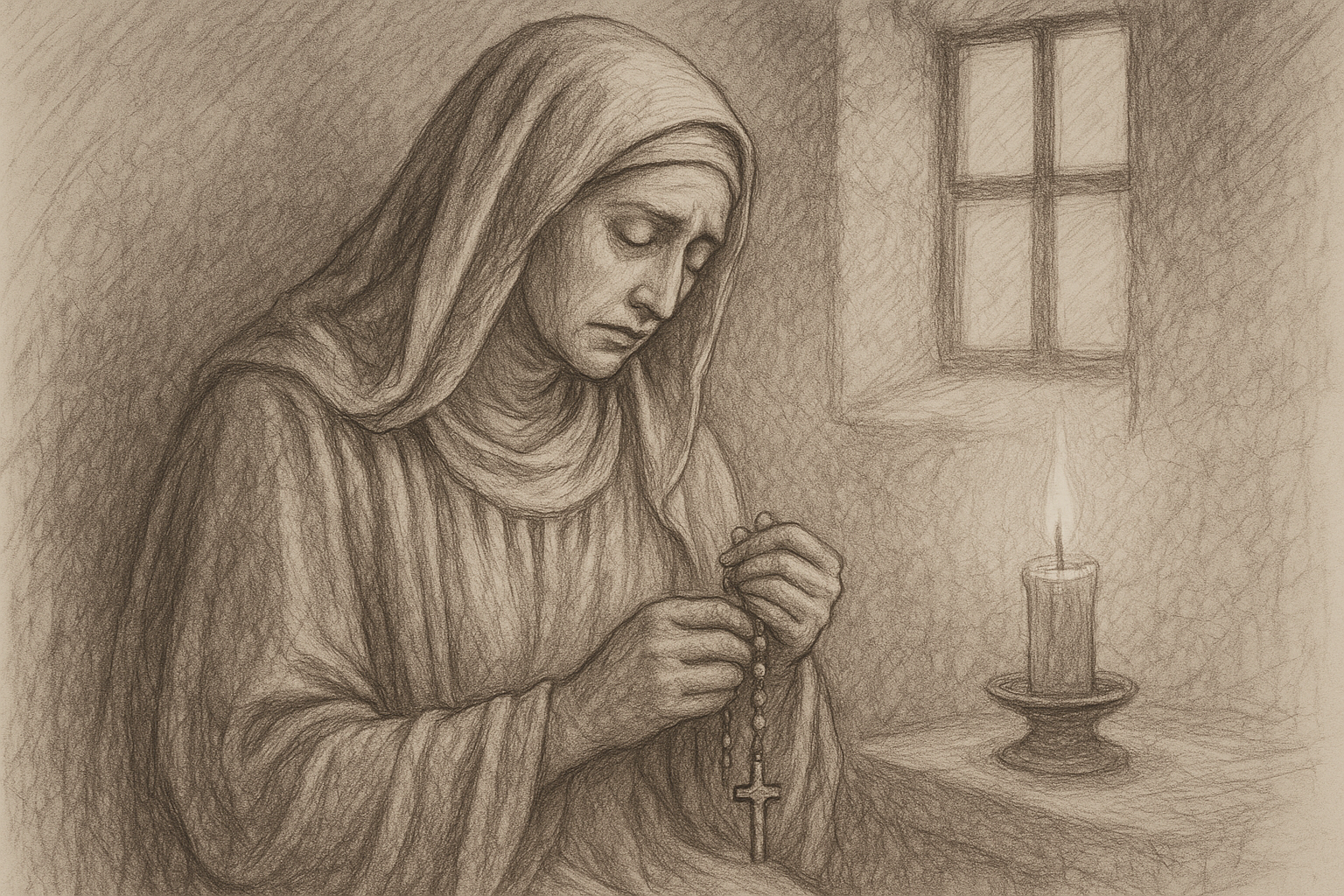
Monica's greatest known labor was intercession. Catholic memory has long linked her with tears because her prayer was not detached or theoretical. It cost her something. She prayed for her husband, her children, and especially Augustine. She sought help from wise Christians. She stayed close to the life of the Church. She refused despair.
Augustine himself tells us in his Confessions that Monica grieved over him deeply. At one point, a bishop is said to have encouraged her, telling her that a child of such tears could not be lost. Whether remembered as exact quotation or faithful Christian memory, the line captures the spirit of her life: the Lord does not ignore sincere prayer. Scripture often presents this same pattern. The widow in [[VERSE|luke|18|1-8|the persistent widow]] is not praised for power, but for perseverance. Jesus teaches that we should pray always and not lose heart. Monica lived that truth in the ordinary pressure of family sorrow.
Her prayer was not merely emotional endurance. It was rooted in confidence that God acts through time. That confidence belongs to the Catholic understanding of prayer. We do not pray as if God were reluctant and could be worn down by volume. We pray because the Father is good, because Christ intercedes for us, and because grace can reach where we cannot. Monica's example reminds Catholics that the measure of prayer is not speed, but fidelity.
Exile, healing, and the hand of Providence
Monica's life also included movement and loss. After Patricius died, she continued to care for her family and to remain near Augustine as he sought his path. At one point she followed him to Milan, where he was teaching rhetoric. There, through a chain of events shaped by grace, Augustine encountered St. Ambrose and the preaching of the Church in a new way. Monica did not convert Augustine by argument alone. She prepared the ground by a long history of prayer, witness, and patient love.
The story is important because it protects us from a false idea of sanctity. A holy life is not always neat. Monica did not see immediate results. Her son resisted. Her hopes were delayed. Yet the delay did not mean defeat. In the economy of God, time is not wasted when it is filled with fidelity. Monica's perseverance reflects the biblical conviction that the Lord hears the cry of the poor and the oppressed, even when the answer unfolds slowly.
When Augustine finally came to faith and was baptized, Monica's joy was deep and real. Her prayer had not been empty. What she had sought most faithfully was now visible before her. Yet even this moment is best understood not as the end of the story, but as proof that God's mercy had been at work all along. Monica had cooperated with grace by refusing to stop asking.
What the Church sees in St. Monica
The Church remembers St. Monica as a saint because her holiness was not spectacular in the worldly sense. She is not chiefly honored for travel, learning, or public authority. She is honored for faithfulness in suffering, purity of intention, and love that would not give up. That is why so many Catholics turn to her when family life becomes heavy.
Her witness is especially comforting for parents whose children have drifted from the faith, for spouses carrying a difficult marriage, and for anyone who feels powerless before the choices of someone they love. Monica shows that powerlessness is not the same as uselessness. A person can be unable to control an outcome and still cooperate with grace through prayer, sacrifice, and patience.
The Psalms give language to this kind of trust: I waited patiently for the Lord; he inclined to me and heard my cry Psalm 40:1. Monica's life echoes that waiting. She did not rush into cynicism. She waited with tears. Her prayer life was not passive resignation. It was active trust in a God who sees.
Three lessons from Monica's life
- Pray steadily, not only when feelings are strong. Monica's example shows that prayer can be faithful even when it is weary, repetitive, and hidden from others.
- Do not measure God by your timetable. Her life teaches that grace may work slowly, but delay is not the same as absence.
- Offer love without surrendering truth. Monica loved Augustine deeply, but she did not abandon her Christian convictions in order to keep peace.
These lessons are simple, but they are hard to live. Many Catholics know the temptation to stop praying because an answer seems too late. Monica gently corrects that temptation. She reminds us that a prayer offered in love can shape a soul in ways we cannot see.
Monica's place beside Augustine
It is impossible to tell Monica's story without Augustine, but it is equally important not to erase her by making her only a supporting character. Augustine's conversion is one of the great moments in Christian history. Yet his mother's hidden labor is part of that grace-filled story. Her life reveals the unseen cooperation that often stands behind a visible conversion.
In this sense, Monica reflects the wider communion of saints. The Church is not a collection of isolated spiritual athletes. We bear one another's burdens. We pray for the living and the dead. We trust that God uses the faithfulness of one person for the good of another. Monica's life is a maternal image of this mystery. She loved, interceded, and remained close to Christ.
Her own death came not long after Augustine's baptism, at Ostia. The accounts of her final days show a soul at peace, speaking with her son about eternal life and the joy of the saints. Her death is not presented as tragedy, but as completion. The woman who had prayed through so much sorrow now entered the rest for which she had long hoped. The Church remembers that holy end with gratitude, because it shows that steadfast prayer belongs not only to the struggle of life, but to the hope of heaven.
How Catholics can pray with St. Monica today
Many Catholics keep St. Monica close because her life meets them where they actually live. She is a saint for the home, for the kitchen table, for the bedroom where someone worries in silence, for the parish pew where tears are hidden behind a prayer book. Her intercession is sought for family members who have drifted, for those trapped in addiction or confusion, and for those whose hearts are becoming tired of waiting.
To pray with Monica is to bring specific people before the Lord without pretending that everything is under control. It is to say, in effect, that God knows this person better than I do, and loves them more than I can manage. That kind of prayer can be painful, because it requires surrender. But it also makes room for peace.
Catholics can also learn from Monica to pair prayer with sacramental life. She was not an isolated spiritual figure. Her strength belonged to a Christian world of worship, teaching, and fellowship. The Mass, the sacraments, Scripture, and the support of faithful pastors all shape endurance. Monica's holiness was personal, but not private in the shallow sense. It was formed within the Church.
That is why her witness still matters so widely. In a culture that often demands instant results, St. Monica shows a better way. She invites Christians to remain close to Christ when nothing seems to move, to keep asking when answers are delayed, and to trust that God is at work even in the silence. Her life is not flashy. It is something more enduring. It is the beauty of faith that does not let go.
For anyone praying over a beloved person today, Monica offers a quiet companionship. She knows what it means to wait with tears, and she knows that the Lord is faithful. Her life still says to the Church that no prayer offered in love is lost before God.
Keep Reading on Lets Read The Bible
Frequently Asked Questions
Why is St. Monica associated with persistent prayer?
St. Monica is remembered for praying faithfully for her husband and especially for her son Augustine over many years. Her life became a Christian witness to perseverance, trust, and hope in God's timing.
What is St. Monica the patron saint of?
St. Monica is commonly invoked for mothers, wives, difficult marriages, and families praying for the conversion of loved ones. Catholics also ask for her intercession when prayer feels slow or discouraging.
How does St. Monica encourage Catholics today?
She encourages Catholics to keep praying even when answers do not come quickly, to trust God's grace in family life, and to remember that hidden fidelity can bear lasting fruit.