Bible Stories
The Easter Story
The Passion, Death, and Resurrection of Jesus Christ
Site Admin | May 5, 2026 | 379 views
The Easter story stands at the very center of Christianity. Everything in the Old Testament prepares for it, everything in the New Testament flows from it, and every Sunday of the Church's life proclaims it again. Easter is not simply a spring holiday, a family custom, or a memory of something inspiring that happened long ago. Easter is the account of how Jesus Christ freely entered into suffering, carried the sins of the world, died upon the Cross, and rose again in glory. It is the story of the victory of divine love over sin, death, fear, and despair.
For Catholics, Easter is not an isolated day but the summit of the Paschal Mystery. Holy Thursday, Good Friday, Holy Saturday, and Easter Sunday belong together. The Last Supper, the agony in the garden, the trial before religious and civil authorities, the scourging, the carrying of the Cross, the Crucifixion, the burial, the silence of the tomb, and the Resurrection all form one saving drama. The Gospels tell the story with sobriety and power. They do not rush. They invite us to remain near Christ, to watch, to pray, to mourn, and finally to rejoice.
The main scriptural witnesses to the Easter story are found in Matthew 26-28, Mark 14-16, Luke 22-24, and John 13-21. Each Gospel emphasizes different details, yet all proclaim the same saving truth: Jesus truly suffered, truly died, truly was buried, and truly rose again. The Church reads these passages not as symbolic tales but as the foundation of real history and living hope.
The Last Supper and the beginning of the Passion
The Easter story begins in an upper room in Jerusalem. Jesus knows that his hour has come. He gathers with the Twelve during Passover, the feast that remembers Israel's deliverance from slavery in Egypt. That setting matters deeply. In the Old Covenant, the blood of the Passover lamb marked out the people of God for rescue. Now, in the fullness of time, Jesus reveals himself as the true Lamb whose sacrifice will bring a greater deliverance, not from Pharaoh, but from sin.
At the supper Jesus gives thanks, breaks bread, and identifies the bread with his Body. He takes the cup and identifies it with his Blood, poured out for many. Catholics hear here the institution of the Holy Eucharist. The Lord does not merely speak of future grace. He gives himself sacramentally and places into the hands of the apostles the mystery the Church will celebrate until he comes again. The Easter story therefore begins not only with sorrow but with gift. Even before Calvary, Christ is already giving himself away in love.
At the same meal Jesus also washes the feet of his disciples, teaching them that divine authority is expressed through humble service. The King stoops. The Master kneels. The One through whom all things were made takes the place of a servant. This is one of the great paradoxes of Holy Week: the closer Christ comes to the hour of his triumph, the more deeply he reveals his humility.
Gethsemane, betrayal, and abandonment
After supper, Jesus goes to the Mount of Olives, to a garden called Gethsemane. The garden is significant. Humanity first fell in a garden, and now the Redeemer enters another garden to begin the reversal of that disaster. There, under the weight of what lies ahead, Jesus prays in anguish to the Father. The Gospels reveal his full humanity in this moment. He is not acting a part. He knows the cost. He feels the terror of suffering. He knows he will drink the cup to the dregs.
Yet the prayer of Jesus is not governed by fear. It is governed by obedience and love. He asks that the cup might pass, but he entrusts himself entirely to the Father's will. This matters spiritually. Many people imagine holiness means never feeling distress. Gethsemane shows the opposite. Holiness is perfect trust in the midst of distress. Christ does not escape human agony. He sanctifies it by offering it to the Father.
Then Judas arrives, guiding soldiers and officials. One of the Twelve betrays the Lord with a kiss, a gesture that should have signified affection. The disciples scatter. Peter, who had promised fidelity, will soon deny even knowing Jesus. The Easter story is honest about human weakness. Even those closest to Christ fail him. Yet that very failure becomes the place where mercy will later be revealed with extraordinary tenderness.
The trials, the Cross, and the death of Jesus
Jesus is taken before the high priest and accused. False witnesses are sought. He is mocked, struck, and condemned. Then he is brought before Pontius Pilate, the Roman governor. Pilate sees that Jesus is not guilty of any crime deserving death, yet he lacks the courage to defend him. Under political pressure and public shouting, he delivers Jesus to be crucified. The Lord is scourged, crowned with thorns, clothed in mock royalty, and presented to the crowd in humiliation. The One who is true King receives a parody of enthronement before ascending the Cross, which will become the throne of redeeming love.
On the way to Golgotha, Jesus carries the Cross. Simon of Cyrene is compelled to help him. Women mourn. Bystanders stare. Roman soldiers drive the procession forward. The Savior of the world appears defeated. Yet the Church sees here not a collapse of God's plan but its fulfillment. Jesus is the suffering servant foretold in the prophets, the obedient Son who carries what humanity cannot bear for itself.
At Calvary, Jesus is nailed to the wood. Above him stands the inscription identifying him as King of the Jews. Around him are soldiers, mockers, passersby, the beloved disciple, holy women, and his mother. The Cross is public. Redemption is not hidden in a corner. It is carried out before the world. Jesus speaks words of forgiveness, promises paradise to the repentant thief, entrusts his mother and disciple to one another, and finally surrenders his spirit to the Father.
Catholic devotion lingers at the Cross because the Cross reveals who God is. He is not indifferent to suffering. He enters it. He does not conquer evil by imitating its cruelty. He overcomes it through self-giving love. The death of Jesus is a true sacrifice. He is priest and victim. He offers himself for the salvation of the world. This is why Good Friday is both mournful and strangely radiant. The Church grieves, but she grieves before the very act through which she is healed.
The silence of Holy Saturday
After Jesus dies, his body is taken down and placed in a tomb. Joseph of Arimathea offers the burial place. A great stone is rolled in front. The holy women see where he is laid. Then comes Holy Saturday, one of the most haunting days in the Christian calendar. Nothing seems to move. Heaven is quiet. The disciples are scattered and afraid. The promises of Jesus seem impossible to reconcile with the sealed tomb before them.
Holy Saturday teaches an important spiritual lesson. God is still at work when all visible signs seem absent. The silence of the tomb is not emptiness. It is hidden action. Christian tradition speaks of Christ descending to the dead, proclaiming victory and opening the gates for the righteous who awaited redemption. Even in death, Jesus is not passive. He enters the deepest places to bring light where humanity could not go on its own.
Many believers know something of Holy Saturday in their own lives. There are seasons when prayer feels quiet, grief seems heavy, and hope appears buried. The Easter story includes this day so that no faithful soul will think the silence means abandonment. The tomb is not the end of the story. It is the threshold before dawn.
The empty tomb and the risen Lord
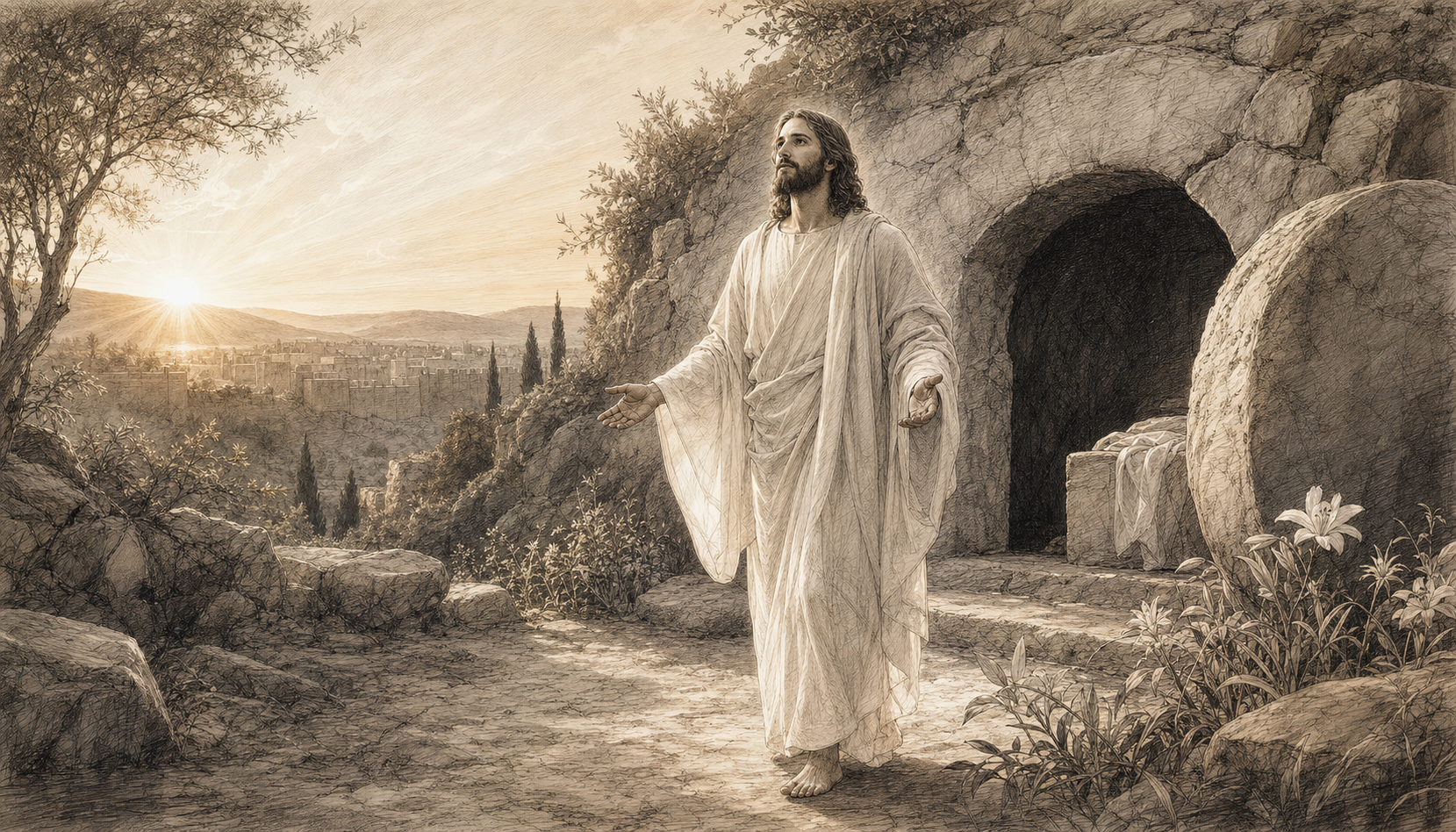
Very early on the first day of the week, the women come to the tomb. In the Gospels, they are not expecting Resurrection. They come with grief, spices, and love. This detail is important because it highlights the surprise of Easter morning. The stone is rolled away. The tomb is empty. Angels announce that Jesus is not there, for he has risen. Fear and joy mingle. The women become the first witnesses to the Resurrection proclamation.
Peter and the beloved disciple run to the tomb. They see the burial cloths. Mary Magdalene weeps and then encounters the risen Christ, who calls her by name. In other accounts Jesus appears to the women, to the apostles, to disciples on the road to Emmaus, and later to the gathered Church. These appearances matter because Easter is not the survival of an idea. It is not merely that the cause of Jesus lived on in the hearts of his followers. The claim of Christianity is much stronger: Jesus Christ truly rose bodily from the dead.
The Resurrection does not erase the Cross. The risen Christ still bears the marks of his wounds. Easter glory includes transformed suffering, not amnesia. This gives the Christian vision of hope its distinctive shape. What is raised is not a stranger to pain, but the crucified Lord himself. Therefore, when Catholics speak about resurrection life, they do not mean a shallow optimism. They mean that death has truly been breached from within by the Son of God.
Why Easter changes everything
The Easter story changes how Christians understand sin, suffering, forgiveness, death, worship, and the future of the world. If Christ has risen, then despair is never the final word. If Christ has risen, then repentance is worthwhile because mercy is real. If Christ has risen, then the Eucharist is not empty symbolism but communion with the living Lord. If Christ has risen, then the Church is not simply a human association preserving religious memory, but the body of a living Savior who still teaches, sanctifies, and shepherds his people.
Easter also changes the meaning of discipleship. The apostles who were fearful become bold witnesses. Peter, who denied Jesus, is restored. Thomas, who doubted, confesses Christ as Lord and God. Mary Magdalene becomes a herald of the Resurrection. In every age, Easter takes broken people and sends them out renewed. The Church is full of saints whose lives were transformed not because they were naturally strong, but because they came to believe that Christ is alive.
For Catholics, the Easter story is renewed in the liturgy in a special way at the Easter Vigil, where darkness gives way to light, salvation history is proclaimed, baptismal promises are renewed, and the Alleluia returns. The whole Church learns again that the Christian life begins in death and resurrection with Christ. To belong to him is to pass through the Cross toward life.
Praying with the Easter story
To pray with the Easter story is to place yourself within it. Sit in the upper room and listen as Jesus gives himself. Stand in Gethsemane and watch him surrender to the Father's will. Walk the road to Calvary and behold love without reserve. Keep vigil near the tomb. Then run with the women toward the dawn and hear the news that death has been defeated. The point is not to imagine yourself as a spectator only, but as one personally included in the grace won there.
Easter invites a response. Gratitude, repentance, worship, and hope all belong here. So does mission. The risen Lord sends his disciples out with peace and purpose. The world that crucified him is still the world he loves. Therefore Christians do not keep Easter hidden away as a private consolation. They carry it into homes, parishes, workplaces, suffering, and ordinary days. Every act of mercy, every confession of sin, every worthy Communion, every prayer in darkness is marked by Easter whether we feel it or not.
The Easter story is the story that tells every other story where it is going. Sin is real, grief is real, the Cross is real, and so is the empty tomb. Jesus Christ is risen, and because he lives, hope is not a wish. It is a fact grounded in the victory of the living Lord.