Bible Stories
Adam and Eve
Creation, Freedom, Temptation, and the First Promise of Redemption
Site Admin | May 4, 2026 | 584 views
The story of Adam and Eve is often treated either too lightly or too harshly. Some reduce it to a children's tale about a tree and a serpent. Others approach it only as a story of blame and failure. Scripture presents something richer and deeper. In Genesis 1-3 we are given the opening drama of human existence: creation, dignity, freedom, communion, temptation, sin, judgment, mercy, and the first promise that evil will not have the final word. This is why Adam and Eve are not minor figures in the Bible. Their story is the doorway into the whole history of salvation.
Catholic reading takes Genesis seriously as inspired Scripture while also reading it according to its literary form. The opening chapters are rich with symbolic depth, theological truth, and revealed history. They teach that God truly created the world, truly created the human person in a unique way, truly made man and woman for communion with him and with each other, and truly permitted a fall through free disobedience. The point is not curiosity about every physical detail of Eden. The point is truth about God, the human person, and the wound that runs through history.
Creation begins in goodness
The Adam and Eve story cannot be understood unless it is placed inside the goodness of creation. Genesis opens with the majestic proclamation that God made heaven and earth. Light, sea, land, stars, plants, animals, and all the rhythms of the created world come forth by his wise command. Again and again the text insists that what God makes is good. That repeated word matters. The Bible does not begin in chaos without meaning. It begins in order, purpose, and gift.
Then comes the creation of the human person. Man is not merely one creature among many. Humanity is made in the image and likeness of God. This does not mean human beings are divine by nature, but that they bear a unique dignity and vocation. They can know God, love God, respond freely, and exercise stewardship over creation. In the Catholic tradition, this dignity grounds the sanctity of life, the moral seriousness of our actions, and the beauty of every human vocation.
Genesis also teaches that it is not good for man to be alone. Eve is created not as an afterthought but as a true partner, equal in dignity, complementary in vocation, and fitted for communion. The language of Adam recognizing Eve as bone of his bones and flesh of his flesh conveys wonder and kinship. Marriage, family life, and the call to fruitful love are already present before sin enters the scene. This is important: the Bible's first word about man and woman is not suspicion but gift.
The garden, the command, and the freedom to obey
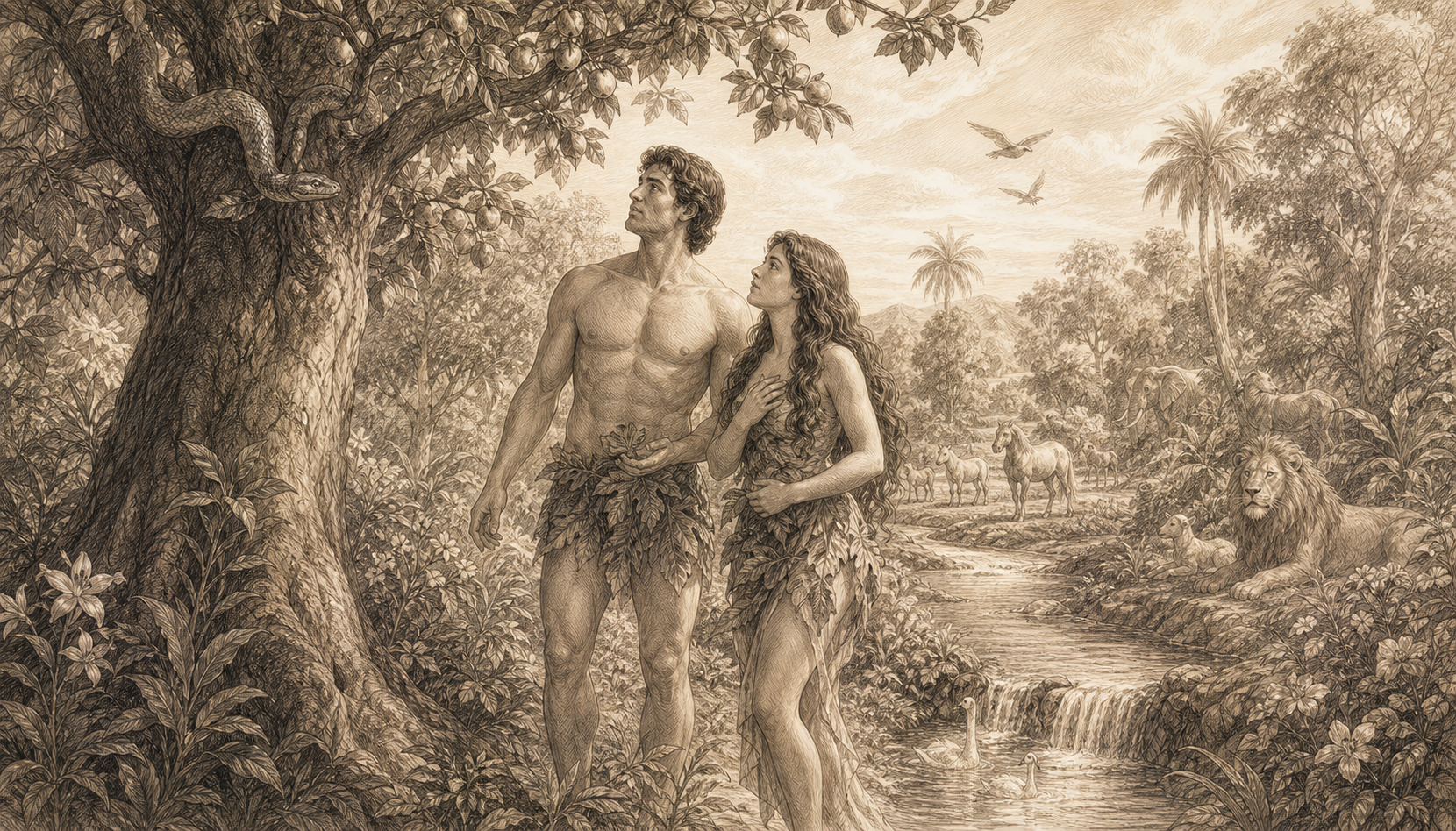
God places Adam and Eve in a garden of delight. Eden represents not merely pleasant scenery but ordered intimacy with God. The human race begins in a place of abundance. Food is provided, work has meaning, creation is at peace, and man and woman live without shame before God and one another. Yet even in Eden, freedom is real. Love cannot be programmed. For communion to be genuine, obedience must be possible and disobedience must also be possible.
That is why the divine command concerning the forbidden tree is so important. God is not withholding happiness from the first human beings. Rather, he is establishing the truth that creaturely freedom flourishes under divine wisdom. Adam and Eve are not gods. They receive life; they do not invent it. The command teaches that the moral order is not an arbitrary burden but a path of trust. To obey God is to remain inside reality as it truly is.
This helps explain why the temptation in Genesis strikes at something deeper than appetite. The serpent suggests that God is not trustworthy, that obedience is constricting, and that autonomy would be more fulfilling than communion. Every later temptation echoes this original lie. Sin usually begins not with an action but with a distortion of God's character. If the human heart can be persuaded that the Creator is holding something back, rebellion starts to feel reasonable.
The temptation and the Fall
The serpent is cunning. He does not begin with open defiance but with a question that twists the command. He invites Eve to focus on the prohibition rather than the abundance. Then he directly contradicts God and promises a counterfeit glory: you will be like God. Here the root of the Fall becomes clear. Adam and Eve are tempted to seize what can only be received. Instead of trusting God's fatherly wisdom, they turn inward and grasp.
Eve sees that the fruit is desirable. Adam takes and eats as well. The sin is simple in action and immeasurable in consequence. It is not merely about eating something forbidden. It is an act of disobedience at the center of the human vocation. The first man and woman choose self-assertion over dependence, suspicion over trust, and private judgment over loving submission. The catastrophe is spiritual before it is social. Their relationship with God is wounded first, and every other fracture follows.
Immediately the change is felt. Their eyes are opened, yet the promised godlike freedom does not arrive. Instead they experience shame. They hide. They sew coverings. They fear the sound of God walking in the garden. This is one of the saddest movements in all of Scripture. The God who had created them for communion is now approached as a threat. Sin darkens perception. The human person does not stop longing for God, but begins to flee from the very One he needs most.
Judgment, blame, and the wound that enters history
When God calls out, "Where are you?" he is not seeking information. He is summoning the sinners to truth. The exchange that follows is painfully familiar. Adam blames Eve and indirectly blames God who gave her to him. Eve blames the serpent. Responsibility is evaded, relationships are strained, and the harmony of Eden begins to unravel. Sin rarely remains private. Once truth is refused at the center, blame spreads outward.
The judgments pronounced in Genesis describe the disorder introduced by sin. The serpent is cursed. Human labor becomes painful. Relationships become marked by tension. Childbearing is touched by sorrow. The ground itself resists easy mastery. Finally, death enters human history. Catholic theology sees here the reality traditionally called original sin: not personal guilt transferred mechanically, but a wounded condition inherited by the human race from its first parents. We are born into a world that is good, yet not intact.
Death is perhaps the most severe sign of the rupture. Adam and Eve were made for communion with God, and therefore for life. By turning from the source of life, they subject themselves to mortality. Yet even here Scripture does not present God as gleefully punitive. The sorrow of Genesis 3 is the sorrow of truth. A creature cannot reject the Creator without damaging himself. Divine judgment names reality as it has now become.
The first promise of hope
And yet Adam and Eve is not finally a story of despair. In the very chapter of the Fall, hope appears. God speaks of enmity between the serpent and the woman, between the serpent's offspring and hers. Christian tradition has long heard in this verse the first promise of the Redeemer, sometimes called the Protoevangelium, the first Gospel. The victory over evil will come through the line of the woman. Salvation history begins right there, in the middle of loss.
This is one reason Catholics read Genesis with both realism and hope. The Church does not minimize sin, but neither does she leave humanity imprisoned there. Adam is a figure of the first fallen man; Christ is the new Adam who obeys where the first disobeyed. Eve is the mother of all the living in the natural order; Mary, by her faithful yes, becomes associated with the dawning of new life in the order of grace. The Bible begins with a garden lost, but it does not end there.
Even the detail of God making garments for Adam and Eve carries a note of mercy. He sends them out of the garden, but he does not abandon them to nakedness and chaos. There is discipline, but there is also care. The fallen human race leaves Eden not because God has ceased to love, but because history must now move through redemption.
What the story says about us
Adam and Eve is not only about ancient beginnings. It is about every human heart. We recognize ourselves in the temptation to doubt God's goodness, to redefine moral reality on our own terms, and to hide after sin rather than confess it. We know the experience of shame, blame, fractured relationships, and labor that feels heavy. The world of Genesis 3 is not difficult to identify because it is our world.
At the same time, we also recognize the longing for Eden. Human beings continue to hunger for innocence, peace, belonging, beauty, and intimacy with God. That longing is not sentimental weakness. It is a sign that we were made for something greater than endless conflict with ourselves. The restlessness of the human heart is not evidence against God. It is often evidence that we were created for communion we cannot manufacture on our own.
This is why the story of Adam and Eve belongs in serious Christian reflection on marriage, sexuality, freedom, suffering, temptation, and redemption. It tells the truth about the greatness of human beings and the tragedy of sin. It also prepares us to understand why grace is necessary. If the wound were shallow, moral improvement alone might be enough. But Scripture presents a deeper condition, one requiring a Savior.
Reading Adam and Eve through Christ
The New Testament repeatedly looks back to Genesis. St. Paul especially sees Adam as a figure whose disobedience affected many, while Christ's obedience brings justification and life. The contrast is striking. In a garden, the first Adam fell before temptation. In the garden of Gethsemane, the new Adam remained faithful. The first Adam grasped at equality with God; Christ, who truly is divine, humbled himself and became obedient unto death. The first Adam brought death through a tree; Christ brings life through the wood of the Cross.
This Christ-centered reading does not erase the seriousness of Genesis. It fulfills it. The point of the Fall narrative is not to trap people in guilt, but to reveal why redemption is so astonishing. When Catholics hear the Easter proclamation or watch someone receive baptism, they are hearing the answer to Eden. Grace is not an improvement program. It is rescue, healing, and elevation.
Adam and Eve teaches that the human story begins in goodness, is wounded by sin, and is carried forward by a promise. The garden is lost, but God does not abandon the work of his hands. From the beginning, he is already preparing the road to redemption.