Bible Stories
David and Goliath
The Battle Where Faith Proved Greater Than Fear
Site Admin | May 2, 2026 | 351 views
The story of David and Goliath is one of the most beloved battle scenes in all of Scripture, but its true meaning is often reduced to something smaller than the Bible intends. Many people remember it as an inspiring lesson about believing in yourself when the odds are against you. The biblical story is deeper. David does not step onto the field because he trusts his own greatness. He steps forward because he is jealous for the honor of the living God. David and Goliath is a story about faith, courage, covenant identity, and the truth that the Lord saves in ways that overturn worldly expectations.
The account appears in 1 Samuel 17, during a period when Israel is struggling under weak leadership and external threat. Saul is king, but he has become spiritually compromised and fearful. The Philistines, long-standing enemies of Israel, gather for war. Their champion, Goliath of Gath, is enormous, heavily armed, and terrifying. He embodies military might and intimidation. Day after day he comes forward to challenge Israel, and day after day the people, including Saul, shrink back in fear.
Goliath's challenge and Israel's fear
Goliath is not merely a big soldier. The narrative presents him almost as the concentrated image of everything that makes earthly power seem invincible. His height, armor, spear, and public boasting are all described at length. He stands as a visible argument against faith. He taunts Israel and, more importantly, he taunts the God of Israel. He invites a representative duel, expecting that fear will defeat the enemy before any weapon is used.
Saul and his men are dismayed. This matters. Saul was once chosen in part because of his impressive stature. Humanly speaking, he is the one who should step out to answer the challenge. But the man who once looked like a king now lacks kingly courage. Fear drains the army of its strength. This is one of the recurring biblical lessons: external resources are not enough when the heart is not anchored in God.
For modern readers, Goliath is powerful because he represents not only military threat but every giant that makes the faithful heart feel small: public pressure, humiliation, insecurity, entrenched evil, and problems that seem far too large for ordinary obedience. The story speaks across centuries because fear still loves spectacle.
David arrives quietly
Into this scene comes David, not as a decorated warrior but as a young shepherd delivering food to his brothers. His arrival is almost deliberately ordinary. He is not summoned for his military skill. He comes because of a simple duty given by his father. This detail is spiritually rich. God often prepares great moments through hidden fidelity. David's future public courage is rooted in private obedience.
When David hears Goliath's challenge, he responds differently from everyone else. He is not naive about danger, but he sees the issue more clearly. The real scandal is not that Israel faces a giant. The scandal is that an uncircumcised Philistine is mocking the armies of the living God and no one is answering. David's perspective is theological before it is tactical. He measures the battlefield according to covenant reality, not merely visible force.
Even within his own family David is misunderstood. His eldest brother assumes pride and meddling. This too is a familiar biblical theme. Those moved by zeal for God are not always immediately recognized. Yet David does not waste energy defending his reputation. He continues toward the task in front of him.
The confidence that comes from memory
When David is brought before Saul, he explains why he is willing to fight. He recalls his experience as a shepherd defending sheep against the lion and the bear. This is not bragging. It is testimony. David has seen the Lord help him in smaller but real trials, and those memories now strengthen him for a greater contest. Faith often grows like this. It does not appear out of nowhere. It is built through remembered deliverance.
David's confidence is not vague positivity. He explicitly says that the Lord who delivered him before will deliver him again. Here we see one of the clearest marks of biblical courage. Courage is not denial of danger. It is steadiness rooted in God. David is not pretending Goliath is unimpressive. He is claiming that Goliath is not ultimate.
Saul attempts to clothe David in royal armor, but it does not fit. David sets it aside. This is an important moment. He cannot fight someone else's battle with someone else's borrowed identity. He must go in the way God has prepared for him. That preparation comes not from the court but from the pasture, not from spectacle but from faithfulness.
The battle belongs to the Lord
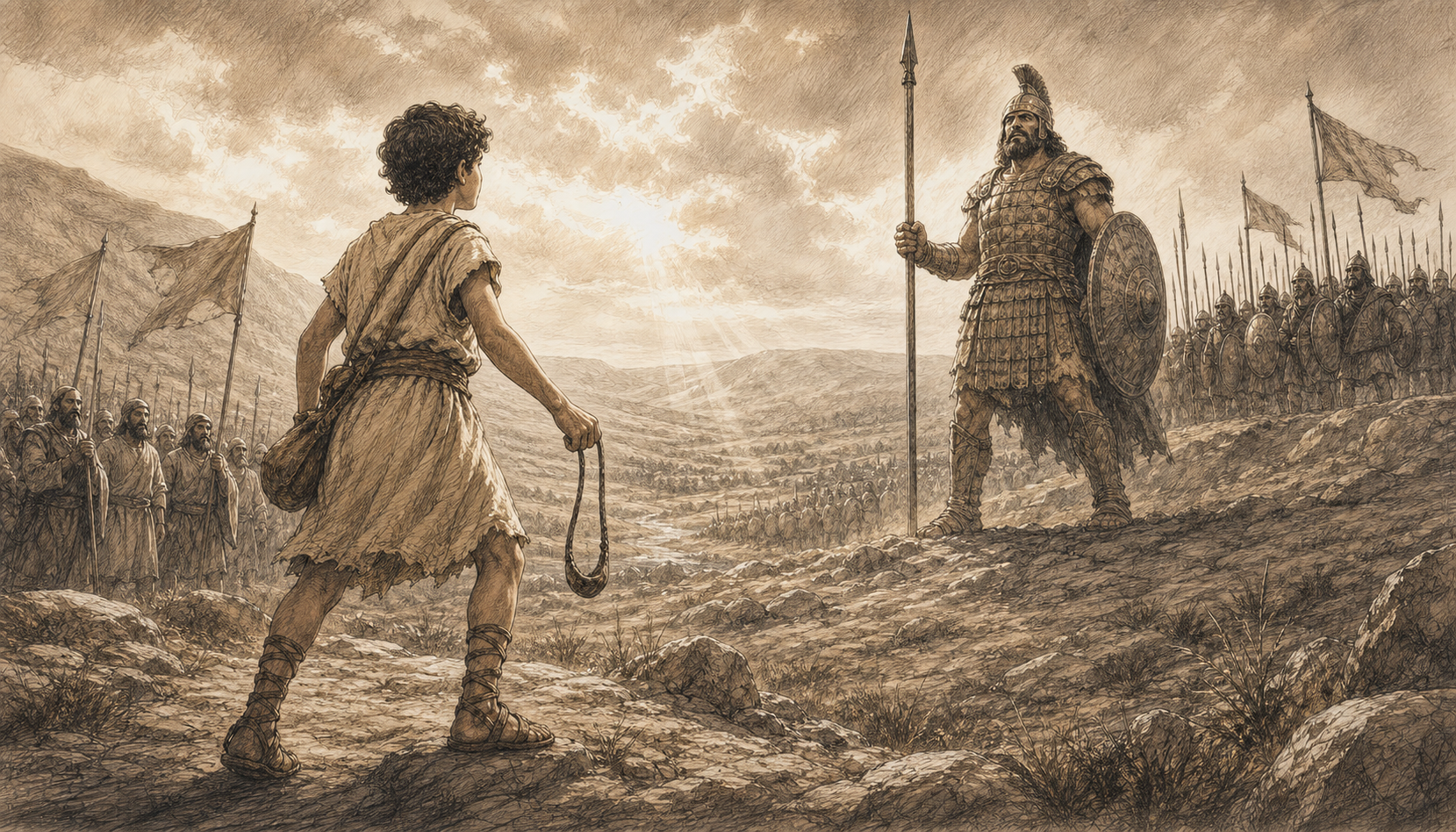
David takes his staff, his sling, and five smooth stones. Goliath despises him on sight. The contrast is dramatic and intentional. The giant comes armored with bronze, sword, and spear. David comes in apparent weakness. But then he speaks the words that interpret the entire chapter. He says that Goliath comes with sword and spear, but David comes in the name of the Lord of hosts, the God of the armies of Israel whom Goliath has defied.
Those words are the heart of the story. David does not believe he is stronger than Goliath in worldly terms. He believes the battle belongs to the Lord. The issue is God's honor, God's people, and God's power to save. This is why the story has echoed through Christian history. It is not a manifesto of self-confidence. It is a testimony that faith can stand where worldly strength collapses.
David runs toward the Philistine, slings a stone, and strikes Goliath in the forehead. The giant falls. David then uses Goliath's own sword to finish the victory. Panic spreads through the Philistine ranks and Israel surges forward. In a single moment the whole emotional atmosphere of the battlefield changes. Fear had paralyzed Israel; faith unleashes action.
Why the story matters in salvation history
David and Goliath is not just a motivational episode. It belongs to the unfolding history through which God prepares his people for the coming of the Messiah. David's victory marks him out publicly and begins his rise in the awareness of Israel. The shepherd who defeats the giant will one day become king. This matters because the line of David will eventually lead to Jesus Christ, the Son of David, who defeats a far greater enemy than any Philistine champion.
Christian readers have often seen in David a figure of Christ. David steps forward on behalf of a fearful people who cannot save themselves. He wins victory where others are powerless. He triumphs not by the conventional logic of force but by the power of God. Christ fulfills this pattern perfectly. Humanity trembles before sin, Satan, and death; the true anointed one goes forth in obedience and wins the battle for us.
There is also an important lesson here about vocation. David is not chosen because he fits the expected mold. Earlier in 1 Samuel, God had already taught that man looks on the outward appearance, but the Lord looks on the heart. The victory over Goliath dramatizes that truth in public. God delights to work through humble instruments so that his own glory may be unmistakable.
The spiritual giant in every age
Every generation faces forms of Goliath. Sometimes the giant is interior: fear, shame, addiction, resentment, or despair. Sometimes it is external: cultural pressure, injustice, hostility to the faith, family crisis, illness, or impossible responsibility. The temptation is always the same - to decide in advance that the giant sets the terms of reality. David refuses that temptation. He looks first to God.
This does not mean every faithful Christian will see every difficulty vanish as dramatically as the giant falling in the valley. Scripture does not teach magic thinking. It does teach that the believer is never permitted to measure the future solely by visible odds. Faith names a larger truth. God is not absent. God is not diminished. God is not intimidated. Even when outcomes are slow, hidden, or painful, the battle still belongs to him.
David also teaches that zeal for God's honor can purify fear. He is not absorbed in proving himself. He is moved by the disgrace brought against the Lord's name. The saints often display this same freedom. When the self ceases to be the center, courage becomes possible. Love is stronger than self-protection.
Praying with David's courage
To pray with this story is to bring your giants into the light of God. Name them honestly. Do not pretend they are small if they are not. Then listen to David's confession again: the Lord saves. Remember the smaller rescues God has already given you. Remember the times he carried you through what once felt impossible. Memory feeds courage.
The story also invites a practical humility. David had trained with the sling in hidden places. The great public victory was supported by faithful work no crowd had seen. Much of the Christian life is like that. The Lord prepares us for future responsibilities through ordinary prayer, daily duty, unseen charity, confession, patience, and fidelity in small things. When the decisive hour arrives, it often draws upon long hidden formation.
David and Goliath teaches that courage is born from faith, not ego. The giant falls because the Lord is faithful, and the shepherd becomes a sign that God can save through humble means when his people trust him more than they trust appearances.