Bible Stories
The Good Samaritan
Mercy in Motion and the Command to Love Our Neighbor
Site Admin | April 30, 2026 | 820 views
The parable of the Good Samaritan is one of the clearest and most challenging teachings of Jesus about love of neighbor. Its title has become so familiar in modern speech that many people use it for any kind act done by a stranger. Yet in the Gospel of Luke the story has sharper edges. Jesus tells it in response to a lawyer who wants to justify himself. The parable is not meant merely to congratulate decency. It is meant to unsettle boundaries, expose selective compassion, and redefine neighbor-love according to the merciful heart of God.
The story appears in Luke 10:25-37. A scholar of the law asks Jesus what must be done to inherit eternal life. Jesus points him to the law: love God with all your heart, soul, strength, and mind, and love your neighbor as yourself. The man then asks, "And who is my neighbor?" That question drives the parable. It is not a neutral request for information. It is an attempt to draw a manageable line around responsibility. Jesus answers not with a definition, but with a story that makes the line impossible to keep.
The road and the wounded man
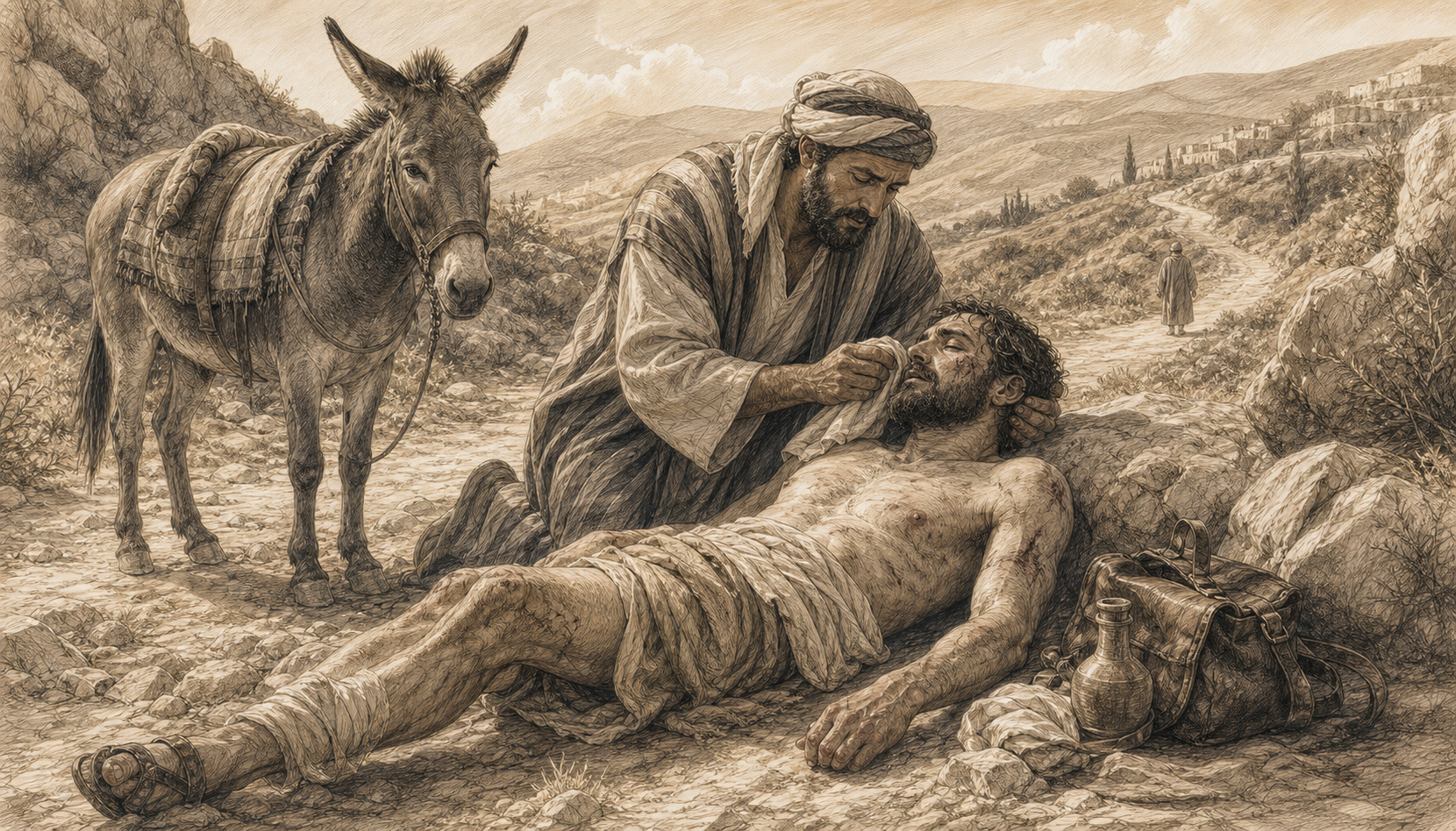
A man is going down from Jerusalem to Jericho when he falls among robbers. They strip him, beat him, and leave him half dead. Jesus gives no name, no tribe, and no moral biography. The wounded man is simply a human being in need. This matters. Before the question of who will help him arises, the story strips away all the usual markers by which people decide who is worthy of notice. Need itself becomes the claim.
The road from Jerusalem to Jericho was known for danger, and the image of a traveler attacked there would have been vivid and believable to Jesus' hearers. The man lies exposed, unable to rescue himself. He is not an abstract case study. He is a person at the edge of death. Christian mercy begins when suffering is seen as personal rather than theoretical.
This opening scene also reveals how fragile ordinary life can be. One moment a person is traveling with a destination in mind; the next he is lying on the roadside dependent on the compassion of others. The parable therefore touches not only moral duty but human vulnerability. Every person who hears it is forced to admit that he could one day be the wounded man as well as the passerby.
The priest and the Levite pass by
First a priest comes along and sees the wounded man, but passes by on the other side. Then a Levite does the same. Jesus does not spell out their motives. Perhaps they fear ritual impurity, ambush, inconvenience, delay, or entanglement. The silence is deliberate. It allows the hearer to insert any number of respectable excuses. What matters is that both men see and do not act.
The priest and the Levite are especially striking figures because they are associated with sacred service. Their failure warns that religious status does not automatically produce mercy. One can know the law, serve in holy things, and still fail to love in the decisive moment. The parable therefore examines not only social ethics but the integrity of worship itself. Love of God that does not bend toward the suffering neighbor is already compromised.
This is one reason the Good Samaritan has always pierced Christian consciences. It refuses to let compassion remain theoretical. It asks whether our piety reaches the roadside. Do our schedules, institutions, and habits create people who stop? Or do they produce people too protected, hurried, or self-absorbed to be interrupted by mercy?
The Samaritan draws near
Then comes the twist that would have startled Jesus' original audience: a Samaritan arrives. Samaritans and Jews lived with deep religious and historical hostility between them. Jesus deliberately makes the merciful figure someone the listener might be inclined to distrust or despise. The point is not to flatten the real tensions of history, but to show that neighbor-love cannot be confined within tribal comfort.
The Samaritan sees the man and is moved with compassion. Unlike the earlier passersby, he does not merely observe. He draws near. He binds wounds, pours on oil and wine, lifts the injured man onto his own beast, brings him to an inn, and pays for his care. Mercy here is practical, costly, embodied, and inconvenient. It uses time, resources, touch, and personal risk.
The details matter because they rescue compassion from sentimentality. The Samaritan does not merely feel sorry. He acts. Christian charity is always more than internal emotion. It is love made concrete. In Catholic life this becomes visible in works of mercy, care for the sick, assistance to the poor, hospitality, and the willingness to be interrupted for the good of another.
Mercy and the shape of true neighbor-love
At the end of the story Jesus does not ask, "Which man qualified as the wounded traveler's neighbor?" Instead he asks which of the three proved neighbor to the man who fell among robbers. The direction of the question changes everything. The lawyer wanted to know whom he had to count in. Jesus asks what kind of person he must become. Neighbor is no longer merely a category to identify. It becomes a vocation to live.
This shift is spiritually decisive. It is always easier to ask who deserves my concern than to ask whether I am becoming merciful. The first question protects the self. The second converts it. Jesus is training the heart away from calculation and toward generosity. The Christian must not search for the minimum obligation that still counts as righteousness. He must learn to love in the manner of the Father.
That is why the parable remains so demanding. It touches politics, class, race, inconvenience, prejudice, and the temptation to outsource mercy. It exposes the way human beings often divide the world into my people and other people, worthy sufferers and suspect sufferers, emergencies that count and those that do not. The Samaritan collapses those distinctions by seeing first the wound.
The Catholic reading of the parable
Catholics have always read the Good Samaritan as a direct summons to moral action, but also often as an image of Christ himself. Humanity is the wounded traveler, beaten by sin and left powerless. The law and its ministers, while holy in their place, do not by themselves heal the deepest wound. Christ comes near, binds wounds, bears us up, brings us into the inn of the Church, and provides what is needed for our restoration. This interpretive tradition does not replace the moral meaning. It deepens it. We are called to show mercy because we have first received mercy.
The sacraments illuminate this further. The oil and wine used by the Samaritan have often reminded Christians of healing and Eucharistic grace. The inn suggests a place of continued care, not instant transformation. Grace restores us truly, but often through a process. This sacramental imagination helps explain why the Church has never seen mercy as a private feeling detached from visible practices of healing and communion.
The parable also stands close to Catholic social teaching. Human dignity is not earned by usefulness or similarity. The suffering person has a claim on us because he is a person. The common good requires structures of justice, but the parable also reminds each believer that no system relieves him of personal responsibility to love concretely.
The barriers that keep people from stopping
Why do people pass by? Sometimes it is fear. Sometimes exhaustion. Sometimes prejudice. Sometimes the subtle belief that another person's pain belongs to someone else. The priest and the Levite force readers to confront these motives honestly. The Samaritan forces readers to imagine another way. If mercy is to become a habit, the heart must be retrained by prayer, grace, and repeated acts of attention.
Modern life creates its own versions of the other side of the road. Digital distance can make suffering feel abstract. Busyness can make interruption feel like a threat. Ideology can make compassion selective. Even charity itself can become performative rather than personal. The parable cuts through all of that. Mercy begins by noticing and continues by drawing near.
At the same time, the story does not ask every person to solve all suffering everywhere at once. The Samaritan helps the person placed before him on the road he is actually traveling. This too is wisdom. Christians are not called to omnipotence. They are called to fidelity. The next act of mercy is often nearer than we think.
Go and do likewise
The parable ends with Jesus' direct command: go and do likewise. The lawyer had asked about inheriting eternal life, and Jesus' answer comes down to this: life with God is inseparable from love that bends toward the wounded. This is not salvation by mere human activism. Rather, it is the evidence that the heart has begun to share the life of God. Mercy is not a side issue to holiness. It is one of its clearest signs.
To pray with the Good Samaritan is to ask two questions. Where am I tempted to pass by? And where have I myself been carried by mercy I did not deserve? The one who knows he has been lifted by grace becomes slower to measure others coldly. He becomes more ready to spend himself for love.
The Good Samaritan teaches that neighbor-love is not defined by convenience, likeness, or advantage. It is defined by mercy. Jesus does not merely tell us to admire the Samaritan. He commands us to become the kind of people who cross the road toward the wounded because that is what divine love has already done for us.