Saints and Witnesses
The Hidden Fire of St. John of the Cross
A Carmelite saint shows how God purifies the soul, deepens prayer, and teaches Catholics to trust the darkness without losing hope.
Site Admin | May 9, 2026 | 113 views
St. John of the Cross is often remembered for his poetry, his sharp spiritual insight, and his teaching on the dark night of the soul. Yet his enduring importance is not only literary or theological. He speaks to ordinary Catholics because he knew what it was to be tested, misunderstood, confined, and stripped of comfort. His witness offers something very steady: the conviction that God can be near even when the soul cannot feel Him.
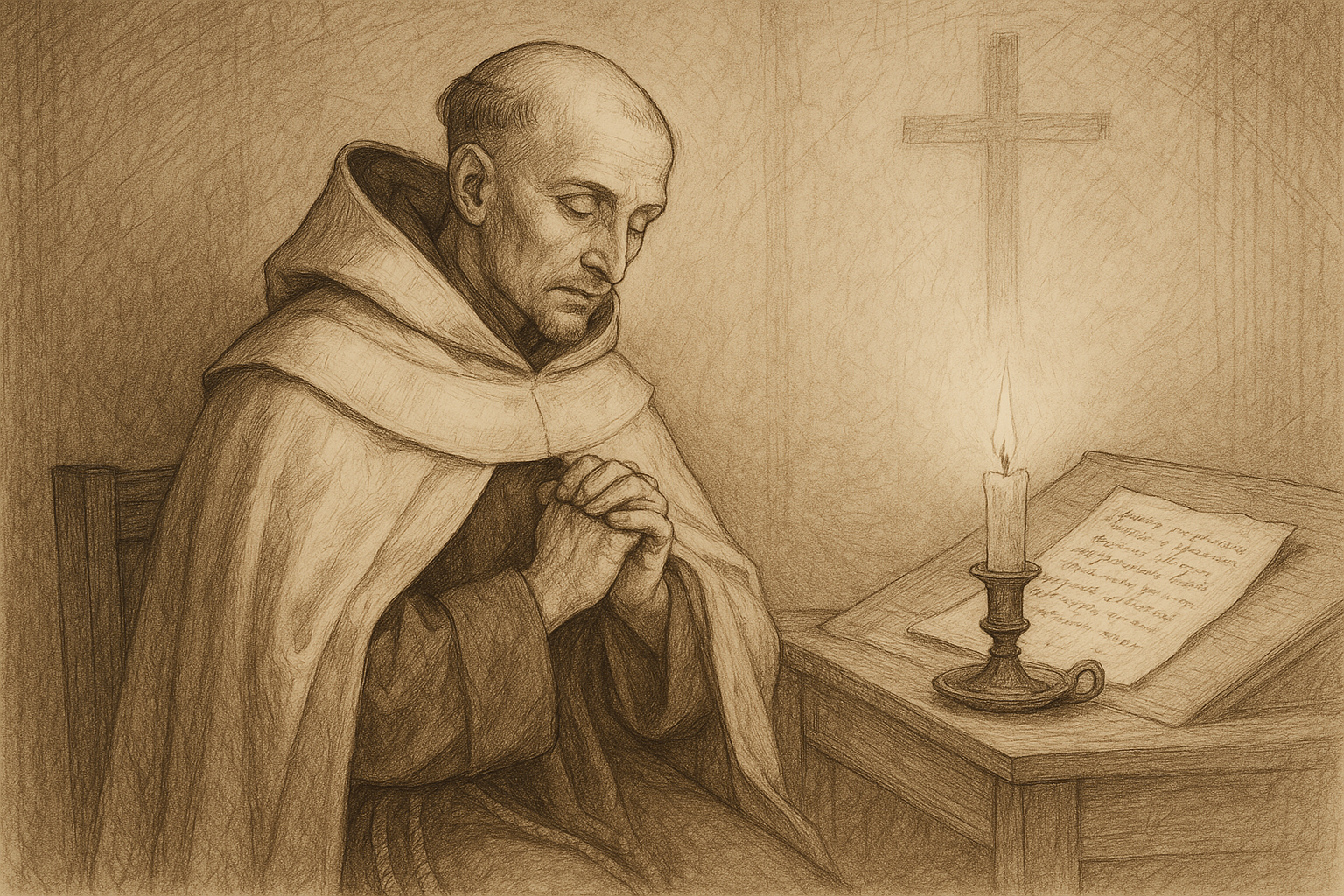
Born Juan de Yepes in 1542 in Spain, he entered the Carmelite Order and later became closely associated with St. Teresa of Avila in the reform of the Carmelites. That reform was not simple or peaceful. It demanded discipline, prayer, and courage in a Church and society already full of tension. St. John of the Cross paid a personal price for his fidelity, including imprisonment by Carmelite opponents in Toledo. Out of suffering, he did not produce bitterness. He produced deeper surrender to God and some of the finest spiritual writing in Christian history.
A saint formed by prayer, reform, and trial
St. John of the Cross was not a detached scholar inventing ideas from a distance. He was a priest, a Carmelite, and a reformer who knew the demands of a consecrated life from within. He desired a life ordered more fully to prayer, poverty, and contemplative love. His collaboration with St. Teresa of Avila helped renew the Carmelite tradition through a return to deeper recollection and stricter observance.
This context matters because his teaching on the soul did not emerge from theory alone. It came from the lived experience of someone who had given himself to God and then had to learn that fidelity may include obscurity. The Church later recognized the value of his wisdom by naming him a Doctor of the Church. That title does not simply honor scholarship. It recognizes that his teaching helps the faithful understand the path to holiness.
His major works, including The Ascent of Mount Carmel, The Dark Night, The Spiritual Canticle, and The Living Flame of Love, all return to one essential truth: God desires to unite the soul to Himself in love. For that union to deepen, lesser attachments often must be purged away.
The dark night is not God gone missing
Many people hear the phrase dark night of the soul and think first of depression, spiritual dryness, or personal crisis. St. John of the Cross certainly includes the pain of interior trial in his teaching, but he does not mean despair. His point is more exact and more hopeful. God may allow the soul to pass through purification so that faith becomes less dependent on feelings and more rooted in love.
In Scripture, God often leads His people through hiddenness before showing His glory. Israel passed through the desert. Elijah heard the Lord not in the wind or earthquake, but in the quiet whisper. Jesus Himself went into the wilderness before His public ministry, and He prayed in agony at Gethsemane. St. John of the Cross helps Catholics see that spiritual darkness can be a place of purifying grace rather than a sign that God has abandoned the soul.
[[VERSE|isaiah|55|8-9|My thoughts are not your thoughts]]
His teaching does not invite passivity or sentimental resignation. It asks for trust. If God is purifying the soul, then the believer should not panic when consolations fade. Instead, the soul can continue in faith, patience, obedience, and prayer. This is especially valuable in an age that often expects instant clarity and visible results.
Why his witness still reaches Catholics today
St. John of the Cross speaks powerfully to Catholics who live with distractions, overactivity, and constant noise. He reminds us that spiritual depth is not measured by busyness or by emotional intensity. It is measured by union with God, and that union is often formed in silence.
His witness is compelling for at least three reasons. First, he teaches that suffering does not have the last word. Second, he shows that holiness is not reserved for the naturally serene or gifted. Third, he insists that prayer is not a technique for self-improvement but a relationship in which God gradually reshapes the heart.
In a culture that prizes self-expression, St. John of the Cross proposes surrender. In a culture that avoids sacrifice, he proposes purification. In a culture that wants immediate spiritual proof, he proposes faithfulness in the dark. None of this is morbid. On the contrary, it is deeply hopeful, because it trusts that God is at work even when His work is concealed.
For many Catholics, this is exactly the kind of St. John of the Cross Catholic inspiration that endures. He does not flatter the human ego. He guides the soul toward God.
Purification ordered toward love
St. John of the Cross never treats spiritual purification as an end in itself. The goal is not emptiness for its own sake. The goal is love. When God detaches the soul from lesser loves, He does so in order to make room for a fuller charity.
This is one of the most important lessons in his writing. People often imagine holiness as the accumulation of religious experiences. St. John of the Cross sees it differently. Holiness is the gradual transformation of desire. The soul becomes more capable of loving God above all things and loving neighbor with greater freedom.
That helps explain why he speaks so often of the senses and the spirit being purified. Human desire can cling to created goods in ways that shrink the heart. By mercy, God leads the soul beyond attachment to gifts and toward the Giver. This is not a rejection of creation. It is a right ordering of the whole person.
At its best, his thought also guards Catholics from confusing emotional sweetness with maturity. Consolation can be a gift, but it is not the foundation. Faith, hope, and charity are. When those virtues are rooted in Christ, the soul can remain steady in every season.
What his life teaches about suffering
It would be a mistake to speak of St. John of the Cross only in abstract terms. His imprisonment is central to understanding his witness. During that confinement, he endured harsh treatment and isolation. Yet even there, he wrote poetry that would become a treasure of the Church. The detail matters because it shows that Christian fruitfulness is not limited by outward circumstances.
His life testifies that holiness can flower under pressure. He did not escape the cross by spiritualizing it away. He carried it with Christ. That is why his testimony feels so honest. He does not promise that prayer will remove every difficulty. He shows that prayer can transfigure suffering into an offering.
Catholics today often face quieter forms of trial: loneliness, unanswered prayer, family strain, confusion about vocation, spiritual dryness, or the fatigue that comes from trying to remain faithful in a restless world. St. John of the Cross does not offer easy remedies. He offers companionship from someone who walked through spiritual darkness and came out with firmer hope.
His example also reminds us that the saints are not made by comfort. They are formed by grace received in difficulty. That truth is not meant to frighten believers. It is meant to encourage them. If God could work so profoundly in the life of a suffering Carmelite priest, He can also work in the hidden trials of a modern Catholic home, parish, or vocation.
How to receive his teaching without forcing it
Because St. John of the Cross is such a profound writer, readers sometimes approach him with unnecessary anxiety. His teaching can sound severe if isolated from its purpose. But he is not asking every person to seek emotional emptiness or to distrust all consolation. He is asking the soul to become free enough to love God more purely.
A careful Catholic reading of his works begins with humility. Not every dry season is the same, and not every difficulty is a dark night in his technical sense. Some struggles call for patience, some for repentance, some for wise counsel, and some for ordinary perseverance. His writings are best read slowly, with prayer, and in harmony with the Church's tradition of discernment.
A few simple habits make his wisdom easier to receive:
- Remain faithful to prayer even when prayer feels thin.
- Accept ordinary duties as part of God's formation.
- Ask whether an attachment is keeping the heart from peace.
- Read Scripture with patience rather than rushing to emotional payoff.
- Seek the sacraments, especially the Eucharist and Reconciliation, as concrete sources of grace.
These practices do not manufacture holiness. They dispose the soul to receive it. That is very much in keeping with St. John of the Cross, who understood that God is the primary actor in the journey of sanctification.
A teacher for the prayerful and the weary
St. John of the Cross remains beloved because he names experiences many Catholics recognize but struggle to explain. He gives language to silence, trial, longing, and purified desire. He also keeps the destination clear: union with God in love.
That is why his witness still matters. He is not merely a saint of mystical theology. He is a reminder that God works most deeply where human confidence is weakest. He tells the Church that hiddenness is not always absence, that suffering can become a place of love, and that the soul is being drawn toward a glory greater than what it can presently see.
For Catholics trying to remain faithful in an anxious age, that message is a gift. St. John of the Cross does not ask us to chase spiritual novelty. He invites us to trust the Lord who purifies, guides, and unites the soul to Himself, even when the road feels dim.
A short prayer drawn from his spirit
Lord Jesus Christ, when my heart is restless or dry, purify my desires and keep me near You. Teach me to trust Your work even when I cannot see it, and lead me into the love that does not fail.
Keep Reading on Lets Read The Bible
Frequently Asked Questions
Who was St. John of the Cross in the Catholic Church?
St. John of the Cross was a 16th century Carmelite priest, reformer, poet, and Doctor of the Church. He is especially known for his teaching on purification, contemplation, and the dark night of the soul.
What does St. John of the Cross mean by the dark night of the soul?
He means a period of spiritual purification in which God leads the soul beyond dependence on feelings and consolations, so that faith and love can become deeper and more free. It is not simply emotional sadness, though it may include hardship.
How can Catholics apply St. John of the Cross today?
Catholics can apply his teaching by remaining faithful in prayer, accepting times of dryness without panic, seeking the sacraments, and allowing God to reorder their desires toward greater love and freedom.