Saints and Witnesses
St. Thomas Aquinas and the Grace of a Mind Made Humble
A look at the Dominican saint whose love of truth joined prayer, study, and holiness in one life
Site Admin | May 3, 2026 | 102 views
St. Thomas Aquinas is often remembered for his vast intellect, but that is only part of the story. He was not simply a brilliant theologian who happened to be Catholic. He was a saint whose whole life was shaped by the conviction that truth is a gift to be received, loved, and lived. That conviction still gives Catholics a strong and steady St. Thomas Aquinas Catholic inspiration, especially in an age that often separates faith from reason or treats learning as a purely private pursuit.
Aquinas was born around 1224 or 1225 in Roccasecca, near Naples, into a noble family. He studied in Naples and later entered the Dominican Order, despite strong resistance from his family. The Dominicans were a young preaching order devoted to study, poverty, and the teaching of the faith. Aquinas chose them because he saw that the life of the mind could serve the salvation of souls. He would spend the rest of his life proving, by both word and example, that study can become an act of worship when it is ordered to God.
A saint who made room for truth
One of the most attractive things about St. Thomas Aquinas is the calm seriousness with which he approached truth. He did not treat doctrine as a burden to be endured. He treated it as light. In his writings, especially the Summa Theologiae, he asked hard questions, weighed objections, and answered with patience. That method alone can still teach Catholics something important. Faith does not fear careful thought. Faith invites it.
Aquinas believed that reason can genuinely reach truth about the world and about God, though reason has limits and must be completed by revelation. That balance remains deeply Catholic. It guards against two opposite errors: pride that thinks human intelligence can explain everything, and fear that treats serious thought as a threat to devotion. Aquinas shows another way. He shows a mind disciplined by grace.
"Grace does not destroy nature, but perfects it." This well-known summary of Aquinas captures the harmony he saw between creation and redemption. God does not erase what He made. He heals, elevates, and brings it to fulfillment.
That is why Aquinas still speaks so powerfully to students, parents, teachers, priests, and lay Catholics who want to think clearly without losing their peace. He reminds us that the path to wisdom is not self-display. It is docility before God. In a culture that often rewards being loud, quick, and certain of everything, Aquinas offers a more patient holiness.
The prayer behind the scholarship
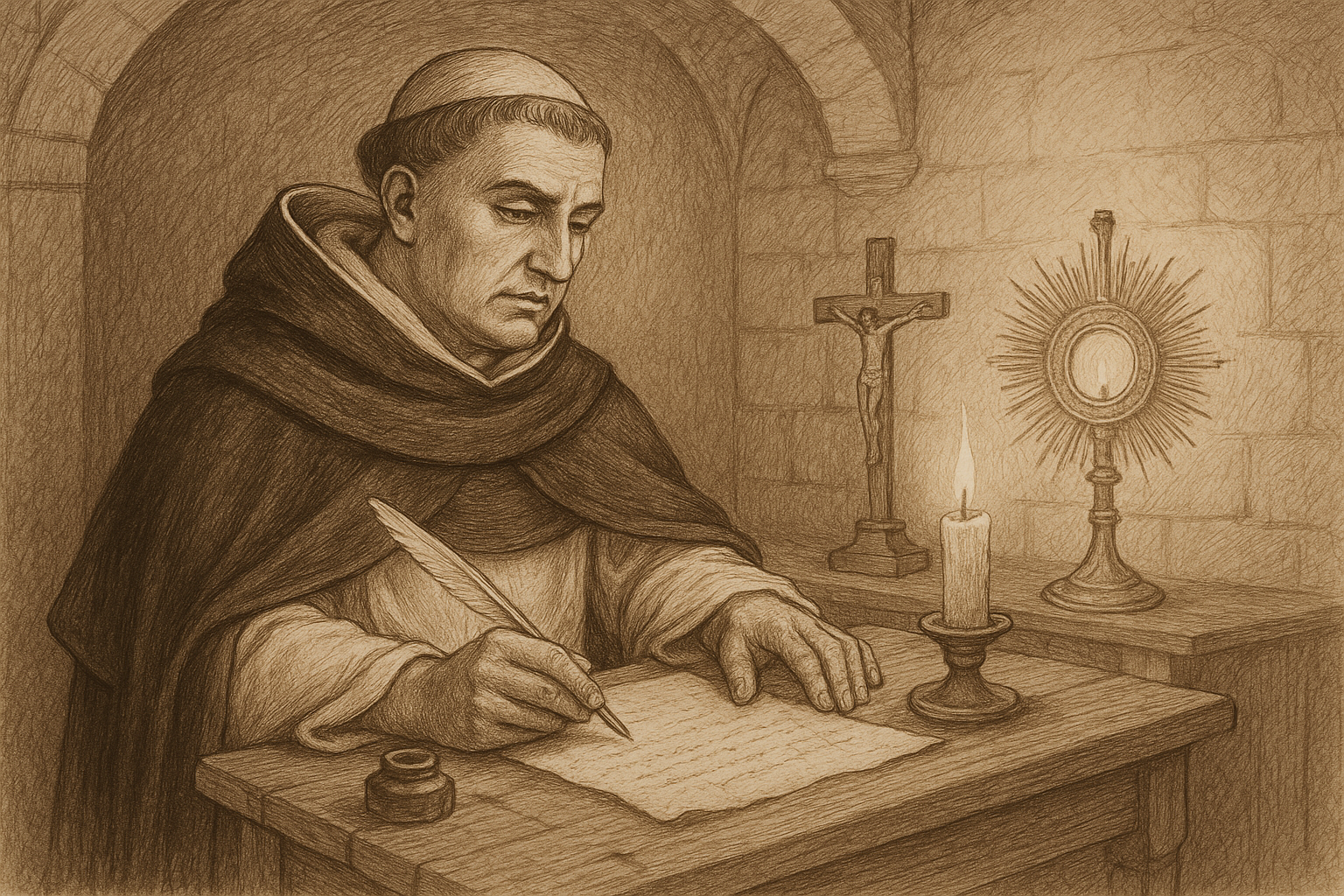
It is easy to isolate Aquinas as a scholar and overlook the spiritual engine of his life. But his learning did not float above his prayer. It flowed from it. He prayed the Psalms, celebrated the liturgy, and approached theology as a servant of contemplation. For him, the highest knowledge was not mere information. It was communion with God.
There is a striking lesson here for modern Catholics who feel pulled between work, study, and prayer. Aquinas did not believe those things had to compete. He believed they belonged together when rightly ordered. A parent who reads Scripture carefully, a teacher who forms young minds faithfully, a lawyer who seeks justice honestly, a student who studies with discipline and humility: all of these can be living in the spirit of Aquinas.
His devotion also corrected the tendency to make religion a matter of feelings alone. Feelings matter, but they are not the whole of faith. Aquinas knew that the will, the intellect, and the emotions all need grace. The Christian life is not built on a passing mood. It is built on truth received, sacraments celebrated, and charity practiced.
The Eucharist at the center
St. Thomas Aquinas had a deep and lasting devotion to the Eucharist. His hymns for the feast of Corpus Christi, including Pange Lingua and Adoro Te Devote, remain among the Church's most beloved prayers. They are not the work of a detached academic. They are the words of a believer adoring the Lord truly present under the appearances of bread and wine.
That Eucharistic faith gives his theology its warmth. Aquinas was not interested in abstract systems for their own sake. He wanted to speak of Christ, the sacraments, virtue, and grace because he believed Christ meets His people concretely. The Eucharist is the heart of that meeting. In the sacrament, the Lord feeds the Church not with symbols alone, but with Himself.
For Catholics today, this is a needed corrective. It is possible to admire doctrine and still grow indifferent to the altar. Aquinas does not allow that separation. He points theology back to worship. He insists that truth culminates in adoration. The mind is not finished when it has understood something true about God. The mind is finished when it kneels.
Why his witness still reaches ordinary Catholics
Aquinas can seem intimidating at first glance. He was learned, methodical, and remarkably productive. Yet his witness is not reserved for academics. In fact, ordinary Catholics may be among those who need him most. His life offers several concrete reasons for hope.
- He shows that holiness and intelligence belong together. A Catholic does not have to choose between being devout and being thoughtful.
- He teaches patience with difficult questions. Aquinas did not rush to easy answers. He examined problems carefully and trusted that truth would hold.
- He reminds us that study can be an offering. Reading, teaching, and learning can become acts of service when done for God and neighbor.
- He keeps doctrine connected to love. For Aquinas, truth is not a trophy. It is a path to communion with God.
- He restores confidence in the Church's intellectual tradition. Catholics do not need to apologize for believing that faith can be разумной and coherent, because the Church has long produced thinkers who prove it.
His life also offers comfort to those who feel they are not especially gifted. Aquinas was brilliant, but holiness did not come to him because of brilliance alone. It came through obedience, discipline, chastity, prayer, and perseverance. In other words, the virtues that matter most are available to every Catholic. No one needs a doctoral degree to become faithful in the Aquinas way.
When the world misunderstands greatness
St. Thomas Aquinas was not always appreciated in his own time. In fact, his thought faced suspicion and criticism. That should not surprise Catholics. The world often misunderstands great saints because saints do not fit neatly into worldly expectations. They are not interested in being impressive for its own sake. They are interested in being true.
There is something consoling in that. Catholics who feel out of step with prevailing trends can look to Aquinas and remember that fidelity does not depend on popularity. The saint's task is not to echo every fashion of the age. It is to hand on what has been received. Aquinas did that with unusual clarity and courage.
He also knew that truth can be demanding. Catholic doctrine is not a set of slogans chosen for convenience. It is a coherent vision of God, man, creation, sin, grace, the sacraments, and destiny. Aquinas helped the Church express that vision in language that could be studied, prayed, and defended. His work became a gift not because it was clever, but because it served the Church's mission.
The Church later recognized his singular importance by naming him a Doctor of the Church. That title does not mean his every opinion is beyond discussion, but it does mean his witness has been judged especially fruitful for Catholic teaching. His influence remains vast because he was faithful to what is deepest in the Catholic tradition: reverence for truth, confidence in grace, and love for Christ.
A teacher for a distracted age
It is hard not to see how directly Aquinas speaks to the modern world. We live amid constant information, quick opinions, and shallow certainty. Many people are overloaded with words but starved for wisdom. Aquinas proposes a slower, more reverent way. He invites Catholics to ask not only,
Keep Reading on Lets Read The Bible
Frequently Asked Questions
Why is St. Thomas Aquinas important to Catholics today?
St. Thomas Aquinas remains important because he shows that faith and reason belong together. His life and writings help Catholics think clearly about doctrine, virtue, grace, and the sacraments while keeping prayer and worship at the center.
What is St. Thomas Aquinas best known for?
He is best known for the Summa Theologiae, his major theological work, and for his deep Eucharistic devotion. He also composed beautiful hymns for Corpus Christi that are still used in the Church.
How can an ordinary Catholic follow St. Thomas Aquinas' example?
By studying the faith with humility, praying before learning, seeking truth with patience, and offering daily work to God. Aquinas' example is not only for scholars. It is for anyone who wants to love God with the mind and the heart.