Saints and Witnesses
St. Augustine and the Grace That Would Not Let Him Go
A Catholic reading of Augustine's restless heart, hard-won conversion, and enduring witness to mercy.
Site Admin | April 23, 2026 | 113 views
St. Augustine remains one of the most compelling saints in the Church because he never pretended to be holy before he was healed. He wrote as a man who knew the pull of pride, desire, ambition, and self-deception, and he also wrote as a man who had been found by mercy. That combination gives his witness a lasting force. His life speaks to Catholics who know how uneven conversion can be, how long the road to repentance may feel, and how patient God is with the human heart.
Augustine was born in 354 in Thagaste, in North Africa, and his early life was marked by intellectual brilliance and moral unrest. He studied rhetoric, pursued success, and sought happiness in the created world, but none of it gave him peace. For years he searched for truth in movements and philosophies that promised insight without surrender. He also lived a life that did not yet honor the Lord he would later confess. In that restlessness, many Catholics recognize themselves. Not because everyone shares Augustine's exact story, but because the deeper pattern is familiar: the soul was made for God and will not settle for substitutes.
The Heart That Would Not Rest
Augustine's most famous line from the Confessions captures the spiritual drama of his life: the human heart is restless until it rests in God. That insight is not merely poetic. It is deeply biblical. Scripture repeatedly shows that the human person cannot be satisfied by lesser goods when the soul was created for communion with the living God. The psalmist cries out, "As a deer longs for flowing streams, so longs my soul for you, O God" Psalm 42:1. Augustine understood this longing not as a theory but as a wound he had lived through.
He searched for wisdom among the Manichees, and later among other intellectual and spiritual influences of his age. Yet his mind, though sharpened by learning, still needed humility. The saints often witness that intellect by itself does not save. It can clarify, refine, and defend the faith, but it must bend before revelation. Augustine did not become a Christian because he finally mastered his questions. He became a Christian because grace broke through his resistance and made him willing to believe.
Conversion as Surrender, Not Performance
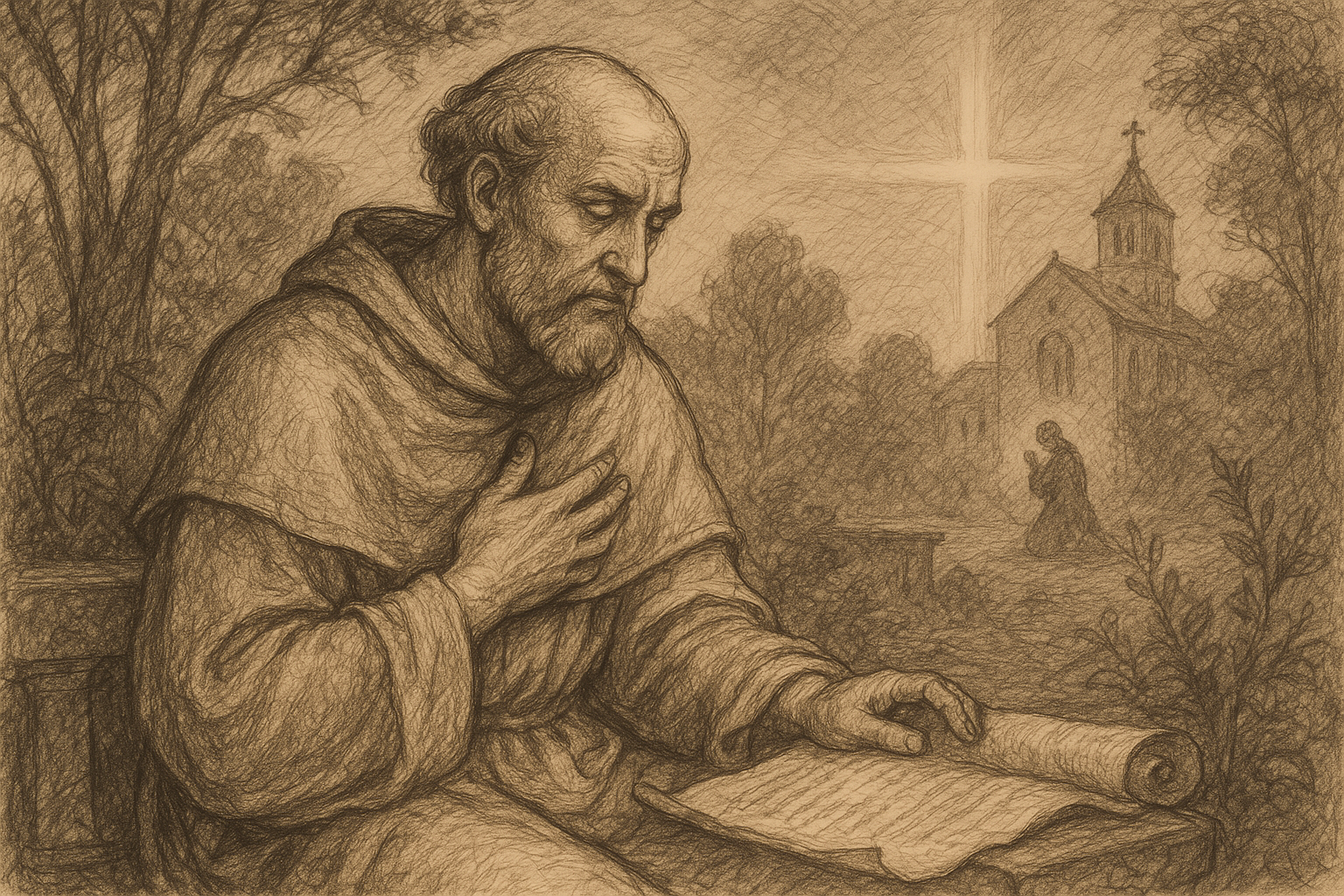
One of the most beautiful things about Augustine's conversion is that it was not an act of spiritual self-promotion. It was surrender. He had heard the teaching of the Church, especially through the preaching and example of St. Ambrose in Milan. He had felt conviction. He had experienced inner conflict. Yet he remained divided, unable to let go of the life he knew. Then came the famous moment in the garden, when the words tolle lege, take and read, led him to open Sacred Scripture and encounter the apostolic command that cut directly into his struggle: "Let us walk properly as in the daytime, not in revelry and drunkenness, not in debauchery and licentiousness, not in quarreling and jealousy" Romans 13:13.
The passage continued with a line that reached into his heart: "But put on the Lord Jesus Christ, and make no provision for the flesh, to gratify its desires" Romans 13:14. Augustine later described the moment as a decisive turning. Grace did not flatter him. It named his condition and called him out of it. That is one reason his witness still matters. Catholic conversion is not primarily about self-improvement. It is about being claimed by Christ, who says, "Follow me" Matthew 9:9, and makes the soul able to answer.
Augustine's story also reminds us that conversion can involve time. God had been preparing him through Scripture, through friendship, through the prayers of his mother Monica, and through the unrest of his own conscience. The final surrender came after many hidden graces. That is often how God works. He does not waste the years before conversion. He gathers them into mercy.
Monica, Prayer, and the Quiet Power of Hope
No account of Augustine is complete without St. Monica. Her witness is not dramatic in the worldly sense, but it is luminous in the Church's memory. She prayed, wept, waited, and trusted God with her son. In her persistence, Catholics see one of the clearest signs that holiness is often hidden in fidelity. Monica did not control Augustine's conversion. She interceded. She believed that grace could do what her own words could not.
Her life gives shape to a profoundly Catholic hope. Parents, spouses, friends, and pastors may labor for years without visible results. Monica shows that prayer is never wasted. The Lord hears the cry of those who wait upon him. "I waited patiently for the Lord; he inclined to me and heard my cry" Psalm 40:1. Augustine's eventual conversion is one of the Church's strongest reminders that love expressed through prayer can outlast resistance.
Monica also keeps Augustine from being misunderstood as a lone genius who simply reasoned himself into holiness. Catholic sanctity is rarely solitary. It is nurtured in the communion of saints, in the patient labors of others, and in the silent support of those who refuse to stop hoping.
From Bishop to Teacher of the Faith
After his conversion and baptism in 387, Augustine returned to North Africa and eventually became bishop of Hippo. In that role, he served the Church with remarkable energy. He preached, wrote, corrected error, and defended Catholic doctrine in turbulent times. He became a major voice against the Donatists and Pelagians, and his theological writings helped shape generations of Christian thought.
Yet Augustine's influence does not rest on academic achievement alone. He taught because he had first been taught by grace. He defended the faith because he had first been rescued by it. His works remain important because they join truth and humility. He knew the mind of the sinner and the mercy of the Savior, and that union gave his theology its force.
For Catholics today, that matters. We are sometimes tempted to separate doctrine from conversion, as if teaching were merely an exercise in ideas. Augustine refuses that division. For him, truth is personal because truth is Christ. The Church does not announce abstractions. She proclaims the One who saves.
Augustine's Honest View of the Human Person
Augustine is also valuable because he takes sin seriously without despairing of grace. He knew that the human will can be fragmented, that desire can be disordered, and that pride distorts even our best intentions. His account of the human person is sober, but not cynical. He does not say that we are beyond repair. He says that we are made for God and need God to heal us.
That insight has pastoral value for every age. Many Catholics know the sorrow of repeated weakness. Some feel trapped in habits they cannot easily shake. Augustine's life does not offer a quick slogan. It offers hope grounded in truth: if grace could turn his heart, it can work in ours too. The Lord is not intimidated by long struggles.
This is one reason the Church keeps returning to Augustine. He helps believers avoid two errors at once. On one side is pride, which pretends we can save ourselves. On the other is despair, which assumes our sins are stronger than God's mercy. Augustine stands between them and says, in effect, that both pride and despair are forms of blindness. Christ alone gives sight.
"By the grace of God I am what I am" 1 Corinthians 15:10. Augustine's witness makes that line feel concrete rather than abstract. Grace was not decorative in his life. It was decisive.
Why Augustine Still Inspires Catholics
The phrase St. Augustine Catholic inspiration is more than a topic label. It names a real spiritual gift. Augustine inspires because he was intellectually alive, morally honest, and thoroughly converted. He shows that a person can be deeply tangled in sin and still become a servant of the Church. He shows that a restless heart can become a preaching heart. He shows that a soul formed by the world can be remade by grace.
His witness still speaks in several practical ways:
- He encourages Catholics who fear they have wandered too far for God to find them.
- He reminds believers that intellectual questions do not exclude faith, but must be brought to Christ.
- He teaches that conversion is often gradual before it is decisive.
- He honors the hidden labor of prayer, especially the prayers of loved ones.
- He shows that holiness can emerge from a past marked by real sin, not merely minor mistakes.
Augustine also helps Catholics read their own lives with greater honesty. He did not sanitize his past, but neither did he glorify it. He let grace reinterpret everything. That is a profoundly Christian act. The believer does not deny the old life, but neither does he remain imprisoned by it. In Christ, the past can become testimony.
A Saint for Restless Times
Modern life often trains people to chase noise, novelty, and self-invention. Augustine speaks with unusual relevance into that world because he knew the emptiness of always reaching and never arriving. He understood the temptation to look for peace in status, pleasure, intellectual control, and admiration. He also knew that the soul becomes itself only when it turns toward God in humility.
For Catholics, his life invites a simple but demanding question: where am I still resisting grace? Augustine does not let us settle for vague admiration. He asks us to pray honestly, to repent concretely, and to trust that God still calls. The same Christ who met Augustine through Scripture and interior grace still meets his people in the Church, in prayer, in the sacraments, and in the slow work of sanctification.
That is why Augustine endures not only as a doctor of the Church, but as a companion. He stands beside every Catholic who has been delayed, distracted, or divided, and he points toward the mercy that kept pursuing him until he finally rested in God.
Keep Reading on Lets Read The Bible
Frequently Asked Questions
What makes St. Augustine such an important Catholic saint?
St. Augustine is important because his life joins deep intellect, sincere repentance, and powerful witness to grace. He became one of the Church's greatest teachers after a dramatic conversion, showing that God can transform even a restless and sinful heart.
Why do Catholics find Augustine's conversion so encouraging?
His conversion shows that grace often works over time and that no one is beyond God's reach. Augustine struggled for years before surrendering, which gives hope to Catholics who feel torn between good intentions and repeated weakness.
How does St. Monica fit into Augustine's story?
St. Monica, Augustine's mother, prayed for him with steady faith and tears. Her perseverance is a reminder that intercession matters and that God often answers prayer in ways that unfold slowly, but powerfully.