Jesus and the Gospels
The Fig Tree That Refused to Bear Fruit, and the Mercy Hidden in Jesus' Warning
A close Catholic reading of Christ's warning over the barren fig tree and the call to repentance that still reaches every disciple
Site Admin | March 16, 2026 | 108 views
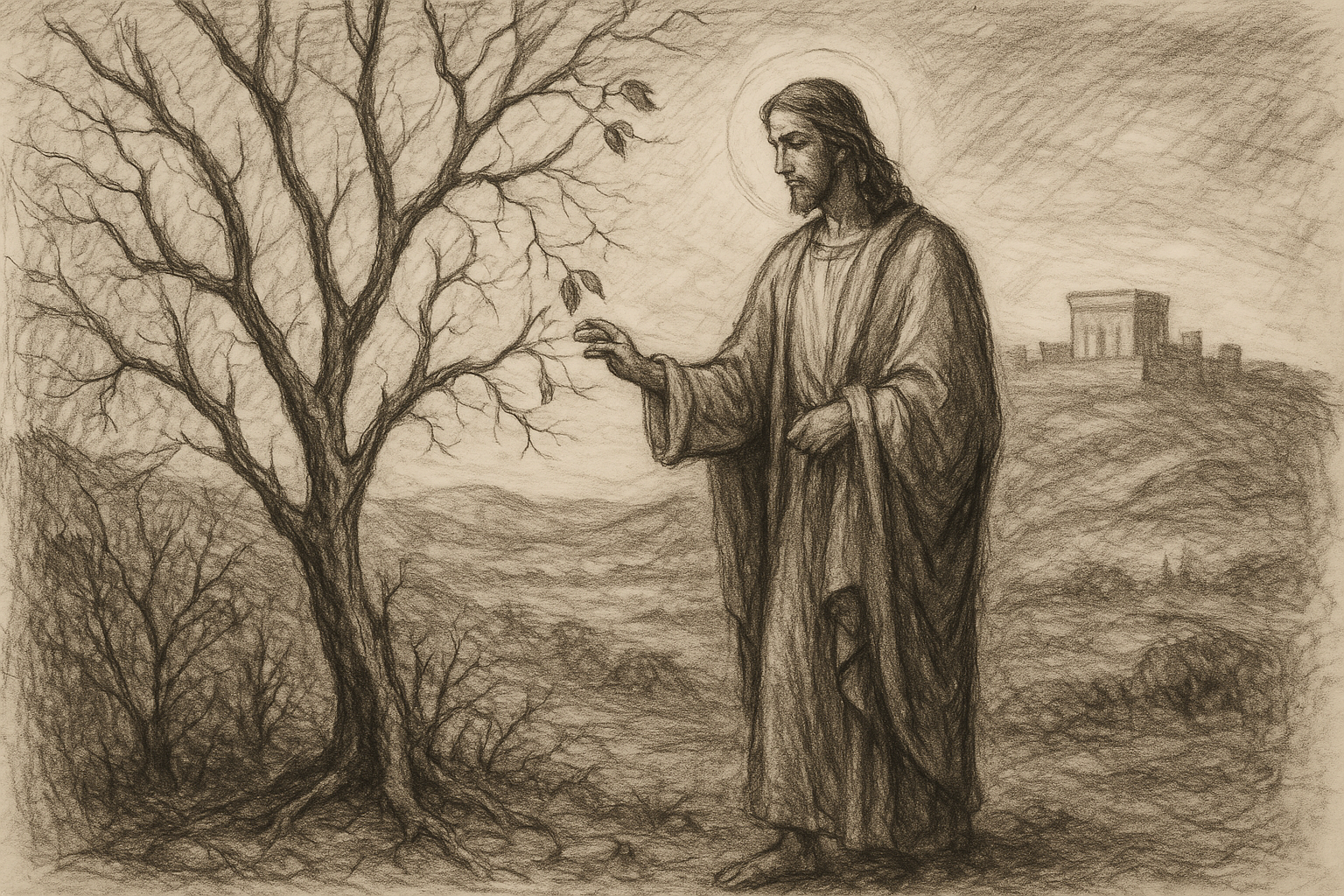
The barren fig tree is a brief Gospel image, but it lingers because it feels so plain and so searching. Jesus notices a tree with leaves, approaches it looking for fruit, and finds none. The scene is simple, yet it carries the weight of judgment, mercy, and spiritual truth. In the barren fig tree explanation, the Church has always heard more than a lesson about botany. She hears a warning about a life that looks alive from a distance but has not yet yielded the fruit that God seeks.
This passage appears most directly in the Gospel according to Mark, where Jesus comes to a fig tree and finds only leaves, because it was not the season for figs [[VERSE|mark|11|12-14|Mark 11:12-14]]. A nearby account in Matthew presents a similar and even more startling moment, where the tree withers after Jesus speaks to it [[VERSE|matthew|21|18-22|Matthew 21:18-22]]. Read together, these texts do not invite us to imagine Christ acting in irritation or caprice. Rather, they draw us into the prophetic way He teaches. Like the prophets before Him, Jesus uses a visible sign to unveil an invisible reality.
The setting matters more than the shock
At first glance, the episode can seem harsh. Why would Jesus approach a tree when it was not the season for figs? Scripture itself helps us read the scene properly. In the Gospels, fig trees often stand for Israel, for Jerusalem, and for the expectation that God's people should bear fruit in keeping with covenant faithfulness. A tree full of leaves but lacking fruit becomes a sign of outward appearance without inward fulfillment. The image is not merely about one plant. It is about the tragic possibility of religious life that seems promising but remains empty where it counts.
The timing is important as well. Mark places the event in the days leading up to the Passion, when Jesus enters Jerusalem and confronts the fruitlessness He sees there. The fig tree is commonly read alongside the cleansing of the Temple in the same section of Mark's Gospel [[VERSE|mark|11|15-19|Mark 11:15-19]]. The two scenes illuminate one another. The Temple was meant to be a house of prayer for all nations, yet it had become something else. The fig tree, leafy but barren, mirrors that same sorrowful mismatch between appearance and reality.
In that light, the episode is not random at all. It is a enacted prophecy. Jesus is showing that God does not seek religious decoration, but true fruit. He is not satisfied by sacred language, public devotion, or a reputation for holiness if these do not become obedience, mercy, justice, and conversion.
What Christ is teaching through the barren fig tree
The first lesson is that God looks for fruit. This is one of the clearest themes in the New Testament. John the Baptist had already warned that every tree that does not bear good fruit is cut down and thrown into the fire Matthew 3:10. Jesus later teaches that a tree is known by its fruit, because what comes from the heart eventually reveals itself in speech and action Matthew 12:33. The barren fig tree places that principle in front of us in a concrete and memorable way.
The second lesson is that leaves can deceive. Leaves suggest life, cover, vitality, and promise. A person can have the outer signs of religion while remaining spiritually dry. This is one reason the passage is so uncomfortable, and also why it is so useful. It strips away illusion. It asks whether prayer, Mass attendance, sacramental life, and Catholic identity are bearing real fruit in patience, chastity, generosity, humility, truthfulness, and love of neighbor.
The third lesson is that delay is dangerous. The fig tree does not get forever to become fruitful. Neither do we. The Gospel's urgency is not meant to create despair, but conversion. Scripture often uses the language of season, harvest, and readiness to remind us that grace is not a license to postpone repentance. The Lord is patient, but patience is not indifference. He gives time because He desires repentance, not because sin is harmless.
Jesus' warning is severe because love is severe when it refuses to let us settle for a barren life.
The fig tree, then, is not only about punishment. It is about truth. Christ names reality so that reality can be healed. A diagnosis can sound frightening, but it is merciful if it leads to treatment. In this way, the barren fig tree explanation becomes a call to wakefulness rather than fear.
A Catholic reading: leaves are not enough
Catholic life is sacramental, visible, and embodied. That is a gift, but it also means we can become content with externals. We can know the prayers, attend the liturgy, and speak the language of faith while still resisting the deeper work of grace. The barren fig tree stands as a warning to every baptized person who has become accustomed to the forms of discipleship without allowing them to reshape the soul.
The Church does not teach that we earn salvation by our own effort. We are saved by grace through faith, and even our good works are themselves made possible by God. Yet grace is real, and it produces fruit. The Council of Trent defended this truth against the idea that interior conversion can remain invisible forever. A living faith becomes active in charity. It makes a person more patient with family, more honest in business, more careful with speech, more faithful in hidden duty, and more willing to forgive.
This is why the barren fig tree is such a useful mirror for ordinary Catholic life. It asks questions that are not dramatic but are decisive:
- Has my prayer made me more docile to God's will?
- Has regular confession led to real amendment of life?
- Has receiving the Eucharist deepened my charity?
- Has my knowledge of doctrine become humility rather than pride?
- Has my devotion overflowed into mercy toward others?
These are not questions for anxious self-accusation. They are questions for honest discipleship. A tree is not shamed by being asked whether it bears fruit. It is simply being asked to become what it was made to be. In the same way, a Catholic life is not meant to remain merely respectable. It is meant to become fruitful in Christ.
Mercy is hidden inside the warning
It is easy to hear the fig tree passage as only a threat. But in the Gospel, even hard sayings are often merciful. Jesus does not expose barrenness to humiliate the sinner. He exposes it so that the sinner might return. His severity is medicinal. He tells the truth because He loves the soul enough to save it from self-deception.
Seen this way, the fig tree belongs to the same pattern as the Lord's other wake-up calls. The rich fool is warned that life can be required of him this very night [[VERSE|luke|12|16-21|Luke 12:16-21]]. The virgins are told to keep watch because the bridegroom may arrive unexpectedly [[VERSE|matthew|25|1-13|Matthew 25:1-13]]. The servant who hides his talent is not condemned for having little, but for doing nothing with what he received [[VERSE|matthew|25|14-30|Matthew 25:14-30]]. In each case, God is not asking for spectacle. He is asking for faithfulness.
The barren fig tree also helps us understand repentance as more than regret. Repentance is turning toward God in a way that changes the direction of life. It is not only feeling sorry that fruit is absent. It is receiving the grace to become fruitful. That is why the sacrament of Reconciliation is so precious in Catholic life. It does not merely name sins; it opens the way to renewal. The Lord who warns also restores.
This is important because many people respond to spiritual barrenness with either denial or despair. Denial says,
Keep Reading on Lets Read The Bible
Frequently Asked Questions
What is the barren fig tree in the Gospels meant to teach?
It is a prophetic sign that warns against outward religion without real conversion. Jesus uses the fig tree to show that God seeks genuine fruit in the lives of His people, not leaves alone.
Why did Jesus curse the fig tree if it was not the season for figs?
The point is not a botanical complaint but a symbolic act. Mark presents the tree as a sign of fruitlessness, especially in connection with Jerusalem and the Temple. Jesus is teaching through a visible sign, not reacting in an ordinary way to an ordinary tree.
How can Catholics apply the barren fig tree explanation to daily life?
By asking whether prayer, the sacraments, and devotion are producing real fruit such as charity, humility, obedience, and repentance. The passage invites an honest examination of whether our faith is alive in action.