Jesus and the Gospels
When Prayer Is Honest: The Pharisee and the Tax Collector Before God
Jesus draws a sharp line between self-approval and mercy-filled prayer, and Catholic readers still find their hearts inside the story.
Site Admin | March 3, 2026 | 77 views
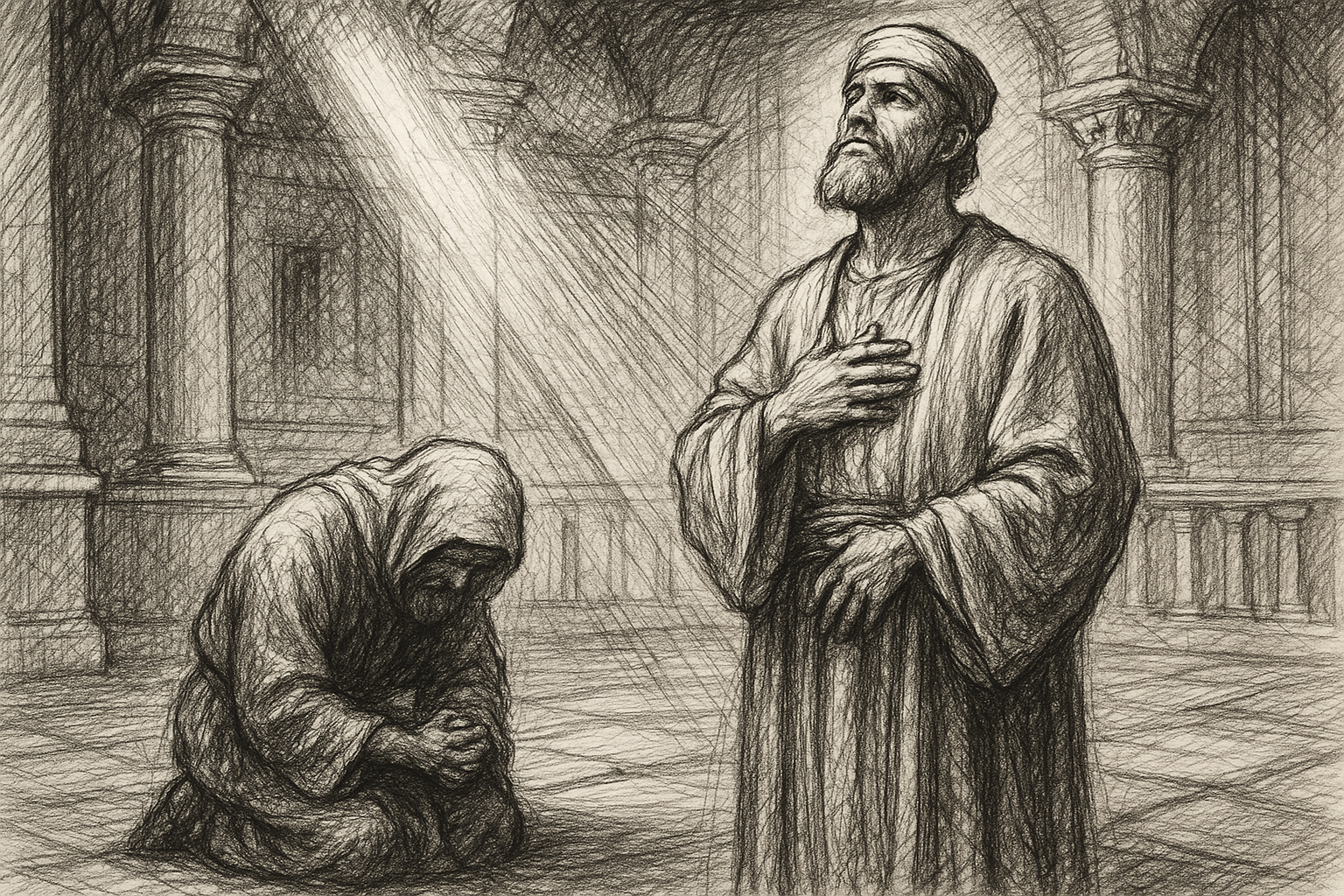
Among the short parables of Jesus, few speak as directly to the heart as the scene of the Pharisee and the tax collector. It is brief, pointed, and quietly severe. One man stands near the front of the temple and thanks God that he is not like other men. Another stands far off, unable even to lift his eyes, and asks only for mercy. At the end, Jesus overturns the expected verdict: it is the humble sinner, not the self-satisfied observer of the law, who goes home justified.
The force of this Gospel depends on more than a contrast in personalities. It reaches into the meaning of prayer itself. In Luke 18:9 to 14, Jesus speaks to those who trusted in themselves that they were righteous and despised others. That opening line tells us how to read the passage. This is not merely a lesson about two men in ancient Jerusalem. It is a warning about the human heart when religion becomes a stage for self-congratulation instead of a meeting with the living God.
The scene in Luke's Gospel
Luke places this parable in a context that matters. Jesus has been teaching about prayer, perseverance, and the coming of the Son of Man. Immediately before and after, the Gospel shows that prayer is not an accessory to discipleship. It is part of the Lord's own concern for the poor, the rejected, the repentant, and the childlike. Luke often highlights people who are overlooked by the world but close to God's mercy.
Here the setting is the temple, the center of Israel's public worship. That detail is important. The men are not at home in private reflection. They are standing before God, before the covenant, before the holy place where sacrifice, praise, and petition were offered. The Pharisee belongs to a movement known for careful observance of the law, and the tax collector belongs to a profession widely hated because it was associated with collaboration and dishonesty. Jesus chooses a pair that would have seemed obvious to his listeners. But the obvious verdict is not the one he gives.
The Pharisee's prayer has the outward shape of thanksgiving, but inwardly it turns into comparison. He lists his fasts and tithes, and in those actions there is nothing wrong. Fasting and generosity are good works. The problem is not the discipline itself. The problem is the spirit in which he offers it. He does not simply thank God for grace. He congratulates himself in the presence of others, and then he uses the tax collector as a dark foil for his own pride.
The tax collector, by contrast, stands at a distance. He will not even look upward. He beats his breast, a bodily sign of sorrow, and says, God, be merciful to me, a sinnerLuke 18:13. The entire prayer is stripped down to its essential truth. He does not defend himself. He does not negotiate. He does not compare. He asks for mercy.
What Jesus is exposing
The Pharisee and the tax collector Catholic meaning becomes clear when we notice that Jesus is not condemning moral effort. The Church does not teach indifference to holiness or law. On the contrary, Catholics are called to pray, fast, give alms, and live in obedience to God. The parable exposes something subtler and more dangerous: the corruption of good works by pride.
A person can do religious things and still resist God. A person can be correct in external practice and still be far from mercy. The Pharisee's error is not simply that he sees the tax collector's sins. It is that he cannot see his own need. Once a soul begins to measure itself against other people rather than against the holiness of God, prayer becomes distorted. The mouth may speak to heaven, but the heart is already rehearsing self-justification.
Jesus closes the parable with one of his most bracing reversals: Everyone who exalts himself will be humbled, but the one who humbles himself will be exaltedLuke 18:14. That sentence reaches beyond the temple scene. It describes how grace works. God does not deny the good he has done in us, but he resists self-exaltation because pride closes the door to receiving what only mercy can give.
Humility does not mean pretending that nothing good has been done. It means telling the truth about where every good gift comes from.
That is one reason this parable remains so searching. It does not simply ask whether we are outwardly religious. It asks whether our religion has made us more open to God or more impressed with ourselves.
Mercy before merit
Catholic faith always holds together God's grace and our response. We are saved by grace, not by self-made moral achievement. At the same time, grace truly transforms us, and good works really matter because they are the fruits of communion with Christ. The tax collector's prayer guards this balance well. He does not claim merit. He pleads for mercy. Yet his humility is itself a doorway to grace.
This is deeply consonant with the Church's life of prayer. In the Mass, in the sacrament of Penance and Reconciliation, in the Liturgy of the Hours, and in private devotion, Catholics do not come before God as spiritual creditors. We come as beggars who have been loved first. Even when we confess serious sin, the posture is not despair but trust. The God who judges also heals. The same Lord who tells the truth about sin also offers forgiveness.
The tax collector's words have echoed through Christian prayer for centuries because they are so simple and true. God, be merciful to me, a sinner is a compact act of contrition. It does not excuse, minimize, or self-dramatize. It simply places the sinner under God's mercy. Many Catholics will recognize in this line the spirit of the Church's penitential prayers, and especially the humility required in confession. Before absolution, before peace, before any sense of spiritual relief, there must be honesty.
The Pharisee, by contrast, shows what happens when religious habit becomes spiritual blindness. He may have followed the law faithfully, but he has not learned to kneel inwardly. He stands in the temple, yet his heart is elsewhere. He has not entered prayer as dialogue. He has entered as self-display.
How the parable reads in Catholic life
For Catholics today, the parable is both consoling and unsettling. It consoles because no one is beyond mercy. Even a man known for dishonesty and public shame can go home justified when he turns to God in humility. It unsettles because pride can hide inside the best habits. A person may attend Mass faithfully, know the prayers, defend the faith, and still secretly trust in his own righteousness.
That is why the Church consistently encourages examen of conscience. Not because Catholics are meant to live in scrupulous fear, but because spiritual growth depends on truth. We cannot repent of what we refuse to name. We cannot receive mercy if we insist on appearing flawless.
This parable also speaks to the way Catholics speak about others. The Pharisee despises the tax collector. That contempt is deadly because it places one sinner above another in a false court. The Church asks us to correct wrongdoing, yes, but never to forget that every person stands in need of grace. The holy ones are not those who need no mercy. They are those who know they have received it.
Here are a few concrete ways this Gospel can shape daily life:
- Begin prayer with honesty rather than performance. Speak plainly to God about weakness, fear, gratitude, and need.
- Make frequent use of the prayer of the tax collector, especially before confession or when temptation to pride appears.
- Examine whether spiritual disciplines are making you more compassionate or more self-satisfied.
- Ask for the grace to rejoice in another person's repentance instead of comparing wounds and virtues.
- Remember that fasting, almsgiving, and prayer are meant to open the heart, not build a case for self-approval.
None of this diminishes the real beauty of disciplined Catholic life. It places that beauty in the right light. Fasting can purify desire. Almsgiving can free us from possessiveness. Prayer can make us steady before God. But every one of those gifts can be twisted if we begin to think we have made ourselves holy. The parable strips away that illusion.
Why the story still reaches us
There is something disarmingly modern about the Pharisee's posture. We live in an age of comparison, public image, and self-presentation. It is easy to curate a version of ourselves that appears disciplined, informed, and respectable. But the Lord sees through all of that. He is not looking for a polished performance. He is looking for contrition, trust, and openness to grace.
At the same time, the tax collector's prayer is profoundly contemporary in the best sense. It is short enough to be remembered, simple enough to be repeated, and deep enough to accompany a lifetime. When spoken with sincerity, it becomes a school of humility. It teaches the soul not to hide from God and not to justify itself. It teaches us to stand before divine mercy as we really are.
This is one reason the parable belongs close to the center of Catholic spirituality. It protects us from two opposite errors. One error is despair, the belief that sin has made mercy impossible. The other is pride, the belief that we are already acceptable on our own terms. Jesus rejects both. The tax collector is not crushed by shame, because mercy is real. The Pharisee is not upheld by his achievements, because pride is not holiness.
To pray this Gospel well is to let God search us. It is to ask not, How do I compare? but Lord, what do You see? That question changes prayer, confession, relationships, and the way we understand ourselves. It also restores peace, because the soul no longer has to defend its image. It can simply stand in truth before the One who already knows everything and yet still offers mercy.
In the end, the Pharisee and the publican, or tax collector, are not only two men in a temple. They are two ways of approaching God. One trusts in himself and leaves unchanged. The other trusts in mercy and goes home justified. That is a pattern Catholics still need, because every Christian life begins again at the same place: not with self-approval, but with the prayer that dares to be honest before God.
Keep Reading on Lets Read The Bible
Frequently Asked Questions
What is the main Catholic lesson of the Pharisee and the tax collector?
The main lesson is that humility opens the heart to God's mercy, while pride can hide even inside religious practice. Jesus shows that God justifies the one who comes in truth and repentance.
Does this parable mean good works do not matter?
No. The Church teaches that prayer, fasting, almsgiving, and obedience are good and necessary. The parable warns that good works lose their spiritual fruit when they are used to build self-righteousness.
How can Catholics pray like the tax collector today?
Catholics can pray with simple honesty, especially using short penitential prayers such as 'God, be merciful to me, a sinner.' It is also helpful to bring the same humility to confession, daily examen, and the Mass.