Jesus and the Gospels
When the Wind Rose, Christ Was Already There
A close reading of the calming of the storm and the quiet lesson it offers Catholics about fear, faith, and the Lord's presence.
Site Admin | February 5, 2026 | 77 views
The storm on the lake and the fear in the boat
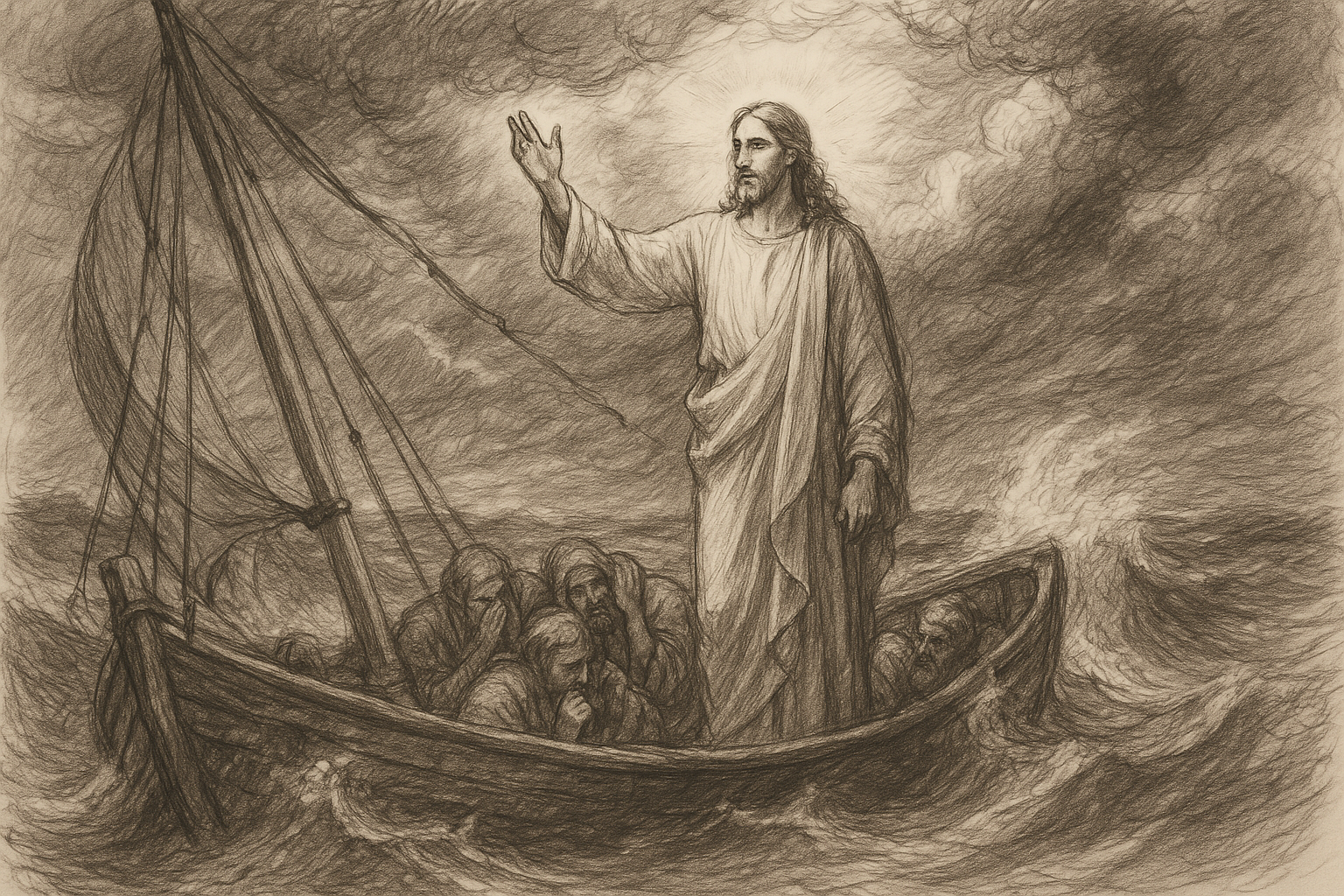
The calming of the storm is one of the most memorable scenes in the Gospels because it feels so immediate. The disciples are in a boat on the sea when a violent squall rises. Waves fill the boat, the men grow afraid, and Jesus is there with them, asleep on a cushion. They wake Him with a cry that is at once honest and desperate: "Teacher, do you not care that we are perishing?" Mark 4:38
That question is one many people have prayed in different words. It comes from the place where human fear meets divine silence. The disciples are not acting out a pious drama. They are overwhelmed. They see danger, they feel helpless, and they want the Lord to do something now.
The Lord does act. Jesus rises, rebukes the wind, and says to the sea, "Peace! Be still!" Mark 4:39 At once the storm ceases. The water becomes calm. Then He turns to His disciples and asks, "Why are you afraid? Have you still no faith?" Mark 4:40
For Catholics, this is not only a display of divine power. It is a revelation of who Jesus is. He is not merely a prophet who speaks about God from a distance. He is the Lord who commands the sea, the One who is present in the boat, even when He seems asleep.
What the Gospel scene reveals about Jesus
In Sacred Scripture, the sea often carries the sense of chaos, danger, and forces beyond human control. The disciples know boats and weather. They are fishermen, not strangers to storms. Their fear is not weakness in the abstract. It is the response of real men who understand how quickly nature can overwhelm them.
The miracle shows Jesus doing what only God can do. In the Old Testament, the Lord alone is master over the sea and the deep. The Church reads this scene in the light of the whole Bible, and that wider context matters. When Jesus quiets the wind and waves, He is not simply rescuing exhausted disciples. He is revealing divine authority.
There is another detail worth noticing. Jesus is in the boat before the storm begins. He does not arrive after the crisis is underway. He is already there. That fact does not remove the danger, but it changes its meaning. The disciples are not abandoned, even if they feel abandoned. Christ is close, even when He appears to sleep.
This is one reason the passage speaks so directly to Catholic prayer. Faith does not mean pretending storms are not real. Faith means believing that Christ remains Lord in the storm. He may seem silent, but silence is not absence.
The disciples' fear and the human heart
The disciples' fear is easier to understand than their rebuke of Jesus at first glance. In distress, people often assume that delayed help means uncaring help. The cry, "Do you not care?" Mark 4:38 is painfully human. It exposes how quickly suffering can tempt the soul to doubt the Lord's goodness.
Many Catholics know this experience. A family crisis, a diagnosis, a financial struggle, a betrayal, a long season of prayer without visible answer, any of these can make the heart feel like a boat taking on water. The temptation is not only to fear, but to interpret fear as proof that God is distant.
The Gospel corrects that interpretation. The Lord's question, "Have you still no faith?" Mark 4:40 is not a harsh dismissal. It is a summons. Jesus is leading the disciples from panic to trust, from the immediate evidence of the waves to the deeper truth of His presence.
Faith, in the Catholic sense, is not a vague confidence that everything will turn out the way we want. It is assent to God's truth and surrender to His care. Sometimes that means the storm calms quickly. Sometimes it means the soul is steadied before the weather changes. The miracle in the boat assures us that Christ has power over both outcomes.
The calm after the command
When Jesus speaks, the storm stops. The Gospel does not present this as a gradual improvement or a symbolic shift in mood. It is immediate. Creation obeys its Creator.
That instant calm matters because it shows the completeness of Christ's authority. The disciples are not helped by advice, technique, or encouragement alone. They are helped by His word. The same is true in the spiritual life. Grace does not merely inspire us from afar. It comes from Christ Himself, who acts with saving power.
The disciples respond with awe: "Who then is this, that even wind and sea obey him?" Mark 4:41 Their question is the right one. It points toward the mystery at the heart of the Gospel. Jesus is not one religious teacher among many. He is the Son of God, and the world responds to Him as it should.
Catholics can also see in this scene an echo of the Church's own life. The boat has often been a symbol for the Church traveling through history, sometimes on calm waters, sometimes through confusion, persecution, or fear. The Lord remains in the boat. He does not desert His people. His presence may be hidden for a time, but His lordship is never in doubt.
Trust when the Lord seems asleep
Perhaps the most searching part of the story is not the wind but the sleeping Christ. Why would the Lord sleep while His followers struggle? Scripture does not answer that question directly, but it gives us enough to reflect on it with humility.
Jesus is truly human, and His fatigue is real. He is not pretending to need rest. Yet His sleep also becomes a test of faith. The disciples must decide whether they trust Him only when He is visibly active or also when He appears hidden. That question remains alive for every generation.
Catholic tradition has long urged the faithful to persevere in trust, especially in times when God seems quiet. The life of prayer often includes seasons that feel uneventful or dry. The Lord may seem asleep, but He is still Lord. He is not indifferent to our needs, and He is not limited by our timing.
This is where the scene becomes spiritually bracing. The disciples wanted immediate rescue, and Jesus gave it. But He also gave them something deeper: a revelation of faith. They learned that His presence is more important than their control, and His word more trustworthy than the storm's noise.
"Why are you afraid? Have you still no faith?" Mark 4:40
That question is not meant to shame the faithful. It is meant to purify trust. Christ wants His disciples to rely on Him not only after deliverance, but before it. That is the shape of mature faith.
How Catholics can pray with this Gospel
The calming of the storm offers several practical lessons for Catholic life.
First, bring your fear to Jesus honestly. The disciples did not hide their panic. They cried out. Prayer does not require polished words when the heart is in distress. A simple plea, even an imperfect one, can become an act of faith.
Second, remember that Christ is present before the answer arrives. You may not yet see the calm you ask for, but the Lord is not absent from the boat. In the sacraments, in the liturgy, in Scripture, and in prayer, He continues to be with His people.
Third, distinguish between the storm and the truth. Fear can make every wave look final. The Gospel insists otherwise. What looks overwhelming is not ultimate. Christ is ultimate.
Fourth, let the miracle enlarge your sense of who Jesus is. The point is not merely that Jesus can help in emergencies. It is that He is Lord over creation, Lord over history, and Lord over the human heart.
Fifth, ask for faith as much as for relief. Sometimes the deeper grace is not that the trouble vanishes at once, but that the soul learns to stand before God with greater trust.
The meaning of peace in a Catholic key
The words "Peace! Be still!" Mark 4:39 are more than a command to the weather. They also sound like a promise for the interior life. Christ's peace is not the absence of conflict in every external circumstance. It is the ordered calm that comes from being held by God.
Catholics should be careful not to reduce peace to emotional comfort. The peace of Christ may coexist with suffering, uncertainty, or sacrifice. The martyrs had peace. The saints knew trials. The Blessed Virgin herself lived through joys and sorrows, often without clarity about what the future held. Yet all of them lived beneath the providence of God.
In that sense, the storm at sea becomes a mirror for the soul. The waves are real, but so is the Lord. The heart may tremble, but grace can still speak more loudly than fear. When Christ says, "Peace," He is not denying reality. He is naming the deeper reality that His presence creates.
That is the heart of the Jesus calming the storm Catholic meaning. The miracle shows us a Savior who is powerful enough to command creation and close enough to hear trembling voices. It teaches that trust is not foolish, prayer is not wasted, and fear does not have the final word.
So when life becomes rough and the boat feels small, Catholics can return to this Gospel scene with confidence. The One who stilled the sea has not changed. He is still in the boat, still Lord of the waters, and still able to bring peace where the heart has only known panic.
Keep Reading on Lets Read The Bible
Frequently Asked Questions
What is the Catholic meaning of Jesus calming the storm?
It reveals Jesus as Lord over creation and teaches Catholics to trust His presence even when life feels chaotic. The scene shows that Christ is not distant from suffering, but with His disciples in the middle of it.
Why did Jesus seem asleep during the storm?
The Gospel presents His sleep as real human rest, but also as a test of faith. The disciples had to learn that Christ is present even when He seems silent or hidden.
How can Catholics pray with this passage in daily life?
Catholics can bring fears honestly to Jesus, ask for trust as well as relief, and remember that Christ is present in prayer and the sacraments even before circumstances change.