Jesus and the Gospels
When Christ Steps into the Boat: Peter's First Call and the Shape of Discipleship
The Gospels show Peter being drawn from ordinary labor into a life that would be tested, purified, and made fruitful by grace.
Site Admin | January 18, 2026 | 88 views
The calling of St. Peter is one of those Gospel scenes that feels at once simple and immense. A fisherman is at work. The Lord is nearby. A few words are spoken. Then a life changes. In the Catholic imagination, this moment is not only the beginning of Peter's mission. It is also a window into how Christ calls every disciple: personally, patiently, and with a claim that reaches deeper than talent or status.
When Catholics speak about the calling of St. Peter Catholic meaning, they are usually thinking of more than one Gospel passage. Peter is first drawn to Jesus through witness and encounter, then confirmed in his mission along the shore, and later established in a special office among the Apostles. The Lord who calls Peter in the beginning is the same Lord who shapes him through failure, forgiveness, and responsibility. That is why Peter remains so close to the Church's memory. He is not a flawless hero. He is a man whose weakness becomes the place where grace can be seen most clearly.
Peter is called in the middle of ordinary life
The Gospel accounts place Peter in the life he knew best: fishing. In Luke 5:1 and Matthew 4:18, Jesus meets Peter by the sea, not in a temple or a palace. The Lord steps into the world of nets, boats, and tired hands. This matters. Divine calling is not reserved for people who have already arranged themselves into spiritual perfection. Christ enters real work, real fatigue, and real responsibility.
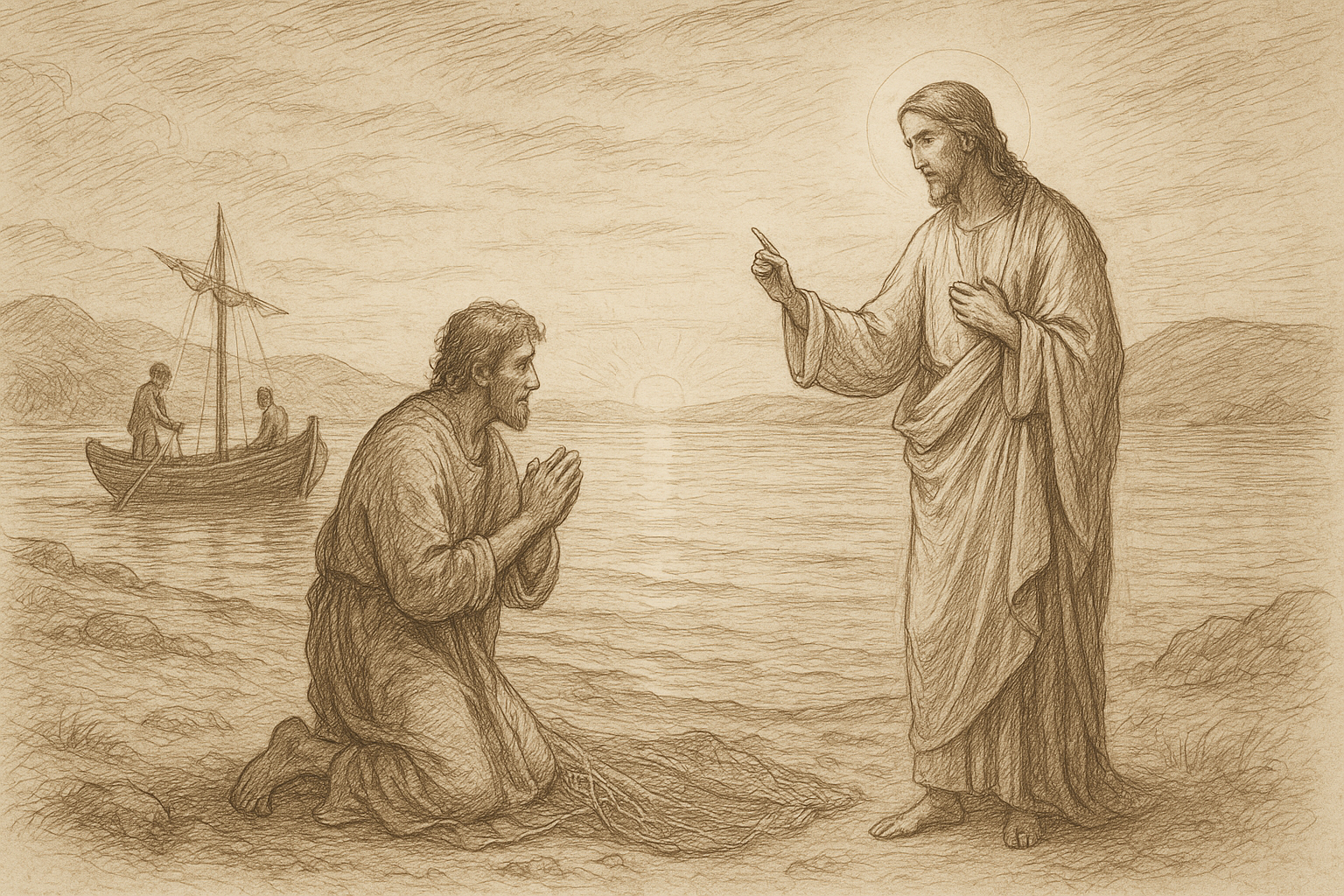
In Luke's account, Peter has already labored all night without success. Jesus asks him to put out into deep water and lower the nets again. Peter's reply is memorable because it blends honesty with obedience: he has reason to hesitate, but he still trusts the Lord's word. When the catch overflows the boat, Peter falls at Jesus' knees and says, Luke 5:8. That response is deeply Catholic in spirit. Peter sees both the holiness of Christ and the truth about himself. Grace does not flatter him. It reveals him.
There is a beautiful pattern here. Jesus does not begin by arguing Peter into discipleship. He speaks, commands, and acts. Peter obeys before he fully understands. In that obedience, he discovers abundance. This is often how God works in the spiritual life. The call may begin with uncertainty, but trust opens the way to fruitfulness.
The first call is also a call to leave something behind
In the Synoptic Gospels, Jesus says to Peter and Andrew, Matthew 4:19. The response is immediate: Matthew 4:20. The same pattern appears with James and John. They leave what is familiar because the One who calls them is greater than what they are leaving behind.
Catholics can sometimes read this too quickly and imagine a romantic break from ordinary life. But the Gospels present something more demanding and more human. Peter is not leaving a meaningless life. Fishing is honest work. It is work tied to livelihood, family, and rhythm. To follow Christ is not to despise creation or responsibility. It is to let even good things take second place before a greater good. The call of Peter reveals that discipleship has a cost because it reorders love.
That reordering remains central to Catholic life. A person may be called to marriage, priesthood, consecrated life, or faithful lay witness in the world. The exact form differs, but the pattern is the same. Christ asks for a real surrender, not a symbolic one. He does not simply improve Peter's schedule. He claims Peter's future.
Peter's weakness does not disqualify him
If the story of Peter ended with the miraculous catch, it would still be beautiful. But the Gospels do not allow Peter to remain a one-dimensional figure. Very soon, he becomes the disciple who speaks boldly, misunderstands, falters, and is corrected. He confesses Jesus as the Christ, then resists the idea of a suffering Messiah. He walks on the water, then begins to sink. He promises fidelity, then denies the Lord. And yet Jesus does not discard him.
This is one of the most consoling aspects of the calling of St. Peter Catholic meaning. Christ does not call Peter because Peter is already finished. He calls him because he can be formed. The Lord sees what Peter will become under grace. Catholic spirituality is realistic about sin, but it is also realistic about mercy. A fallen disciple is not the same as a rejected disciple.
Peter's tears after the denial matter as much as his boldness before it. The risen Lord later asks him three times, John 21:15. That scene is not merely a correction. It is a restoration. Love is asked for where love was once denied. The Lord heals by re-entering the wound. Peter's mission is renewed, not because he has become self-sufficient, but because he has been forgiven and trusted again.
The Church sees in Peter a sign of Christ's care for His people
Catholics honor St. Peter not simply because he was first among the Apostles, but because his calling points to the way Christ guides the Church. In Matthew 16:18, Jesus speaks of building His Church on the rock and entrusting keys. This does not erase Peter's humanity. Instead, it shows that Christ often places great responsibility into fragile hands. The primacy given to Peter is a gift for the Church, but it remains rooted in Jesus' authority, not Peter's natural greatness.
That truth guards Catholics from two errors. The first is idealizing Peter so much that his humanity disappears. The second is reducing him to his failures. The Gospels do neither. Peter is both strong and weak, both impulsive and faithful, both rebuked and commissioned. That complexity is part of the Church's own story. Christ does not build with imaginary people. He builds with sinners whom He has called, forgiven, and sent.
From a Catholic perspective, Peter's role also reminds us that authority in the Church is meant for service. The one who is called to strengthen others must first be strengthened by Christ. The one who will confirm his brothers must first learn to rely on mercy. Peter's office is not a reward for personal brilliance. It is a cross-shaped responsibility sustained by grace.
Peter teaches that vocation begins with encounter
Many people think of vocation as a decision. In one sense, it is. We respond freely. But Peter's calling shows that vocation begins even earlier, in encounter. He meets Jesus, hears His voice, and begins to see the world differently. That is why the scene by the lake is so enduring. It is not merely about leaving a job. It is about being redefined by the presence of Christ.
For Catholics today, this has practical meaning. Prayer, the sacraments, Scripture, and the Church's life are not accessories to a private faith. They are places where Christ still speaks. A person may not hear a dramatic voice from the shore, but the Lord still summons hearts through the Gospel, through conscience, through the quiet pressure of grace, and through the needs of others.
Peter also reminds us that a calling can unfold gradually. At first he is an eyewitness. Then he is a follower. Then he is a confessor of faith. Then he is a shepherd among the Apostles. Then, after failure, he becomes a witness of mercy. Christian vocation is often like that. God reveals only enough for the next act of obedience. He does not always explain the whole road at once.
What Peter's call asks of Catholics today
Peter's story is not distant from ordinary Catholic life. It asks several direct questions:
- Do I make room for Jesus to interrupt my routine?
- Am I willing to obey even when I do not yet understand?
- Do I believe that my failures can be healed and used by grace?
- Have I mistaken comfort for fidelity?
- Am I willing to let Christ decide what fruitfulness looks like?
These are not abstract questions. They reach into the concrete rhythm of a Catholic life. A parent trying to be patient, a priest carrying responsibilities, a young person discerning a future, an older person learning to trust God more deeply: each can recognize something of Peter in the struggle between fear and obedience.
Peter's example is especially helpful because he never becomes a saint by denial of his weakness. He becomes a saint by letting Christ meet him there. That is a very Catholic lesson. Holiness is not the same as self-protection. It is the work of grace shaping a human person through repentance, fidelity, and love.
The boat, the net, and the shore remain familiar places of grace
There is a quiet beauty in the fact that Jesus calls Peter near water. The sea is a place of labor, unpredictability, and dependence. Nets can come up empty. Weather can change. Strength has limits. The setting becomes a symbol of the spiritual life itself. We cast our nets. We try. We fail. Christ speaks again. And often the true miracle is not only the catch, but the willingness to try once more at His word.
Peter's story also teaches Catholics how to read their own lives sacramentally. Ordinary places can become sites of encounter. Work can become a place of vocation. Failure can become a place of mercy. Fear can become a place of trust. Even a boat at the edge of the lake can become the beginning of a mission that reaches the whole Church.
When Catholics pray with the calling of St. Peter, they are invited to ask not only,
Keep Reading on Lets Read The Bible
Frequently Asked Questions
What is the main Catholic meaning of Peter's calling in the Gospels?
Peter's calling shows that Jesus meets people in ordinary life, calls them by grace, and forms them through obedience, mercy, and mission. It also points to Peter's special role among the Apostles and in the life of the Church.
Why does Jesus call Peter even though Peter is flawed?
Because Christ calls sinners and transforms them. Peter's weakness does not cancel his vocation. Instead, it becomes the place where God's mercy and strength are made visible.
How can Catholics apply Peter's calling today?
Catholics can learn to listen for Christ in daily life, obey even when they do not fully understand, and trust that God can use ordinary work, failures, and responsibilities for holiness and service.