Jesus and the Gospels
The Quiet Work of the Kingdom in the Parable of the Seed Growing Secretly
Christ teaches that God's reign often advances below the surface, where patience, trust, and grace do their hidden work.
Site Admin | March 18, 2026 | 99 views
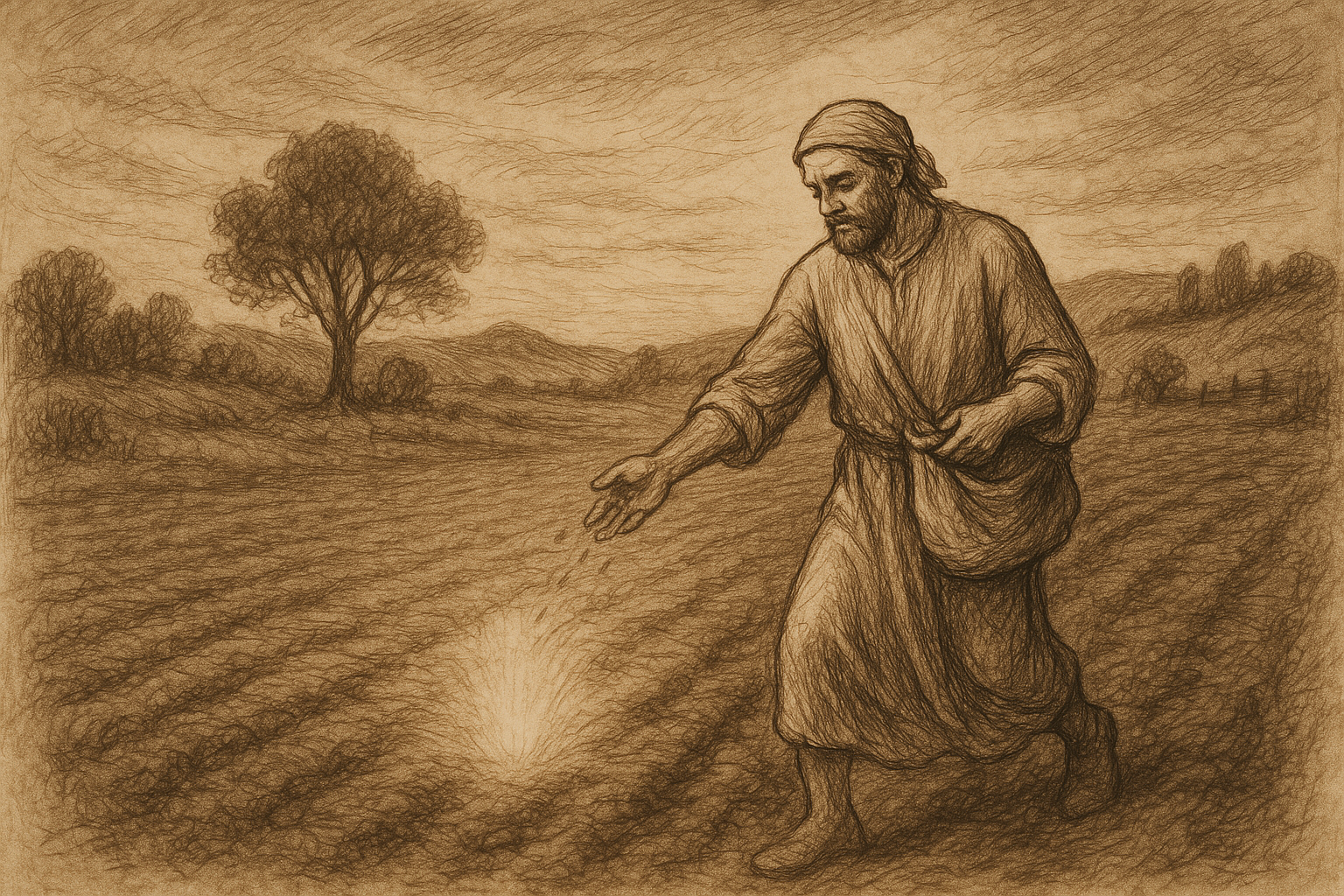
Among the parables of Jesus, the seed growing secretly is one of the most consoling for believers who know how slow holiness can feel. It appears only in the Gospel of Mark, where Jesus says, "The kingdom of God is as if a man should scatter seed upon the ground" Mark 4:26. The farmer sleeps and rises, night and day, and the seed sprouts and grows "he knows not how" Mark 4:27. Then, in time, the grain is ready for harvest Mark 4:28.
This small parable carries a large promise. Christ is showing that the Kingdom of God is real, active, and alive, even when it cannot be measured at every moment. For Catholics, that is more than a comforting image. It is a way of seeing the life of grace, the life of the Church, and the hidden way God often works in the human heart.
The setting of the parable in Mark's Gospel
Jesus tells this parable in the context of teaching about the Kingdom of God, a theme that runs through His preaching from the beginning of the Gospel. Mark presents Christ as the One who announces God's reign and calls men and women to repentance and faith Mark 1:15. The parable of the seed growing secretly belongs to a series of agricultural images that explain how divine life takes root and unfolds.
The key detail is that the farmer does not force the growth. He scatters the seed and then returns to ordinary life. The growth happens beyond his control. The soil receives, the seed acts, and the life inside the seed unfolds according to God's design. Jesus is not praising passivity as though human effort does not matter. He is teaching humility before the mystery of grace.
In Catholic life, that humility matters. We plant, water, pray, teach, confess, receive the sacraments, and endure. Yet it is God who gives the increase. Saint Paul says plainly, "I planted, Apollos watered, but God gave the growth" 1 Corinthians 3:6. The parable and the apostolic teaching belong together.
What Jesus is revealing about the Kingdom of God
The seed growing secretly explanation begins here: the Kingdom is not a worldly empire that expands by force, publicity, or constant display. It is God's life entering the world in Christ, taking root quietly, and bearing fruit in ways often hidden from the eye. The Gospel does not deny visible signs. The Church is visible, the sacraments are visible, and the works of mercy are visible. But the deepest growth often happens where no crowd applauds.
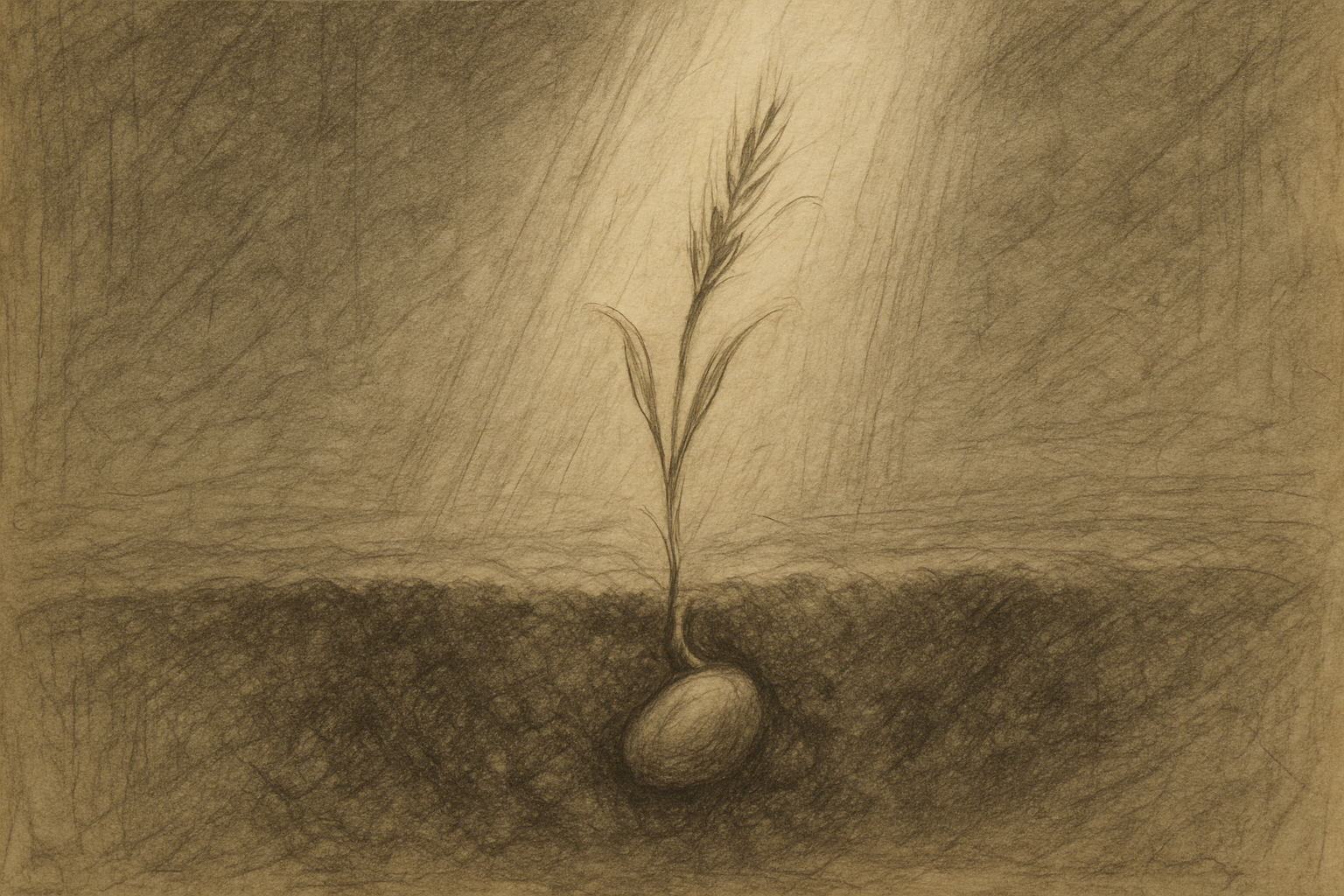
That hiddenness is not weakness. It is how God loves to work. In Scripture, the Lord often acts through what seems small. He chooses Bethlehem, a manger, fishermen, and a cross. In the parable, the seed is alive before the harvest appears. So it is with grace. A person may look unchanged for a time while God is quietly preparing conversion, patience, forgiveness, or courage.
The parable also teaches that the Kingdom has its own timetable. Human beings tend to ask for instant results. We want visible progress, immediate answers, and measurable success. Jesus gives instead the image of organic growth. A seed does not become a stalk in a moment. It does not hurry because the gardener is impatient. It grows because life is already within it.
The Kingdom grows according to God's wisdom, not our urgency.
A Catholic way to hear the parable
Catholic tradition has always honored both grace and cooperation. We are not saved by our own effort, yet we are not saved without response. The parable of the seed growing secretly helps hold those truths together. The sower does his work, but the hidden increase belongs to God. Likewise, the Christian receives grace and then lives it out in daily fidelity.
This matters especially when faith feels ordinary. Many Catholics live long stretches of life without dramatic spiritual experiences. Most holiness is made of repeated acts: attending Mass, making a good confession, praying the Rosary, forgiving an insult, caring for children, serving a neighbor, persevering in illness, or returning again to prayer after distraction. These acts can seem small. Yet in the light of this parable, small does not mean ineffective.
Jesus is telling us that the seed of the Word can be at work even when we cannot trace its progress. A parent praying for a child may see no immediate change. A person battling a habitual sin may feel only the slowness of recovery. A parish may labor faithfully for years before fruit appears. The parable invites trust. God is not idle in the hidden season.
Scripture's wider witness to hidden growth
The Bible often presents God's work as both hidden and sure. Isaiah compares the Word of God to rain and snow that do not return empty but accomplish what He sends them to do Isaiah 55:10-11. That image is close to Jesus' parable. The Word enters the world and does its work in ways beyond human scheduling.
Our Lord also speaks elsewhere of the seed that falls into the ground and dies in order to bear much fruit John 12:24. That saying points directly to His own Paschal mystery. Christ's death seemed, from the outside, like defeat. Yet through the Cross and Resurrection the Kingdom came with power. The seed growing secretly is therefore not only about our personal growth. It also reflects the pattern of Christ Himself: hidden, surrendered, fruitful.
Saint Paul adds another dimension when he writes that God's power is made perfect in weakness 2 Corinthians 12:9. What looks small, delayed, or fragile is often the very place where grace is most active. That is deeply Catholic, because it reflects the mystery of the Incarnation. God does not save by spectacle alone. He saves by entering the lowliness of human life.
How the parable speaks to daily Catholic life
Most Catholics know the ache of praying for something that seems to move slowly. The seed growing secretly meets that ache with patience. It says that unseen work is still work, and that God's silence is not absence. This can change the way we approach ordinary duties.
- In prayer: Dryness does not mean failure. Even simple fidelity can be a fertile place for grace.
- In family life: Years of example, correction, and forgiveness may bear fruit long after the moment has passed.
- In moral conversion: A struggle that feels stuck may still be part of real growth under God's care.
- In parish life: Quiet ministries, hidden sacrifices, and patient service often prepare the ground for visible renewal.
The parable also guards us from discouragement when results are slow. The Church is not built by spiritual impatience. She is built by Christ, who works through time. A saint is not made in a day. Neither is a family healed in a day, nor a habit broken in a day, nor a culture renewed in a day. Yet the seed of grace, once planted, is never meaningless.
The sacraments and hidden growth
Catholics can hear this parable especially well through sacramental life. In Baptism, grace is given in a humble sign of water. In the Eucharist, Christ feeds His people under the appearances of bread and wine. In Confession, mercy is spoken through an ordinary priestly ministry. These sacraments are visible, yet their power is often hidden. Their fruit may unfold over years.
That hiddenness is fitting because grace respects the pattern of the parable. God is not trying to impress us with noise. He is trying to save us. The sacramental life teaches us to look beyond appearances and to trust what Christ has promised. Even when we do not see immediate transformation, the Lord is at work.
Hope for those who feel spiritually small
Many believers worry that their faith is too weak, too inconsistent, or too unimpressive to matter. The seed growing secretly explanation answers that worry with quiet confidence. The power is not in the size of the seed, but in the life God has placed within it. A small act of trust can be enough for a beginning. A weak prayer can still be heard. A return to Mass after a long absence can open the door to a new season of grace.
This is one reason the parable is so full of hope. It protects the soul from despair and from pride. Despair says nothing is happening. Pride says I must make it happen. Christ says instead that God is already at work, and that the harvest belongs to Him. We are called to faithfulness, not mastery.
When the harvest arrives, it will reveal what the hidden months concealed. Then what seemed invisible will prove to have been real all along. That is true in a field, and it is true in a soul. The Word of God does not return empty. The Kingdom grows, and those who wait on the Lord learn to recognize His patient faithfulness in the ordinary rhythm of days.
Keep Reading on Lets Read The Bible
Frequently Asked Questions
Where is the parable of the seed growing secretly found in Scripture?
It is found in Mark 4:26-29, where Jesus describes the Kingdom of God as seed that grows while the farmer sleeps and rises.
What is the main lesson of the seed growing secretly explanation?
The main lesson is that God's Kingdom grows by His power and timing, often in hidden ways that human beings cannot fully see or control.
How can Catholics live this parable in daily life?
Catholics can live it by practicing steady prayer, receiving the sacraments, doing ordinary duties faithfully, and trusting God to bring fruit in His time.