Jesus and the Gospels
When the Door Is Shut: Christ's Lesson from the Friend at Midnight
A close reading of Jesus' midnight parable and the steady faith it asks of every Christian
Site Admin | March 14, 2026 | 99 views
The parable often called the Friend at Midnight is one of the shortest in the Gospels, but it has a long reach into Catholic prayer. Jesus tells it after teaching the Our Father, so the scene is already marked by intimacy: disciples are being shown how to speak to God as Father, and then Christ immediately adds a story about a man who knocks at an inconvenient hour. The lesson is plain enough to hear, yet rich enough to ponder for a lifetime.
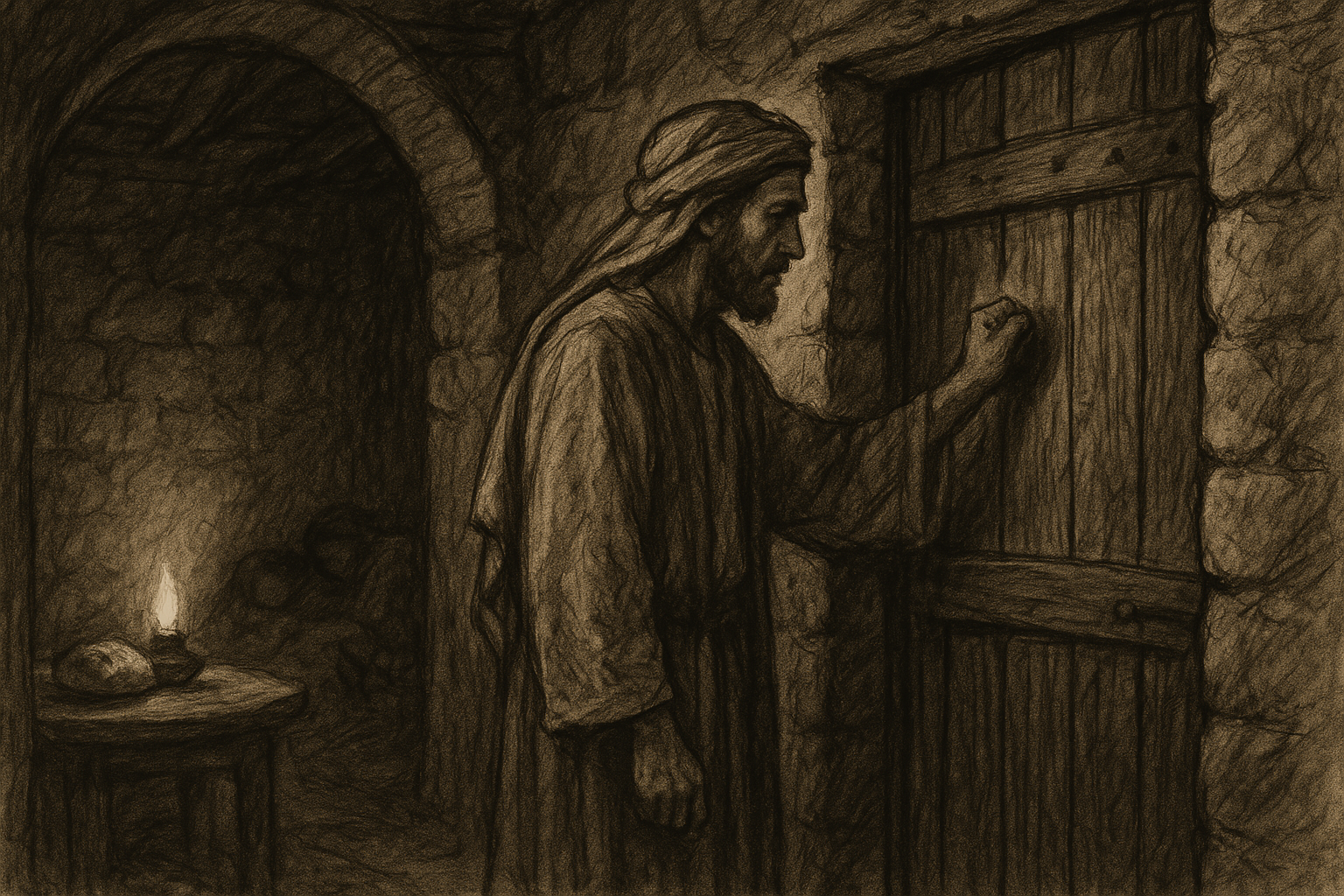
In Luke's Gospel, Jesus says that if a man goes to a neighbor at midnight asking for bread, the neighbor may not rise because of friendship, but he will get up because of the other man's persistence. Christ then draws the point out directly: ask, and it will be given; seek, and you will find; knock, and the door will be opened. The passage is found in Luke 11:5 through Luke 11:10.
The setting of the parable
To hear the story well, it helps to picture the ordinary world behind it. In the villages of ancient Palestine, hospitality was not optional. A guest arriving after a journey could not simply be turned away, and bread was an essential sign of welcome. The man in Jesus' parable is caught between two obligations: he has a visitor to feed and no food in the house. So he goes to a friend, not in luxury but in necessity.
Midnight heightens the tension. The hour is not just late. It is socially awkward, physically exhausting, and unexpectedly urgent. The house is already shut for the night. Children are sleeping. The village is quiet. In that setting, the knocking is almost embarrassing. Yet Jesus makes that awkward persistence the very center of the lesson.
It is worth noticing what Jesus does not say. He does not present God as irritated by prayer, nor does He teach that the Father is reluctant to be generous. The story uses an everyday human exchange to illuminate a spiritual truth. If even a sleeping neighbor can be roused by persistence, how much more will the Father hear those who come to Him in faith. Christ is not comparing God's heart to a reluctant man so much as showing that persistence belongs to serious asking.
What Jesus is teaching about prayer
The Friend at Midnight explanation becomes clearer when it is read alongside the verses that follow. Jesus says, ask, seek, and knock. These are not three separate prayers for three kinds of people. They are a pattern of persevering prayer. The one who asks does not presume; the one who seeks does not give up; the one who knocks does not turn away when the door remains closed for a moment.
Catholic prayer has always made room for this kind of perseverance. We pray not because God is hard of hearing, but because prayer changes us as much as it asks for help. In persistent prayer, the heart is schooled in hope. We come to God again and again, not as clients demanding a service, but as children relying on a Father's wisdom and timing.
This is one reason the parable is so valuable in daily Christian life. Many prayers are not answered instantly, and some are answered in ways we would not have chosen. A sick child, a strained marriage, a stubborn habit, a vocation delayed, a grief that does not lift quickly, all of these test whether prayer is only a tool for getting results or a living relationship with the Lord. Jesus gives His disciples a model for the second path.
Ask, and it will be given to you; seek, and you will find; knock, and it will be opened to you. For everyone who asks receives, and the one who seeks finds, and to the one who knocks it will be opened. Luke 11:9 Luke 11:10
Persistence is not pressure
Some readers worry that persistent prayer sounds like wearing God down. But that is not the Catholic reading of the text. God is not persuaded by fatigue. He is not overcome by our repetition. Rather, repeated prayer expresses trust. It is a way of saying that even when the answer has not come, the relationship remains real.
In that sense, persistence is not pressure but fidelity. It is the widow who keeps appealing, the psalmist who cries out again, the disciple who returns to the Lord with the same need because the need is still there. Scripture is full of this steady candor before God. The parable belongs to that whole biblical pattern of prayer that does not flatter God and does not perform for others, but simply keeps coming back.
Jesus also teaches us that prayer is not magic. The point is not to find the right formula or accumulate enough repetitions to unlock heaven. The point is to remain before the Father with confidence. That confidence is rooted in God's goodness, not in our technique. If the answer seems delayed, the delay does not mean indifference. Sometimes it means that God is leading the soul more deeply into trust, patience, and humility.
The hidden generosity of the Father
Luke places this parable in a chapter where Jesus first teaches the Our Father. That matters. The prayer begins with reverence and surrender: hallowed be Your name, Your kingdom come. Then it turns to daily need: give us each day our daily bread, forgive us our sins, lead us not into temptation. The Friend at Midnight is not a random illustration. It follows a prayer that already tells us to rely on God for bread.
In that light, the neighbor who arrives at midnight becomes a picture of human need at its most exposed. He has nothing to offer. He has no time to prepare. He comes empty handed. That is not unlike the soul that comes before God in prayer. We bring our poverty, not our merit. We bring our hunger, not our sufficiency. Catholic prayer is at its healthiest when it knows this.
At the same time, Jesus is revealing something deeper than bare dependence. He is unveiling the Fatherly generosity of God. The Father is not stingy. He is not an anxious hoarder of good things. The rest of the passage makes that clear when Jesus speaks of a father who would never give a snake when his child asks for a fish, or a scorpion when he asks for an egg. The logic is simple and comforting: earthly parents, with all their limits, still know how to give good gifts; God gives the Holy Spirit to those who ask Him. See Luke 11:11 through Luke 11:13.
How Catholics can pray this parable
The Friend at Midnight explanation reaches into ordinary Catholic life in very practical ways. The parable encourages a prayer life that is regular, confident, and unashamed of need. This is why the Church has always valued fixed prayer as well as spontaneous prayer. The Psalms, the Liturgy of the Hours, the Rosary, novenas, Eucharistic adoration, and simple personal prayers all teach the soul to keep knocking.
In particular, the Rosary reflects this steady rhythm of asking and trusting. Repetition in Catholic prayer is not empty when it is filled with love. A mother repeating the Hail Mary, a worker praying the Rosary on the commute, a sick person whispering the same plea each night, all of this can be a holy form of persistence. The words may be familiar, but the heart behind them is alive.
The parable can also purify our expectations. Sometimes we pray for something specific and receive something better, though not immediately recognizable as better. Sometimes we are given strength rather than removal, peace rather than explanation, or endurance rather than escape. The Father hears. The Father sees. The Father gives what is truly good, even when the gift arrives in a different shape than we expected.
For Catholics, this lesson also harmonizes with the sacraments. We do not pray in isolation. We pray as members of Christ's Body, nourished by grace. In confession, we come knocking for mercy. In the Eucharist, we receive the Bread of Life, which answers every deeper hunger. In every sacramental encounter, Christ teaches us that the open door is not our achievement but His gift.
When prayer feels ordinary, or delayed, or tired
Many believers know the quiet discouragement that can come after long prayer. The words feel dry. The answer seems late. The same intention has been brought to God for weeks, months, or years. The Friend at Midnight speaks into that space without embarrassment. It tells us that need does not disqualify us and delay does not cancel trust.
There is also comfort in the fact that the man in the parable is not heroic in the worldly sense. He is not a saintly mystic on a mountaintop. He is a neighbor with a problem. He needs bread. That is often how Christian prayer begins, not with elevated language but with real hunger. Christ does not despise such prayer. He dignifies it. He places it in the center of His teaching.
So when prayer feels ordinary, it may actually be closer to the Gospel than we think. Faithfulness at the hour of need is not small. A repeated prayer for a child, a spouse, a conversion, a job, a healing, or a wayward heart may look unimpressive to the world. But in God's sight, such perseverance can be an act of hope that keeps the door from becoming a wall.
Jesus does not ask His disciples to pretend that the night is not dark. He asks them to knock anyway. And because He Himself is the one who teaches the prayer, the disciple can do so without fear. The Father who hears in secret is not tired of His children. He is generous beyond measure, and He knows what to give, when to give it, and how to make even delay serve love.
Keep Reading on Lets Read The Bible
Frequently Asked Questions
What does the Friend at Midnight mean in Luke's Gospel?
It is Jesus' parable about a man who asks a neighbor for bread at midnight. The point is not that God is unwilling, but that disciples should pray with steady persistence and trust.
Does this parable teach that God needs to be persuaded by repeated prayer?
No. Catholic reading understands the parable as a lesson in perseverance, not in wearing God down. Repeated prayer shows faith, dependence, and hopeful trust in the Father's goodness.
How can Catholics apply the Friend at Midnight to daily prayer?
It encourages faithful habits such as the Rosary, the Psalms, novenas, adoration, and simple personal prayer. It reminds believers to keep asking, even when answers seem delayed.