Jesus and the Gospels
When Prayer Stops Performing and Starts Telling the Truth
In Luke's parable of the Pharisee and the tax collector, Jesus unveils the kind of prayer that can reach God and the kind that only circles back to the self.
Site Admin | March 4, 2026 | 76 views
The parable of the Pharisee and the tax collector in Luke 18:9-14 is brief, but it has an enduring power because it exposes something every disciple must face: the difference between appearing righteous and truly standing before God. Jesus tells this parable to those who were confident in their own righteousness and despised others, so the story is not only about two men in the Temple. It is about the human heart. It is about prayer. It is about the way pride can make even sacred language hollow, while humility can turn a single sentence into a cry that reaches heaven.
For anyone seeking the the Pharisee and the Publican explanation, the key is to begin where Luke begins. This is not a moral tale invented in the abstract. It is a scene set in the Temple, the holy place where Israel went to worship the Lord. Jesus places two men there side by side. One is a Pharisee, a member of a group known for strict observance of the Law and public devotion. The other is a tax collector, or publican, a man widely regarded as a sinner because of his work and his cooperation with the Roman system. In the eyes of the crowd, the contrast would have been immediate and obvious. In the eyes of God, the deeper contrast is not social status but interior truth.
The Temple, the crowd, and the shock of reversal
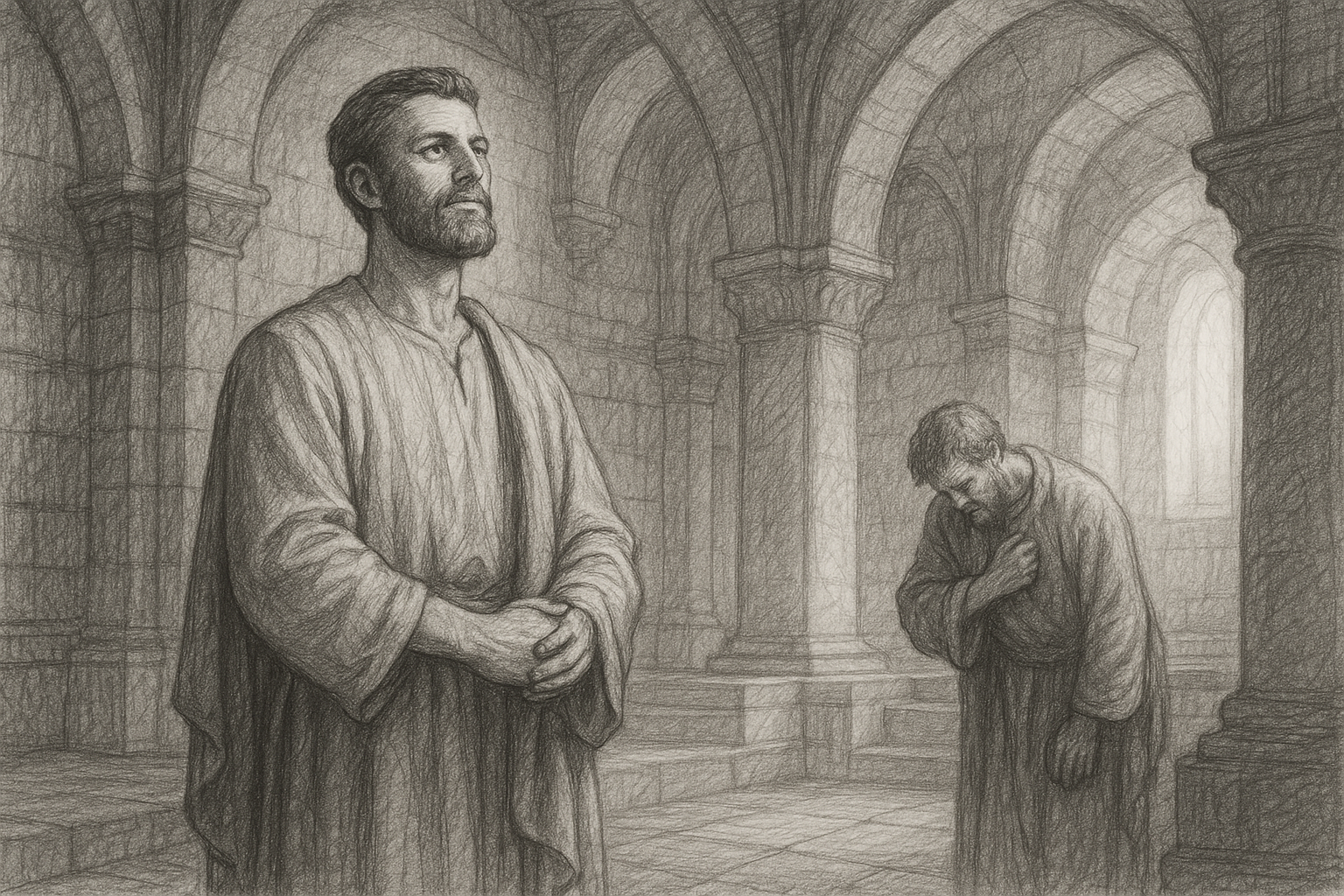
The setting matters. The Temple was the heart of Jewish worship, a place of sacrifice, prayer, and reverence. When Jesus says both men went up to pray, He is not speaking of casual private reflection. He is describing worship before the Lord. The Pharisee stands apart and prays about himself, thanking God that he is not like other men: extortioners, unjust, adulterers, or even like the tax collector beside him. He fasts twice a week. He pays tithes on all he possesses. On the surface, these are acts that resemble piety. Fasting and tithing are real disciplines of religion. The problem is not that he performs them, but that he turns them into a mirror of self-congratulation.
The tax collector, by contrast, stands far off. He will not even lift his eyes to heaven. He beats his breast and says, God, be merciful to me, a sinner! In just a few words, he tells the truth about himself. He does not compare himself with others. He does not list religious achievements. He does not argue his case. He asks for mercy. And Jesus says that it is this man, not the other, who went home justified.
That reversal would have startled many listeners. In a world where outward religious observance could be admired and sinners could be dismissed, Jesus gives honor to the one who knows his need. He does not condemn fasting, tithing, or the Law. He condemns the heart that uses such things to claim superiority. The parable is not anti-religious. It is anti-pride. It teaches that God resists the proud and gives grace to the humble.
God does not despise discipline, but He does resist the heart that turns discipline into a weapon against others.
What Christ is teaching about prayer
The deepest lesson of the parable is not simply that the tax collector is sorry and the Pharisee is boastful. Jesus is revealing what prayer is meant to be. Prayer is not a speech before an audience. It is not self-display. It is not a place to rehearse our spiritual resume. Real prayer is an encounter with the living God, and when a person stands before the Holy One, comparison with neighbors becomes foolish.
The Pharisee's prayer is filled with the word I. I thank you. I am not like the rest of men. I fast. I give tithes. Even his thanksgiving is twisted inward. He seems to address God, but he is really admiring himself. The tax collector's prayer, on the other hand, is almost entirely directed beyond himself. He sees God, sees his own sin, and asks for mercy. His prayer is short because the truth is plain.
Catholic tradition has always prized both public prayer and private prayer, but it has also insisted that prayer must be sincere. The lips may speak correctly while the soul is far away. This is why the Church repeatedly warns against vainglory, spiritual pride, and judgment of others. A person can attend Mass, keep devotions, and still nurse a hidden contempt for neighbors. Another person can arrive burdened by failure, and yet be nearer to the truth if he comes in repentance and trust.
In this light, the tax collector's posture matters as much as his words. He stands far off, lowers his eyes, and beats his breast. These are signs of sorrow and reverence. They are not theater. They express an interior reality. His body agrees with his prayer. He does not pretend to holiness. He asks for mercy as one who knows he cannot heal himself. That is a posture every Christian needs, whether approaching the confessional, kneeling before the Blessed Sacrament, or making a quiet examination of conscience at day's end.
Humility is not self-hatred
Some readers misunderstand humility and think it means acting worthless or denying the gifts God has given. That is not what Christ teaches. Humility is truth. It means seeing ourselves as we are before God. We are loved, created, and redeemed, but we are also dependent, wounded, and in need of grace. The tax collector does not say he has no worth. He says he is a sinner and that he needs mercy. That is not despair. It is the beginning of wisdom.
The Pharisee, however, mistakes self-satisfaction for confidence. He may truly avoid grave sins, and he may sincerely practice the Law, but he has become blind to his own need. Pride is so dangerous because it can wear the clothing of virtue. A person can be correct in doctrine, disciplined in practice, and still be far from God if he uses religion to elevate himself above others. Jesus does not leave room for this illusion. At the end of the parable He says that everyone who exalts himself will be humbled, and the one who humbles himself will be exalted.
That saying runs through the whole Gospel. It appears in the Magnificat when Mary praises the Lord for lifting up the lowly. It appears in Jesus' own life when He empties Himself and takes the form of a servant. It appears again in the Beatitudes, where the poor in spirit and the meek are blessed. The tax collector stands within this pattern. He is not praised because sin is harmless, but because truth and repentance are the doorway to mercy.
How the parable touches daily Catholic life
The parable is not only for those who are obviously religious or obviously sinful. It speaks to ordinary Catholic life because every believer can drift toward the Pharisee's temptation. This happens when prayer becomes comparison, when discipline becomes self-approval, or when devotion becomes a way to sort people into the worthy and the unworthy. It can happen in a family, in a parish, in a ministry, or in the privacy of the mind. The heart silently says, I am grateful I am not like them. That sentence may never be spoken aloud, but it can poison prayer all the same.
The remedy is not to abandon good works. The remedy is to do them with truth. Fasting should make us more merciful, not more severe. Tithing should loosen our grip on possessions, not strengthen our pride. Confession should lead to conversion, not to self-justification. Even knowledge of the faith can become dangerous if it creates contempt rather than charity. Christ invites Catholics to examine not only what they do, but how they stand before God while doing it.
Here the sacramental life offers a beautiful safeguard. In the Confession, the penitent comes like the tax collector: honest, exposed, and asking for mercy. In the Eucharist, the faithful do not approach because they have made themselves deserving, but because Christ feeds His needy people. In daily prayer, the same attitude is possible. A father or mother who prays while exhausted, a student distracted by anxiety, an older person bearing grief, a convert still learning the language of devotion, all can pray the tax collector's prayer in their own way: God, be merciful to me, a sinner.
This is not a formula for shame. It is a prayer of freedom. It releases us from pretending. It makes room for grace. It also makes us patient with others, because once we know our own need, we are less eager to rank the sins of our neighbors. A humble Catholic is not shocked that mercy is necessary. He is thankful that mercy is real.
Christ, mercy, and the promise of justification
Jesus ends the parable with a verdict: the tax collector went home justified. This is one of the most important words in the passage. To be justified is to be put in right relation with God, to be made righteous by His grace. The tax collector is not justified because his words are magical or because his sin no longer matters. He is justified because he comes in humility and opens himself to mercy. He places himself where grace can reach him.
For Catholics, this fits beautifully with the whole life of conversion. Grace precedes and enables our return to God, yet we are still called to respond. We do not save ourselves, but we do truly repent. We do not earn mercy, but we can reject pride and ask for it. The parable therefore guards us from two errors at once: presumption, which assumes we are fine as we are, and despair, which says our sins place us beyond God's care.
In the end, the parable invites a simple and demanding prayer. Not a polished one. Not a self-protective one. A truthful one. The Church has long taught prayers of sorrow and trust for good reason, because the human heart is healed when it stops defending itself before God. The tax collector's cry is small, but it is full of reality. And reality, in the presence of God, is where mercy begins.
When Catholics return to this Gospel passage, they are not asked to admire the tax collector from a safe distance. They are asked to stand beside him. The Temple is still the place where hearts are revealed. The Lord still sees beneath appearances. And the prayer that reaches Him is still the one that says, with reverence and confidence, that we need His mercy more than we need our own reputation.
Keep Reading on Lets Read The Bible
Frequently Asked Questions
Why does Jesus favor the tax collector over the Pharisee?
Jesus favors the tax collector because he comes before God in humility and truth. He does not boast, compare himself with others, or trust in his own goodness. He asks for mercy, and that honest repentance is what opens him to justification.
Does this parable mean fasting and good works are unimportant?
No. Jesus is not rejecting fasting, tithing, or other good works. He is warning against using them as proof of superiority. Good works matter, but they must be joined to humility and charity.
How can Catholics pray like the tax collector today?
Catholics can pray like the tax collector by being honest about sin, avoiding self-justification, and asking for God's mercy with trust. A simple act of contrition, a sincere confession, or a quiet plea before the Eucharist all reflect that spirit.