Bible Stories
Noah's Ark
Judgment, Mercy, Covenant, and a New Beginning
Site Admin | May 3, 2026 | 367 views
The story of Noah's Ark is one of the most widely recognized passages in the Bible, yet it is also one of the most misunderstood. In popular imagination it is often reduced to a bright children's image of animals entering a boat two by two. Scripture tells something much weightier. Noah's Ark is a story about the seriousness of sin, the grief of God over human corruption, the righteousness of one man who walks faithfully, the preservation of life through obedience, and the covenant mercy that follows judgment. It belongs to the earliest history of salvation, and the Church has long seen in it a powerful foreshadowing of baptism and the saving shelter of Christ.
The main account appears in Genesis 6-9. These chapters come shortly after the story of Adam and Eve and Cain and Abel, showing how quickly sin spreads through the human family. Violence grows. Wickedness becomes normal. Human hearts turn persistently away from God. The flood narrative does not present a deity irritated by small failures. It presents a world deeply bent toward destruction. That context matters if we are to understand why the flood is not random cruelty but an act bound up with divine justice and divine preservation.
A world filled with corruption
Genesis describes the state of humanity in stark terms. Wickedness is great upon the earth. The thoughts of the human heart are continually turned toward evil. Violence fills the land. This repeated emphasis matters because the Bible wants readers to understand that sin is never merely private. It enters families, communities, culture, and systems. What began in Eden as distrust of God has now become a civilization marked by corruption.
The text also speaks of God's sorrow, using language that expresses how grievous human rebellion is in the sight of the Creator. Catholic theology does not take this to mean that God is emotionally unstable or subject to surprise. Rather, Scripture uses vivid human language to show that sin is a real offense against divine goodness. The God who made human beings for communion does not look indifferently upon the destruction they bring upon themselves and one another.
This aspect of the story can be uncomfortable, but it is important. Modern people often prefer a God who affirms without judging. Yet a world without divine judgment would also be a world in which violence, cruelty, and corruption are never truly named for what they are. Noah's Ark reminds us that holiness and mercy belong together. God is patient, but he is not morally empty.
Noah walks with God
Against the darkness of the age, Noah stands out. Scripture calls him righteous in his generation and says that he walked with God. The phrase is beautiful and simple. Noah is not described as dazzling, powerful, or socially impressive. He is marked by fidelity. He listens. He obeys. He believes what God says even when the command before him seems extraordinary.
God instructs Noah to build an ark, a massive vessel that will preserve him, his family, and representatives of the animal world through the coming flood. The ark is not a clever human rescue project. It is given by divine instruction down to the details. Once again the pattern of salvation history appears: God initiates, man responds in faith, and life is preserved through obedient trust. Noah does not save the world by ingenuity alone. He trusts the word of God and acts upon it.
Catholic readers have long seen Noah as a witness to persevering faith. He acts on a future he cannot yet see. He labors in obedience while the surrounding world continues in indifference. There is something profoundly practical here. Fidelity is often repetitive and patient long before it looks triumphant. Noah builds, prepares, and waits. Holiness frequently looks exactly like that.
The ark and the gathering of life
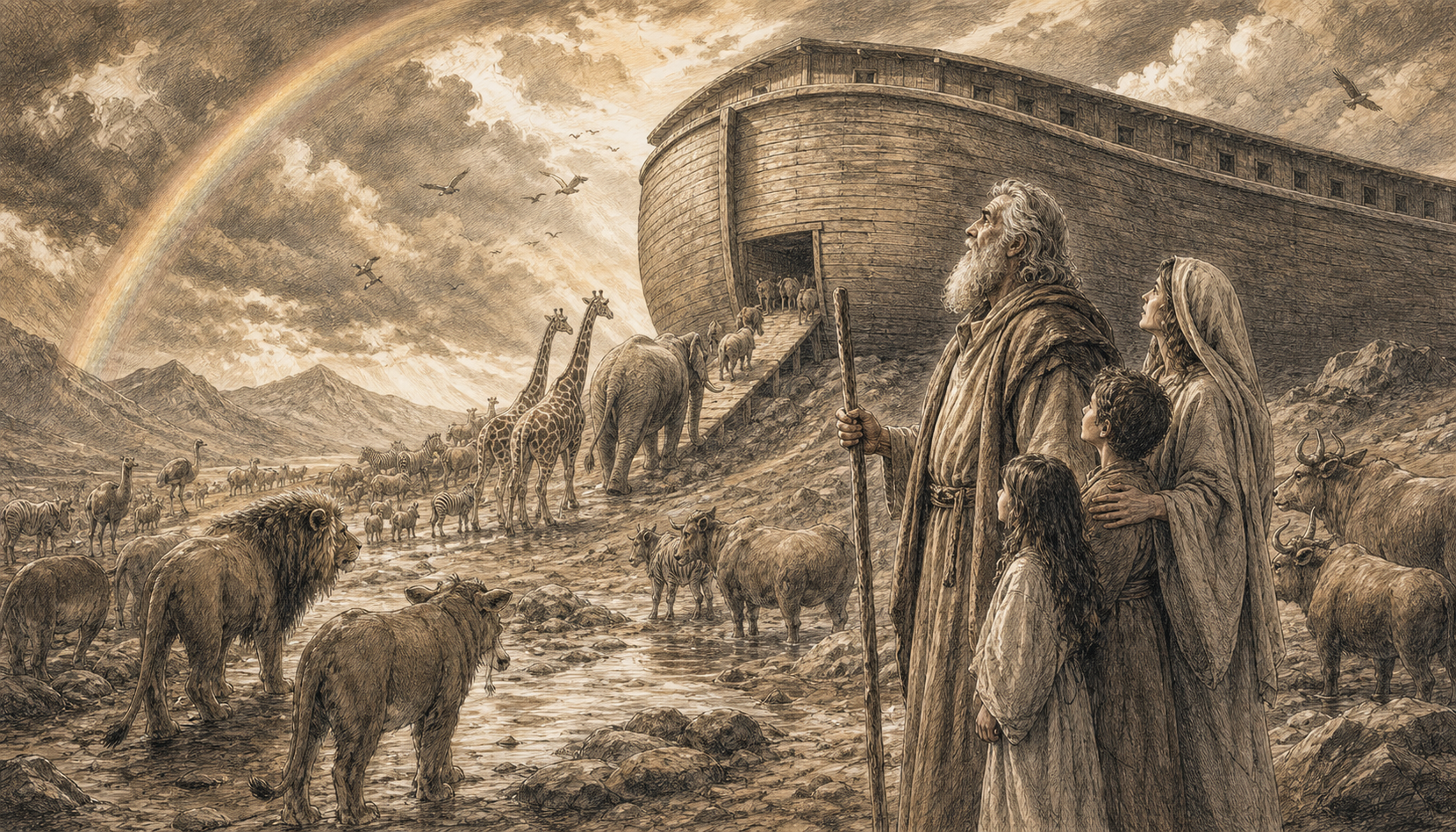
God commands Noah to bring his wife, his sons, their wives, and living creatures into the ark. The imagery is striking. In a world bent toward death, God prepares a place where life will be kept safe. The ark is not merely wood and pitch. It is a sign of divine preservation. The Creator who judges corruption also remembers the life he has made and acts so that creation will not be erased.
The animals entering in pairs, and in some cases in larger numbers according to the text, emphasize that God's concern reaches beyond humanity alone. Creation suffers under the consequences of human sin, but it is also included in God's preserving care. The biblical worldview never treats the material world as meaningless. The flood story underlines how seriously the Creator takes the order of life he established.
Christian tradition often sees the ark as a figure of the Church. Just as the ark carried those entrusted to it through the waters of judgment into a renewed world, so the Church bears the baptized through the waters of death into new life in Christ. This does not flatten Genesis into allegory. It reveals the deep unity of Scripture. The God who saved Noah by water and wood is preparing, even then, the greater salvation that will come by the Cross and baptism.
The flood and the undoing of the world
When the flood comes, Genesis describes the very fountains of the deep bursting forth and the windows of heaven being opened. The language echoes the opening creation account in reverse. The ordered world seems to collapse back toward watery chaos. Mountains disappear beneath the waters. Human pride, violence, and false security are swept away. It is a severe scene, and Scripture does not sentimentalize it.
Yet even here the narrative remains focused on God's faithfulness to his word. The ark rides over the waters. Noah is not forgotten. Neither are those with him. Judgment is real, but it is not the entire story. Preservation remains present within it. That tension is essential for reading the passage well. The flood is not destruction for its own sake. It is judgment ordered toward a new beginning.
For many readers, the flood story raises difficult questions about justice. Those questions should be approached with humility. Scripture's central aim here is not to satisfy all speculative curiosity but to reveal that sin has grave consequences, that humanity cannot build a durable civilization apart from God, and that divine mercy provides a way of salvation where none would otherwise exist. The text is meant to awaken moral seriousness, not detached debate alone.
The resting of the ark and the dove of peace
At last the waters begin to recede. The ark comes to rest. Noah waits, sends out birds, and finally receives the sign that dry land is returning. The dove that comes back with an olive leaf has become one of the most recognizable symbols in the biblical imagination. It speaks of peace after judgment, hope after waiting, and the beginning of restored life.
Noah does not rush out in self-assertion. He leaves the ark at God's command. This too is instructive. The righteous life is not merely about entering the place of safety. It is about remaining attentive to God until the right moment to move forward. Noah's obedience continues after the danger has passed. Gratitude and dependence do not end when relief arrives.
Once on dry ground, Noah builds an altar and offers sacrifice. This is one of the most important details in the whole account. The first public act after preservation is worship. Noah recognizes that survival itself is not the highest good. Right relationship with God is. The flood has not made him independent. It has deepened the truth that life is received and must be offered back in thanksgiving.
The covenant and the rainbow
After the flood, God establishes a covenant with Noah and with every living creature. He promises that the waters will never again destroy all flesh in the same way, and he gives the rainbow as the sign of that covenant. In Scripture, covenant is never a sentimental arrangement. It is a solemn bond initiated by God, carrying both promise and moral seriousness. The rainbow therefore is not merely a pretty ending to a dramatic story. It is a sign that divine mercy has spoken over the future.
The covenant with Noah is broad and universal. It extends not just to one family line in a narrow sense, but to the whole created order. This anticipates later covenants while also showing that God has not abandoned the world. Human sin remains real after the flood, as the rest of Genesis makes plain, but the Creator commits himself to the future of creation and continues to guide history toward redemption.
Catholic readers often dwell on the connection between covenant and baptism here. St. Peter explicitly links the flood and baptism, saying that the waters prefigure the sacrament that now saves. The point is not that water by itself rescues, but that God uses water as a sign and instrument of passage from judgment to life. In Noah's day, the faithful pass through the flood. In Christ, the baptized pass through death into new life.
What Noah's Ark teaches today
Noah's Ark teaches that sin is not harmless, that obedience is precious, and that God preserves life even when the world becomes dark. It also teaches patience. Noah builds long before he sees the fulfillment. He remains inside the ark while the waters rage. He waits again while the earth dries. His faith is not theatrical. It is steady.
The story also warns against treating divine patience as permission. The surrounding generation likely lived as though tomorrow would look like today forever. Scripture repeatedly warns against that spiritual complacency. The Christian life requires vigilance, repentance, and readiness. Yet the same story gives profound comfort. God knows how to preserve those who are his. He is not confused by the chaos of history. He prepares rescue before judgment arrives.
Finally, Noah's Ark teaches that salvation always leads back to worship. The goal is not merely to be spared disaster. It is to live in covenant with God. After the waters recede, Noah steps into a renewed world under promise. The Christian is called to do the same after grace: to leave behind the old life, to walk in fidelity, and to remember that the God who judges sin is also the God who makes a way for life to continue under mercy.
Noah's Ark is a story of judgment, but not of hopelessness. It is a story of the God who will not call evil good, yet who also refuses to abandon the life he has made. Through obedience, through waiting, and through covenant mercy, a new beginning is born from the waters.