Jesus and the Gospels
When Prayer Feels Late: The Midnight Friend in Luke's Gospel
Jesus' parable of persistence reveals how God invites bold, trusting prayer in the dark of the night.
Site Admin | March 13, 2026 | 90 views
The parable of the Friend at Midnight appears in Luke 11:5-8, placed right after the disciples ask Jesus, "Lord, teach us to pray." That setting matters. Jesus does not give a theory about prayer from a distance. He answers a direct request from people who have begun to sense that prayer is not only a duty, but a relationship that has to be learned.
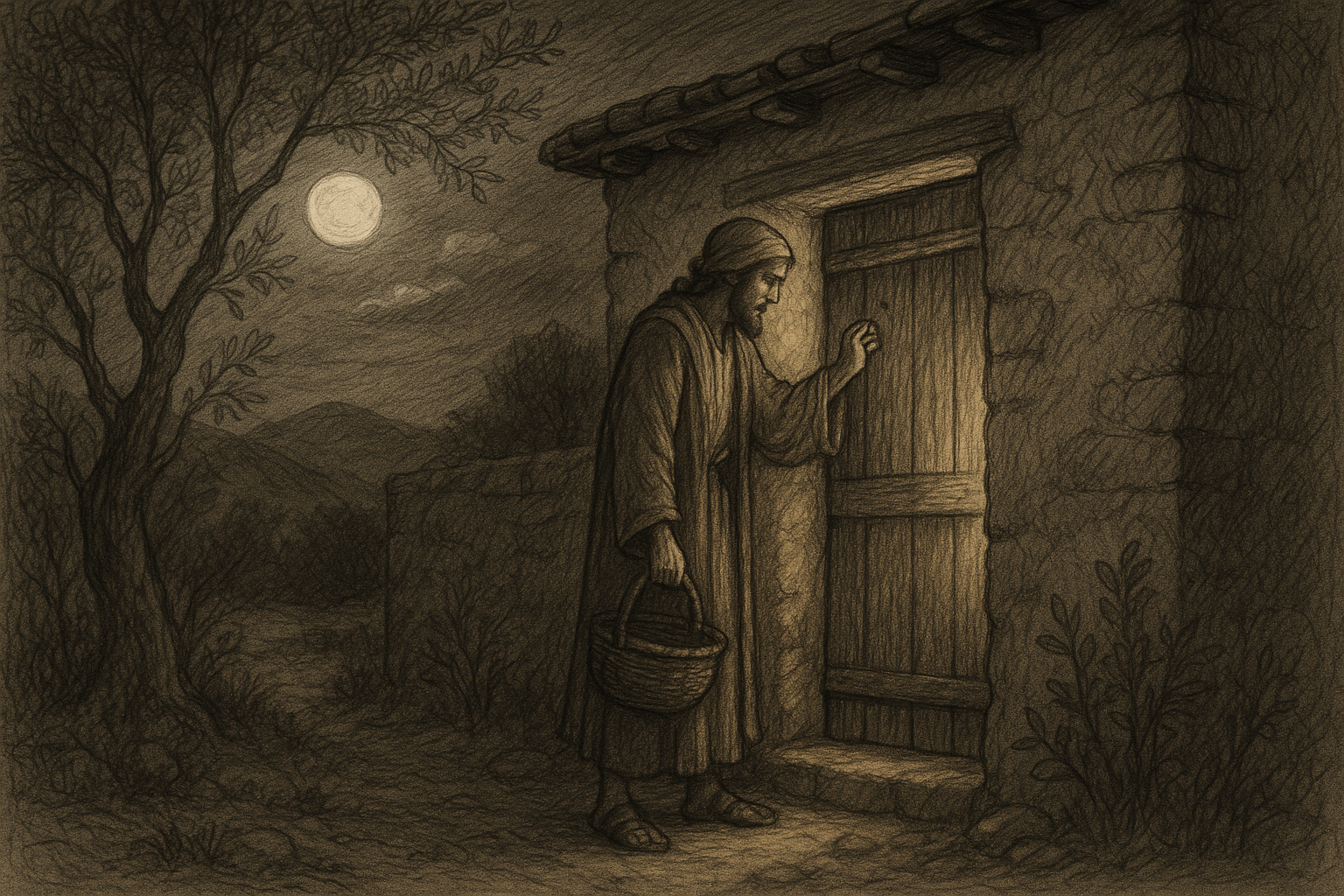
In the story, a man receives an unexpected visitor at midnight and has nothing to set before him. He goes to a neighbor and asks for loaves of bread. At first, the neighbor refuses because the household is shut up and the children are already in bed. Yet because the man keeps asking, the neighbor gets up and gives him what he needs. Jesus then draws the lesson: ask, seek, knock. The point is not that God is reluctant in the way the neighbor is reluctant. The point is that faithful prayer does not grow tired before the need is answered.
The setting in Luke gives the parable its force
Luke often places Jesus' teachings about prayer within real human need. Here, the need is simple and urgent. Hospitality in the ancient world was not a small social courtesy. To fail a guest was serious. The man at the door is embarrassed because he cannot honor his visitor. His request is not selfish. It is an appeal for mercy, made in the middle of the night, when shame and desperation are sharper than at noon.
That detail helps us see the the Friend at Midnight Catholic meaning more clearly. The parable is not mainly about manners or about getting one's own way. It is about approaching God from a place of need, even when the hour is inconvenient and the answer seems delayed. The man has no bread of his own, and that is precisely the truth that drives him to the door. In spiritual life, that same poverty can become the beginning of prayer.
Jesus follows the parable with a teaching that widens the horizon. He speaks of asking, seeking, and knocking, then of a father who gives good gifts to his children. In Luke, the gift is ultimately the Holy Spirit, the great gift of God to those who ask. So the parable does not stop at persistence for material help. It opens into the whole life of prayer, where the soul learns to stand before God again and again in trust.
Persistence is not pressure on God
It can be easy to misunderstand the neighbor who keeps knocking. Some readers hear the story and imagine that prayer works because repeated asking wears down a reluctant God. But that reading does not fit the Gospel. The Lord is not teaching that heaven must be annoyed into action. Rather, Jesus uses a human example to show that persistence belongs to the logic of real dependence.
In ordinary life, people often give up too soon. They stop praying because the answer is slow, or because they cannot see how the request could be fulfilled, or because disappointment has made them cautious. Yet the Gospel repeatedly shows that the Lord welcomes bold, repeated appeals. The widow who keeps pressing for justice, the blind man who cries out along the road, the Canaanite woman who will not stop pleading for her daughter, all show that persistence can be a form of faith. It is not unbelief with better stamina. It is trust that refuses to let silence have the last word.
Catholic prayer is never magical. It is not a technique for controlling God. But it is also not a passive recital detached from the heart. The Church has always encouraged persevering prayer because love itself perseveres. A child keeps returning to a parent. A friend keeps speaking to a friend. A disciple keeps waiting upon the Lord. The heart that prays repeatedly is not trying to manipulate God. It is consenting to remain in relationship.
The parable speaks to the rough edges of real life
Jesus chose a midnight scene for a reason. Midnight is inconvenient, dark, and unprepared. It is the hour when normal arrangements fail. That is when many people discover what prayer really is. Not every need arrives in daylight, with a tidy plan and adequate supplies. Some needs come at midnight: illness, fear, family trouble, guilt, grief, unemployment, temptation, or the quiet recognition that one's soul is hungry and empty.
At such moments, prayer is often stripped down to its essentials. There may be no eloquent words, only a repeated plea. There may be no immediate sense of peace, only the decision to keep knocking. The Friend at Midnight teaches that this stripped-down prayer is still prayer. It is not beneath the dignity of discipleship. In fact, it may be one of the purest forms of faith, because it admits need without disguise.
The Catechism describes prayer as a living relationship with the living God, and relationships are tested in delayed moments. We discover whether we believe God is truly Father when the answer does not come on our preferred schedule. Perseverance does not force God to act. It makes the heart ready to receive what God knows to give, when and how He wills.
What Catholics can learn from the neighbor and the guest
The parable contains two human figures who help us reflect on prayer from different angles. The guest at midnight represents need. The neighbor at the door represents reluctant human help. Between them lies the motion of prayer. The man does not deny his lack. He names it. He does not pretend he can solve the problem alone. He asks.
For Catholics, this has a sacramental shape. We come to God with empty hands and receive grace as gift. We do not begin prayer by presenting our achievements. We begin by acknowledging dependence. That is why prayer often works best when joined to humility. It is also why the saints speak so often of spiritual poverty. The poor in spirit are not the spiritually lazy. They are those who know they need bread they cannot make themselves.
The neighbor's reluctance can also remind us of something sobering about human life: people are not always immediately available. Friends fail. Helpers are tired. Family members are distracted. Institutions can be slow. That reality does not make charity useless, but it does teach us not to root our deepest hope in human reliability alone. The Lord remains the one who hears in the night. He is never asleep in the way human households sleep.
Jesus does not shame the one who comes late and empty handed. He teaches him to keep coming.
The Gospel invitation: ask, seek, knock
The three verbs Jesus uses after the parable are beautifully active: ask, seek, knock. Asking recognizes dependence. Seeking suggests movement. Knocking implies perseverance and confidence that someone is there. Together they sketch the rhythm of Christian prayer.
Ask when you know your need, even if the request feels small or repetitive.
Seek when the answer is not obvious and you need light for the next step.
Knock when the door seems closed and you must continue in faith before it opens.
These actions do not describe three separate kinds of people. They describe the maturing shape of prayer over time. A beginner asks. A searching soul seeks. A tested believer knocks with patience. In all of it, God is not a distant force but a Father who knows how to give what is truly good.
This is where Catholic prayer becomes especially concrete. We ask in the words of Scripture. We seek in the liturgy. We knock in the Rosary, in novenas, in silent adoration, in daily petitions, in tears, and in the long practice of returning to God after distraction or sin. Perseverance is not dramatic. It is often hidden in ordinary fidelity.
How this parable shapes Catholic living today
Modern life trains people to expect instant results. Messages are answered quickly, deliveries arrive with tracking updates, and many problems can be managed through speed. Yet the soul does not live by speed. The soul needs patience, attention, and hope. The Friend at Midnight confronts our impatience and teaches us to stay with God when life is unresolved.
One practical lesson is to make room for repeated prayer instead of treating a single prayer as the final word. A Catholic might pray for a sick relative every day, return to the same intention for a prodigal child, or continue asking for freedom from a habit that has resisted easy change. Repetition can feel weary, but in prayer repetition becomes a sign of fidelity. The words may be the same, but the heart is not exactly the same, because each return deepens surrender.
Another lesson is to pray without embarrassment. The man at the door had to admit he had nothing to offer his guest. Many of us resist that admission. We prefer to seem composed, self-sufficient, and spiritually tidy. But grace reaches people who stop pretending. The midnight friend is an image of honest prayer. We tell the Lord the truth about the hour, the shortage, and the need.
A third lesson is to let prayer enlarge charity. The man at midnight asks bread not only for himself, but for his guest. That detail matters. Christian prayer is rarely only about private comfort. We pray for others because love turns outward. A Catholic habit of intercession, especially for those who have no strength to pray for themselves, mirrors the compassion that runs through the Gospel.
Prayer, perseverance, and trust in the Father
At the heart of this parable is confidence in the goodness of God. Jesus is not describing a universe that must be bullied into kindness. He is revealing a Father whose generosity is more certain than our feelings. We may not understand the timing of every answer. We may not receive every earthly request in the form we hoped. But the Lord does not ask us to interpret silence as absence.
Instead, He teaches perseverance because perseverance purifies desire. Over time, prayer becomes less about forcing outcomes and more about communion with God. The soul learns that being heard is not identical to getting what it first requested. Sometimes the Lord answers by giving patience, clarity, conversion, or peace before He gives the thing we asked for. Sometimes He redirects the request itself. Always, He remains present to the one who knocks.
That is why the Friend at Midnight has remained so powerful in Christian reflection. It understands ordinary fatigue and ordinary need. It meets people where they are, in the middle of the night, and tells them not to stop praying. The door may feel slow to open. The house may seem silent. Yet the Gospel insists that faith can keep knocking until mercy is known.
For Catholics, the parable is an invitation to return to prayer with renewed simplicity. Ask plainly. Seek patiently. Knock without shame. The Father who sees in secret is already attentive, and the bread of grace is never farther away than His will to give it.
Keep Reading on Lets Read The Bible
Frequently Asked Questions
What is the Friend at Midnight in the Gospel of Luke?
It is Jesus' parable in Luke 11:5-8 about a man who wakes a neighbor at midnight to ask for bread for an unexpected guest. Jesus uses it to teach persistence in prayer.
Does the parable mean we have to persuade God to help us?
No. Catholic teaching does not see prayer as pressuring a reluctant God. The parable shows that perseverance belongs to real faith, while God remains a loving Father who knows what we need.
How can Catholics live the message of the Friend at Midnight today?
By praying regularly for real needs, staying faithful when answers are delayed, practicing intercession for others, and trusting that God hears even when His response is not immediate.