Jesus and the Gospels
Peter on the Shore: The Gospel Moment That Changed a Fisherman Forever
The calling of St. Peter in the Gospel reveals how Christ meets ordinary labor, asks for trust, and forms a shepherd for His Church.
Site Admin | January 19, 2026 | 77 views
The calling of St. Peter in the Gospel is one of those scenes that never becomes ordinary. A boat, a net, a tired fisherman, and the voice of Jesus Christ. At first glance, it is a simple beginning. Yet the Church has always seen something far larger in it. This is not only the story of how Simon left his livelihood behind. It is the story of how the Lord draws a man into communion, purifies his heart, and prepares him for a mission that will serve the whole Church.
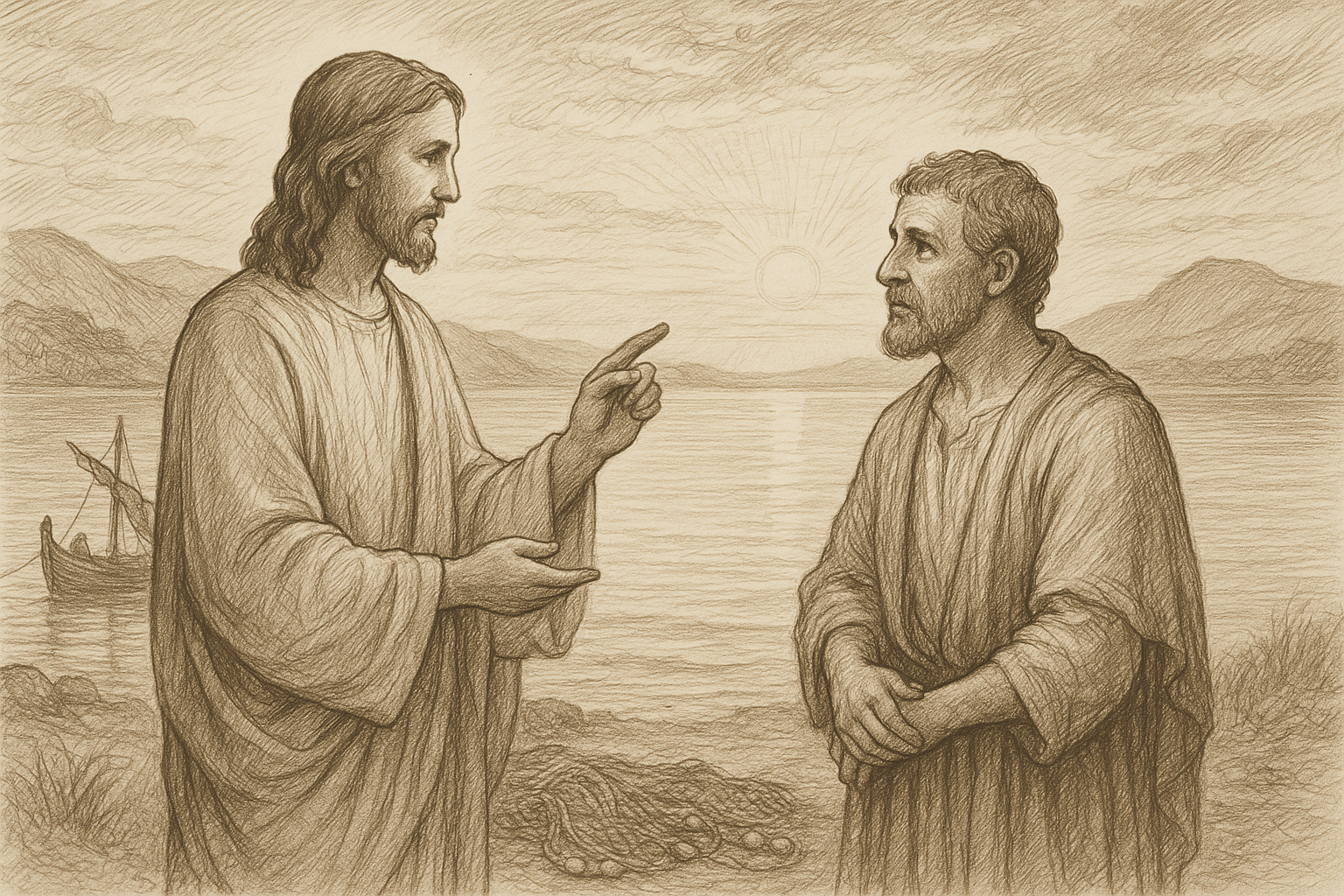
Peter's call appears in more than one Gospel setting. In Luke 5:1-11, Jesus teaches from Simon's boat, commands a second catch of fish, and then says, Do not be afraid; henceforth you will be catching men. In Matthew 4:18-20, Jesus sees Peter and Andrew at the Sea of Galilee and calls them with the same directness. In John 1:40-42, Andrew brings Simon to Jesus, who looks at him and gives him a new name: Cephas, which means Peter. The Gospels are not confused here. They are showing different moments in the same larger calling, a call that unfolds by stages, just as many vocations do.
Jesus calls Peter in the middle of ordinary work
It matters that Peter is called while fishing. The Lord does not wait for Simon to become impressive, polished, or spiritually self-sufficient. He meets him in labor, fatigue, and routine. Catholic readers can find comfort in that. Grace does not arrive only in moments that feel dramatic or religious. Christ enters the places where people are simply trying to do what is in front of them.
Peter is not idle when Jesus approaches. He is washing nets, repairing what has been used, preparing for the next day. There is something deeply human in that detail. Many people encounter Christ while tending to responsibilities they did not choose with enthusiasm but receive anyway. Work can become a place of surrender. The Gospel reminds us that the Lord is not distant from daily labor. He steps into it.
In Luke 5:4, Jesus tells Simon, Put out into the deep and let down your nets for a catch. The command is simple, but it asks for trust. Peter has worked all night and caught nothing. Still, he answers, At your word I will let down the nets Luke 5:5. That sentence is the hinge of the scene. Discipleship begins when human calculation yields to the word of Christ.
The miracle is not only about fish
The miraculous catch in [[VERSE|luke|5|6-7|Luke 5:6-7]] reveals Jesus' power, but it also reveals Peter's heart. The abundance of fish is meant to awaken wonder. The boat nearly sinks. The nets nearly break. The image suggests a gift too large to manage by ordinary strength. This is often how grace feels. God does not always give in measured portions that fit neatly into human plans. Sometimes His generosity overwhelms before it consoles.
Peter's response is striking. He does not boast. He does not ask how to repeat the miracle. Instead, he falls at Jesus' knees and says, Depart from me, for I am a sinful man, O Lord Luke 5:8. That confession is one of the most important moments in the Gospels. Peter sees both the holiness of Jesus and his own unworthiness. Catholic tradition does not treat holiness and humility as opposites. They belong together. The closer one comes to Christ, the more clearly one sees the truth about oneself.
Jesus does not reject Peter's confession. He answers it with mercy and mission: Do not be afraid Luke 5:10. This is the pattern of divine calling throughout Scripture. God reveals, man trembles, and God strengthens. The Lord does not call because the disciple is already complete. He calls in order to complete what is lacking.
Peter is chosen, but not yet finished
The Gospels present Peter as a man of impulse, courage, confusion, and failure. That is part of what makes his call so important. Jesus does not choose him because he is already saintly in a finished sense. He chooses him because grace can work through a real human being. Peter will later confess Christ with great faith, and he will also deny Him in fear. He will be bold and weak, attentive and scattered, loyal and in need of mercy. Yet none of that cancels the call.
For Catholics, this matters because it reflects the way sanctity actually grows. The saints are not people who never stumbled. They are people who kept returning to the Lord. Peter's call teaches that vocation is not based on spiritual performance. It is based on the initiative of Christ. The Lord speaks first. The disciple responds, sometimes hesitantly, sometimes imperfectly, but truly.
In Matthew 4:19, Jesus says, Follow me, and I will make you fishers of men. Notice the promise. Jesus does not merely ask Peter to leave something behind. He promises to make him into something new. Discipleship is not simple renunciation. It is transformation. A fisherman becomes an apostle. A man who once gathered fish for a living will one day gather souls by preaching the Gospel.
The Catholic meaning of Peter's call
Peter's calling carries special weight in Catholic faith because Peter is not only an apostle among others. He becomes a visible shepherd in the Church, one whom Christ later entrusts with a unique role. The Church sees in Peter the beginnings of a ministry that will serve unity, confession of faith, and pastoral care. This does not mean Peter was superior in human perfection. It means Christ gave him a responsibility for the good of all.
When Jesus gives Simon the name Peter in John 1:42, the renaming itself is significant. In Scripture, a new name often signals a new vocation. Peter is called into a relationship that reaches beyond private devotion. He will belong to Christ in a public and ecclesial way. His life will matter for others. That too is part of the calling of St. Peter in the Gospel. The Lord is not only saving Simon for Simon's sake. He is preparing him to strengthen his brothers.
Catholics also recognize in Peter a pattern of conversion that remains relevant in every age. To follow Christ is to move from self-reliance toward obedience, from fear toward trust, from scattered effort toward a single aim. Peter's story shows that the Lord does not erase a person's natural temperament. He redirects it. Peter's decisiveness, once mixed with impulsiveness, becomes strength under grace. His boldness, once untamed, becomes pastoral courage. Christ does not merely ask people to be less themselves. He makes them truly themselves in holiness.
What Peter teaches about prayer
Peter's call offers practical wisdom for prayer, especially for Catholics who want to listen more attentively to Christ. First, it teaches that prayer begins with encounter, not technique. Peter is not given a method. He is given Jesus. The center of prayer is not self-analysis but relationship. We come before the Lord because He is holy, living, and near.
Second, Peter teaches the need for honesty. His words, I am a sinful man, O Lord, are a prayer worth remembering Luke 5:8. Some people hesitate in prayer because they feel too aware of weakness. Yet Peter shows that weakness is not an obstacle if it is brought into the presence of Christ. In fact, it can become the place where grace is most clearly received.
Third, the scene teaches trust in God's word even when the outcome is not visible. Peter lets down the nets after a long, disappointing night. Many Christians know the experience of praying through dryness, temptation, or uncertainty. The lesson is not to pretend that these struggles are easy. It is to remain where Christ has asked us to remain, and to do what He has asked us to do.
Lessons for discipleship that remain close to home
The calling of St. Peter in the Gospel still speaks to ordinary Catholics in a direct way. Its lessons are simple enough to remember and demanding enough to shape a life.
- Christ often calls through ordinary circumstances. Work, family life, fatigue, and routine are not barriers to discipleship.
- Obedience comes before clarity. Peter does not understand everything before he acts, but he responds to Jesus' word.
- Holiness begins with humility. Peter recognizes his sinfulness and lets Jesus speak mercy into it.
- Calling includes mission. To follow Christ is also to be sent by Him for the sake of others.
- Failure does not end the story. Peter's later weakness is real, but so is the mercy that restores him.
These are not abstract principles. They touch the daily decisions of family life, parish life, prayer, and service. A parent who keeps serving quietly, a teacher who speaks truth patiently, a young adult who tries again after disappointment, a priest or deacon who returns to the Lord after discouragement, all of these can recognize something of Peter's journey.
Peter's call and the life of the Church
There is also an ecclesial dimension to Peter's call that Catholics should not overlook. Peter is drawn out of the boat, but he is not drawn away from the people God will later entrust to him. The Church is built by men and women who have first heard Christ speak personally, then learned to live for others. Peter's story is never simply private spirituality. It is always outward-facing.
That is why the Church continues to read Peter's call with reverence. It reminds believers that the Lord still builds His Church through those who are willing to listen, repent, and follow. The path is not glamorous. It begins with a boat, a net, a command, and a frightened heart. Yet that is enough for grace to begin its work.
Peter's first answer to Jesus was not perfect. His whole life would become a long schooling in trust. That is also true for most disciples. Christ does not ask for a flawless beginning. He asks for a willing heart. And when that heart says yes, even with trembling, the Lord knows how to make a fisherman into a shepherd.
Keep Reading on Lets Read The Bible
Frequently Asked Questions
Where does the calling of St. Peter appear in the Gospels?
It appears in several Gospel scenes, especially [[VERSE|luke|5|1-11|Luke 5:1-11]], [[VERSE|matthew|4|18-20|Matthew 4:18-20]], and [[VERSE|john|1|40-42|John 1:40-42]]. Each passage highlights a different aspect of Peter's call.
Why is Peter's response so important in the Gospel account?
Peter's response matters because he obeys Jesus' word even after disappointment, and then responds with humility when he recognizes his own sinfulness. His call shows that discipleship begins with trust and repentance.
What practical lesson can Catholics take from Peter's calling today?
Catholics can learn to listen for Christ in ordinary life, obey even when the path is not fully clear, and trust that God can transform weakness into mission through grace.