Jesus and the Gospels
The Quiet House at Bethany and the Better Portion
A Catholic reading of Martha and Mary, where work, prayer, and friendship with Christ meet in one ordinary home.
Site Admin | January 28, 2026 | 86 views
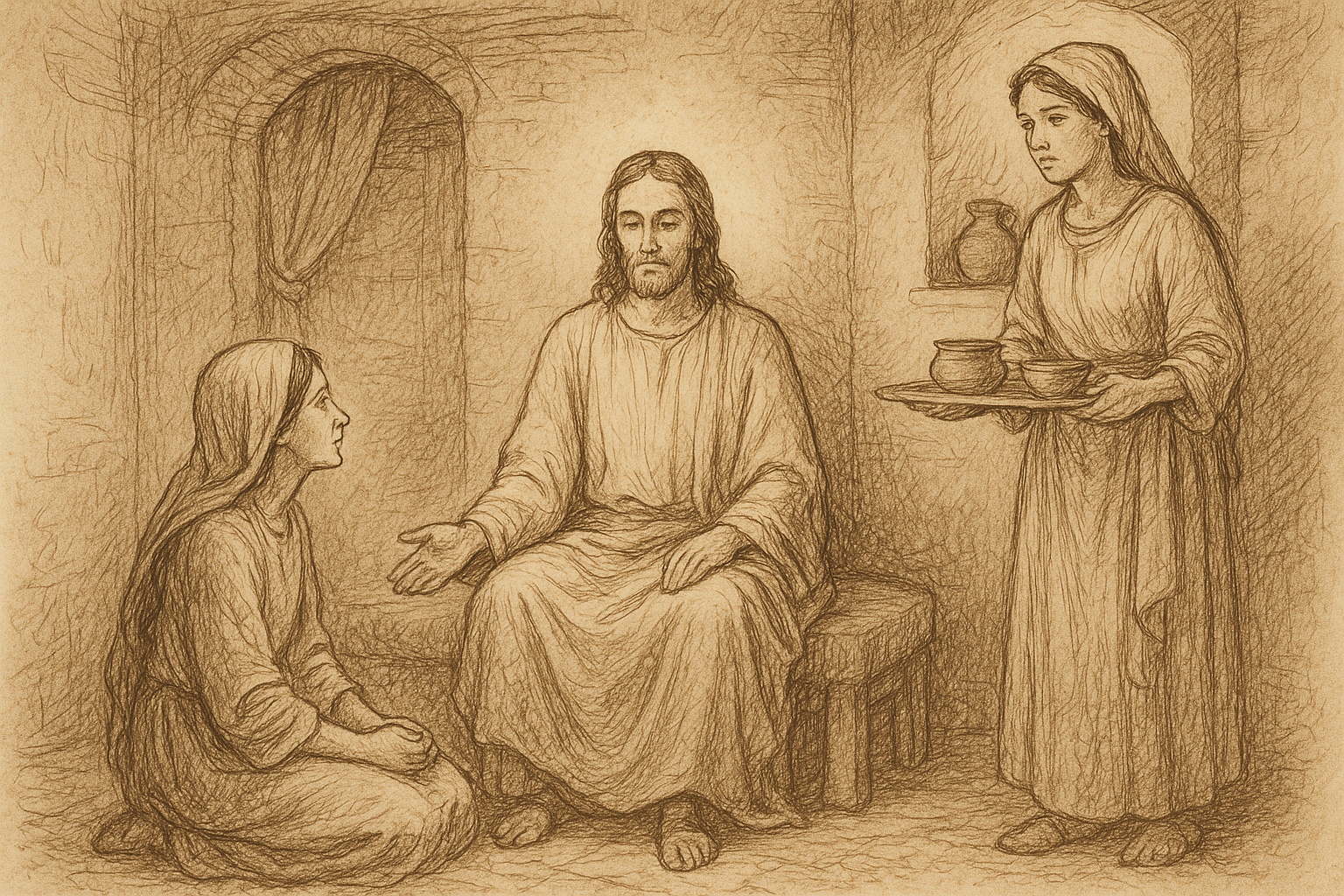
Few Gospel scenes feel more familiar than the one in the house of Martha and Mary. Jesus enters an ordinary home, and an ordinary day becomes a moment of revelation. There is a meal to prepare, guests to receive, a sister at His feet, and another sister working hard in the background. The scene is brief, but it has stayed with the Church because it speaks so directly to the life of every believer.
The Martha and Mary of Bethany Catholic meaning is not a simple lesson about being busy or being quiet. It is a window into discipleship itself. In Bethany, we see that the Christian life is not divided between action and prayer as if one were holy and the other merely practical. Rather, both must be ordered to Christ. Martha serves Him. Mary listens to Him. Jesus receives both women with truth and tenderness, yet He also calls Mary's choice the better portion, because the heart must first belong to the Lord before it can serve Him well.
Who were Martha and Mary of Bethany?
The Gospels present Martha and Mary as sisters of Lazarus and friends of Jesus. Their home in Bethany seems to have been a place where Christ rested, ate, and stayed among those who loved Him. Luke gives the most famous scene: Martha welcomes Jesus into her home, while Mary sits at His feet and listens to His word (Luke 10:38-42). John later shows the sisters again in the grief and faith that surround Lazarus, and it is there that Jesus reveals His power over death (John 11:1-44). At the end of John 12, Martha serves at table again while Mary anoints Jesus with costly perfume, an act of devotion that foreshadows His burial (John 12:1-8).
These brief appearances matter because they show real human love around Jesus. Bethany is not a place of abstraction. It is a home with bread, tears, incense-like perfume, and the ordinary work of hospitality. The sisters are not symbols before they are persons. They are women whose faith is made visible through their different responses to the presence of Christ.
The first scene: work, worry, and the voice of the Lord
In Luke's account, Martha is distracted by much serving. Her concern is not frivolous. Hospitality in the ancient world was a serious duty, and in any age a guest must be cared for. Martha is doing something good. Yet her service begins to weigh on her because she becomes inwardly divided. She asks Jesus to tell Mary to help her, and in that request we hear both fatigue and a little resentment.
Jesus answers with remarkable gentleness: "Martha, Martha, you are anxious and troubled about many things; one thing is needful. Mary has chosen the good portion, which shall not be taken away from her" (Luke 10:41-42). He does not mock her labor. He does not dismiss the value of serving. Instead, He names the spiritual danger hidden inside good work: anxiety. Martha has allowed the demands of the moment to scatter her heart. Mary, by contrast, has made a choice that centers everything on the Lord Himself.
This is one reason the Church has cherished the passage. It does not tell us to stop working. It tells us that work loses its peace when it is detached from listening. In a Catholic reading, Martha is not rebuked for service as such, but for service without interior rest in God. When the heart is restless, even holy work can become burdensome. When the heart is still before Christ, work can become an offering.
Mary at the feet of Jesus
Mary's posture is as important as her silence. In the Gospel world, to sit at a teacher's feet is the posture of a disciple. Mary is not simply relaxing while Martha labors. She is receiving the word of the Lord as one who knows that His presence is a gift greater than any task that might be finished that hour. Jesus praises this choice because she has placed communion before efficiency.
That matters deeply for Catholics, because prayer is not an optional accessory to discipleship. Prayer is the place where disciples learn who Jesus is and what it means to belong to Him. Mary reminds us that the first duty of the Christian is not to produce results but to receive the Lord. Before we speak for Christ, we must listen to Him. Before we serve Him, we must rest in His friendship.
The image of Mary at Jesus' feet also echoes the life of the Church herself. At Mass, at adoration, in lectio divina, and in quiet prayer, believers take the same posture in spirit. We come to sit before the Lord and let His word judge, console, and reorder us. Mary is not praised because she is naturally more spiritual than Martha. She is praised because, at that moment, she has recognized what is most necessary.
Martha's holiness is real too
It is easy to turn Mary into a champion of prayer and Martha into a symbol of distraction, but the Gospels do not allow a shallow contrast. Martha appears elsewhere as a woman of deep faith. In John 11, when Jesus comes after Lazarus has died, Martha meets Him with words of sorrow and hope: "Lord, if you had been here, my brother would not have died" (John 11:21). Then she makes one of the boldest professions of faith in the Gospel: "I believe that you are the Christ, the Son of God, he who is coming into the world" (John 11:27).
That confession should not be overlooked. Martha is not spiritually inferior in any simple sense. She is a woman who loves Jesus, speaks honestly to Him, and believes in His power even in the shadow of death. Her story teaches that holiness includes service, courage, and truth spoken in grief. She is not less faithful than Mary. She is a disciple whose faith becomes visible in different circumstances.
The Church often reads Martha and Mary together because together they show the fullness of Christian life. Martha embodies active charity. Mary embodies contemplative attention. One receives Jesus through service, the other through listening. Yet both are needed in the body of Christ. The saints have long recognized this harmony. The Church does not choose between prayer and action as though only one were worthy. She seeks a life where action springs from contemplation and contemplation bears fruit in love.
Bethany and the shape of Catholic discipleship
For Catholics, the Bethany household suggests a pattern for the Christian home and the Christian soul. Christ enters, and everything is changed by His presence. The home becomes a school of discipleship. The sisters do not simply host a famous teacher. They receive the Lord who reveals the Father. Their house becomes a place where the Word is heard, where grief is met, where food is shared, and where love is made visible.
This is why the Bethany scenes speak so strongly to Catholic spirituality. The faith is not only about private feelings or ideas. It is sacramental, embodied, and relational. Jesus comes near. He eats. He speaks. He weeps. He calls. He is loved by name. The story of Martha and Mary therefore reminds us that our own homes can become places of holiness when Christ is welcomed there. A home where prayer is spoken, Scripture is heard, guests are received, and service is done without bitterness begins to resemble Bethany.
At the same time, Bethany warns us against letting busyness become a disguise for neglect. It is possible to work constantly and still miss the Lord. It is possible to be very active and very anxious. Martha's problem was not effort but interior fragmentation. The Lord's answer calls Catholics to an ordered life in which duties are done, but not at the cost of losing peace in His presence.
The better portion and the Catholic life of prayer
When Jesus says that Mary has chosen the better portion, He is not speaking only about a personality type or a private preference. He is speaking about the priority of communion with God. The better portion is not laziness, silence for its own sake, or withdrawal from responsibility. It is the grace of placing Christ first.
In Catholic life, this priority is visible in many ways. The Mass is the greatest expression of it, because there the faithful do not merely do something for God. They receive the Lord who gives Himself. The Psalms, the Rosary, adoration, and silent prayer all help form the same attitude Mary displays in Luke's Gospel. They teach the soul to linger before God, to hear His word, and to let that word shape action.
That is also why the Martha and Mary passage has often been linked to the contemplative and active dimensions of Christian vocation. Some are called in a special way to lives of quiet prayer, while others live out discipleship in demanding service. Yet every Christian needs both. Even those who spend their days in work and family responsibilities must cultivate an inner Mary. Even those devoted to prayer must remain attentive to the needs of others, as Martha does in her own way. The saintly life is not split into competing parts. It is unified by charity.
"One thing is needful" is not a rebuke to effort, but a reminder that every effort must begin from love of Christ.
What Catholics can take from the sisters of Bethany
The story of Martha and Mary invites a few practical habits that remain very simple and very demanding:
- Begin the day by listening. Even a short prayer before the demands of the day can restore the soul's order.
- Let service be an offering. Work done for family, parish, or neighbor becomes lighter when it is consciously united to Christ.
- Notice anxiety early. When service turns resentful, the heart may need silence more than another task.
- Honor both temperaments. The Church needs those who serve visibly and those who pray quietly, and many people are called to both.
- Stay close to Jesus in ordinary places. Bethany was a home, not a sanctuary, yet it became holy because Christ was there.
There is also a challenge here for those who prefer Martha's way and those who prefer Mary's. The active soul must learn not to despise contemplation. The contemplative soul must learn not to despise practical charity. Each sister can correct the other when the story is read in faith. Martha reminds Mary that love must take bodily form. Mary reminds Martha that action without listening becomes heavy. Jesus gathers them both into His friendship and refuses to let either one become a caricature.
Why the Bethany sisters still speak to the Church
In the end, the sisters of Bethany remain beloved because they reveal how close Jesus comes to ordinary life. He enters a home where one sister serves and another listens. He stands with them before the death of their brother. He receives devotion that looks like extravagant love. Through all of it, He shows that the heart of discipleship is communion with Him.
That is the enduring Martha and Mary of Bethany Catholic meaning: the Christian life needs both the hands of Martha and the listening heart of Mary, but it must never forget that Christ Himself is the center. Service is good. Prayer is better in the order of first things. Yet the truest goal is not choosing one sister over the other. It is learning how to love the Lord in such a way that our work becomes prayer and our prayer sends us back into love of neighbor.
When the home is busy, when duties multiply, when the soul feels pulled in many directions, the voice of Jesus in Bethany still speaks with quiet authority. He invites us to come closer, sit down, and receive the better portion that cannot be taken away.
Keep Reading on Lets Read The Bible
Frequently Asked Questions
What is the main Catholic lesson from Martha and Mary of Bethany?
The main lesson is that discipleship requires both service and prayer, but both must be ordered to Christ. Martha shows active love, while Mary shows the priority of listening to the Lord.
Did Jesus rebuke Martha for serving?
No. Jesus did not condemn service itself. He gently corrected Martha because anxiety had begun to burden her heart. Her work was good, but it needed the peace that comes from first resting in Christ.
Why is Mary said to have chosen the better portion?
Mary chose to sit at Jesus' feet and listen to His word. Jesus called this the better portion because communion with Him is the foundation of every Christian life and every act of service.