Jesus and the Gospels
At the Foot of the Cross: St. John and the Quiet Strength of Faith
St. John stands where love does not flee, and his presence at Calvary reveals the shape of Christian discipleship.
Site Admin | January 24, 2026 | 88 views
John at Calvary in the Gospel account
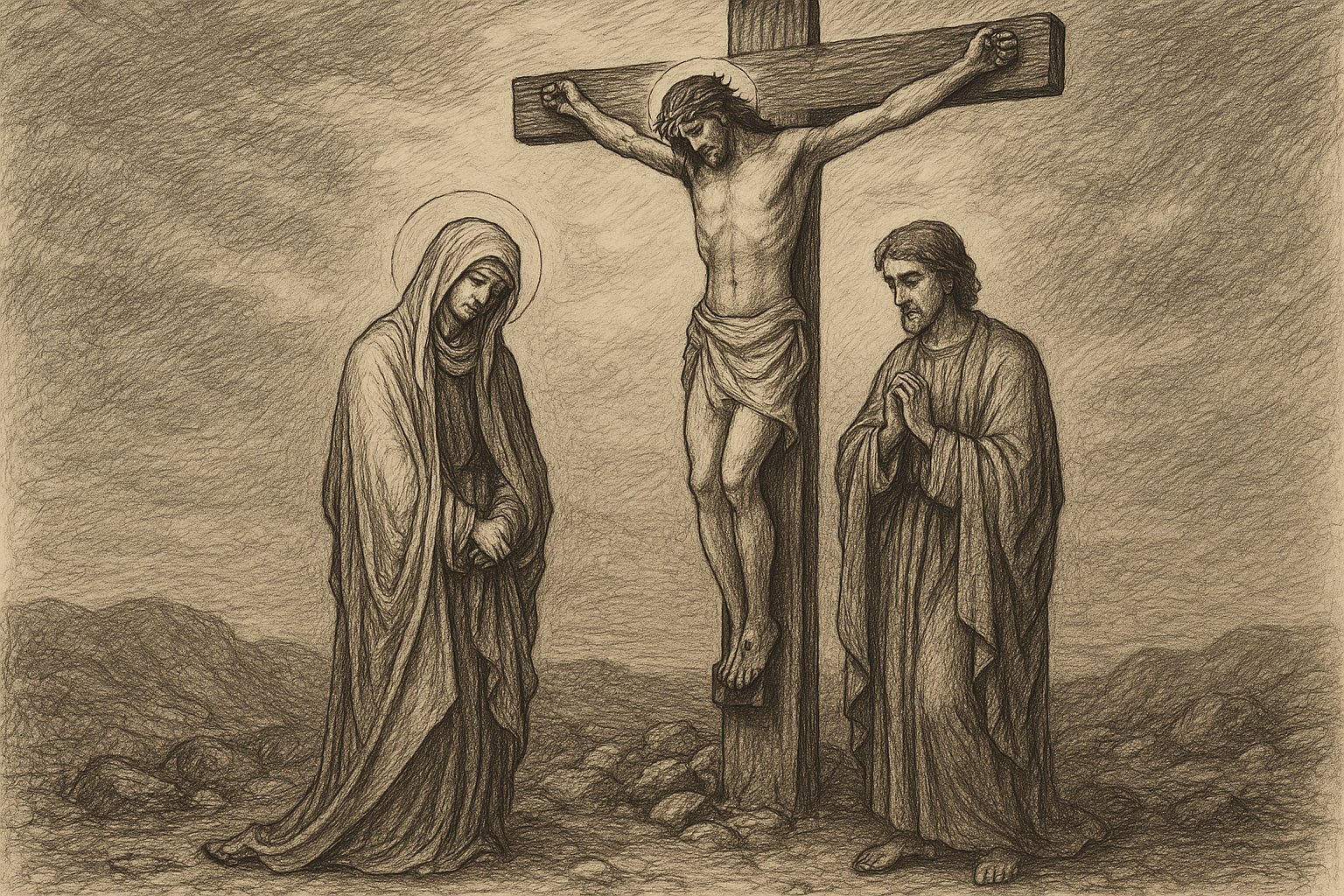
The scene is brief, but it carries great weight. Near the end of St. Johns Gospel, Jesus stands at the Cross while His mother, her sister, Mary the wife of Clopas, and Mary Magdalene are near Him. The beloved disciple is there too. The Gospel says:
Standing by the Cross
This is not a passing detail. John alone among the Twelve is explicitly named at the Cross in the Fourth Gospel, and the scene becomes one of the most tender and solemn moments in the entire New Testament. The Church has long read it with reverence because it shows both the suffering of Christ and the fidelity of those who remain near Him when others are scattered.
Earlier, the disciples had fled in fear. Peter denied Jesus. Yet John is present at Calvary. Scripture does not tell us everything about how he arrived there, but it does tell us enough to see the spiritual meaning: the disciple whom Jesus loved remains close to Jesus when closeness is costly.
The beloved disciple and the meaning of presence
St. John is often called the beloved disciple because the Fourth Gospel speaks of the one whom Jesus loved. The title is not a sign of private favor in a worldly sense. It points to the mystery that discipleship begins with being loved by Christ and then answering that love with fidelity.
At the Cross, John does not preach, argue, or explain. He simply stays. That silence matters. In the Gospels, love often appears not as noise but as nearness. John had leaned close to Jesus at the Last Supper. Now he stands close again, but this time the nearness is marked by sorrow, sacrifice, and a depth of trust that cannot be measured by comfort.
For Catholics, this is a powerful image. The Cross is not only something to admire from a distance. It is a place to remain with Christ in faith, even when understanding is incomplete. John shows that true discipleship does not require the absence of pain. It requires steadfastness in the presence of pain.
Jesus entrusts Mary to John
The heart of the scene comes in Jesus words from the Cross. Seeing His mother and the beloved disciple standing near, He says to His mother:
Woman, behold your son
Then He says to the disciple:
Behold your mother
The Church reads these words with both historical and spiritual depth. On the most immediate level, Jesus is providing for His mother. Even in agony, He fulfills the duties of filial love. But the words also open a wider meaning. The beloved disciple receives Mary not merely as an acquaintance to assist, but as mother. John, standing for every faithful disciple, is entrusted to Mary in the hour of redemption.
This scene has shaped Catholic devotion for centuries. Mary is not separated from the work of Christ. She is present at His Passion as the mother of the Redeemer, and then she is given to the disciple as mother. In her, Catholics see not a rival to Jesus, but the one who leads believers more deeply into His life. If John is the first to receive her in this new role at Calvary, then the scene becomes a sign of what the Cross creates: a new family gathered around the sacrifice of Christ.
There is also a quiet beauty in the way John receives her. Scripture says that from that hour the disciple took her into his own home. The gesture is simple, but it suggests a whole pattern of Christian life. To receive Mary is to welcome her care, her faith, and her maternal intercession into the daily life of discipleship. The disciple is not left to stand alone before the Cross.
St. John as a witness of faithful love
Johns presence at Calvary is especially striking when set beside the fear of the others. The Passion narratives do not hide the weakness of the disciples. That honesty is part of their truth. Yet John stands as a reminder that grace can preserve a heart even when everything around it collapses.
His witness is not heroic in a worldly sense. He does not stop the Crucifixion. He does not alter the suffering. But he stays near the One who is suffering for the life of the world. In Catholic life, this kind of fidelity is often overlooked because it is hidden. Many of the most important acts of love are not dramatic. They are patient acts of presence, prayer, endurance, and trust.
That is why John is so important for Christians who suffer alongside those they love. He teaches that sometimes the most faithful thing one can do is remain near Christ and near the ones Christ has entrusted to us. At Calvary, love is not measured by strength alone, but by perseverance.
The Cross reveals the shape of the Church
The scene at Calvary also points beyond John as an individual. Many Catholic writers have seen in Mary and John a sign of the Church itself. At the foot of the Cross, there is already a new communion being formed. The Crucified Lord gathers people not by power but by self-giving love.
This is not an abstract symbol. It is grounded in the concrete words of Jesus. He creates relationship where there was separation. He gives His mother to the disciple and the disciple to His mother. The family of God is born in the hour of sacrifice.
That is one reason the scene speaks so deeply to Catholic worship. Every Mass is joined to the sacrifice of Calvary. When believers come before the altar, they do not merely remember a past event. They enter sacramentally into the saving offering of Christ. John at the Cross is therefore a model of Eucharistic faith as well: he stands with Mary in attentive reverence before the mystery of redemption.
What John teaches about suffering
There is a temptation to think that faith should remove suffering altogether. Calvary shows otherwise. It shows that God can be present in suffering without making suffering good in itself. The Cross is not a denial of pain. It is the place where God enters it and transforms it from within.
Johns example helps Catholics learn how to stay with Christ when life is painful. He does not receive immediate answers. He receives a command, a mother, and the sight of the Savior dying for the world. Sometimes that is enough to begin a deeper kind of faith.
For the believer, this means:
- remaining faithful even when prayer feels dry,
- standing beside the suffering without fleeing from discomfort,
- honoring the Blessed Virgin Mary as a motherly guide in discipleship,
- and trusting that Christ is still at work when all seems lost.
John does not tell us how to control suffering. He tells us how to endure it in love. That lesson remains valuable in families, in illness, in grief, and in the hidden crosses that shape ordinary life.
Mary and John together before the Crucified Lord
It is impossible to separate John at Calvary from Mary. She stands where Simeon had foretold she would stand, with a sword piercing her soul. John stands as the disciple who receives her. Together they reveal two dimensions of Christian life: receptivity and fidelity.
Mary says yes to God from the beginning and remains yes all the way to the Cross. John learns to remain. Their different vocations meet in the same place. Catholics often find in this scene an invitation to both Marian devotion and courageous discipleship. To belong to Christ is to belong with others in the household of faith.
The Cross also corrects any shallow idea that holiness is mainly about feeling uplifted. At Calvary, holiness looks like endurance, sorrow joined to trust, and love that stays. John teaches the Church that a disciple does not always have to do something visible. Sometimes he must simply be there, awake, reverent, and faithful.
Living the scene today
How can Catholics bring this Gospel scene into daily life? One way is to pray with John at the Cross during times of trial. A person facing illness, family strain, or spiritual dryness can ask for the grace to stand near Christ rather than run from Him. Another way is to imitate John in the care of others. To stay present to a suffering friend, to listen without rushing, and to pray quietly with someone in grief can all become forms of Calvary love.
John also reminds us to make room for Mary. Catholics do not honor her because they want to diminish Christ. They honor her because Christ Himself gave her to the Church. Her presence at the Cross is not decorative. It is maternal and real. When believers turn to her with trust, they are learning the posture of the beloved disciple who received her from Jesus.
Finally, John teaches that the Cross is not the end of love. It is the revelation of love at its purest. The disciple who stays with Jesus at Calvary will also be prepared to recognize Him after the Resurrection. Fidelity in sorrow often becomes the soil in which joy later grows.
John at the foot of the Cross shows a disciple who does not turn away from the hour of sacrifice. He stands with Mary, receives her from Jesus, and learns that love remains even when all visible strength is gone. In that silence before the Crucified Lord, the Church discovers what faithful discipleship looks like when it is stripped down to its essence.
Keep Reading on Lets Read The Bible
Frequently Asked Questions
Why is St. John called the beloved disciple at the Cross?
The Gospels identify John as the disciple whom Jesus loved, a title that points to his close relationship with Christ and to the grace of being chosen as a faithful witness. At the Cross, that love is shown in his steadfast presence.
What does Jesus mean when He says, Behold your mother?
Catholics understand Jesus words to mean that Mary is entrusted to the beloved disciple and, in him, to all faithful disciples. The scene also shows Jesus providing for His mother even in His Passion.
What can Catholics learn from St. John standing at Calvary?
John teaches Catholics to remain faithful to Christ in suffering, to trust the Cross when life is painful, and to welcome Mary as a motherly guide in the life of discipleship.