Jesus and the Gospels
Matthew at the Tax Booth: Mercy That Interrupts a Life
A close look at the Gospel scene where Jesus calls a tax collector, and what that moment reveals about mercy, conversion, and discipleship.
Site Admin | January 20, 2026 | 90 views
The calling of St. Matthew is brief in the Gospel, but it is spiritually immense. In a few lines, Saint Matthew tells us that Jesus saw a tax collector at his work, called him, and received him into discipleship. The scene is simple, almost quiet, yet it holds a whole theology of mercy. For Catholics, the calling of St. Matthew Catholic meaning is not merely that a sinner was chosen. It is that Christ entered the ordinary world of compromise and exclusion, and brought a man into the freedom of conversion.
St. Matthew's own account is found in Matthew 9:9, where Jesus says, "Follow me," and Matthew rises. Mark and Luke preserve the same moment with small differences that deepen the portrait. In Mark 2:13-17 and [[VERSE|luke|5|27-32|Luke 5:27-32]], the Gospel writers show not only the call itself, but the scandal it caused. Jesus did not simply speak to a respectable religious figure. He called a man associated with Roman taxation, public suspicion, and moral distance. That choice is part of the message.
A tax collector at the center of the scene
To modern readers, a tax collector may sound like an ordinary civil servant. In the first century, however, tax collectors were widely regarded as collaborators with an occupying power and as men who profited from their office. They stood close to money, bargaining, and the resentment of their neighbors. A person like Matthew could be legally useful and socially despised at the same time. That tension matters, because the Gospel does not present Jesus calling someone already admired by everyone. He calls one of the rejected.
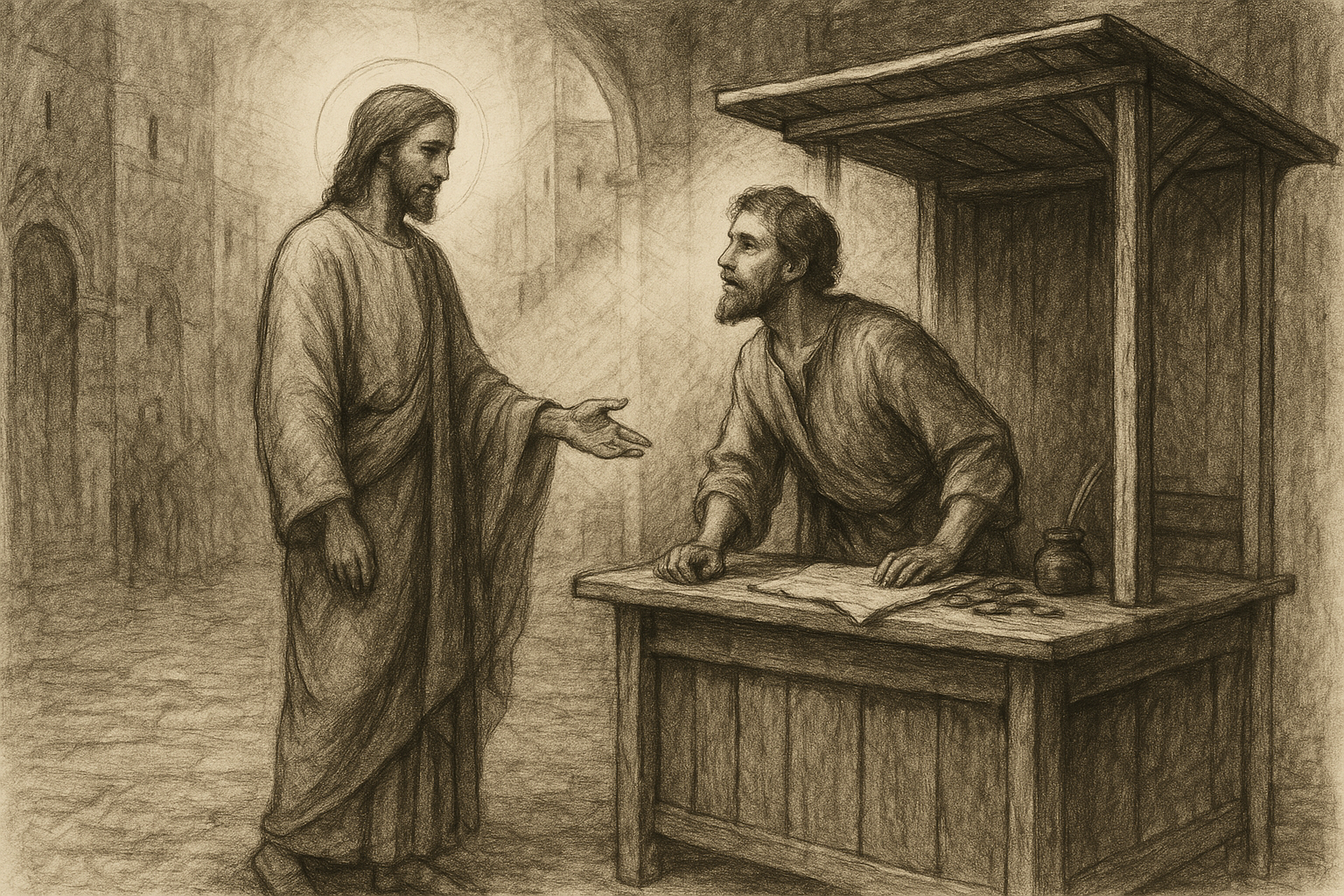
When Matthew is sitting at the tax booth, he is not hiding his condition from Jesus. The Lord sees him exactly where he is. That is a pattern repeated throughout the Gospels. Christ does not wait at a distance for people to become clean enough to approach. He goes toward them. He sees the wound, the compromise, the habits of sin, and the narrowness of a life that has become too small. Then he speaks a word that is both command and invitation: Follow me.
This is one reason the calling of St. Matthew Catholic meaning is so rich. It shows that grace is personal before it is abstract. Jesus does not begin with a lecture. He begins with a relationship. The call is not first a system of ideas, but an encounter with the living Lord. Matthew is addressed by name, and that personal summons changes everything.
The power of the Lord's word
Matthew does not negotiate. He does not request a delay, ask for conditions, or promise to reflect further and respond later. The Gospel says he rose and followed him. That movement is itself part of the miracle. The command of Christ carries the grace to obey. What Jesus asks, he also enables.
Catholics recognize in this pattern something of the structure of all authentic conversion. God is always first. He sees before we see. He calls before we feel ready. He offers grace before we can claim credit. Matthew's response teaches that conversion is not chiefly a human achievement but a surrender to divine initiative. The man at the booth becomes a disciple because Christ's word has authority to create a new future.
There is also a beautiful humility in the Gospel's silence about Matthew's inner thoughts. We are not told that he felt heroic. We are told only that he rose. Often the first sign of conversion is not a speech but an action. One stands up from whatever has kept one seated in sin, self-protection, or despair. The Lord's word is strong enough to move a person from one way of life to another.
Mercy at table
The calling would be striking enough by itself, but Matthew's Gospel immediately adds a meal. Jesus sits at table in Matthew's house, and many tax collectors and sinners come to eat with him Matthew 9:10. The Pharisees ask why Jesus would do this, and the Lord answers with memorable clarity: "Those who are well have no need of a physician, but those who are sick" Matthew 9:12. He then adds, "I desire mercy, and not sacrifice" Matthew 9:13, quoting Hosea Hosea 6:6.
This is not a rejection of sacrifice in the Catholic sense. Rather, it reveals the heart that sacrifice is meant to serve. God does not want external worship detached from mercy, repentance, and love of neighbor. In Jesus, the truth of the law and the tenderness of God meet without contradiction. The table becomes a sign of communion, and that communion begins with mercy.
For Catholics, this scene naturally recalls the sacramental life of the Church. Christ still welcomes sinners to himself, not because sin is harmless, but because healing is possible. The Eucharist is not a reward for the already perfected, but the food of pilgrims who need grace. At the same time, the Gospel does not permit complacency. Matthew does not remain at the tax booth. He leaves it. Mercy receives him as he is, but mercy also changes him.
What Matthew teaches about conversion
St. Matthew becomes an enduring witness to the fact that no past is stronger than Christ's call. The Church has long seen in his life a sign of hope for those who feel trapped by reputation, habit, or regret. A man who had been known by what he took becomes known by whom he followed. That reversal is at the heart of Christian conversion.
There is also a hidden lesson here about dignity. Matthew's identity is not erased when he becomes a disciple. It is fulfilled. Grace does not make a person less human. It restores the person to the truth of who he is before God. Many people fear conversion because they imagine it as humiliation. The Gospel shows something else. To be called by Christ is to be given back to oneself.
Matthew's later role in the Church, traditionally associated with the Gospel that bears his name, strengthens this reading. The man who once handled accounts now bears witness to the kingdom. The one whose life was ordered around money now records the words and deeds of the Savior. This transformation is not decorative. It is the fruit of discipleship. When Christ calls, he also commissions.
How Catholics can receive this Gospel scene today
The calling of St. Matthew Catholic meaning becomes most practical when we ask what it asks of us now. The first answer is simple: we must listen for Christ's voice in the ordinary places of life. Matthew was not in a temple or a place of public honor. He was at work. God still calls people in workplaces, kitchens, commutes, friendships, disappointments, and routines. The Lord is not confined to dramatic moments.
A second lesson is that Christ's call may arrive where we least expect it, and perhaps where we would rather not be seen. Many of us prefer to present a cleaned-up version of ourselves to God. Matthew reminds us that Jesus already knows where we are seated. He does not call the idealized self. He calls the real person.
A third lesson is the courage to rise. Some conversions are immediate and dramatic, while others unfold slowly. Yet every authentic response includes a willingness to move. That movement may mean leaving a sinful habit, making a confession after a long absence, forgiving someone who has wounded us, or accepting a vocation we once resisted. The shape differs, but the grace is the same.
It is also worth noticing that Matthew's call is bound to mercy, not self-congratulation. A disciple is not someone who has proven moral superiority. A disciple is someone who has been shown mercy and now lives from that mercy. This protects Catholic life from both pride and despair. Pride says, I am already fine. Despair says, I cannot change. Matthew's story answers both: Christ can forgive, and Christ can transform.
The Church reads Matthew as a witness of grace
Throughout Christian tradition, St. Matthew has stood as a sign that God writes straight with crooked lines. The collector who may once have been seen as a symbol of exploitation becomes an apostle and evangelist. His feast day has long been kept in the Church as a reminder that grace is not theoretical. It enters human history and gives it direction.
For the Catholic imagination, this matters because salvation is never only about private feeling. It is about communion, mission, and witness. Matthew does not simply enjoy a personal pardon. He joins the Twelve. He belongs to a people being formed by Christ. The same Lord who called him also sends the Church to call others. Mercy received becomes mercy shared.
That is why the scene continues to speak with unusual freshness. We may prefer religious stories about the obviously holy, the well prepared, or the naturally admirable. The Gospel is more searching than that. It tells the truth about sinners, and it tells the greater truth about a Savior who calls sinners by name. Matthew's booth becomes an altar of sorts, the place where an old life ends and a new one begins.
Jesus saw a man others had already judged, and he saw more than a reputation. He saw a heart that could still be turned toward God.
That is the hope offered in every age. Christ does not come only for those who have already succeeded at holiness. He comes for those who need mercy, and all of us do. The calling of St. Matthew invites Catholics to trust that no one is too far gone for the Lord's gaze, no habit too entrenched for his word, and no life too ordinary to become a place of discipleship.
If Christ can stop at a tax booth and make an apostle there, then he can also stop in the ordinary places of our own lives. He can call us from whatever has held us, and he can teach us, step by step, how to follow.
Keep Reading on Lets Read The Bible
Frequently Asked Questions
Why is the calling of St. Matthew important in Catholic teaching?
It shows that Jesus calls sinners personally and mercifully. Matthew's conversion is a sign that grace can interrupt an ordinary life and lead a person into discipleship.
What does Jesus mean when he says, "Follow me" to Matthew?
Jesus is not giving a vague suggestion. He is issuing a real call to leave behind the old life and enter a new relationship of trust, obedience, and mission.
How can Catholics imitate St. Matthew today?
By listening for Christ in daily life, responding promptly to grace, going to Confession when needed, and allowing mercy received from Christ to become mercy shown to others.