Jesus and the Gospels
Touching the Wounds: St. Thomas and the Mercy of the Risen Christ
The Gospel account of St. Thomas after the Resurrection reveals both the patience of Christ and the path from doubt to faith.
Site Admin | January 23, 2026 | 89 views
The scene of St. Thomas after the Resurrection in the Gospel is brief, but it has remained unforgettable in the life of the Church. Few passages speak so directly to the human struggle to believe. Thomas is not given a tidy answer or a rebuke alone. He is met by the risen Jesus, who bears the marks of the Cross and invites him to come close.
This is not merely a private moment between one Apostle and his Lord. It belongs to the whole Church. In Thomas we see fear, disappointment, longing, hesitation, and finally a confession of faith that reaches beyond what he can touch with his hands. His story shows that the Resurrection is not an abstraction. It is the victory of the same Jesus who was crucified, now alive forever.
The Gospel setting of Thomas's doubt
The story comes in the Gospel of John, after Jesus has already appeared to the disciples on the evening of Easter Sunday. The disciples are gathered behind locked doors, and the risen Christ comes to them in peace, showing them his hands and his side. They rejoice when they see the Lord. Thomas, however, is not present.
When the other disciples tell him, We have seen the Lord, Thomas refuses to accept the testimony without evidence. He says that unless he sees the nail marks and puts his finger into the wounds, he will not believe. His words are blunt, but they are also recognizably human. He is not mocking the others. He is speaking from the place of a wounded disciple who has seen the Lord die and does not yet know how to receive the news of life.
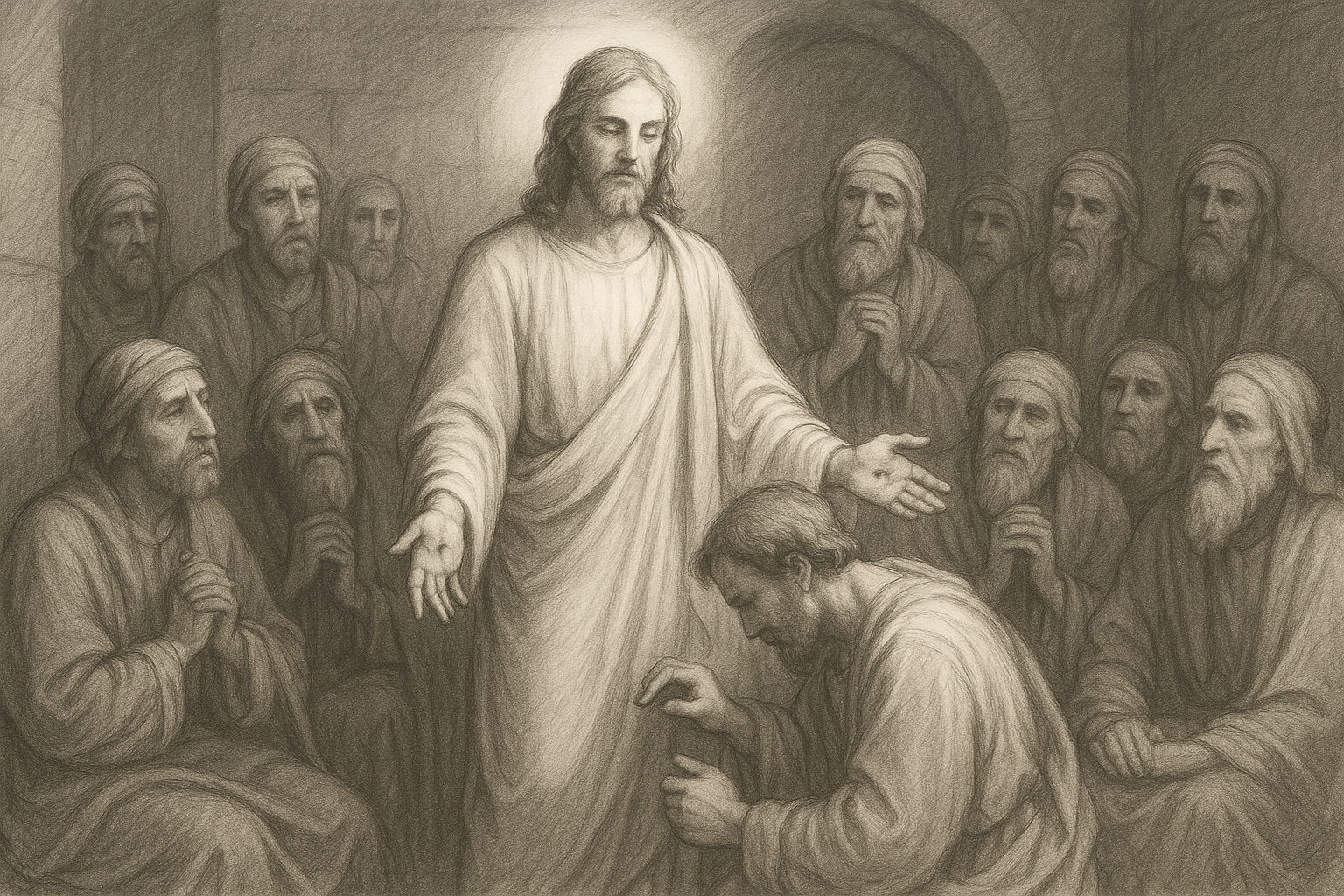
A week later, Jesus comes again while the disciples are gathered. This time Thomas is there. The Lord does not shame him in front of the others. He addresses Thomas directly and repeats, almost word for word, the conditions Thomas had set. Then he speaks the gentle command that has echoed across Christian history: Do not be unbelieving, but believe John 20:27.
What Jesus does, and does not, do
It is important to notice how Christ responds. He does not erase the wounds. He does not present a different body. The risen Lord is recognized precisely by his crucifixion marks. The Resurrection is not a denial of the Passion, as if the Cross had never happened. It is the transformation of suffering by divine life. The wounds remain, but now they speak of glory rather than defeat.
Jesus also does not force faith by spectacle. He offers Thomas what he asked for, but he leads him toward something greater than proof by touch. The invitation is personal, even merciful. Thomas is not treated as an outsider to be dismissed, but as a disciple to be restored.
This matters for Catholic readers because it reveals the character of divine patience. Christ is not impatient with the honest struggler who still stands near the door. He comes to him. He gives him time. And he leads him from what can be grasped by the senses to a deeper act of trust.
The confession that crowns the scene
Thomas answers with one of the most beautiful proclamations in all the Gospels: My Lord and my God! John 20:28. The words are short, but they are immense. In one sentence Thomas recognizes both the lordship and the divinity of Jesus. He does not merely say that Christ is alive. He worships him.
For the Church, this confession is a treasure. It speaks plainly about who Jesus is. The same one whom Thomas had seen die on the Cross is now confessed as Lord and God. The Resurrection does not lower Jesus to the level of a spiritual teacher. It reveals him in fullness. Thomas, who seemed at first to need the strongest proof, ends by giving the clearest profession of faith.
There is also a quiet mercy in the way Jesus receives that confession. He does not correct Thomas for speaking too much. He accepts the worship that belongs to him. The risen Christ is not merely demonstrating that he survived death. He is drawing his disciple into adoration.
Blessed are those who have not seen
Jesus then speaks a beatitude that reaches beyond Thomas to all later believers: Blessed are those who have not seen and have believed John 20:29. This is not a rebuke aimed only at Thomas. It is a blessing for the whole Church, especially for those who would believe through apostolic witness rather than direct sight.
Here the Gospel opens into the life of Catholic faith. We do not see the risen Lord with bodily eyes as the first disciples did, yet we are not left without access to him. We receive his word in Scripture, his presence in the Church, and his grace in the sacraments. Faith is not blind in the sense of irrational. It is the confident surrender of the heart to the testimony of God, who does not deceive.
Thomas helps us understand that faith and sight are not enemies, but they are not the same. Sight can confirm faith, but faith is called to rest finally in the reliability of Christ. The blessedness Jesus speaks of is not the reward for pretending to know what we do not know. It is the grace of trusting the Lord who has proven himself worthy of trust.
St. Thomas after the Resurrection in the Gospel and the life of prayer
Many Catholics find themselves close to Thomas in one way or another. There are seasons when prayer feels dry, when God seems distant, when the heart wants reassurance. The Gospel does not condemn the disciple who wants to know that Christ is real. It shows that such longing can become a doorway to deeper faith.
Thomas teaches us to bring our uncertainty into the presence of Jesus rather than away from him. He does not disappear from the apostolic band. He remains with the other disciples, and that matters. Even in confusion, he stays near the community of faith. That is often where the Lord finds us: not because we are already strong, but because grace keeps us close.
In prayer, then, the lesson is not to pretend certainty we do not have. The lesson is to be honest before God. We can say, in effect, Lord, I believe, but help my unbelief. We can ask to recognize Christ in the Gospel, in the Eucharist, and in the quiet movement of grace. Thomas shows that the path from doubt to faith is not always instant, but it can be real.
The Church Fathers and the meaning of Thomas
Christian tradition has long reflected on this scene. The Fathers of the Church saw in Thomas both the weakness of the human heart and the wisdom of God, who turns even hesitation into witness. Thomas became, in the providence of God, not a scandal but a testimony. The one who doubted most sharply was also the one who confessed most plainly.
This is spiritually useful because it guards us against two errors. The first is despair, which says that doubt makes faith impossible. The second is superficiality, which treats faith as if it were never tested. The Gospel gives neither. It shows a real apostle with a real difficulty, and a real Lord who answers him with truth and mercy.
The Church also hears in Thomas a reminder that the Resurrection is credible because it is tied to apostolic witness. Christianity is not built on a vague inner feeling. It rests on the testimony of those who encountered the risen Christ and handed on what they had seen and heard. Thomas, once convinced, becomes part of that witness.
Practical lessons for discipleship
The Gospel episode of Thomas offers several concrete lessons for daily Christian life:
- Stay near the Church when faith is difficult. Thomas remained with the disciples, and that kept him close to the place where Jesus came.
- Be honest in prayer. The Lord is not threatened by sincere questions.
- Let Christ define reality. The Resurrection is not whatever we would prefer it to be. It is the living Jesus, wounded and glorified.
- Move from testing to trust. At some point, the heart must answer the Lord with faith, not merely demand more signs.
- Remember that wounds can become witnesses. In Christ, suffering is not denied but redeemed.
These lessons are not only for people who think of themselves as doubters. They apply to every disciple, because every disciple must move from one form of trust to a deeper one. Even strong faith is called to mature. Thomas is a companion for that journey.
A disciple transformed by the encounter
Christian tradition later remembers Thomas as a missionary and martyr, a man who did not remain trapped in his first hesitation. That is fitting. The one who once needed to touch the wounds came to bear witness to the risen Lord with his whole life. The Gospel does not freeze him in the moment of doubt. It shows him being changed by grace.
This is part of the beauty of St. Thomas after the Resurrection in the Gospel. His story is not about embarrassment. It is about conversion. He begins with resistance, but he ends in worship and witness. He begins by demanding proof, but he ends by surrendering to the truth that Christ is Lord and God.
For Catholics, that ending is deeply consoling. The risen Jesus still comes to his disciples. He still knows how to speak to the wounded heart. And he still leads honest seekers from uncertainty into the joy of faith, where the final word is not doubt, but adoration.
Keep Reading on Lets Read The Bible
Frequently Asked Questions
Why is St. Thomas called the doubting apostle?
He is remembered that way because he initially refused to believe the other disciples had seen the risen Jesus unless he could see and touch the wounds himself. The Gospel also shows that his doubt did not have the last word.
What is the main Catholic lesson from St. Thomas after the Resurrection?
The main lesson is that Christ meets sincere doubt with mercy and leads the disciple toward a deeper confession of faith. Thomas's story also shows that the Resurrection is bodily and real, not merely symbolic.
How can Catholics pray with the story of St. Thomas?
Catholics can pray honestly, asking the Lord to strengthen faith, to help unbelief, and to open the heart to recognize Christ in Scripture, the Eucharist, and daily life.