Jesus and the Gospels
The Cry by the Road: Bartimaeus and the Mercy That Opens the Eyes
A close look at the blind beggar of Jericho and what his healing reveals about faith, prayer, and the way Christ still meets the poor in spirit.
Site Admin | February 1, 2026 | 80 views
The beggar who would not be quiet
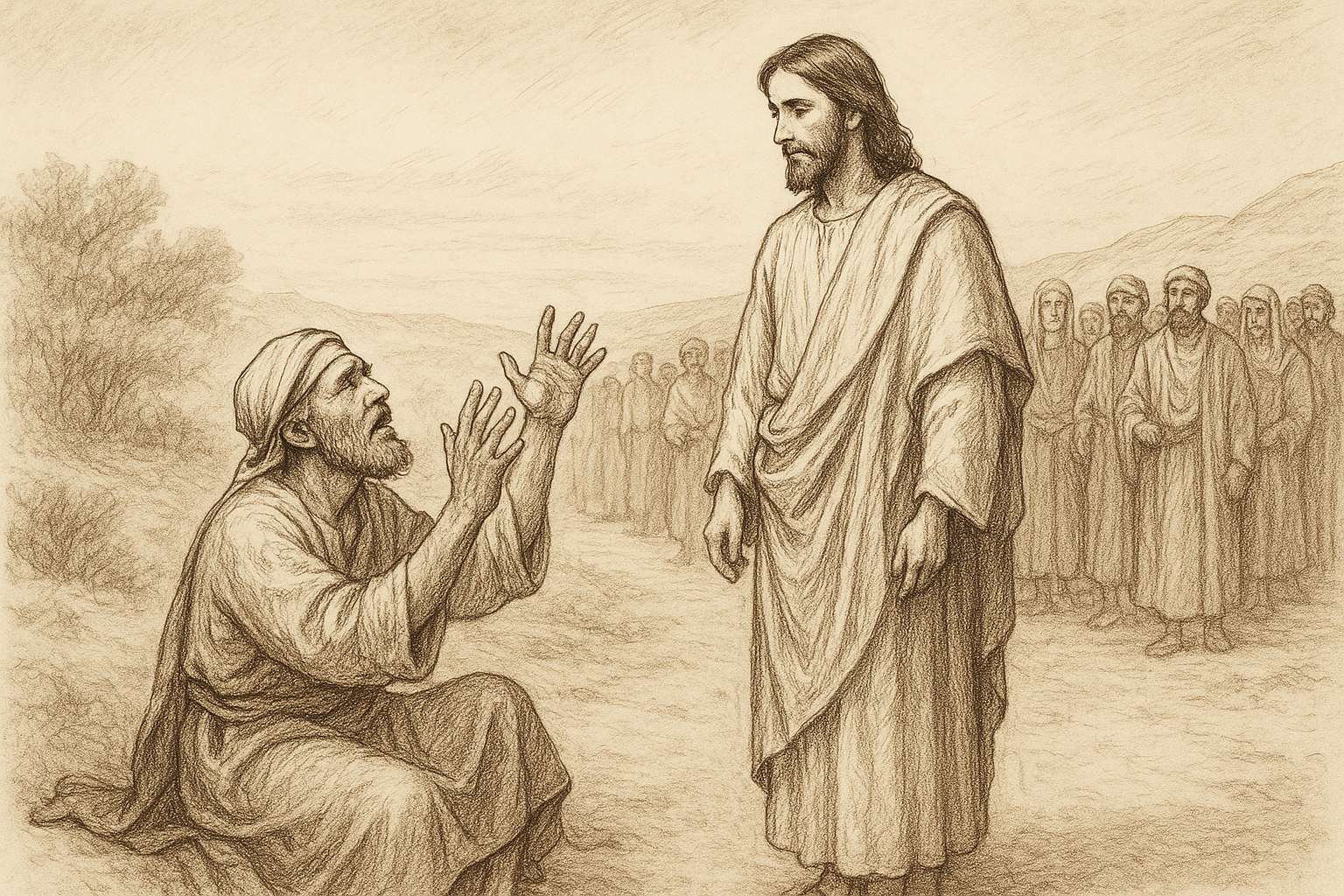
The healing of blind Bartimaeus appears in the Gospel according to Mark, where Jesus is passing through Jericho on the road toward Jerusalem. Bartimaeus sits by the roadside, blind and poor, dependent on the kindness of others. When he hears that Jesus of Nazareth is near, he begins to cry out, "Jesus, Son of David, have mercy on me!" Mark 10:47.
That cry is one of the most striking lines in the Gospels. Bartimaeus does not ask for a comfortable life, status, or an explanation. He asks for mercy. In the biblical world, to call Jesus the Son of David is to recognize him as the promised Messiah, the royal heir who comes to save. Bartimaeus sees more clearly in faith than he does with his physical eyes. Though blind in body, he perceives who Christ is.
The crowd tries to silence him, but he cries out all the more. That detail matters. The man who cannot see refuses to let discouragement speak the last word. His persistence becomes a kind of prayer. He is not polished, not measured, not impressive by worldly standards. Yet he is direct, honest, and desperate for the Lord. The Gospel presents him as a model of the soul that knows its need.
Jesus stops for the one everyone overlooked
Mark tells us that Jesus stood still and said, "Call him" Mark 10:49. In a brief moment, the whole scene changes. The crowd that had been telling Bartimaeus to be quiet now tells him to take courage. Jesus does not merely heal at a distance and move on. He stops. He listens. He summons the man to himself.
This is one of the tender truths of the Gospel: Christ is never too busy for the person at the roadside. Bartimaeus is socially small, materially poor, and physically impaired. But to Jesus he is not invisible. The Lord's attention restores dignity before it restores sight. He calls Bartimaeus into personal encounter.
Then comes a detail full of movement and hope: Bartimaeus throws off his cloak, springs up, and comes to Jesus Mark 10:50. A beggar's cloak may have been his possession, his covering, and perhaps even the place where he collected alms. To cast it aside is to leave behind what belongs to his old life. He rises with expectancy. Faith always moves toward Christ.
Jesus asks him, "What do you want me to do for you?" Mark 10:51. This question is not because Jesus lacks knowledge. It draws Bartimaeus into honest speech. The Lord often leads people to name their desire. In prayer, that honesty matters. Bartimaeus answers, "Master, I want to see" Mark 10:51. Simple words, but they contain a whole life of longing.
Faith that asks and faith that receives
Jesus replies, "Go your way; your faith has saved you" Mark 10:52. At once Bartimaeus regains his sight and follows Jesus on the way. The Gospel does not separate healing from discipleship. Bartimaeus does not receive a miracle and then depart unchanged. He receives sight and immediately becomes a follower.
For Catholics, this is an important pattern. Faith is not merely an inner feeling. It is a living trust that leads to encounter, obedience, and communion with Christ. Bartimaeus believed enough to call out, enough to keep calling, enough to come when summoned, and enough to follow after being healed. His faith was active, humble, and persistent.
It is also worth noticing that Jesus says his faith has saved him. The word in Scripture can carry the sense of being healed and rescued. The miracle is bodily, but it points beyond the body. Bartimaeus receives more than restored vision. He is drawn into salvation. In the Gospels, physical healing often serves as a sign of deeper restoration, a foretaste of the wholeness Christ came to bring.
Catholic readers naturally hear in this scene an echo of sacramental life. Christ continues to touch, heal, and restore through grace. He gives light to minds darkened by sin, strength to wills weakened by fear, and mercy to hearts that have grown weary or proud. The Church does not treat the healing of Bartimaeus as a mere spectacle of wonder. It is a revelation of what Jesus does for those who come to him in faith.
The spiritual blindness Bartimaeus helps us name
Physical blindness in the Bible often becomes a sign of spiritual need. That does not mean blindness is a punishment for personal sin. The Gospels reject any crude assumption that disability is simply the result of moral failure. Rather, blindness reminds us of the human condition apart from grace. We are not always able to see as we should. We misjudge, forget, resist, and wander.
Bartimaeus can therefore stand for every soul that knows it needs mercy. He is the one who refuses denial. He does not pretend he is fine. He does not act self-sufficient. He cries out because he knows Jesus alone can help him. That is a deeply Catholic instinct. The saints are not those who claim to need nothing. They are those who keep turning toward the One who can heal what they cannot heal themselves.
There is also a warning in the crowd's reaction. The people near Jesus can become obstacles to the mercy they ought to welcome. They are close to the Savior, but not yet fully shaped by his compassion. Their impatience is a small portrait of how religious life can become hardened. A community can repeat the name of Jesus while forgetting the tenderness of Jesus. Bartimaeus reminds us that the poor and the inconvenient must not be pushed aside when Christ is near.
The Lord's question, "What do you want me to do for you?" also invites self-examination. Many people want relief, but not conversion. Many want help, but not surrender. Bartimaeus wants sight, and sight in the Gospel is never only about information. To see rightly is to come into the truth of reality before God. We can ask ourselves whether we are asking Christ to improve our circumstances, or to remake our hearts.
Jericho, the road, and the shape of the Christian life
Jericho is not a random setting. Jesus is on the road to Jerusalem, where his Passion will unfold. Bartimaeus is healed as Christ moves toward the Cross. This matters because the Lord's mercy is not detached from sacrifice. He gives sight on the way to giving his life. The healing at Jericho looks ahead to the greater redemption won at Calvary.
The phrase on the way also describes Christian discipleship. Bartimaeus does not stay seated by the roadside once he sees. He follows. The healed man becomes a companion of Jesus. That is a pattern for every Catholic life: encounter, mercy, conversion, and then perseverance along the path of the Lord.
In this light, Bartimaeus can be read alongside the other Gospel calls and healings that reveal Jesus' heart. Like Peter, he is summoned into a new life. Like Matthew, he receives mercy that interrupts ordinary life. Like the household at Bethany, he learns that closeness to Christ changes what matters most. Yet Bartimaeus remains unique because his voice so vividly captures the prayer of the poor: have mercy on me.
What Catholics can learn from Bartimaeus today
First, Bartimaeus teaches us to pray with perseverance. Even when the crowd resists, he keeps calling. Many Catholics know what it is to pray through distraction, dryness, discouragement, or pain. The Bartimaeus scene says that steadfast prayer is not wasted. The Lord hears the one who calls from the heart.
Second, he teaches us to be specific. He does not ask vaguely for a better life. He says what he needs. In Catholic prayer, honesty is a form of humility. It is good to tell the Lord where we are blind: perhaps in a habit of sin, a refusal to forgive, confusion about a vocation, or fear about the future. Christ is not offended by truth spoken in dependence.
Third, Bartimaeus teaches us to leave behind what keeps us from Christ. The thrown cloak is a beautiful image of detachment. Not every attachment is sinful, but anything that prevents us from running to the Lord must be loosened. Sometimes that means a particular sin. Sometimes it means pride, self-protection, or the need to appear strong.
Fourth, he teaches us that healing leads to following. A received grace becomes a path of discipleship. When Christ restores us, he does not merely send us back to the old life with improved conditions. He calls us onward. The healed person is invited to walk with Jesus, to listen, to obey, and to learn the ways of the Kingdom.
"Jesus, Son of David, have mercy on me!" Mark 10:47
That prayer is short enough to carry through a busy day, and deep enough to accompany a lifetime. Catholics have long treasured brief prayers that keep the heart turned toward God. Bartimaeus gives us one of the simplest and most forceful cries in Scripture. It is the cry of the needy, but also the cry of the believing.
When we pray like Bartimaeus, we admit that we are not self-sufficient. We confess that only Christ can open what is closed and bring light where there is darkness. We also learn that mercy is not humiliation. To ask for mercy is to stand in the truth before the God who loves us. Bartimaeus is not diminished by his plea. He is honored by it.
The healing of blind Bartimaeus Catholic meaning is therefore more than a lesson about a miracle. It is a window into the way Jesus sees the lowly, hears the persistent, and transforms the one who comes to him. The beggar at the edge of the road becomes a disciple on the road. And that is still how Christ works: he calls the overlooked, he answers the honest cry, and he leads those he heals into the light of his own way.
Keep Reading on Lets Read The Bible
Frequently Asked Questions
Why does Bartimaeus call Jesus the Son of David?
Bartimaeus uses a messianic title. By calling Jesus the Son of David, he identifies him as the promised royal heir and Savior. His cry shows real faith, because he sees more than the crowd does about who Jesus is.
What is the Catholic meaning of Bartimaeus throwing off his cloak?
The cloak can be read as a sign of leaving behind an old life. Bartimaeus rises immediately and goes to Jesus, which suggests readiness, trust, and detachment from whatever kept him fixed in place. Catholics often see in this a call to let go of whatever hinders a full response to Christ.
How can Catholics pray with Bartimaeus today?
A simple prayer like "Jesus, Son of David, have mercy on me" can become a steady prayer of the heart. Catholics can use it in moments of distraction, sorrow, temptation, or confusion, asking Christ for mercy, healing, and the grace to follow him more closely.