Saints and Witnesses
St. Monica and the Quiet Strength of a Prayer That Would Not Let Go
A saintly witness to patient love, tears offered to God, and the steady hope that grace can still reach the hardest heart.
Site Admin | April 25, 2026 | 109 views
St. Monica is one of those saints whose memory feels close to daily Catholic life. She was not a martyr in the bloodiest sense, nor a founder of a religious order, nor a famous theologian. Yet her name endures because her life shows something many believers need to remember: grace often works slowly, and love can remain faithful even when the results are hidden for years. For Catholics seeking St. Monica Catholic inspiration, her story offers more than comfort. It offers a pattern for prayer, patience, and hope.
Monica lived in the fourth century in North Africa, in the Roman world of Thagaste, and later in other places connected to the life of her son, Augustine. What we know of her comes chiefly from Augustine's own writings, especially his Confessions. That alone is telling. The Church remembers Monica not because she wrote treatises or held public office, but because her holiness shaped a son whose conversion would echo through the centuries. She was a married woman, a mother, a believer, and a persevering intercessor. Her sanctity was ordinary in its setting and extraordinary in its fidelity.
A life marked by patient faith
Monica's life was not smooth. Augustine tells us that she endured a difficult marriage and family tensions, and that her husband Patricius was not easy to live with. She also grieved over Augustine's early moral restlessness and his attachment to error. Yet Monica did not answer disorder with despair. She answered it with prayer, discipline, and tears offered to God. In that sense, her life looks very much like the life of many Catholic parents, grandparents, spouses, and friends who carry invisible burdens before the Lord.
Her holiness is deeply human. She was not spared sorrow, and she did not pretend sorrow was pleasant. But she remained rooted in the conviction that God hears. The saints often teach in this way: not by removing the pain of life, but by showing that pain can be entrusted to divine mercy. Monica's witness is especially consoling because it is domestic. Her battleground was the home, the heart, and the long delay between promise and fulfillment.
"Let us run toward the Savior and all his light" Let us run toward the Savior and all his light.
That line captures the spiritual direction of Monica's life. She was not centered on herself or on controlling outcomes. She was oriented toward Christ. Her prayer was not a technique for getting what she wanted. It was a surrender to the One who saves.
What Augustine's story reveals about Monica
Monica cannot be separated from Augustine, but it would be a mistake to reduce her to a supporting role in someone else's biography. Augustine's conversion was, in part, the fruit of her faithful witness. He himself recognized the power of her prayer. Yet his journey also shows that God was at work in ways Monica could not fully see at the time. She prayed for a son whose mind was brilliant and whose heart was divided. She was not given an instant answer. She was given time, and within that time she was asked to continue believing.
Many Catholics know this experience well. A loved one remains distant from the Church. A child resists faith. A spouse seems unchanged. A friend drifts. The temptation is to measure prayer only by visible success. Monica reminds us that prayer is first an act of communion with God, and only secondarily an expectation about results. That does not make prayer weak. It makes prayer real.
Augustine's eventual conversion did not happen because Monica manipulated events. It happened because grace met him through many causes: Scripture, the witness of others, the preaching of St. Ambrose, and the interior action of God. Monica's role was to remain faithful within that larger providence. She is a saint for anyone who has ever wondered whether hidden intercession matters. In the economy of God, it matters greatly.
Tears that became prayer
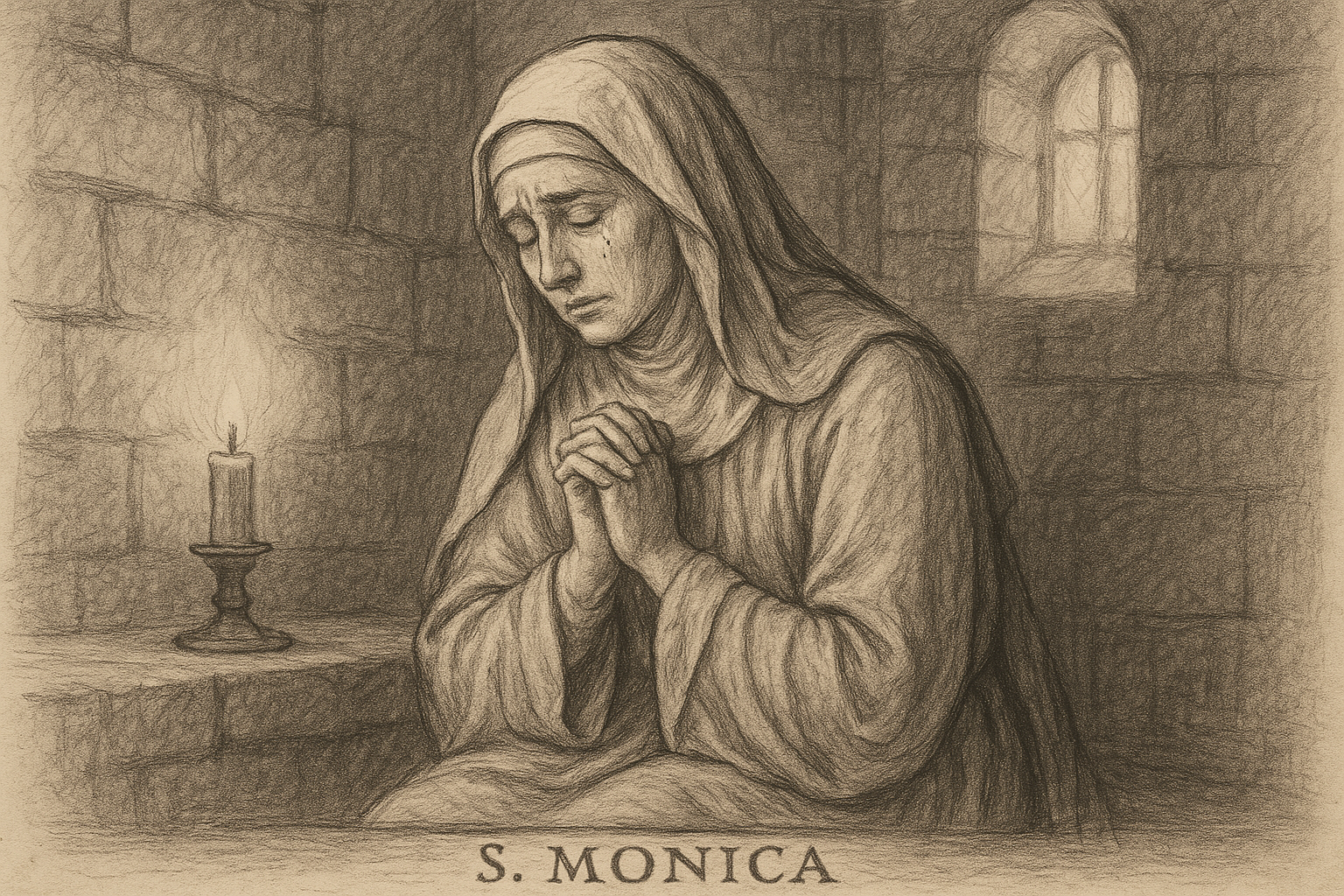
One of the most memorable features of Monica's witness is her tears. In a secular age, tears are often treated as weakness. In Catholic tradition, tears can be a form of prayer. They can express contrition, longing, compassion, and hope. Monica's tears were not sentimental. They were the visible sign of a heart that refused to stop loving.
The Bible itself honors this kind of prayer. Scripture does not hide the tears of the faithful. It shows us Hannah pleading for a child, David repenting before God, and the psalmist crying out from distress. Monica stands in that biblical line of prayerful sorrow. Her tears were not an end in themselves. They were joined to trust.
"The Lord is near to the brokenhearted" The Lord is near to the brokenhearted.
That nearness is one reason Monica remains compelling. She tells Catholics that brokenhearted prayer is not a failure of faith. It can be the very place where faith becomes most purified. When prayer does not feel strong, when words are few, when the future is unclear, the soul can still remain before God. Monica teaches that steadfastness is itself a form of love.
A saint for parents, caregivers, and anyone who waits
Although Monica is often invoked by parents, her witness reaches far beyond parenthood. She speaks to anyone who has ever waited for change in someone they love. She speaks to those who pray for prodigal children, for healing in families, for reconciliation after years of silence, for a spouse's return to practice, or for an adult child to discover the faith anew. She speaks to caregivers who labor without applause, and to those who keep showing up when the future remains uncertain.
Her example also has something to say to modern Catholic discipleship. Many people are tempted to think sanctity must be dramatic to be real. Monica suggests otherwise. Holiness can look like consistency. It can look like daily fidelity. It can look like enduring disappointment without surrendering charity. It can look like a mother who keeps praying, not because she sees immediate success, but because she trusts God more than fear.
That is one of the reasons her witness continues to inspire Catholics. She does not offer a fantasy of easy results. She offers a truth that is sturdier: God works in time, and time belongs to Him.
Monica and the Catholic shape of hope
Catholic hope is not wishful thinking. It is confidence grounded in God's promises. Monica lived that kind of hope. She had reasons to be discouraged, yet she was not governed by discouragement. She believed that the Lord could reach Augustine, and she also believed that her own fidelity mattered even before the answer came. That combination is profoundly Catholic. It honors both divine power and human cooperation.
This is why Monica's witness pairs so naturally with the sacramental life of the Church. Catholics do not pray only with private feelings. They pray as members of a visible communion, nourished by grace through the sacraments. Monica's endurance makes sense in that world. She was not relying on herself alone. She was living in the hope that God gives through the Church, through prayer, through repentance, and through the patient work of grace in ordinary lives.
Her story also reminds Catholics that saints are not idealized abstractions. They are people whose lives were transformed by God. Monica was not perfect, and that matters. Her sanctity was not the absence of struggle. It was the refusal to let struggle have the final word. That is a powerful lesson for believers who feel ordinary, weary, or spiritually overlooked.
Three ways Monica still speaks to the Church
Monica's witness remains practical because it touches three enduring needs in Catholic life.
- She teaches perseverance. Prayer is not measured only by speed. Some intentions belong to a long road, and fidelity along that road is precious to God.
- She teaches intercession. Love for others is not passive. It becomes prayer, sacrifice, and patient hope for their good.
- She teaches surrender. Monica prayed intensely, but she did not control the outcome. She placed Augustine in God's hands and continued to trust.
These are not small lessons. They shape how Catholics live in families, parish communities, and friendships. They shape how we respond when a loved one seems far from faith. They shape how we endure unanswered questions. They shape how we understand the hidden power of prayer.
How to pray with Monica today
To pray with Monica is not merely to admire her. It is to imitate her spirit. Catholics can do this in simple, concrete ways. Offer a decade of the Rosary for one person who weighs on your heart. Pray quietly after Mass for someone whose faith is weak. Place a name before God each morning and evening. Ask Monica to teach you how to wait without bitterness. Most of all, keep prayer tied to love, not to anxiety.
It can also help to remember that Monica's prayer was not self-focused. She prayed for conversion, yes, but conversion leads to communion with God and reconciliation with others. Her intercession was for the salvation of a soul and for the healing of a family. That broader horizon matters. Catholic prayer is never meant to shrink us into worry. It is meant to enlarge charity.
If you are tempted to give up on someone, Monica offers a gentler path. Continue to pray. Continue to trust. Continue to love. Not because you can force grace, but because grace is real. Monica's life shows that God can work through years of longing, through tears, through silence, and through the patient faith of one believer who refuses to stop asking.
That is why St. Monica remains so beloved. She is a mother for the weary, a companion for the waiting, and a quiet testimony that the prayers of the faithful are never wasted in God's hands.
Keep Reading on Lets Read The Bible
Frequently Asked Questions
Who was St. Monica in Catholic history?
St. Monica was a fourth-century Christian woman from North Africa, best known as the mother of St. Augustine. The main source for her life is Augustine's own writing, especially his Confessions, which describe her faith, patience, and persistent prayer.
Why do Catholics ask St. Monica for help in prayer?
Catholics often ask St. Monica to intercede because she is a powerful example of persevering prayer for a loved one's conversion. Her witness especially comforts parents, spouses, and family members who are praying for someone they love.
What is the main spiritual lesson of St. Monica's life?
Her life shows that holiness can be lived through patience, tears, and steadfast trust in God's timing. She teaches Catholics that prayer is not wasted even when the answer is delayed.