Bible Stories
Christmas
The Nativity of Jesus Christ and the Wonder of the Incarnation
Site Admin | April 29, 2026 | 314 views
The Christmas story is one of the most beloved in the Christian world, but its beauty is often softened by familiarity. Nativity scenes, carols, candles, and winter traditions can make the story feel gentle in a way that hides how astonishing it truly is. Christmas is the story of the Incarnation - the eternal Son of God taking flesh in the womb of the Virgin Mary, being born in poverty at Bethlehem, and entering human history not through spectacle, but through humility. The Church loves Christmas not only because it is tender, but because it reveals who God is: near, self-giving, faithful, and determined to save.
The Christmas story unfolds across several Gospel scenes, especially Luke 1-2 and Matthew 1-2. To tell it properly, we begin not at the manger but with God's preparation. The birth of Jesus is the fulfillment of promises stretching back through Abraham, David, the prophets, and the whole longing of Israel. Christmas is not a disconnected miracle dropped into history. It is the moment when the long waiting of the covenant begins to flower.
The Annunciation and Mary's yes
The Christmas story begins in a quiet place with an astonishing message. The angel Gabriel is sent to Mary, a virgin betrothed to Joseph, and announces that she will conceive and bear a son who will be called great, Son of the Most High, heir to the throne of David. The promise is immense. The child to be born is not merely a prophet or reformer. He is the long-awaited king and more than a king. He is holy from the beginning, conceived by the Holy Spirit.
Mary's response is one of the most important moments in all Scripture. She asks how this will be, not in unbelief, but in wonder. Then, receiving the angel's answer, she gives her fiat: let it be done to me according to your word. Catholic devotion lingers here because Mary's yes is not passive resignation. It is active trust. Through her obedient faith, the Word becomes flesh. Christmas is therefore inseparable from Mary's humility and courage.
The Incarnation begins hidden. There is no public applause, no political recognition, no worldly fanfare. God chooses a maiden in Nazareth and works in silence. This pattern prepares us for the whole Christmas mystery. Divine greatness will appear in littleness.
Joseph's obedience and the house of David
Matthew's Gospel highlights Joseph's role. When he learns that Mary is with child, he is troubled but righteous. He does not seek her shame. Then an angel appears in a dream and tells him not to fear taking Mary as his wife, for the child is conceived by the Holy Spirit. Joseph obeys. He becomes guardian of the Virgin and foster father of the Messiah, placing Jesus within the house of David as foretold.
Joseph's obedience is quiet and decisive. He does not speak in the Gospel infancy narratives, yet his actions speak clearly. He receives the mission entrusted to him and carries it out with fidelity. Catholic life rightly honors him because he embodies protective love, chastity, steadiness, and trust. Christmas is not only about Mary's yes. It is also about Joseph's faithful guardianship.
The genealogy that precedes Matthew's Nativity account also matters. It roots Jesus in real history, in a family line marked by saints and sinners, kings and outsiders, promise and failure. The Son of God does not float above human history. He enters it fully. This gives Christmas its profound realism. God comes not to an idealized humanity, but to the world as it actually is.
Bethlehem and the humility of the manger
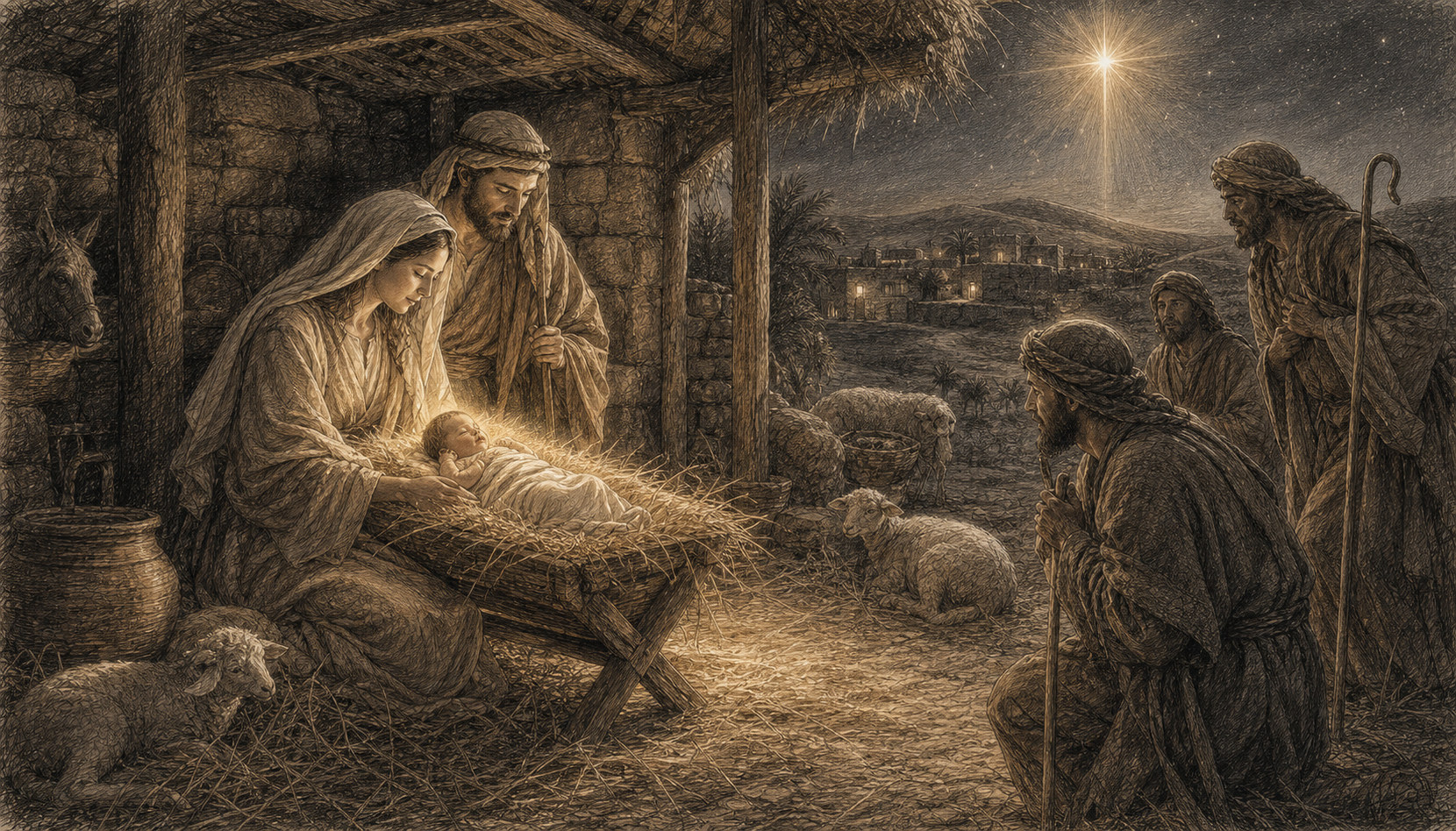
Luke tells us that Joseph and Mary travel to Bethlehem because of the census. Bethlehem, the city of David, is not a random setting. The prophets had long associated it with the ruler who would shepherd Israel. Yet when the time comes for Mary to give birth, there is no room in the lodging place. The Savior of the world is born in poverty and laid in a manger.
This is one of the great revelations of Christmas. God does not save the world by entering first through palaces, armies, or imperial display. He enters through vulnerability. The infant Jesus depends on Mary and Joseph, receives swaddling cloths, and rests among the poor. The humility of the manger is not a sentimental accessory. It belongs to the logic of the Incarnation. The Lord comes near enough to be held.
Catholics cherish the crib because it teaches contemplation. The world expects God to prove himself through visible domination. Christmas invites us instead to kneel before hidden majesty. The child in the manger is true God and true man. The one who made the stars has entered his own creation in such littleness that shepherds may draw near without terror.
The shepherds and the news of great joy
Outside Bethlehem, shepherds keep watch at night. To them comes the angelic announcement that a Savior has been born, Christ the Lord. The sign given is wonderfully simple: a baby wrapped in swaddling clothes and lying in a manger. Then the heavenly host praises God and proclaims peace to those of good will.
The shepherds matter deeply. In a world structured by rank and status, God gives the first public birth announcement not to emperors, priests, or scholars, but to ordinary working men on the night watch. Christmas is already revealing the pattern of the Gospel: the lowly are invited near, and the poor are not forgotten. The shepherds respond exactly as disciples should. They go quickly, they find the sign as told, and they glorify God.
Their witness also shows that contemplation leads to proclamation. Having seen the child, they speak of what was made known to them. Christmas is never only private emotion. It becomes testimony. The Christian who has truly stood before the manger cannot keep entirely silent about the joy he has seen.
The deeper meaning of the Incarnation
Why does Christmas matter so much? Because in the Incarnation, God does something humanity could never accomplish for itself. The eternal Word truly assumes human nature. He does not merely appear human or borrow a temporary disguise. He becomes man. This means that God has entered hunger, fatigue, family life, labor, speech, suffering, and death-bound history from within. Catholic theology treasures this because what is not assumed is not healed. By taking our nature, Christ prepares to redeem it.
Christmas therefore is already ordered toward Easter. The infant in the manger is the same Jesus who will preach the kingdom, institute the Eucharist, die on the Cross, and rise again. The wood of the crib quietly points toward the wood of Calvary. The humility of Bethlehem belongs to the same divine self-giving that will culminate in the Passion. This does not make Christmas less joyful. It makes the joy deeper and more truthful.
The Church also sees in Christmas the dignity of the human person illuminated in a new way. If the Son of God has taken flesh, then human nature is not disposable. Bodies matter. Family life matters. Children matter. The poor matter. Ordinary life can become a place of encounter with God because God himself has entered it.
The magi, Herod, and the cost of the king's coming
Matthew adds the coming of the magi from the East, guided by a star. They represent the nations beginning to come toward Christ. Learned, searching, and attentive to heavenly signs, they journey to adore the newborn king. Their gifts - gold, frankincense, and myrrh - have long been read as signs of kingship, divinity, and suffering. Even at Christmas, the child is identified as more than a local wonder. He is the king for the whole world.
Yet the Christmas story is not sheltered from darkness. Herod reacts with fear and violence. The Holy Family must flee into Egypt. The Church never forgets this because the coming of Christ exposes the resistance of sinful power. The world's Savior is welcomed by some and threatened by others. Christmas therefore contains both adoration and opposition. Light enters darkness, and the darkness does not receive it easily.
This too is part of the truth of the Incarnation. God does not enter a neutral world. He enters a wounded one. The shadow of the Cross already stretches faintly across the infancy narratives. Even so, divine providence protects the child and continues the path of fulfillment.
Christmas in Catholic life
For Catholics, Christmas is not a single sentimental evening. It is a liturgical mystery celebrated through Advent preparation and the Christmas season. The prayers of the Church constantly hold together wonder and doctrine: the Virgin gives birth, the Word becomes flesh, heaven and earth are joined, and grace shines in human history. The Nativity scene, carols, midnight Mass, family meals, generosity to the poor, and the blessing of homes all become ways of receiving the mystery with body and soul.
Christmas also teaches a distinctive spirituality of hiddenness. Many people long for dramatic signs of God. Bethlehem tells us to look at the child, the mother, the just man, the manger, the shepherds, the star, the poor shelter. God is not absent from littleness. He is often found there first. The Christian learns to revere the humble places where grace dwells.
And Christmas teaches joy, not as denial of pain, but as its answer. The world into which Christ is born still contains hardship, imperial power, displacement, and danger. Yet the joy announced by the angels is real because it rests on a fact: the Savior has come. God has not remained distant. He is Emmanuel, God with us.
The Christmas story proclaims that the eternal Son of God entered our world in humility, poverty, and love. The manger reveals the heart of God. He comes near enough to be held so that those who are weary, poor, afraid, and lost may draw near without fear and find in him their Savior.