Family and Vocation
The Man Who Gave Jesus a Father's Welcome
In Nazareth, St. Joseph reveals that fatherhood is built through faithful presence, courageous obedience, and the daily gift of oneself.
Site Admin | October 18, 2026 | 5 views
St. Joseph enters the Gospel quietly. No spoken words of his are recorded, yet his decisions shape the earthly life of Jesus. He receives Mary into his home, gives the child his name, protects his family from danger, and provides a place where the Son of God can grow in wisdom and strength. His silence is not emptiness. It is the silence of a man listening for the next faithful thing he must do.
This makes Joseph especially important in an age that often measures fatherhood by visibility, status, or control. His authority is real, but it is never self-serving. His strength is decisive, but it is not harsh. He stands at the center of the Holy Family without making himself the center of attention.
A reflection on the fatherhood of St. Joseph therefore reaches beyond one admirable saint. It brings us close to the mystery of vocation itself. Joseph shows how a person becomes fruitful by receiving a life entrusted by God and giving himself for it.
Fatherhood begins with receiving
Joseph's first great act of fatherhood is an act of welcome. When he learns that Mary is with child, he faces a situation he cannot fully understand. The Gospel calls him a just man and tells us that he does not wish to expose Mary to shame Matthew 1:19. Even before the angel explains what has happened, Joseph's justice is joined to mercy.
The angel then addresses him as "son of David" and tells him not to fear taking Mary into his home Matthew 1:20. Joseph is asked to receive both Mary and the child whose origin is from the Holy Spirit. He is not given a complete map of the future. He is given enough light to obey.
When Joseph wakes, he does what the angel commanded Matthew 1:24. This simple sentence reveals the character of his vocation. He does not merely admire God's plan. He rearranges his life around it.
Christian fatherhood always contains this element of reception. A child is not a possession, project, or extension of a parent's ambitions. A child is first a gift. The father is called to receive that gift with gratitude and to accept the responsibilities that accompany it. Joseph does this under extraordinary circumstances, but the heart of his response belongs to ordinary family life: welcome the person God has placed before you.
A true father without biological paternity
The Catholic faith confesses the virginal conception of Jesus. Joseph is not the biological father of Christ. Yet this does not make his fatherhood imaginary or merely decorative. His paternal relationship to Jesus is expressed through covenant, marriage, legal responsibility, affection, work, protection, and daily presence.
Joseph is commanded to name the child Jesus Matthew 1:21. In accepting this responsibility, he publicly receives Jesus into his household and Davidic line. Later, Mary herself speaks to the twelve-year-old Jesus of "your father and I" searching for him in sorrow Luke 2:48. The Gospel can acknowledge Joseph's genuine paternal place while also preserving the truth that Jesus is the eternal Son of the Father.
This distinction matters. Biological generation is a profound good, but fatherhood is more than biology. It unfolds through a lasting gift of self. A father becomes fatherly by accepting responsibility for another person's good, forming that person with patience, and remaining present when love becomes costly.
Joseph's example also helps us honor adoptive fathers, foster fathers, stepfathers, grandfathers, godfathers, teachers, priests, and other men who exercise spiritual fatherhood. Their roles are not interchangeable, and none should be confused with another. Still, each can share in the fatherly work of protecting life, communicating wisdom, and helping another person grow in freedom before God.
Authority placed at the service of life
Joseph exercises authority in the Holy Family, but the Gospels portray that authority as service. When Herod threatens the child, Joseph rises during the night, takes Jesus and Mary, and departs for Egypt Matthew 2:14. He acts promptly because another life depends on him.
Such protection should not be confused with domination. Joseph does not protect his family by controlling every circumstance. He cannot remove every danger from the world. Instead, he listens, discerns, acts, and accepts sacrifice. He places his strength between danger and those entrusted to him.
This is an important standard for Christian fatherhood. Paternal authority is not permission to intimidate, manipulate, or demand unquestioning loyalty. Sin can distort authority within families, sometimes with grave consequences. Joseph points in the opposite direction. His authority creates room for Mary and Jesus to flourish. It is disciplined by obedience to God and directed toward the good of others.
The same principle applies beyond the home. Whenever Christians receive responsibility in a parish, school, workplace, or community, authority should become a form of stewardship. The question is not simply, "What am I allowed to command?" It is also, "Whose life have I been asked to protect and strengthen?"
The hidden labor of Nazareth
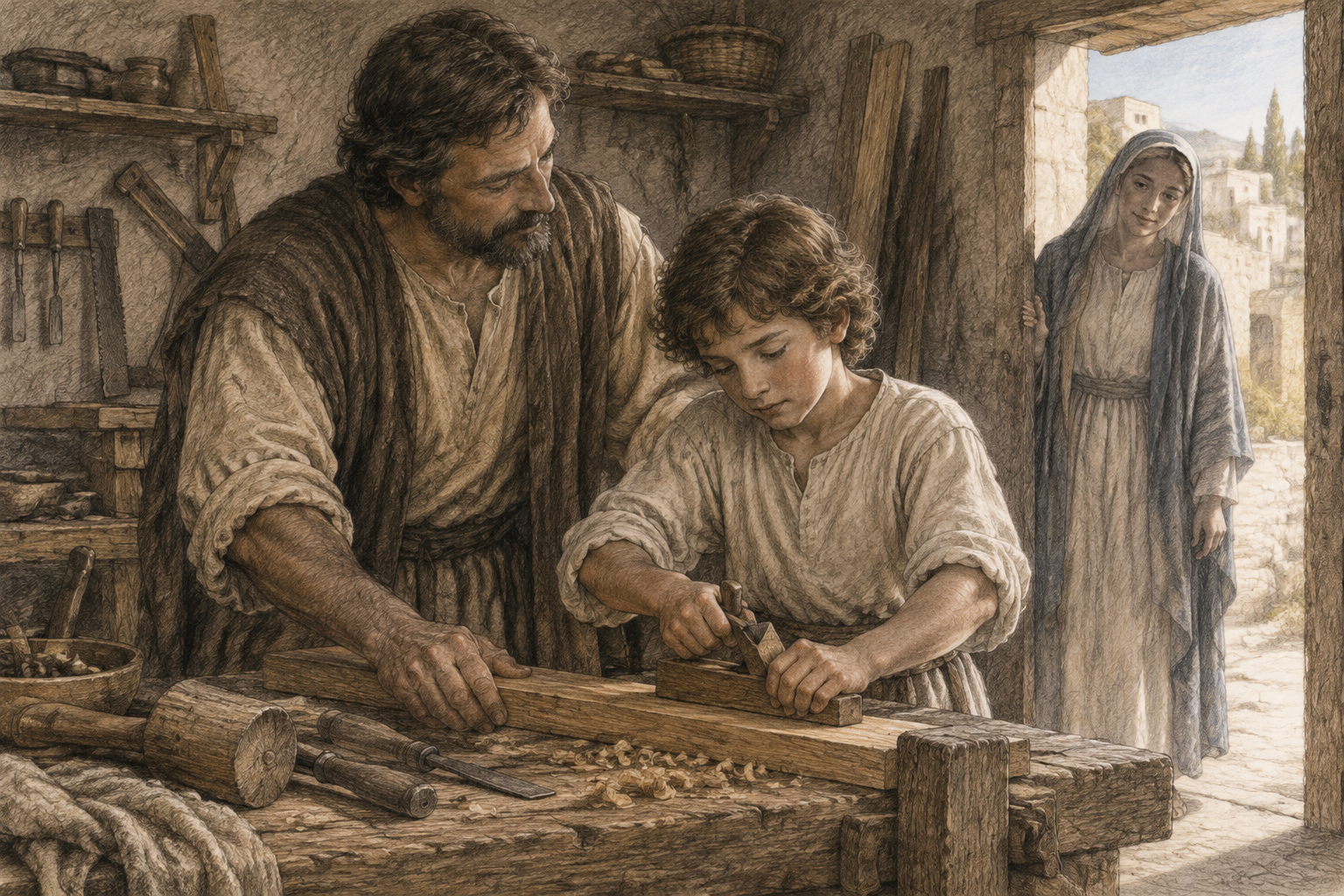
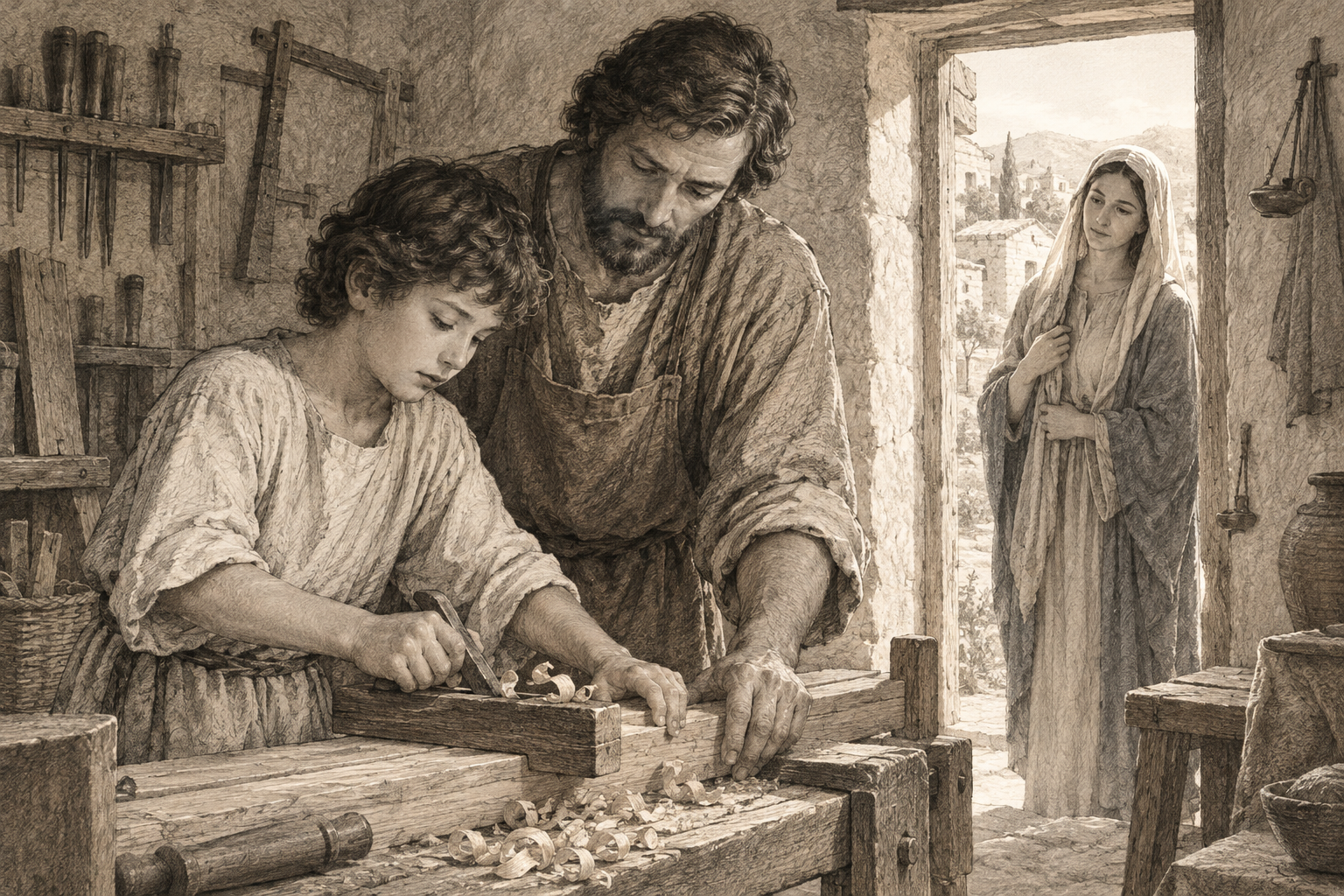
After the danger and displacement surrounding Jesus' early childhood, the Holy Family settles in Nazareth Matthew 2:23. Much of Joseph's fatherhood belongs to these hidden years. They were likely filled with the ordinary demands of providing food, maintaining a home, practicing the faith of Israel, and teaching Jesus the habits of human work.
Jesus was known as the carpenter's son Matthew 13:55. That description suggests how closely Joseph's trade and household were associated with him. The eternal Son truly entered human family life. He did not merely appear to grow. He accepted the ordinary rhythms of childhood and was obedient to Mary and Joseph Luke 2:51.
The Catechism of the Catholic Church teaches that Jesus' obedience in the hidden life fulfilled the fourth commandment and reflected his filial obedience to his heavenly Father. Joseph's role in that hidden life was therefore part of the mystery of the Incarnation. Through an ordinary human home, the Son of God entered the patterns of work, learning, worship, and family affection.
For many fathers, this may be the most encouraging part of Joseph's witness. Most paternal love is not expressed in dramatic rescues. It appears in meals prepared, bills paid, apologies offered, prayers repeated, rides given, boundaries maintained, and promises kept. Much of it goes unseen. Nazareth teaches that hidden faithfulness is not insignificant to God.
Chastity made his love more generous
Joseph's chaste marriage to Mary should not be imagined as cold or emotionally distant. Christian chastity is not the absence of love. It is love purified from possession. Joseph does not treat Mary as someone existing for his gratification. He reverences the mystery of her vocation and gives himself to the mission God has entrusted to them together.
His chastity also shapes his fatherhood. He loves Jesus without needing to claim Jesus as his own achievement. He does not compete with the child's divine identity or make paternal love depend on biological resemblance. He receives the place God gives him and does not grasp for another.
This is a demanding freedom. Parents can be tempted to turn children into proofs of their own success. They may try to direct a child's vocation, personality, or future according to their private hopes. Joseph reminds parents that their children finally belong to God. The parental task is not to manufacture a predetermined life, but to help a person hear and answer God's call.
Wisdom for ordinary believers
Joseph's vocation was unique, but the habits visible in his life can be practiced by anyone. Fathers may see these habits as a direct examination of their paternal calling. Other believers can recognize in them a pattern for spiritual maturity.
- Listen before acting. Joseph does not confuse quick reaction with courage. He allows God's word to correct his fear and redirect his plans.
- Make mercy part of justice. Even in confusion, Joseph refuses to humiliate Mary. Truth and compassion are not enemies in the life of a righteous person.
- Accept costly responsibility. Joseph's yes requires changed plans, physical hardship, work, and uncertainty. Love becomes credible when it remains faithful under pressure.
- Protect without possessing. Joseph guards Jesus and Mary while respecting the mystery of who they are before God.
- Honor hidden work. The years in Nazareth show that holiness often grows through duties that seem repetitive and receive little public praise.
These habits are particularly valuable when family life feels uncertain. A father may not know how every difficulty will be resolved. He may be carrying financial pressure, concern for a child, tension in a marriage, or regret over past failures. Joseph does not offer a technique that makes hardship disappear. He shows how to take the next faithful step without surrendering to fear.
His example should not become a reason for discouragement. Saints are not given to shame those who struggle. They show what grace can form in a human life. A man who recognizes failures in his fatherhood can begin again through repentance, prayer, honest conversation, and concrete acts of repair. Fidelity is renewed one decision at a time.
A fatherhood directed toward God
In the episode of the finding in the Temple, Joseph and Mary do not immediately understand Jesus' words about being in his Father's house Luke 2:49. Joseph's earthly fatherhood is genuine, but it always points beyond itself. He must help Jesus grow while knowing that the child's mission comes from the heavenly Father.
Every Christian father shares this basic limit and privilege. He is not the source of his child's ultimate identity, and he cannot be the final destination of his child's love. His task is to make the goodness, patience, and providence of God more believable through the way he lives.
St. Joseph stands beside families not as a distant ideal, but as a quiet intercessor. Fathers can ask for his courage when decisions are difficult, his restraint when anger rises, his diligence when work is tiring, and his humility when love requires going unnoticed. All believers can ask him for a heart ready to receive Christ and to guard the lives God has placed within reach. Like Joseph, we may not be told everything at once. We are asked to listen, rise, and faithfully make room for Jesus.
Keep Reading on Lets Read The Bible
Frequently Asked Questions
How can St. Joseph be called the father of Jesus if Jesus was conceived by the Holy Spirit?
Joseph was not Jesus' biological father, but his fatherhood was real. As Mary's husband, he received Jesus into his household, named him, protected him, provided for him, and raised him. Catholic teaching preserves both truths: Jesus was conceived virginally, and Joseph faithfully exercised a genuine paternal vocation.
What does St. Joseph teach modern fathers?
Joseph teaches fathers to receive children as gifts, place authority at the service of life, protect without controlling, remain faithful in hidden duties, and lead through obedience to God. His example emphasizes presence and self-giving rather than status or public recognition.
Can men who are not biological fathers imitate St. Joseph's fatherhood?
Yes. Joseph's life illuminates adoptive, foster, and spiritual fatherhood as well as biological fatherhood. Priests, godfathers, teachers, mentors, relatives, and other men can exercise a fatherly care by protecting life, communicating truth, encouraging vocation, and helping others grow in freedom before God.