Family and Vocation
The Quiet House of Nazareth: St. Joseph and the Work of Fatherhood
In protection, labor, obedience, and hidden love, St. Joseph reveals how fatherhood becomes a vocation of faithful presence.
Site Admin | October 17, 2026 | 12 views
St. Joseph speaks no recorded words in the Gospels. We meet him through decisions: he receives Mary, gives the child his name, leads his family away from danger, returns when God calls, works with his hands, and helps form a home in which Jesus grows. His silence is not emptiness. It is filled with attention, obedience, courage, and love.
From the fatherhood of St. Joseph Catholic perspective, fatherhood is more than biological descent or social status. It is a vocation to receive another person's life as a gift and responsibility before God. Joseph did not beget Jesus, who was conceived by the Holy Spirit and born of the Virgin Mary. Yet Joseph exercised a real paternal mission within the Holy Family. He loved, protected, provided for, and guided the child entrusted to him.
This makes Joseph a powerful patron not only for biological fathers, but also for adoptive fathers, foster fathers, stepfathers, grandfathers, godfathers, priests, mentors, and every man called to exercise spiritual fatherhood. His life shows that fatherhood becomes fruitful through faithful presence.
A fatherhood received rather than claimed
Matthew identifies Joseph as the husband of Mary within the genealogy that leads to Jesus Matthew 1:16. This wording protects two truths at once. Joseph is truly Mary's husband, but he is not the biological father of Jesus. His fatherhood begins as something entrusted to him.
That trust arrives during a painful moment. When Joseph learns that Mary is with child, he does not yet understand what God is doing. He intends to act quietly rather than expose her to public shame. An angel then tells him not to fear taking Mary into his home because the child has been conceived by the Holy Spirit Matthew 1:20. Joseph responds by doing as the angel commands Matthew 1:24.
His obedience is not passive. He must surrender his previous expectations and accept a future he could not have planned. He receives both Mary and Jesus. This is the first shape of his fatherhood: not possession, but welcome.
Many fathers discover the same spiritual pattern. A child is never merely a personal project. Children arrive with their own gifts, needs, temperaments, sufferings, and vocations. A father may have hopes for them, but he cannot rightly treat them as extensions of himself. Like Joseph, he is called to receive a life that ultimately belongs to God.
The dignity of naming and belonging
The angel instructs Joseph to name the child Jesus Matthew 1:21. Joseph later gives him that name in obedience Matthew 1:25. In the biblical setting, this is not a casual detail. By naming Jesus, Joseph publicly accepts his paternal responsibility and receives him into the household of David.
Joseph cannot give Jesus his divine identity. The eternal Son receives his mission from the Father. But Joseph can give him the ordinary human belonging of a family, a home, a trade, a community, and a place in Israel's history. God chooses to let these humble realities serve the mystery of the Incarnation.
This helps fathers recognize the sacred weight of daily affirmation. Children need more than food and shelter. They need to know that they belong. A father's attention can communicate that belonging through simple actions: listening carefully, keeping promises, speaking a child's name with tenderness, setting just boundaries, apologizing after failure, and remaining present when life becomes difficult.
Fatherhood is weakened when authority becomes control or when provision becomes a substitute for relationship. Joseph offers another pattern. His authority creates room for Mary and Jesus to flourish. It does not draw attention toward himself.
Courage expressed through protection
Joseph's protective role becomes especially clear when Herod threatens the child's life. Warned in a dream, Joseph rises, takes Mary and Jesus, and departs for Egypt Matthew 2:13 Matthew 2:14. When the danger has passed, he again responds to God's direction and brings them back Matthew 2:19 Matthew 2:21.
The journey must not be sentimentalized. Joseph leads his family into displacement because remaining would be dangerous. He has to act without complete knowledge of how long the exile will last or what it will cost. His courage is measured not by dramatic speech, but by readiness to move when love requires it.
Most fathers will not face the precise danger Joseph faced, but protection remains part of paternal love. It includes guarding children from violence, neglect, exploitation, and destructive influences. It also means creating an environment in which truth can be spoken without fear. A protective father does not try to eliminate every hardship. He helps a child face hardship with wisdom, faith, and the assurance that he or she is not alone.
Protection also requires humility. A father must sometimes admit that he needs help from relatives, friends, teachers, counselors, physicians, or the parish community. Joseph's strength does not consist in self-sufficiency. It consists in prompt cooperation with grace.
The hidden holiness of work
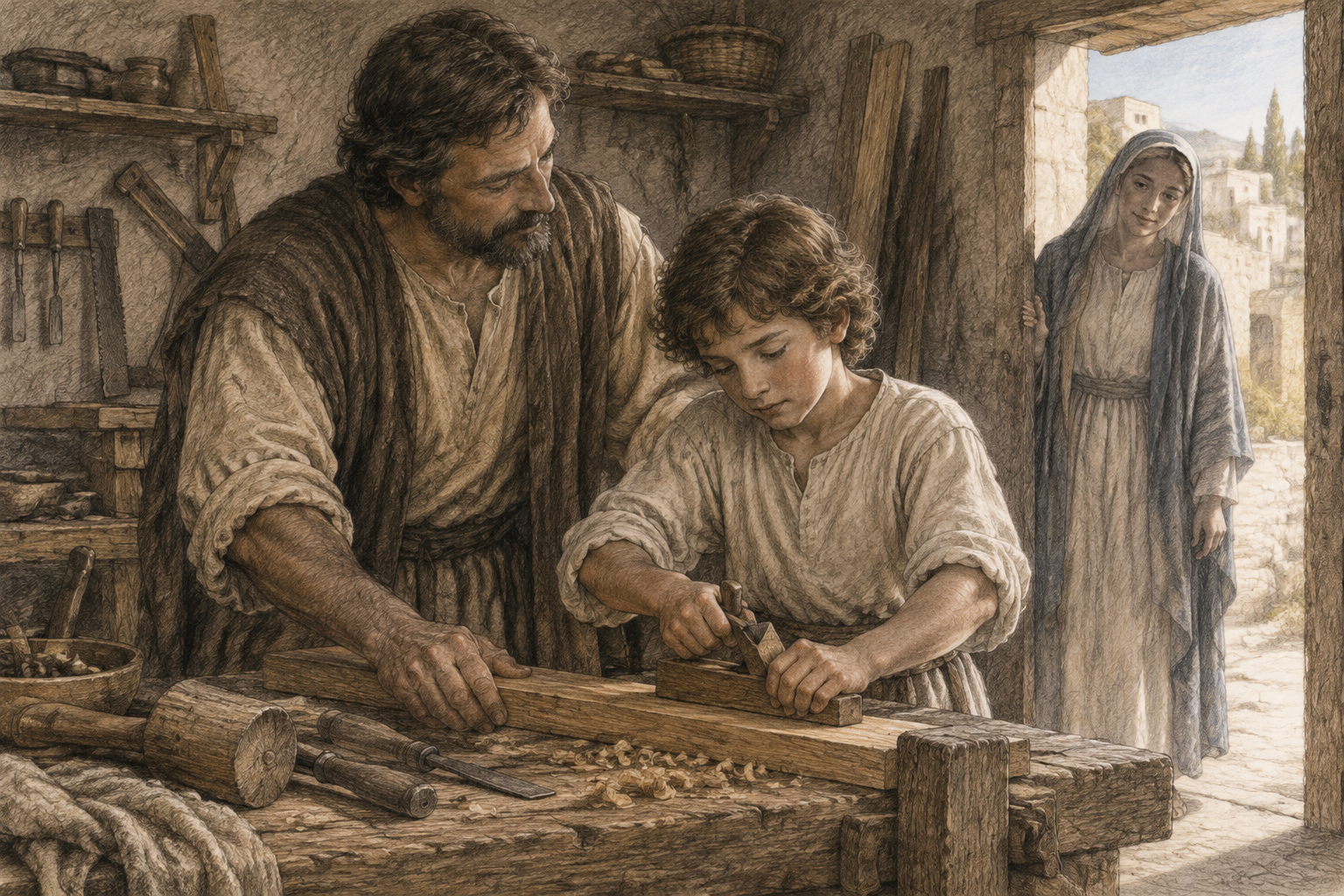
The people of Nazareth know Jesus as the carpenter's son Matthew 13:55. This brief description opens a window onto years of ordinary family life. Joseph worked to support the household, and Jesus grew up within that life of prayer, labor, meals, relationships, and local obligations.
Work is part of Joseph's paternal gift, but Catholic faith does not reduce a father's value to income. Employment can be unstable. Illness or disability can limit what a man is able to do. Some fathers carry the strain of long hours, unemployment, debt, or work that feels unnoticed. Joseph reminds them that honest labor has dignity, while also reminding families that a person is worth more than his productivity.
The deeper offering is the gift of self. A father may offer that gift through paid work, household tasks, nighttime care, patient instruction, prayer, or a difficult decision made for the good of the family. These hidden acts are not interruptions to a spiritual life. When united to God, they become part of it.
At Nazareth, the Son of God entered the rhythm of ordinary labor. Jesus lived in obedience within the Holy Family and grew in wisdom and favor Luke 2:51 Luke 2:52. The home and workshop of Joseph therefore teach that holiness can mature amid tools, chores, fatigue, and repeated duties.
Authority that listens before it acts
Joseph has genuine responsibility, yet he repeatedly listens before acting. He does not invent his mission. He receives it through prayerful obedience. This makes his authority both strong and restrained.
Christian fatherhood cannot be modeled on domination. Its source is God, before whom every human father must kneel. St. Paul speaks of the Father from whom every family in heaven and on earth is named Ephesians 3:14 Ephesians 3:15. A father's authority is therefore accountable. It is given for service, protection, formation, and love.
This kind of authority requires self-command. Anger, fear, pride, and exhaustion can tempt a father to use harsh words or withdraw into silence. Joseph's example invites a pause before reaction. Listening to God does not remove the need for action. It purifies action so that it serves the good of others.
Fathers can practice this listening by praying before major decisions, seeking their spouse's counsel, hearing a child without immediate correction, and examining whether discipline is motivated by love or wounded pride. Firmness and tenderness are not opposites. Both belong to mature fatherhood.
When fathers feel inadequate
Joseph's holiness can seem intimidating if it is treated as effortless perfection. The Gospel, however, places him in circumstances filled with uncertainty. He faces a mysterious pregnancy, forced travel, political danger, exile, and the ordinary burden of providing for a family. During the pilgrimage to Jerusalem, Mary and Joseph experience the anguish of searching for the missing twelve-year-old Jesus. Mary tells him that his father and she have been looking for him with great anxiety Luke 2:48.
That scene matters because many fathers know the fear of not being enough. They worry about finances, their children's choices, their own past mistakes, or their ability to hand on the faith. Some carry wounds from their own fathers. Others grieve children they rarely see, children who have died, or children they hoped to have but never received.
Joseph does not offer an easy answer to every sorrow. He offers companionship in faithful responsibility. His example says that fear need not have the final word. Grace often meets a father not after he has mastered every problem, but while he is taking the next loving step.
Where a father has sinned, grace also makes repentance possible. An apology does not destroy paternal authority. A sincere admission of wrongdoing can restore trust and teach children that mercy is real. The sacraments, especially Reconciliation and the Eucharist, strengthen men to begin again rather than hide behind shame.
Practices shaped by St. Joseph
Devotion to St. Joseph should lead toward imitation. His virtues can enter family life through modest, repeatable practices.
- Begin with reception. Thank God for each family member as a person entrusted to your care, not as someone to control.
- Choose presence. Set aside regular time in which a child or spouse receives undivided attention.
- Protect the home. Establish wise boundaries around media, speech, schedules, and relationships while explaining the good those boundaries serve.
- Honor honest work. Offer daily labor to God, and do not despise tasks that remain unseen.
- Practice prompt obedience. When conscience reveals a needed apology, sacrifice, or change, do not delay without reason.
- Pray for your family. Bring each person's needs before God by name, asking for wisdom rather than mere control over outcomes.
- Accept support. Seek help when burdens exceed your strength. Christian fatherhood belongs within the communion of the Church, not in isolation.
These practices are not reserved for men whose family life looks ideal. St. Joseph is close to families living with uncertainty, migration, financial pressure, hidden sacrifice, and disrupted plans. He is also a patron for men whose fatherhood is spiritual rather than biological. Any man who protects life, teaches truth, encourages holiness, and remains faithfully present can reflect something of Joseph's paternal care.
Love made visible in daily faithfulness
Joseph's life directs attention beyond himself. He helps Mary carry out her unique vocation, and he guards the childhood of Jesus. His greatness lies in placing his strength at the service of God's saving work.
This is why his quiet fatherhood remains so compelling. He does not confuse love with recognition. He does not need to occupy the center in order to be essential. Through his consent, labor, protection, and obedience, the home of Nazareth becomes a place where God's promise is welcomed.
Fathers and spiritual fathers can ask St. Joseph to pray for the same grace: to receive rather than possess, to protect without controlling, to work without making work an idol, and to lead by listening to God. Such fatherhood may remain largely hidden from the world. In the hands of grace, however, its ordinary acts of fidelity can help another person grow in wisdom, freedom, and love.
Keep Reading on Lets Read The Bible
Frequently Asked Questions
Was St. Joseph the biological father of Jesus?
No. Catholic faith teaches that Jesus was conceived by the Holy Spirit and born of the Virgin Mary. Joseph was Mary's true husband and exercised a real paternal role by receiving, naming, protecting, supporting, and raising Jesus. His fatherhood was not biological, but it was genuine and central to the life of the Holy Family.
Why is St. Joseph a model for fathers today?
St. Joseph models fatherhood through faithful presence, protective courage, honest work, prayerful listening, and obedience to God. He shows that paternal authority is meant for service rather than control. His example also speaks to adoptive fathers, foster fathers, stepfathers, grandfathers, godfathers, priests, and spiritual mentors.
How can a family grow in devotion to St. Joseph?
A family can ask for St. Joseph's intercession in daily prayer, celebrate his feast days, meditate on the Gospel accounts of his life, and imitate his virtues through work, protection, patience, and care for one another. Devotion is most fruitful when it leads to greater trust in God and more faithful love within the home.