Family and Vocation
When Two Lives Become a Sign of Grace
Marriage reveals its sacramental depth through covenant, daily fidelity, forgiveness, and a shared path toward holiness.
Site Admin | October 14, 2026 | 24 views
Christian marriage is easy to sentimentalize. Wedding days naturally draw our attention to beauty, promise, family, and joy. Yet the sacrament reaches far beyond the ceremony. It enters the years that follow: the early hopes, the difficult conversations, the meals shared in silence or laughter, the sacrifices no one else sees, and the repeated choice to remain faithful.
A marriage as a sacrament reflection must therefore begin with more than romance. In Catholic teaching, marriage is a vocation and a covenant. It is a real path of grace in which a baptized man and woman give themselves to one another for life. Their union is ordered toward their good as spouses and toward the generation and education of children. Through the sacrament, their faithful love becomes a visible sign of Christ's faithful love for his Church.
This does not mean that every moment of marriage feels holy. It means that God is truly at work within the covenant, including in ordinary and difficult moments. The sacrament does not replace human effort. It strengthens husband and wife to love with a fidelity that relies upon grace rather than emotion alone.
Marriage begins with God's gift
Scripture presents marriage not merely as a useful human arrangement, but as part of the created order. In Genesis, man and woman recognize one another as belonging together in a unique communion. A man leaves his father and mother, clings to his wife, and the two become one flesh Genesis 2:24.
The phrase one flesh includes the bodily union of husband and wife, but it is not limited to a single act. It points toward a shared life. Their homes, hopes, responsibilities, sorrows, decisions, and futures become joined. Each spouse remains a distinct person, yet they are no longer called to live as though the other's good were separate from their own.
Jesus returns to this passage when questioned about divorce. He directs his listeners back to the Creator's intention and declares that what God has joined together should not be separated Matthew 19:6. His words reveal both the dignity and seriousness of the marital covenant. Marriage is not simply a private agreement that remains in force only while it is convenient. It involves a bond established before God.
For this reason, Catholic marriage preparation asks a man and woman to consent freely and to embrace permanence, fidelity, and openness to life. These are not arbitrary conditions added by the Church. They belong to the kind of gift marriage is. A total gift cannot quietly reserve the right to abandon, betray, or exclude the essential goods of the covenant.
A sacrament rooted in Christ's love
Marriage between baptized persons is one of the seven sacraments. The Catechism of the Catholic Church teaches that the matrimonial covenant has been raised by Christ to the dignity of a sacrament. In the Latin tradition, the spouses confer the sacrament upon one another through their exchange of consent, while the priest or deacon receives that consent in the name of the Church under the ordinary canonical form.
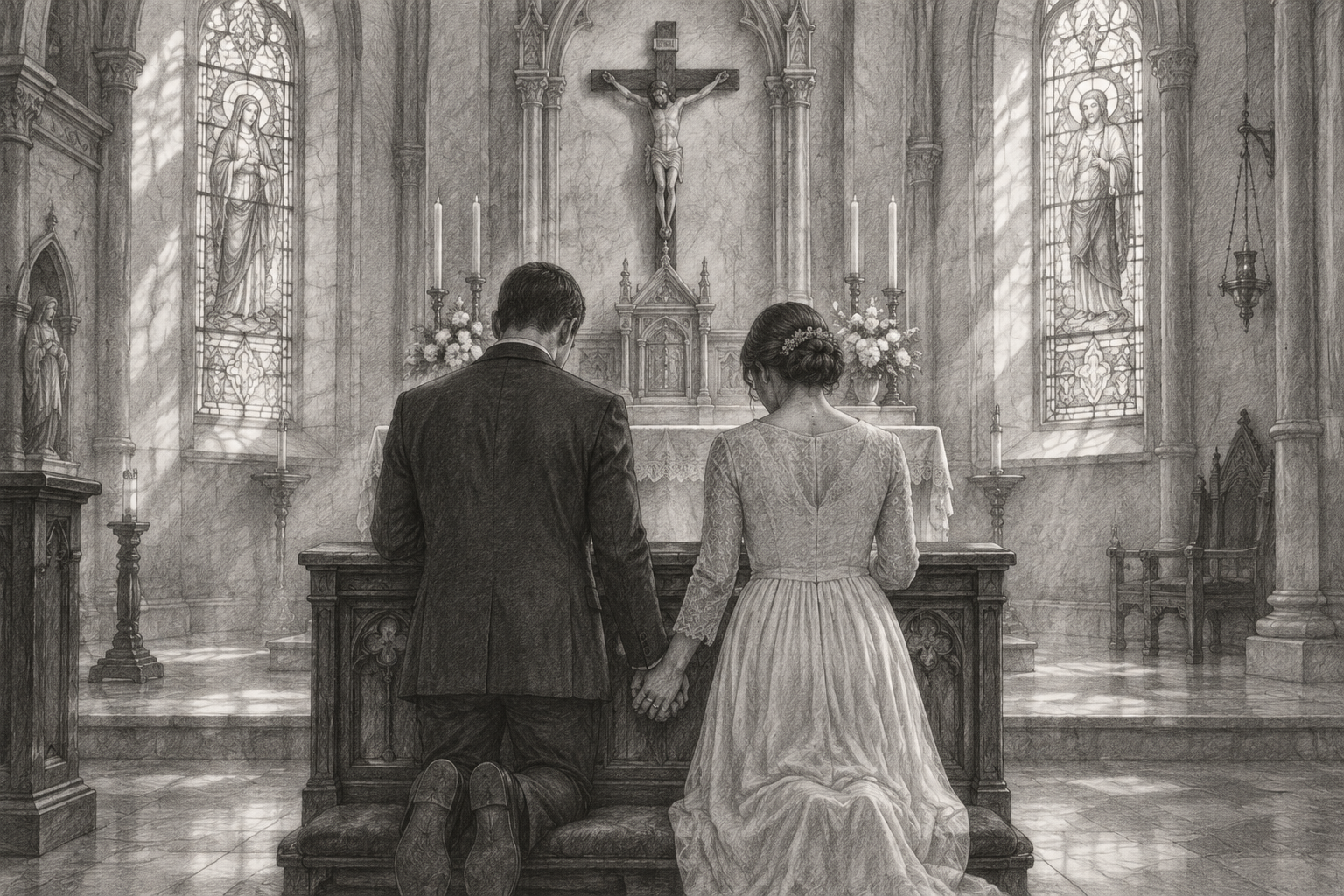
This teaching places the vows at the heart of the wedding. The spouses do not merely describe how they feel. They give and receive one another through a public act of the will. Their promises establish a lifelong covenant, and their bodily union expresses and completes the marital gift.
Saint Paul helps Christians see the mystery contained in this union. He calls husbands to love their wives as Christ loved the Church and gave himself for her Ephesians 5:25. Christ's love is not possessive, self-protective, or temporary. It is self-giving and directed toward the holiness of the beloved.
This comparison should never be used to excuse domination, intimidation, or abuse. Christian authority is modeled on the crucified Lord, who gives himself in love. Paul also calls Christians to mutual submission out of reverence for Christ Ephesians 5:21. The sacramental vision of marriage upholds the equal dignity of husband and wife while recognizing that their communion includes real duties toward one another.
Sacramental marriage is not a claim that two people love perfectly. It is a covenant in which imperfect people receive grace to learn the faithful love of Christ.
The comparison with Christ and the Church also clarifies why marriage is more than a personal source of happiness. Spouses are entrusted with a mission. Their fidelity can bear witness to a world accustomed to temporary promises. Their welcome of children can proclaim that life is a gift. Their patience in suffering can reveal hope. Their home can become a place where prayer, mercy, hospitality, and truth are practiced.
Grace enters the ordinary work of love
Sacramental grace is not magic. It does not remove differences in temperament, financial pressure, fatigue, illness, infertility, grief, or conflict. It does not guarantee that spouses will always communicate wisely. Grace heals and elevates human love, but husband and wife must cooperate with it.
That cooperation often looks remarkably ordinary. A spouse listens instead of preparing a rebuttal. Someone admits fault without attaching an excuse. A couple makes a financial decision together rather than hiding a purchase. They protect time for each other. They pray when prayer feels dry. They seek counsel before resentment hardens into contempt.
The wedding at Cana offers a fitting image. Jesus is present at a wedding feast, and when the wine fails, he responds to the need and manifests his glory John 2:11. The passage is not a promise that married life will be spared embarrassment or scarcity. It does show Christ entering the concrete needs of a household celebration. Catholic spouses can invite him into the parts of their life where patience, courage, affection, or hope seem to have run short.
Practices that make room for grace
- Pray together simply. A brief prayer before sleep, grace before meals, or a decade of the Rosary can help spouses place their shared life before God.
- Return regularly to the sacraments. The Eucharist nourishes communion with Christ, while Reconciliation teaches honesty, repentance, and trust in mercy.
- Speak gratitude aloud. Familiarity can make goodness invisible. Naming a spouse's patience, labor, or kindness strengthens affection and resists habitual criticism.
- Repair conflict promptly. Not every disagreement can be solved quickly, but contempt, threats, ridicule, and deliberate silence should never become accepted patterns.
- Seek wise help when needed. Priests, qualified counselors, physicians, and trustworthy married mentors can assist couples facing burdens they cannot carry alone.
Forgiveness is especially important, but it must be understood correctly. Forgiveness does not declare wrongdoing harmless, and it does not require someone to remain in immediate danger. In cases of violence or abuse, protecting the victim and children is urgent. Separation can be legitimate, even when the marital bond remains. Mercy and justice are not enemies.
Openness to life and the vocation of the family
The marital covenant is ordered toward life. The Church teaches that the unitive and procreative meanings of marital love belong together. Openness to children is therefore not an optional decoration added to an otherwise complete understanding of marriage. It expresses the generous character of the spouses' gift.
Children are not owed to a married couple, and couples who experience infertility should not be treated as though their marriages were less valuable. Their sorrow deserves compassion, not simplistic explanations. A marriage without children can still be fruitful through service, hospitality, spiritual parenthood, care for relatives, and works of mercy. The vocation remains real, and the spouses' love remains capable of bearing good fruit.
When children are given, parents become their first teachers in faith. This teaching begins before a child can understand a catechism lesson. Children observe how adults apologize, handle money, speak about neighbors, attend Mass, respond to suffering, and treat the vulnerable. The family becomes a domestic church when Christ is welcomed into these daily habits.
No Catholic household accomplishes this perfectly. Family prayer may be interrupted. Sunday mornings may be chaotic. Parents may discover that their example has been inconsistent. Holiness in the home does not require presenting a flawless image. It requires returning to God, asking forgiveness, and beginning again.
Marriage is a shared road to holiness
The deepest purpose of marriage is not merely that two people make each other comfortable. Spouses are called to help one another reach heaven. At times this happens through encouragement and affection. At other times it happens through patient truthfulness, sacrifice, or the quiet endurance required by sickness and age.
This shared road changes the way difficulties are viewed. A conflict is not automatically evidence that a marriage has failed. It may reveal selfishness, fear, or an old wound that needs attention. A season without strong romantic feeling does not erase the covenant. Feelings matter, but they are not the whole measure of love. Christian love includes steadfast willing of the other's good.
Husband and wife also need the wider Church. Marriage is personal, but it is not isolated. The parish community prays for couples, celebrates their children, accompanies them in grief, and helps them remember their promises. Married people, in turn, serve the Church through the stability, generosity, and witness of their homes.
Those who are unmarried, widowed, separated, or carrying painful family histories should not hear the Church's praise of marriage as a denial of their dignity. Every baptized person is called to holiness, and human fulfillment is found finally in communion with God. Marriage is one vocation within the Church, not the measure of every person's worth.
Remembering the promise in changing seasons
A wedding vow is spoken once, but it must be lived repeatedly. The meaning of faithful love becomes clearer as circumstances change. The promise made in youth may later be expressed by caring for a spouse through disability, remaining tender during grief, adapting to reduced income, or praying beside a hospital bed.
Couples can benefit from remembering the actual promises they made. An anniversary can be an occasion not only for celebration, but also for gratitude and examination. Where has grace sustained us? Where have we grown careless? Is there an apology that has been postponed? What burden is one spouse carrying alone? What gift is God asking our family to share?
A mature marriage as a sacrament reflection does not pretend that covenant love is effortless. It recognizes that Christ does not stand at a distance from the vows. He remains near, offering mercy after failure, strength for sacrifice, and joy that can deepen after romance has become rooted in tested fidelity. In the ordinary faithfulness of two baptized people who continue to give themselves to one another, the Church sees a quiet but powerful sign: Christ loves his people, keeps his covenant, and does not abandon the work of grace.
Keep Reading on Lets Read The Bible
Frequently Asked Questions
What makes a Catholic marriage a sacrament?
A valid marriage between two baptized persons is a sacrament because Christ has raised the matrimonial covenant to a means and sign of grace. The spouses freely give and receive one another through consent, forming a lifelong and exclusive union ordered toward their good and the generation and education of children.
Does sacramental grace prevent serious problems in marriage?
No. Grace does not remove human weakness, suffering, or the need for communication and practical help. It strengthens spouses to live their covenant faithfully. Couples may also need pastoral care, medical assistance, or qualified counseling. When abuse is present, immediate safety and appropriate professional and legal help are essential.
Is an annulment the same as a Catholic divorce?
No. A declaration of nullity does not dissolve a valid sacramental marriage. After a careful process, a Church tribunal may determine that a valid marital bond was never established because something essential was absent at the time consent was exchanged. Civil divorce addresses the legal effects of a marriage, while a declaration of nullity concerns whether a valid bond arose in the first place.