Sacraments and Liturgy
Nine Fridays Given to the Heart of Jesus
The history, spiritual purpose, and faithful practice of the First Friday devotion
Site Admin | September 8, 2026 | 86 views
The First Friday devotion is one of the Church's best-known practices in honor of the Sacred Heart of Jesus. For generations, Catholics have attended Mass and received Holy Communion on the first Friday of nine consecutive months. Some learned the practice from parents or grandparents. Others first encountered it through a parish announcement, a holy card, or an image of Christ pointing to his wounded and burning Heart.
Yet familiarity does not always bring understanding. The devotion can be reduced to a checklist, treated as a guarantee of salvation, or separated from the Eucharistic life that gives it meaning. First Friday devotion explained carefully is something far richer. It is a sustained response to the love of Christ, especially his love revealed in the Passion and made sacramentally present in the Eucharist.
The heart at the center of the devotion
Devotion to the Sacred Heart honors Jesus Christ himself, with particular attention to his human Heart as a sign of his divine and human love. The object of the devotion is not an isolated organ or merely a religious image. Catholics adore the one divine Person of Jesus Christ, true God and true man, whose real human Heart loved, suffered, and was pierced for us.
This focus is deeply biblical. In Scripture, the heart often represents the center of the person, including one's love, intention, desire, and will. Jesus describes himself as meek and humble of heart and invites the burdened to come to him: Matthew 11:28. At the Last Supper, he gives his Body and Blood to his disciples and commands them to continue this memorial: Luke 22:19. On Calvary, a soldier pierces his side, and blood and water flow out: John 19:34.
As the Father has loved me, so I have loved you. Remain in my love. John 15:9
The Sacred Heart brings these mysteries together. It directs attention to the personal love of the Savior, the cost of that love, and the invitation to remain in it. The flames often shown around the Heart signify burning charity. The cross recalls Christ's saving sacrifice. The crown of thorns and the wound point to suffering endured for sinners.
How the First Friday practice developed
Christian meditation on the wounded side and loving Heart of Christ developed over many centuries. Medieval saints and spiritual writers contemplated the open side of Jesus as a refuge of mercy and a sign of the life poured out for the Church. In the seventeenth century, St. John Eudes helped promote public liturgical devotion to the Hearts of Jesus and Mary.
The First Friday practice is especially associated with St. Margaret Mary Alacoque, a Visitation nun at Paray-le-Monial in France. Between 1673 and 1675, she reported a series of encounters with Christ concerning devotion to his Sacred Heart. These included requests connected with Holy Communion on first Fridays, prayer in memory of his agony, and a feast honoring the Sacred Heart. St. Claude de la Colombiere, a Jesuit priest and her spiritual director, helped her discern and spread the devotion.
As with every approved private revelation, these reported encounters do not add to the deposit of faith or replace the public revelation given in Christ and handed on through Scripture and Tradition. The Church permits and encourages authentic private devotions when they lead the faithful more deeply into the Gospel, the sacraments, and communion with Christ.
Devotion to the Sacred Heart continued to spread. In 1856, Pope Pius IX extended the feast of the Sacred Heart to the universal Church. Later popes taught about Christ's love and the practice of reparation, helping establish the devotion as a significant part of Catholic spiritual life.
Why Friday is set apart
Friday is traditionally associated with the Passion and death of the Lord. By choosing the first Friday of the month, the faithful unite their prayer and Communion with Christ's self-offering on Calvary. The practice also gives spiritual shape to the calendar. Instead of remembering the Passion only during Lent and Holy Week, a Catholic returns to it month after month.
This repetition is not empty when it is offered with attention and love. Human relationships grow through faithful acts repeated over time. Prayer does too. Nine first Fridays provide an extended school of conversion in which a person learns to return to Christ, examine the conscience, seek mercy, and receive the Eucharist more gratefully.
Reparation as a response of love
A central purpose of First Friday devotion is reparation. This word can sound severe, but its foundation is love. Sin offends God, wounds the sinner, and harms communion within the Church. Reparation is a prayerful response to that damage. It joins repentance, intercession, and self-offering to the perfect sacrifice of Christ.
No human devotion adds anything lacking in the Cross. Jesus has accomplished redemption through his death and resurrection. Reparation means allowing his saving love to transform us and offering our prayer for sins, including indifference toward God, contempt for holy things, and unworthy treatment of the Eucharist.
Reparation also requires more than emotion. A person cannot meaningfully console the Heart of Christ while deliberately refusing his commandments or ignoring a neighbor in need. Love for the Sacred Heart should bear fruit in confession, forgiveness, honesty, works of mercy, and greater reverence at Mass.
The nine consecutive First Fridays
The traditional practice is to receive Holy Communion on the first Friday of nine consecutive months in honor of the Sacred Heart and with a spirit of reparation. The devotion is often associated with a promise of the grace of final repentance or perseverance. This promise must be understood within Catholic teaching about grace, freedom, conversion, and the sacraments.
The nine Fridays are not a mechanical contract that makes later faithfulness unnecessary. Nor are they permission to presume upon God's mercy. Salvation is God's gift, and the grace offered through a devotion calls for cooperation. The practice should foster enduring friendship with Christ rather than confidence in having completed a minimum requirement.
Holy Communion must also be received worthily. St. Paul warns Christians against receiving the Body and Blood of the Lord without proper discernment: 1 Corinthians 11:27 and 1 Corinthians 11:28. A Catholic conscious of mortal sin should receive sacramental confession before receiving Communion. Confession does not ordinarily need to occur on the Friday itself, but the communicant must be properly disposed and in a state of grace.
How to begin the devotion faithfully
A person does not need elaborate materials to begin. The heart of the practice is sacramental participation, a sincere intention, and perseverance.
- Find the first Friday Mass time. Check the parish schedule in advance, since weekday Mass times may differ from Sunday schedules.
- Prepare through prayer and examination of conscience. Bring both gratitude and sin honestly before Christ. Ask for the grace to receive him with faith.
- Go to confession when needed. If conscious of mortal sin, receive absolution before Communion. Regular confession is also a valuable companion to the devotion even when mortal sin is not present.
- Attend Mass and receive Holy Communion. Offer your Communion in honor of the Sacred Heart and in reparation for sin, especially offenses against Christ's love and the Eucharist.
- Make a sincere thanksgiving. After Communion, remain attentive to the Lord. Thank him, entrust particular people to his mercy, and ask that your life be conformed to his Heart.
- Continue for nine consecutive months. Mark the dates beforehand and protect them as far as your circumstances allow.
A short prayer after Communion may be simple: Jesus, meek and humble of heart, make my heart like yours. I offer you my love, repentance, and trust. Have mercy on sinners, strengthen your Church, and teach me to remain faithful to you.
No particular private prayer is required for the devotion to be meaningful. A Litany of the Sacred Heart, an act of reparation, silent Eucharistic thanksgiving, or prayer with the Passion narratives may help. The important point is that additional prayers serve the sacramental encounter rather than overshadow it.
If a Friday is missed
Because the traditional practice specifies nine consecutive first Fridays, someone who misses one would ordinarily begin the sequence again. This should not become a cause of panic or scrupulosity. Illness, caregiving duties, lack of access to Mass, and unexpected emergencies are real human circumstances. God is not searching for technical reasons to reject a sincere soul.
If there is uncertainty, a parish priest can provide pastoral guidance. The devotion is a voluntary spiritual practice, not a binding precept. Missing a First Friday is not itself a sin. Beginning again can simply become another humble act of love.
Keeping the devotion connected to the liturgy
First Friday belongs within the Church's sacramental life. It should deepen participation in Mass, not make one attentive only to a private intention. At every Mass, the whole Church is drawn into Christ's offering to the Father. The communicant receives not a symbol of affection but Christ himself, truly present in the Eucharist.
For this reason, the best preparation includes listening carefully to the readings, joining in the prayers, and participating in the liturgical action. The Sacred Heart devotion helps the faithful recognize whose love is present on the altar. The liturgy, in turn, protects the devotion from becoming sentimental or self-centered.
The months may gradually reveal areas that Christ desires to heal. One First Friday may be offered amid grief, another amid distraction, and another after a difficult confession. Perseverance teaches that devotion is not measured by the intensity of a feeling. It is expressed through the repeated gift of oneself to the Lord.
A heart formed by the Heart of Christ
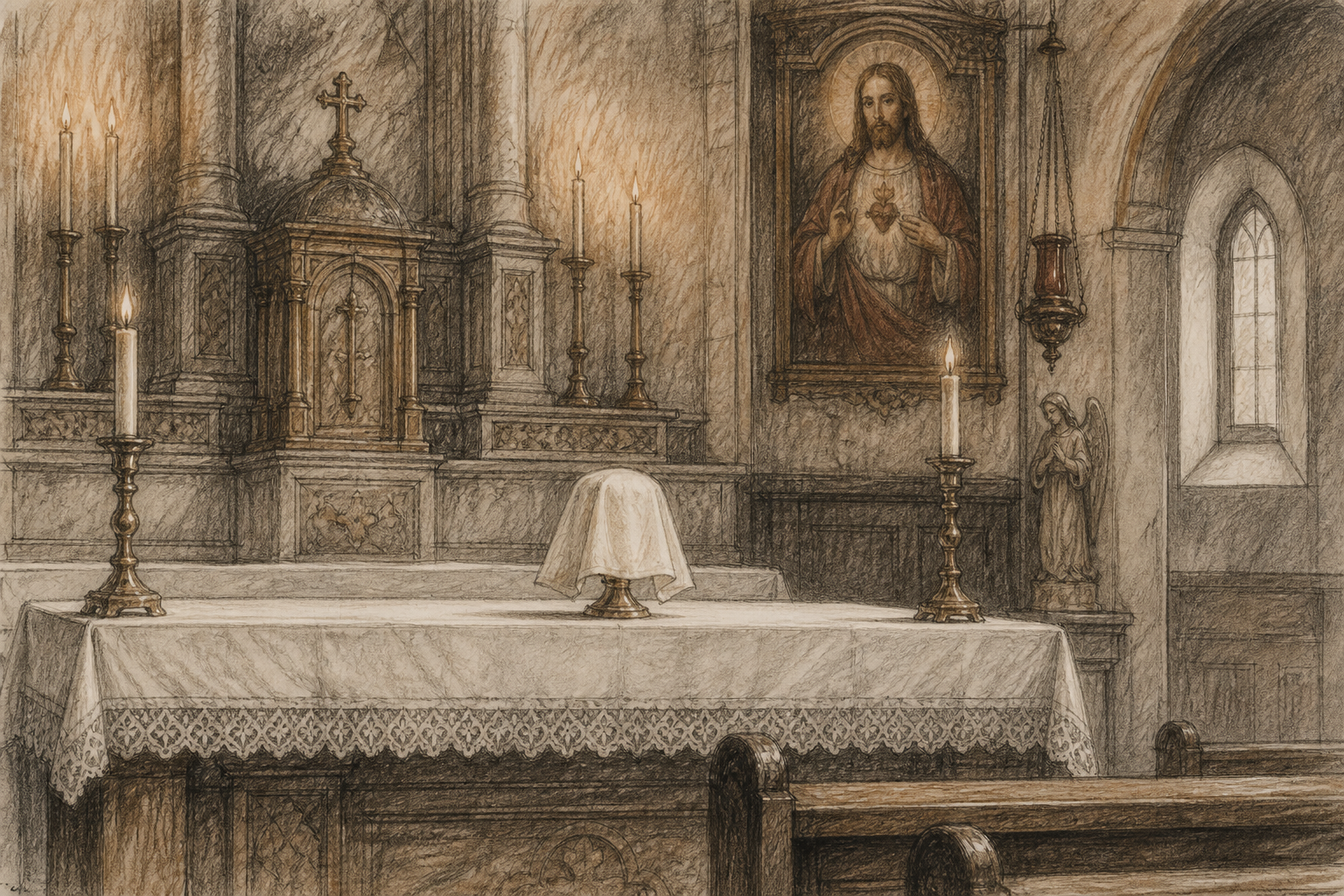
The most fitting fruit of the nine Fridays is a more Eucharistic life. A person who honors the Heart of Jesus should become more patient, truthful, merciful, and ready to sacrifice. Reverence before the tabernacle should be accompanied by charity at home. Reparation for indifference should lead to greater attentiveness toward the lonely and forgotten. Gratitude for mercy should make forgiveness easier to extend.
The First Friday devotion is therefore both intimate and ecclesial. It brings a person close to Jesus, but never in isolation from his Church, his sacraments, or the needs of the world. Month by month, the faithful place weakness, repentance, and hope before the wounded Heart of Christ. He receives no perfect offering from us. He asks instead for a heart willing to return, to remain, and to be taught how to love.
Keep Reading on Lets Read The Bible
Frequently Asked Questions
What is required for the First Friday devotion?
The traditional practice is to receive Holy Communion on the first Friday of nine consecutive months in honor of the Sacred Heart of Jesus and with an intention of reparation. The communicant should be properly disposed and in a state of grace. Confession is necessary before Communion if the person is conscious of mortal sin.
Is the First Friday devotion required for Catholics?
No. It is a voluntary private devotion, not a precept of the Church. Catholics may practice it as a way of deepening Eucharistic faith, repentance, and love for the Sacred Heart of Jesus.
What happens if I miss one of the nine First Fridays?
Since the traditional devotion calls for nine consecutive first Fridays, the usual practice is to begin the sequence again. Missing a Friday is not itself a sin, and illness or other serious circumstances should not cause anxiety. A priest can offer guidance when circumstances are uncertain.