Sacraments and Liturgy
Listening in the Middle of the Mass: Rediscovering the Church's First Great Table
The Liturgy of the Word is not a prelude to Mass but a real encounter with the living God who still speaks through Scripture, prayer, and proclamation.
Site Admin | August 22, 2026 | 78 views
More than a reading before Communion
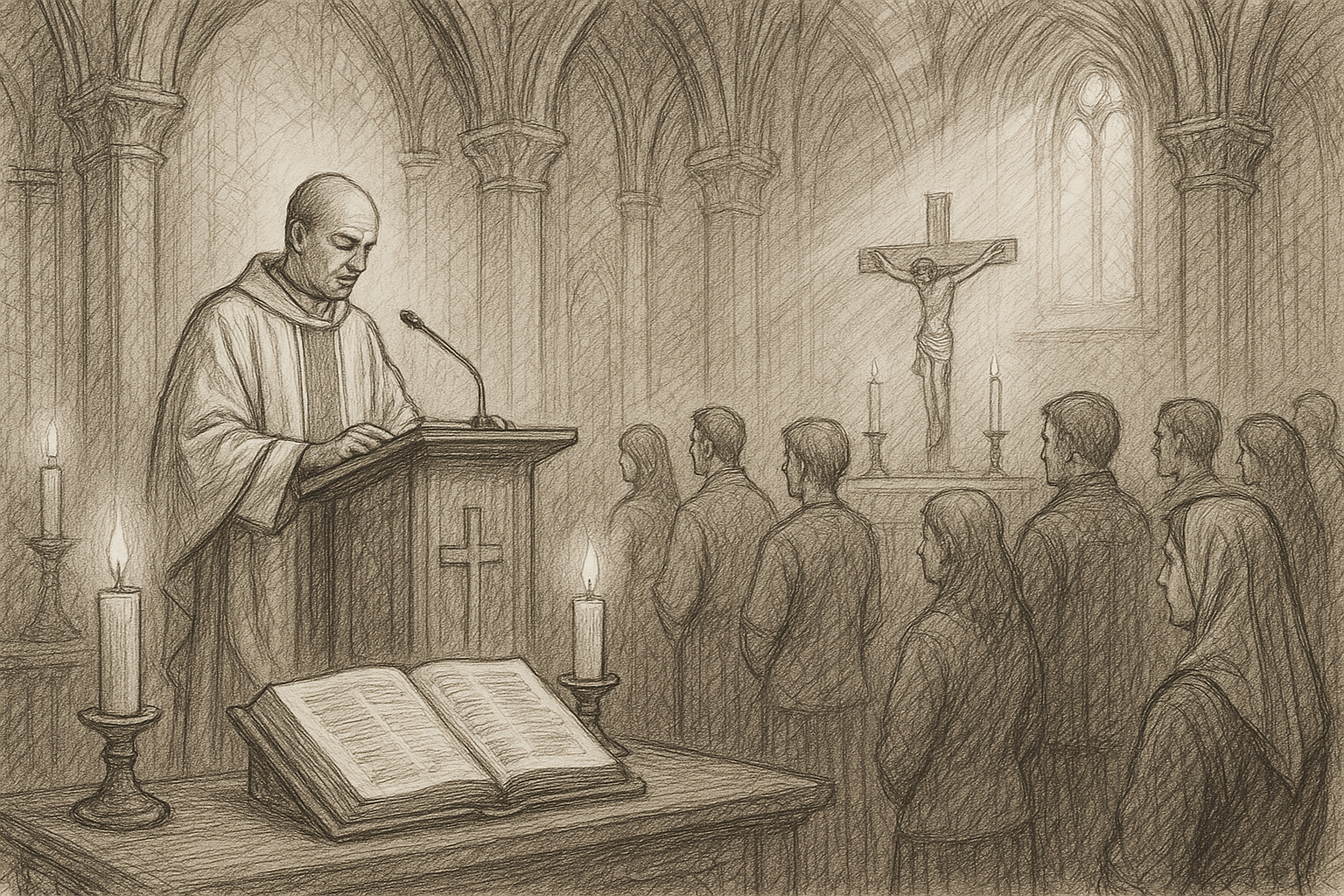
For many Catholics, the Liturgy of the Word can feel like the part of Mass that comes before the part that matters most. The Scriptures are read, the homily follows, prayers are said, and then the Eucharistic Prayer begins. But the Church does not treat this first major movement of Mass as a warm-up. It is a true act of worship, one in which God addresses His people and the people respond in faith.
The phrase the Liturgy of the Word Catholic guide points to something simple but easily forgotten: the Lord is not silent at Mass. He speaks. Not in a vague or private way, but through the public proclamation of His Word, entrusted to the Church and heard in the assembly of the faithful. The Word proclaimed at Mass is meant to be received, believed, and carried into daily life.
This is why the Church gives such care to the readings, the psalm, the Gospel, and the homily. The Word of God is not read merely to inform the mind. It is proclaimed so that hearts may be opened. In the Mass, the Church stands before the living God and listens.
Where the Liturgy of the Word comes from
The roots of the Liturgy of the Word reach deep into salvation history. God has always gathered a people and spoken to them. In the Old Testament, the covenant was renewed through hearing and obedience. At Sinai, the people of Israel heard the Lord's commandments and answered, We will do all that the Lord has spoken Exodus 24:7. That pattern, hearing and responding, is already liturgical.
In the synagogue, the Jewish people assembled to hear the Scriptures read and explained. Jesus Himself entered that pattern when He read from Isaiah in the synagogue at Nazareth and declared the word fulfilled in their hearing [[VERSE|luke|4|16-21|Luke 4:16-21]]. The early Church inherited this rhythm of proclamation and interpretation, and the Mass preserved it in a uniquely Christian form.
Saint Paul describes the faith as something that comes through hearing: Faith comes from what is heard Romans 10:17. That verse captures the spiritual logic of the Liturgy of the Word. God initiates. The Church listens. Faith is stirred, nourished, and deepened by the voice of God made present in Scripture.
What happens in the Liturgy of the Word
Though the exact details can vary by day and season, the structure remains steady. The Liturgy of the Word usually includes these elements:
- a reading from the Old Testament, or during Eastertide from the Acts of the Apostles
- a responsorial psalm
- a reading from the New Testament letters or another apostolic writing
- the Gospel Acclamation
- the Gospel reading
- the homily
- the Profession of Faith on Sundays and solemnities
- the Prayer of the Faithful
Each part has a distinct role. The first reading usually reveals God's covenant action in history. The psalm turns the assembly's response into prayer. The second reading draws the Church into apostolic teaching. The Gospel stands at the center because in it Christ Himself speaks in a special way. The homily helps the faithful receive the Word in light of the Church's living faith. The Creed and the intercessions show that hearing the Word leads naturally to assent and prayer.
This is not a random collection of texts. The Church arranges the readings carefully so that the Word can be heard within the larger mystery of Christ. The same Lord who spoke through Moses and the prophets speaks in the fullness of time through His Son [[VERSE|hebrews|1|1-2|Hebrews 1:1-2]].
Why the Gospel has such a place of honor
Among the readings, the Gospel is given special reverence. The faithful stand to hear it, sing acclamation before it, and often trace the sign of the cross on forehead, lips, and heart. These gestures are not decoration. They express belief that the words of Christ deserve our fullest attention and our deepest readiness.
In the Gospel, the Church hears the deeds and words of the Lord who teaches, heals, forgives, and calls disciples. The Gospel is not simply a historical record. It is the Church's living proclamation of the One who is risen and present. When the deacon or priest announces, The Lord be with you, and then proclaims the Gospel, the assembly is being drawn into an encounter with Christ who speaks through His Church.
The liturgical reverence shown to the Gospel reminds Catholics that Scripture is not an object to examine from a distance. It is a Word to receive with faith, as from the living God.
The homily is meant to open the Word, not replace it
The homily belongs to the Liturgy of the Word because it helps bridge the gap between the text and the life of the faithful. At its best, it does not compete with Scripture or turn the Mass into a lecture. It serves the Word by unfolding its meaning within the Church's faith.
A good homily helps Catholics hear how the readings fit together, how they point to Christ, and how they call for conversion. It should illuminate, not overshadow. It is part of the Church's pastoral care that the Word be explained in a way suited to the people gathered. Yet the homily is always secondary to the readings themselves. The Church does not ask the preacher to replace Scripture, but to lead the assembly deeper into it.
For the listener, this means the best preparation is not to arrive as a consumer of religious commentary. It is to come as a disciple ready to hear. The Word is first proclaimed, then reflected upon. The heart that listens well will often find that a short phrase, a repeated image, or a single verse can linger long after Mass ends.
How the Word prepares us for the Eucharist
The Liturgy of the Word is not isolated from the rest of Mass. It leads naturally to the altar. God speaks so that His people may believe, repent, and offer themselves. Then, having been nourished by the Word, they are prepared to receive the Bread of Life.
This movement is biblical. At Emmaus, the risen Christ first opens the Scriptures to the disciples and then is recognized in the breaking of the bread Luke 24:27 [[VERSE|luke|24|30-31|Luke 24:30-31]]. The Church has long seen in that story a pattern for the Mass. Christ speaks in the Scriptures and gives Himself in the Eucharist. The two are united, not opposed.
The Second Vatican Council taught that Christ is present in His word, since it is He Himself who speaks when the Scriptures are read in the Church. That truth helps explain why Catholics should not think of the first half of Mass as lesser or optional. The same Lord is at work throughout. In the readings, He instructs. In the Eucharist, He feeds. Both are gifts of one Savior.
How ordinary Catholics can live it more deeply
Many Catholics want to pay better attention at Mass but feel distracted, rushed, or simply unfamiliar with the readings. A deeper reception of the Liturgy of the Word begins before Sunday morning. The Church's liturgy bears much more fruit when the faithful prepare a little in advance.
1. Read the readings before Mass
Even a few minutes with the Sunday readings can change the way they are heard. When the passage is already familiar, the mind is freer to notice a phrase or theme. This is not about studying Scripture as a scholar. It is about arriving with a listening heart.
2. Ask one simple question
Before Mass, it can help to ask, What is the Lord saying to me here? That question keeps the focus on receptivity rather than performance. The point is not to prove that one has understood everything. The point is to let the Word speak.
3. Follow the responses with attention
The psalm, the acclamations, and the Creed are not filler. They show that the whole assembly is answering God together. Joining those responses carefully helps form a more receptive habit of prayer. The liturgy teaches the body as much as the mind.
4. Sit with one phrase after Mass
It can be fruitful to carry one line from the readings into the rest of the day. A verse remembered on the drive home or while making dinner may continue to work quietly in the soul. The Word of God often bears fruit in silence long after the final blessing.
5. Connect Scripture with the sacramental life
The Church never separates Scripture from sacrament. The same God who speaks also acts. For this reason, hearing the Word can deepen confession, Eucharistic devotion, family prayer, and the reading of Scripture at home. A Catholic who listens at Mass will often begin to notice Scripture more readily in the rest of life.
What the Liturgy of the Word asks of us
At its core, the Liturgy of the Word asks for obedience, but not in a cold or merely external sense. In Scripture, to hear is to heed. To listen is to be willing to change. The assembly does not gather only to admire the beauty of the texts. It gathers to be converted by the God who speaks through them.
That is why the readings can comfort and unsettle at the same time. They reveal mercy, but they also reveal demands. They console the sorrowful and challenge the complacent. They announce God's faithfulness, but they also call for trust. A faithful Catholic does not approach the Word as a passive observer, but as one who expects the Lord to address real life.
The Liturgy of the Word is therefore both familiar and astonishing. Familiar, because it happens every day and every Sunday across the world. Astonishing, because in that ordinary pattern the living God speaks to His people again and again. If Catholics recover even a little of that wonder, the first half of Mass will no longer feel like a waiting room. It will feel like holy ground.
And when the Scriptures are heard that way, the rest of the liturgy opens more fully too, because the same Lord who speaks in the Word is the Lord who gives Himself in the Eucharist, and His voice is still enough to gather the Church, week after week, into faith.
Keep Reading on Lets Read The Bible
Frequently Asked Questions
Is the Liturgy of the Word less important than the Eucharistic Prayer?
No. The Liturgy of the Word and the Liturgy of the Eucharist are two inseparable parts of one Mass. The first prepares and disposes the faithful to receive the second, and both are ordered to the same encounter with Christ.
Why are there multiple Scripture readings at Mass?
The Church uses multiple readings to show the unity of God's plan of salvation. The Old Testament, psalm, apostolic reading, and Gospel all help reveal how the Scriptures culminate in Christ.
How can I pay better attention during the readings?
Reading the passages beforehand, listening for one phrase that stands out, and praying with the responses of the liturgy can help. Even a small habit of preparation can make the Word more memorable and fruitful.