Prayer and Devotion
Mercy on the Beads: A Prayer for the Whole Wounded World
The Divine Mercy Chaplet explained through its history, Christ-centered theology, and place in daily Catholic prayer.
Site Admin | November 19, 2026 | 25 views
The Divine Mercy Chaplet can be prayed in only a few minutes, yet its words open onto the heart of the Christian faith. It leads us to the Passion of Jesus, teaches us to trust the mercy of the Father, and places the needs of the whole world within our prayer.
This combination of simplicity and depth helps explain why the chaplet has become so beloved. It can be prayed beside a hospital bed, during a quiet morning, on the way to work, with a grieving family, or in a parish church. Its repeated petitions do not require advanced theological knowledge. They ask only that we turn toward Christ and entrust ourselves, other people, and the wounded world to him.
The chaplet is not a substitute for the Mass, the sacraments, or the Church's public prayer. It is a private devotion that draws its meaning from the saving death and resurrection of Jesus. Properly understood, it leads us more deeply into the faith the Church already professes.
Where the Divine Mercy Chaplet came from
The chaplet is closely associated with St. Maria Faustina Kowalska, a Polish religious sister of the Congregation of the Sisters of Our Lady of Mercy. Born Helena Kowalska in 1905, she entered religious life in 1925 and died in 1938. Her spiritual experiences and reflections were recorded in the work commonly known as her Diary.
According to that Diary, Faustina received the form of the chaplet in 1935. The prayer was connected with her mission of proclaiming God's mercy and encouraging trust in Jesus. The familiar words of the chaplet focus not on Faustina herself but on Christ's sorrowful Passion and the mercy offered through him.
Devotion to Divine Mercy spread widely during the twentieth century. St. John Paul II canonized Faustina in 2000 and established the Second Sunday of Easter as Divine Mercy Sunday for the universal Church. This placement is important. Divine Mercy Sunday is not detached from Easter or added as a separate message beside it. It directs attention to the paschal mystery, in which the crucified and risen Lord conquers sin and death.
Faustina's experiences belong to the category of private revelation. Catholics are not required to accept a private revelation as they accept the public revelation given in Scripture and Tradition. Authentic private revelation does not add a new doctrine to the deposit of faith. Its proper role is to help Christians live the Gospel more faithfully in a particular time and place.
The heart of the prayer
The central prayer of the chaplet is addressed to the Father:
Eternal Father, I offer You the Body and Blood, Soul and Divinity of Your dearly beloved Son, our Lord Jesus Christ, in atonement for our sins and those of the whole world.
On the smaller beads, the person praying repeats:
For the sake of His sorrowful Passion, have mercy on us and on the whole world.
These words are thoroughly Christ-centered. They direct our attention to the one sacrifice of Jesus, who offered himself to the Father for the salvation of humanity. The chaplet does not suggest that a private individual performs a new sacrifice or repeats Calvary. Rather, the person praying appeals to the saving work Christ has already accomplished.
The phrase Body and Blood, Soul and Divinity expresses the fullness of Christ's person. Jesus does not save us at a distance. The eternal Son truly entered human life, accepted suffering and death, and rose bodily from the grave. The wording also resonates deeply with Catholic Eucharistic faith, though praying the chaplet is not the same as celebrating or receiving the Eucharist.
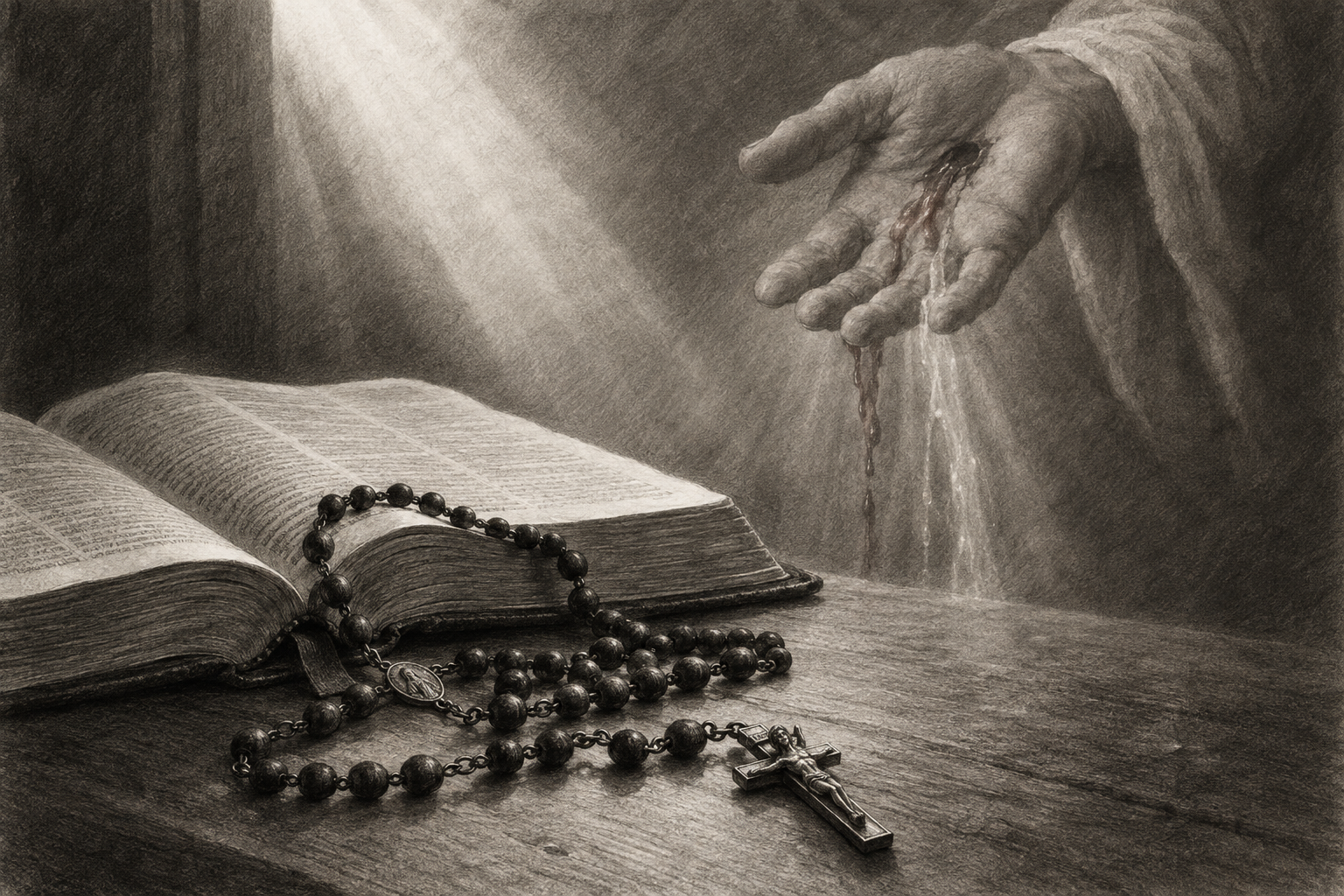
The Gospel of John records that blood and water flowed from the pierced side of Jesus John 19:34. Christian tradition has long contemplated this scene as a sign of the life and grace flowing from Christ's sacrifice. Divine Mercy devotion frequently returns to this image because mercy is not an abstract idea. It comes to us through the incarnate Lord who loved humanity to the end.
Mercy is more than leniency
In ordinary speech, mercy can sound like overlooking wrongdoing. Christian mercy is much richer. God does not pretend that sin is harmless. He confronts sin, calls us to conversion, and provides the grace by which we can be forgiven and changed.
Scripture describes God as rich in mercy Ephesians 2:4. This mercy reveals his faithful love toward people who cannot rescue themselves. It is not opposed to justice, nor does it remove moral responsibility. Mercy heals what sin has damaged and restores communion with God.
The chaplet therefore should not become a way of avoiding repentance. Its words include an acknowledgment of our sins. We stand among those who need forgiveness. The prayer is not directed against a supposedly merciless Father, as though Jesus had to persuade the Father to love us. The Father sends the Son out of love, and the Son freely offers himself in loving obedience. The Holy Spirit draws us into this communion of divine life.
When Catholics pray for mercy, they are approaching the throne of grace with confidence, as the Letter to the Hebrews encourages Hebrews 4:16. Confidence is not presumption. It is trust in God's character, joined to humility about our need.
How to pray the Divine Mercy Chaplet
The standard form uses ordinary rosary beads. It can also be prayed without beads by keeping count in another simple way.
- Begin with the Sign of the Cross.
- Pray one Our Father, one Hail Mary, and the Apostles' Creed.
- On the large bead before each decade, pray: Eternal Father, I offer You the Body and Blood, Soul and Divinity of Your dearly beloved Son, our Lord Jesus Christ, in atonement for our sins and those of the whole world.
- On each of the ten smaller beads, pray: For the sake of His sorrowful Passion, have mercy on us and on the whole world.
- Repeat this pattern for five decades.
- After the fifth decade, pray three times: Holy God, Holy Mighty One, Holy Immortal One, have mercy on us and on the whole world.
- Conclude with the Sign of the Cross.
Some people add approved opening or closing prayers associated with the devotion. These can be spiritually fruitful, but the chaplet remains complete in its familiar basic form.
When and where it can be prayed
Many Catholics pray the chaplet at 3:00 in the afternoon, traditionally called the Hour of Mercy because it recalls the death of Jesus. This is a fitting practice, but it is not a rule. The chaplet can be prayed at any hour.
It may be prayed alone or with others. Families can pray it together. Parishes may pray it during Eucharistic adoration or at another suitable time. It is also common to pray the chaplet for someone who is dying, asking Christ to receive that person with mercy.
The chaplet is often included in a Divine Mercy novena beginning on Good Friday and ending on the Saturday before Divine Mercy Sunday. Yet no one needs to wait for a particular season. A person may begin praying it in the middle of an ordinary week, especially when burdened by fear, guilt, anger, or concern for another person.
A prayer wide enough for everyone
One of the most striking phrases in the chaplet is the whole world. The prayer repeatedly widens our attention. We may begin with a personal wound or an urgent need, but the words prevent us from remaining enclosed within ourselves.
We pray for people we love and people we struggle to love. We pray for victims of violence, those responsible for grave harm, families divided by resentment, the sick, the dying, public leaders, prisoners, refugees, and people whose names are known only to God. This broad intercession reflects the scriptural call to offer prayers for everyone 1 Timothy 2:1.
Praying for the whole world does not make suffering less concrete. It trains the heart to see every person as someone for whom Christ died. Over time, the repetition can soften harsh judgments and expose the limits we place on compassion.
This does not mean ignoring justice or remaining passive in the face of abuse. Mercy seeks truth, protects the vulnerable, and desires the conversion of those who do wrong. Forgiveness does not always remove temporal consequences, and reconciliation may require repentance, safety, and time. The chaplet gives these painful realities to God without pretending they are simple.
Making the chaplet part of daily life
A sustainable prayer practice usually begins modestly. Rather than choosing an ambitious schedule that quickly becomes burdensome, select a time you can reasonably keep. The chaplet may fit after morning prayer, during a lunch break, in the late afternoon, or before bed.
It can help to name an intention before beginning. You might pray for a sick relative, a troubled marriage, peace in a particular place, those approaching death, or the grace to repent of a habitual sin. After naming the intention, let the repeated words carry it. There is no need to explain everything to God.
Distraction is normal. When attention wanders, return gently to the words. The value of prayer does not depend on producing a particular emotion. Some days the chaplet may bring consolation. On other days it may feel dry. Faithfulness in both conditions teaches us to rely on God rather than on our changing feelings.
The devotion should also bear fruit in action. A person who asks for mercy is called to become merciful. That may mean forgiving an offense, making an honest confession, visiting someone who is lonely, giving material help, speaking patiently, or refusing to participate in gossip. Christ identifies himself with those in need Matthew 25:40, so works of mercy are not optional decorations around prayer. They are among its proper fruits.
Keeping the chaplet rooted in the Church
Private devotions flourish best when they remain connected to the Church's sacramental life. The chaplet should deepen hunger for the Eucharist, encourage regular confession, and strengthen attention to Scripture. If devotion becomes detached from these foundations, it can be misunderstood as a technique for obtaining a desired result.
The chaplet is not a spiritual bargain, and its repetition is not magic. We do not control God by saying the correct words a certain number of times. We ask, trust, and surrender. God's answer may not take the form we expect, but his mercy remains present even when circumstances do not immediately change.
This is why the chaplet continues to speak so powerfully in times of uncertainty. It gives us words when our own words fail. It directs fear toward trust, guilt toward repentance, sorrow toward the Passion, and concern for others toward intercession. Bead by bead, the prayer teaches the heart to rest not in its own strength but in Jesus Christ, whose mercy is greater than every wound we bring before him.
Keep Reading on Lets Read The Bible
Frequently Asked Questions
Must the Divine Mercy Chaplet be prayed at 3:00 PM?
No. Praying at 3:00 PM is a traditional practice because the hour recalls the death of Jesus, but the chaplet may be prayed at any time of day or night.
Is the Divine Mercy Chaplet required for Catholics?
No. The chaplet is an approved private devotion, not an obligation. Catholics are free to practice it, and it should remain rooted in Scripture, the sacraments, and the public worship of the Church.
Can the Divine Mercy Chaplet be prayed for someone who is dying?
Yes. Catholics commonly pray the chaplet for the dying, entrusting the person to Christ's mercy. It may also be prayed for the deceased, the sick, particular intentions, and the needs of the whole world.