Prayer and Devotion
An Empty Place Set Before God: Beginning the Practice of Fasting
How voluntary hunger can become a humble school of prayer, freedom, and love
Site Admin | November 22, 2026 | 9 views
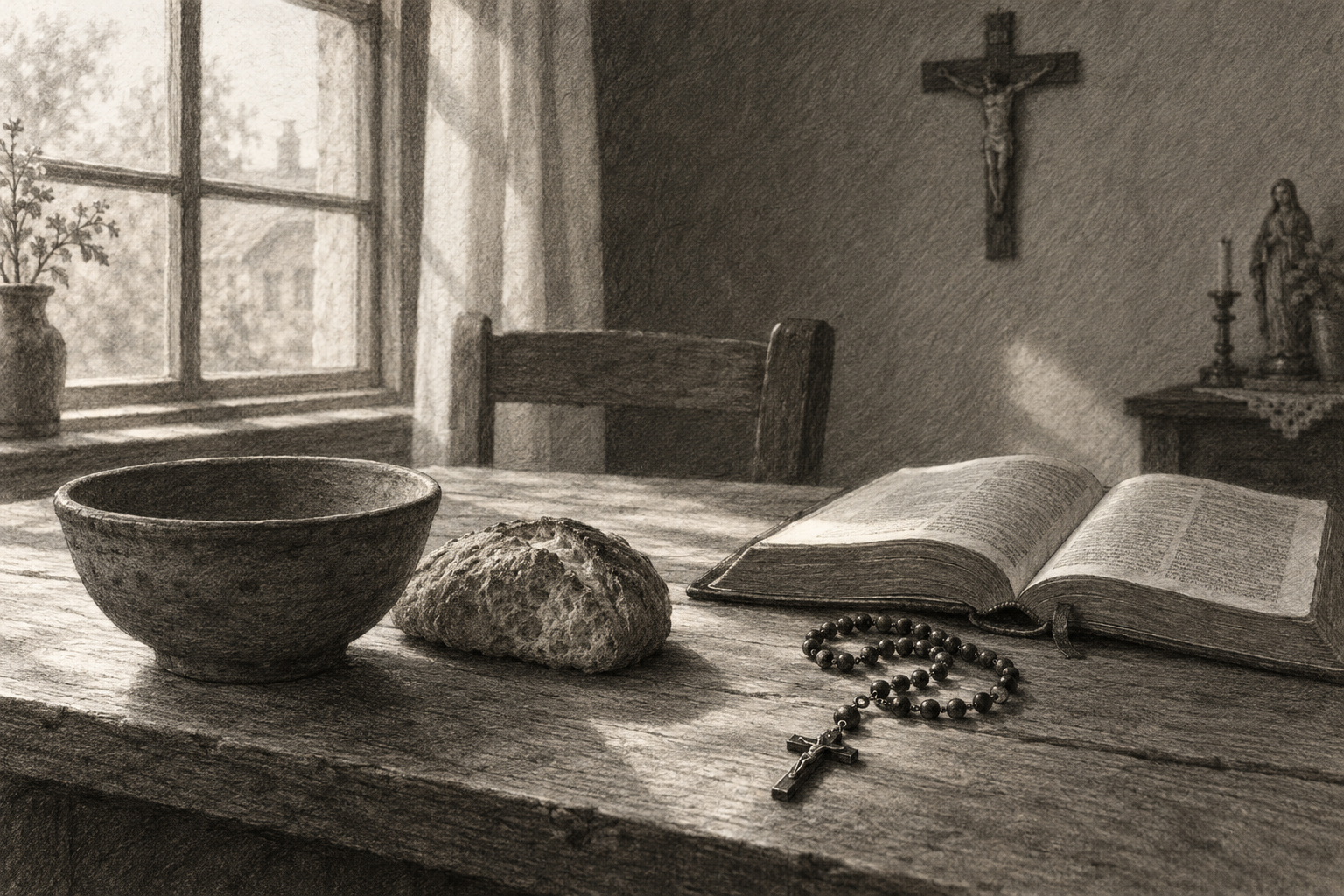
Fasting begins with an empty place. We set aside food, or take less of it, and discover how quickly the body speaks. Hunger interrupts our plans. It exposes habits, impatience, and desires that usually remain hidden beneath the comforts of an ordinary day.
For a Catholic, that empty place is not an end in itself. Fasting is a bodily form of prayer. It is a willing act of self-denial offered to God in repentance, petition, and love. By fasting, we acknowledge that food is good but not our highest good. We ask the Lord to reorder our appetites so that we can receive his gifts gratefully without becoming ruled by them.
A useful fasting Catholic guide must therefore begin with grace. We do not fast to earn God's attention, prove our toughness, or punish the body. We fast because Christ calls his disciples to conversion and because the whole person, body and soul, is invited into that conversion.
Fasting belongs to the biblical life of prayer
Fasting appears throughout Scripture alongside prayer, mourning, repentance, and preparation for God's work. Moses fasted in the presence of the Lord before receiving the words of the covenant Exodus 34:28. The people of Nineveh responded to Jonah's preaching with belief, fasting, and repentance Jonah 3:5. Ezra proclaimed a fast so that the people might humble themselves and seek a safe journey from God Ezra 8:21.
Jesus himself fasted for forty days in the wilderness before beginning his public ministry Matthew 4:2. He also spoke to his disciples about fasting as an expected practice. His words are not framed around gaining admiration. Instead, he warns against gloomy appearances and public displays designed to win human praise [[VERSE|matthew|6|16-18|Matthew 6:16-18]].
This teaching gives Catholic fasting its proper direction. The sacrifice may be real, but it should not become theater. A fast offered quietly to the Father can train the heart to seek the praise that comes from God rather than recognition from others.
What fasting is, and what it is not
In ordinary Catholic usage, fasting means reducing the amount of food we eat. Abstinence means refraining from a particular kind of food, most commonly meat. The two practices are related, but they are not identical.
Fasting is also different from dieting. A diet may be undertaken for health, weight, or athletic performance. Those goals can be legitimate, but they do not automatically make the practice a Christian fast. Fasting becomes a religious act when it is freely offered to God and joined to prayer, repentance, and charity.
Nor is fasting based on contempt for the body. Catholic faith recognizes the body as part of God's good creation and looks forward to the resurrection of the body. Food is a gift, and receiving it with thanksgiving is good. Christian fasting temporarily limits a good thing so that we can grow in freedom and become more attentive to the Giver.
This distinction protects fasting from two errors. One is indulgence, in which every appetite is treated as a command. The other is harshness, in which bodily weakness is treated as shameful. Catholic discipline seeks neither slavery to appetite nor hostility toward the body. It seeks ordered freedom.
The Church's common discipline
In the Latin Church, Ash Wednesday and Good Friday are days of both fasting and abstinence. Fridays during Lent are days of abstinence from meat. The law of abstinence binds Catholics who have completed their fourteenth year. The law of fasting binds those who have reached adulthood until the beginning of their sixtieth year, commonly understood as ages eighteen through fifty-nine.
On a canonical fast day, the usual discipline permits one full meal and two smaller meals that together do not equal another full meal. Eating between meals is not part of the fast. Water and medicine do not break it.
Eastern Catholic Churches have their own venerable fasting disciplines, which can differ from those of the Latin Church. Eastern Catholics should follow the guidance of their own Church and pastor rather than assuming that Latin practice applies in every detail.
The Church's law establishes a shared minimum, not the outer limit of Christian generosity. At the same time, the minimum should not be dismissed as insignificant. Keeping the common fast unites Catholics in a visible act of repentance and reminds us that faith is not merely private.
Who may need to refrain from fasting?
The Church does not ask people to endanger their health. Those who are ill, frail, pregnant, nursing, recovering from surgery, engaged in demanding labor, or living with medical conditions affected by food should act prudently. A person with a history of an eating disorder should not improvise a food fast without appropriate medical and pastoral guidance.
Parents can introduce children to small acts of sacrifice, but children who are not bound by the law should not be burdened with an adult fast. The aim is to form love for Christ, not anxiety around food.
When a food fast would be unsafe, another sacrifice can be chosen. Giving up entertainment, unnecessary purchases, alcohol, social media, or another comfort may become a sincere offering. Such practices do not replace the Church's required discipline for those who are bound and able to observe it, but they can be appropriate for someone who cannot fast from food.
Why hunger can serve the spiritual life
Hunger does not automatically make anyone holy. It can make a person distracted, irritable, or proud. Yet when hunger is received prayerfully, it can reveal where conversion is needed.
A small fast teaches that an urge can be felt without being obeyed. That lesson reaches beyond the table. The person who learns to say no to an unnecessary snack may become better prepared to resist anger, lust, gossip, envy, or compulsive consumption. The discipline is modest, but the freedom it trains is real.
Fasting can also sharpen petition. When hunger returns, it becomes a bell calling the heart back to prayer. A person might quietly repeat, Jesus, I offer this for the person I am praying for, or ask for mercy, healing, peace, or deliverance from sin. The discomfort is not a payment demanded from God. It is a way of bringing the body into the prayer already rising from the heart.
Fasting should also lead toward the poor. The prophet Isaiah rejects fasting that coexists with oppression and indifference. The fast pleasing to God is bound to justice, mercy, and care for those in need [[VERSE|isaiah|58|6-7|Isaiah 58:6-7]]. The money saved by eating more simply can be given as alms. The time saved can be offered in service. Hunger can remind us that many people do not choose when they go without food.
How to begin without making it dramatic
A sustainable fast is usually better than an impressive one that quickly collapses. Begin with a clear intention and a modest practice.
- Name the purpose. Decide why you are fasting. It may be repentance for a recurring sin, intercession for another person, preparation for a feast, or a desire for greater freedom. Place that intention before God.
- Choose a definite period. Start with one meal, part of a day, or a simpler Friday meal. Clear boundaries reduce the temptation to negotiate with yourself throughout the day.
- Keep the practice proportionate. A beginner does not need to attempt a severe or prolonged fast. Choose something that involves real sacrifice without creating needless danger or making ordinary responsibilities impossible.
- Plan the prayer. Decide beforehand how hunger will lead you to God. You might pray a psalm, spend ten minutes in silent prayer, attend Mass, or offer a brief aspiration whenever you notice the fast.
- Join it to almsgiving. Give the cost of the omitted food, or another suitable amount, to someone in need or to a trustworthy work of mercy.
- End with gratitude. Receive the next meal slowly and thankfully. A fast should renew appreciation for food rather than produce resentment toward it.
It is often wise to keep voluntary fasting private. If practical circumstances require an explanation, there is no need to deceive anyone. Simplicity is enough. The goal is not secrecy for its own sake, but freedom from spiritual display.
Common difficulties during a fast
I become irritable
Irritability may reveal that the fast is too severe, but it may also uncover impatience that comfort usually conceals. Do not excuse unkindness by saying that you are fasting. Ask forgiveness when needed, adjust the practice if prudence requires it, and let the discovery become part of your repentance.
I keep thinking about food
This is normal, especially at first. The aim is not to prove that food no longer interests you. Each reminder can become an invitation to return to your intention. Brief prayer is often more helpful than trying to force thoughts of food away.
I failed to complete the fast
Do not turn a broken fast into despair. Consider honestly what happened. Perhaps the plan was unrealistic, the intention was unclear, or an unexpected need arose. Begin again more wisely. Spiritual discipline grows through humility, not perfectionism.
I feel proud of the sacrifice
Pride can attach itself even to good practices. Remember that the ability to fast is itself a gift. Ask God to receive the offering, conceal it within the sacrifice of Christ, and use it for the good of others. Jesus' warning about seeking attention remains a necessary safeguard [[VERSE|matthew|6|17-18|Matthew 6:17-18]].
Deepening the practice over time
Once a modest rhythm is stable, fasting can become part of a wider rule of prayer. Some Catholics choose a simple Friday fast in remembrance of the Lord's Passion. Others fast before an important decision, for a particular intention, or in preparation for a solemn feast. A regular practice should remain compatible with one's health, vocation, and duties.
Spiritual direction can be especially helpful when considering frequent or demanding fasting. A wise priest or spiritual director can help distinguish genuine generosity from pride, compulsion, or avoidance of ordinary responsibilities.
Catholics also observe the Eucharistic fast. In the Latin Church, those receiving Holy Communion ordinarily abstain from food and drink for at least one hour before reception, except for water and medicine. The elderly, the infirm, and those who care for them are given appropriate consideration. This brief fast prepares the body to welcome Christ with attention and reverence.
The deepest purpose of fasting is not mastery for its own sake. It is communion. We make room in order to receive. We accept a small hunger so that a greater hunger can be awakened, the desire for God himself. Christ taught that human life depends on more than bread alone Matthew 4:4. When practiced with prayer, prudence, and mercy, fasting helps that truth move from the page into the habits of the heart.
Keep Reading on Lets Read The Bible
Frequently Asked Questions
What is the difference between fasting and abstinence in Catholic practice?
Fasting limits the quantity of food eaten, while abstinence means refraining from a particular food, ordinarily meat. In the Latin Church, Ash Wednesday and Good Friday are days of both fasting and abstinence.
Can I fast from something other than food?
Yes. Voluntarily giving up entertainment, social media, alcohol, unnecessary spending, or another comfort can support prayer and self-discipline. However, for Catholics who are bound by the Church's required days of fasting and abstinence and are able to observe them, another sacrifice does not ordinarily replace those obligations.
What should I do if fasting from food may harm my health?
Do not undertake a food fast that would endanger your health. People who are ill, pregnant, nursing, frail, recovering from surgery, managing certain medical conditions, or living with an eating disorder should seek appropriate medical and pastoral guidance. A safe alternative sacrifice can still be joined to prayer and almsgiving.