Prayer and Devotion
Beads in the Hand, Christ Before the Eyes
A practical path into the prayers, mysteries, and quiet perseverance of the Rosary
Site Admin | November 16, 2026 | 38 views
The Rosary can appear complicated when first seen in another person's hands. There are beads of different sizes, several prayers, and twenty mysteries arranged across four groups. Yet its basic movement is simple. The lips repeat familiar words while the mind and heart remain with Jesus.
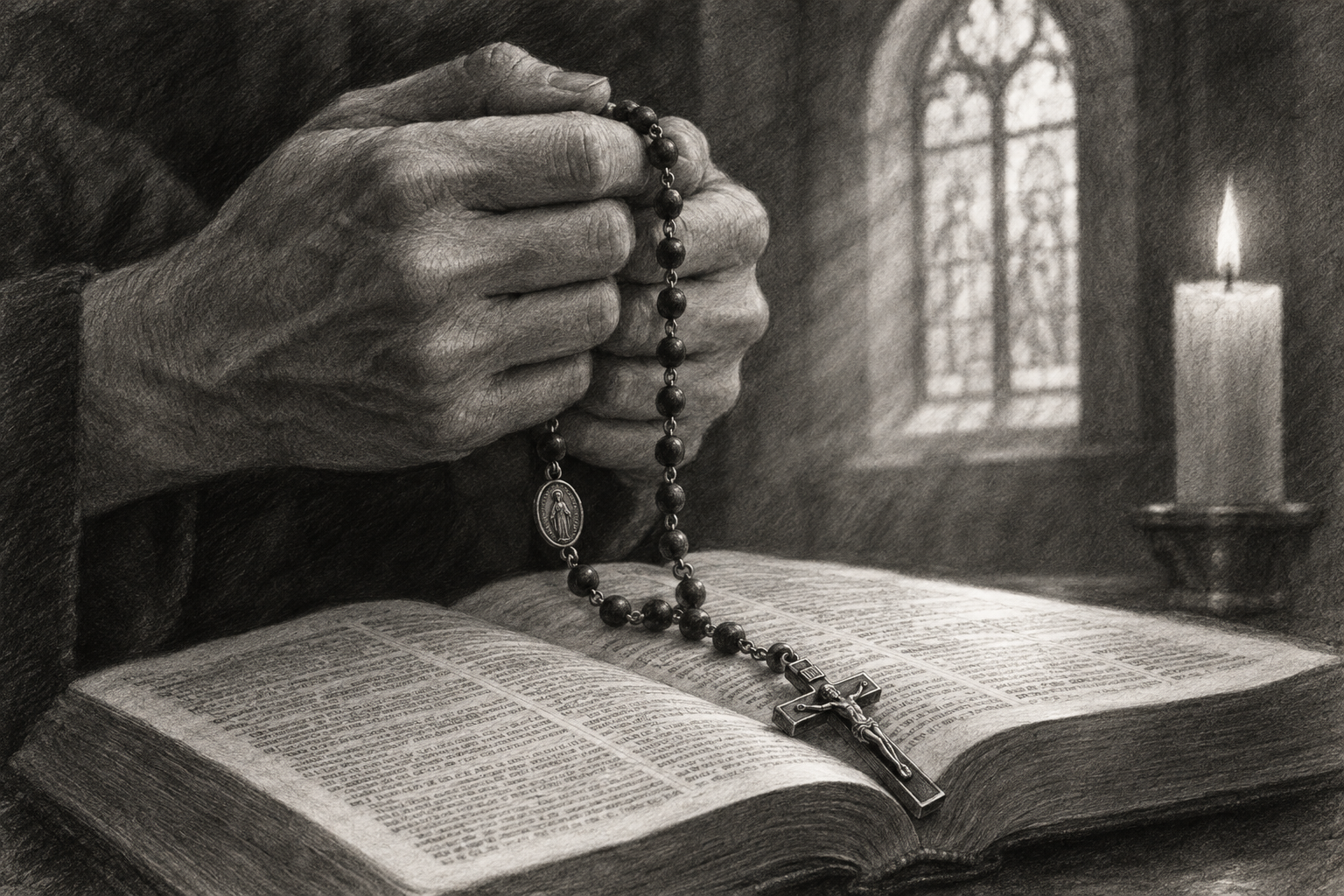
This is why the Rosary is more than a method for counting prayers. It is a form of contemplative prayer rooted in the Gospel. With Mary, the Christian remembers the Incarnation, public ministry, suffering, death, Resurrection, and glory of her Son. The beads give the hands something steady to hold, while the mysteries give the soul somewhere holy to rest.
What the Rosary is
The Rosary is a Catholic devotion made up of vocal prayer and meditation. Its central unit is the decade: one Our Father, ten Hail Marys, and one Glory Be. During each decade, the person praying reflects on a mystery from the life of Christ.
The repetition is intentional. It does not ask us to invent new words every few moments. Instead, the steady rhythm can quiet mental noise and make room for attention to God. Repetition itself is not opposed to sincere prayer. Jesus warned against empty words, not faithful perseverance. In Gethsemane, he returned to prayer as he prepared to offer himself to the Father, as described in Matthew 26:44.
The Rosary is Marian because Catholics pray it with Mary and ask for her intercession. It is Christ-centered because its mysteries lead again and again to Jesus. Catholic devotion to Mary does not give her the worship owed to God alone. Rather, it honors the woman who freely received God's call and points always toward her Son. Her instruction at Cana remains a fitting summary of her role: John 2:5.
Why Catholics return to these beads
The Rosary places the Gospel into a pattern that can accompany ordinary life. Its prayers can be offered in a church, on a morning walk, beside a hospital bed, or in a quiet room after the household has settled. It can express thanksgiving, repentance, petition, or simple love.
It also teaches the heart to remember. Scripture says that Mary treasured the events surrounding Jesus and pondered them within her heart in Luke 2:19. The Rosary encourages a similar kind of prayerful remembrance. We do not merely recall that something happened long ago. We place ourselves before the saving work of Christ and ask for grace to live faithfully now.
Some days this prayer brings consolation. On other days it may feel dry or difficult. Both experiences can become offerings to God. The spiritual value of the Rosary does not depend on achieving a particular emotion. Love is often shown by remaining present, especially when attention is imperfect.
How to pray the Rosary
A full Rosary usually means praying five decades while meditating on one set of mysteries. The following order reflects the common practice of the Latin Church, although small variations exist among families and communities.
- Begin at the crucifix. Make the Sign of the Cross and pray the Apostles' Creed.
- Pray on the first large bead. Say the Our Father.
- Pray on the next three small beads. Say three Hail Marys, traditionally asking for growth in faith, hope, and charity.
- Pray the Glory Be. Some people also announce the first mystery at this point.
- Begin the first decade. Announce the mystery, pause briefly, and pray one Our Father.
- Continue through the decade. Pray ten Hail Marys while meditating on the mystery, followed by the Glory Be. The Fatima Prayer may also be added.
- Complete five decades. After the fifth decade, many Catholics pray the Hail, Holy Queen and a closing prayer, then finish with the Sign of the Cross.
If the entire sequence feels overwhelming, begin with one decade. Announce one mystery, pray the Our Father, ten Hail Marys, and the Glory Be. A single decade prayed faithfully is a real prayer, not a failed attempt at a longer one.
The prayers have biblical roots
The Our Father comes from the prayer Jesus taught his disciples in Matthew 6:9. The opening words of the Hail Mary draw from the angel Gabriel's greeting in Luke 1:28 and Elizabeth's blessing in Luke 1:42. Its second half asks Mary, the Mother of God, to pray for sinners now and at the hour of death.
The phrase Mother of God safeguards the truth about Jesus. Mary is not the source of his divinity. She is called Mother of God because the child she conceived and bore is one divine Person, the eternal Son who truly became man.
The mysteries that shape the prayer
The twenty mysteries are arranged in four groups. A customary weekly schedule assigns the Joyful Mysteries to Monday and Saturday, the Sorrowful Mysteries to Tuesday and Friday, the Glorious Mysteries to Wednesday and Sunday, and the Luminous Mysteries to Thursday. This schedule is helpful, but it is not a binding rule.
The Joyful Mysteries
- The Annunciation
- The Visitation
- The Nativity
- The Presentation
- The Finding of Jesus in the Temple
These mysteries contemplate the hidden beginnings of Christ's earthly life. They invite humility, trust, obedience, and wonder before the mystery of the Word made flesh.
The Luminous Mysteries
- The Baptism of Jesus in the Jordan
- The Wedding Feast at Cana
- The Proclamation of the Kingdom of God
- The Transfiguration
- The Institution of the Eucharist
These mysteries turn toward the public ministry of Jesus. At his Baptism, the Father's love and the presence of the Holy Spirit are revealed in [[VERSE|mark|1|10-11|Mark 1:10-11]]. The Luminous Mysteries help us hear Christ's call to conversion and recognize his gift of himself.
The Sorrowful Mysteries
- The Agony in the Garden
- The Scourging at the Pillar
- The Crowning with Thorns
- The Carrying of the Cross
- The Crucifixion
Here the person praying remains near Jesus in his Passion. These mysteries should not become an exercise in imagining violence for its own sake. They are a meditation on divine love, the gravity of sin, and the mercy of the Savior who gave himself for the world.
The Glorious Mysteries
- The Resurrection
- The Ascension
- The Descent of the Holy Spirit
- The Assumption of Mary
- The Coronation of Mary
The Glorious Mysteries lift the heart toward Christian hope. The tomb is empty, death does not have the final word, and Christ's people are called to share his life. The angelic announcement at the tomb is recorded in [[VERSE|luke|24|5-6|Luke 24:5-6]].
Learning to meditate during the prayers
Many beginners wonder how they can say the Hail Mary while also thinking about a mystery. There is no need to divide the mind with perfect precision. The repeated prayer can become a gentle background while attention rests on Christ.
Before each decade, name the mystery and pause for a few seconds. Picture the Gospel scene without forcing elaborate details. Notice one person, word, or action. At the Annunciation, for example, consider Mary's trust. During the Carrying of the Cross, remain near Christ in his weariness. At the Resurrection, receive again the promise that God brings life from the grave.
A short intention can also focus the decade. Pray the Nativity for families in need, the Agony in the Garden for those who are afraid, or the Descent of the Holy Spirit for the Church. The intention should lead into the mystery rather than replace it.
Scripture can deepen this practice. Before beginning a decade, read one or two verses connected with the mystery. Then allow a word or image from the passage to remain present during the prayers. This slower method is especially helpful when the mysteries have become so familiar that they are recited without attention.
When the Rosary feels difficult
Distraction is the most common difficulty. When the mind wanders, return quietly to the prayer or mystery. There is no need to restart the decade or become irritated with yourself. The act of returning is itself a small movement of love.
Fatigue may call for a shorter prayer. One decade prayed attentively can be wiser than rushing through five with growing frustration. A family with young children might pray a single decade after dinner. Someone who is ill may only be able to hold the beads and say the name of Jesus. God is not measuring vocal efficiency.
Speed can also become a problem. The Rosary does not need to be painfully slow, but the words should remain intelligible. A calm pace allows the prayer to breathe. When praying with others, charity matters more than imposing a personal rhythm.
Another temptation is to treat the Rosary as a guarantee that God will grant a preferred outcome. Catholic prayer is trusting petition, not a technique for controlling events. We bring real needs to God, ask Mary's prayers, and place the answer within the Father's wisdom.
Making the Rosary part of daily life
Choose a realistic time and place. Attach one decade or five decades to a stable part of the day, such as after breakfast, during a commute when it is safe to pray, or before bed. Keep a rosary where it will be seen. A prayer that has a home in the daily schedule is easier to continue than one left to a vague intention.
It can also help to name one purpose before beginning: gratitude for a grace, intercession for another person, repentance for sin, or a desire to know Christ more deeply. Then release the need to judge whether the prayer was successful.
Over time, the mysteries begin to accompany life beyond the spoken decades. A moment of uncertainty may recall the Annunciation. Suffering may draw the heart toward Gethsemane. An experience of mercy may awaken Easter hope. The beads eventually leave the hand, but the life of Jesus remains before the eyes of the heart. That is the quiet work of the Rosary: to let the Gospel take root through faithful, repeated attention to Christ.
Keep Reading on Lets Read The Bible
Frequently Asked Questions
Do Catholics have to pray the Rosary every day?
No. The Rosary is a cherished devotion, not a universal obligation for every Catholic. Daily prayer is strongly encouraged in Christian life, and many Catholics choose the Rosary as part of that prayer, but its frequency should be approached with freedom, faithfulness, and prudence.
Is it acceptable to pray only one decade of the Rosary?
Yes. One decade consists of an Our Father, ten Hail Marys, and a Glory Be while meditating on one mystery. A single decade can be especially suitable for beginners, families with young children, people who are ill, or anyone with limited time.
Is praying to Mary the same as worshiping her?
No. Catholics worship God alone. When Catholics pray to Mary, they are asking for her intercession, much as Christians ask one another to pray for them. Marian devotion honors what God has done in her and leads the faithful toward Jesus Christ.