Prayer and Devotion
At the Fountain of Mercy: Learning to Pray the Divine Mercy Chaplet
A practical introduction to the chaplet's prayers, spiritual meaning, and place within Catholic life.
Site Admin | November 18, 2026 | 26 views
The Divine Mercy Chaplet is a brief prayer, but it opens onto the deepest mysteries of the Christian faith: the Passion of Jesus, the mercy of the Father, the forgiveness of sins, and the call to trust God in every circumstance. Prayed on ordinary rosary beads, it can be completed in about ten minutes. Its simplicity makes it accessible to beginners, while its words provide a lifetime of spiritual reflection.
This Divine Mercy Chaplet Catholic guide explains both the form of the devotion and the faith it expresses. The chaplet is not a substitute for the Mass, Confession, or the Church's liturgical prayer. Rather, it is a private devotion that can help dispose the heart toward repentance, confidence in God, and loving concern for others.
What is the Divine Mercy Chaplet?
The chaplet is associated with the private revelations received by St. Maria Faustina Kowalska, a Polish religious sister who died in 1938. In her spiritual diary, St. Faustina recorded Christ's call to proclaim and trust in divine mercy. The devotion later spread throughout the Catholic Church, especially through the ministry of St. John Paul II.
As with every approved private revelation, the Divine Mercy message does not add to the deposit of faith given in Christ and handed on through Scripture and Tradition. Catholics are not required to practice this particular devotion. The Church commends it because it directs the faithful toward truths already at the heart of the Gospel.
Scripture describes God as being rich in mercy Ephesians 2:4. That mercy is revealed decisively in Jesus Christ. God shows his love for sinners through the death of Christ Romans 5:8, and the pierced side of Jesus pours forth blood and water John 19:34. The chaplet keeps these truths before the mind and places them upon the lips in prayer.
The spiritual heart of the chaplet
The repeated petition of the chaplet is simple: Have mercy on us and on the whole world. These words teach us to approach God neither with presumption nor despair. We do not presume that sin is unimportant, and we do not despair as though God's grace were too small for our failures. We come before the Father because Christ has opened the way.
Mercy does not mean that God ignores evil. Divine mercy confronts sin, forgives the repentant sinner, heals what has been wounded, and makes holiness possible. It is costly mercy, revealed in the sorrowful Passion of Christ. The chaplet therefore joins confidence with contrition. We acknowledge our need while trusting the love that seeks to restore us.
The prayer also moves us beyond private concerns. Its petitions repeatedly include the whole world. We pray for family and friends, but also for strangers, enemies, those far from God, those approaching death, and people whose suffering is known only to him. In this way, the chaplet becomes a school of intercession.
How to pray the Divine Mercy Chaplet
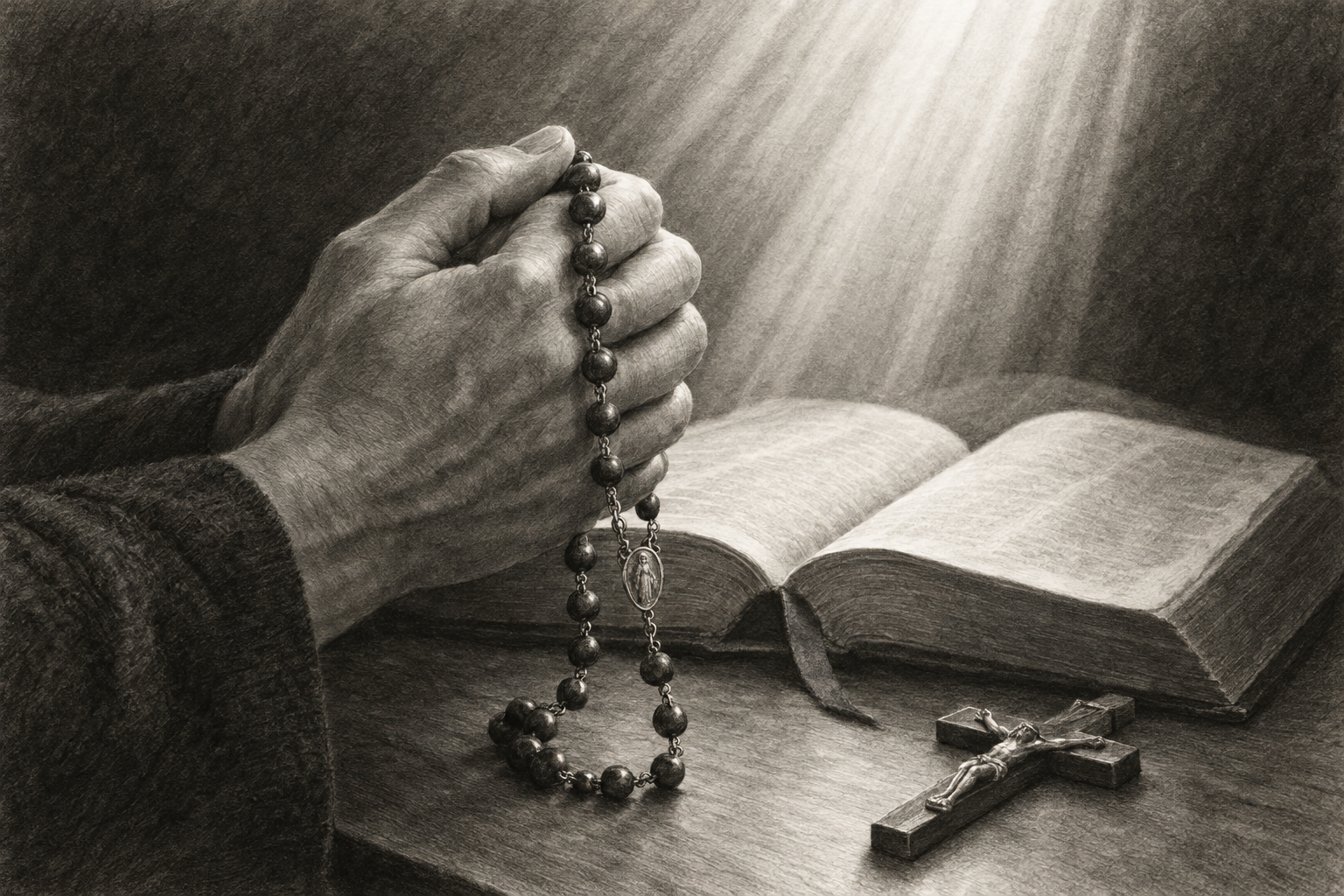
You can pray the chaplet using a standard five-decade rosary. If you do not have rosary beads, you may count the prayers on your fingers or follow them from a printed page. The beads are helpful, but they are not what makes the prayer fruitful.
Begin with recollection
Choose a reasonably quiet place if one is available. Take a moment to remember that you are in God's presence. You may bring a particular person or need to prayer, but it is also good to leave room for the chaplet's universal intention. Begin with the Sign of the Cross.
Some forms of the devotion include optional opening prayers recalling the death of Jesus and the blood and water that flowed from his side. These may be used, but they are not necessary for the basic structure of the chaplet.
Pray the opening prayers
On the first three beads, pray:
- One Our Father
- One Hail Mary
- The Apostles' Creed
These prayers place the chaplet within the wider faith and prayer of the Church. The Our Father teaches us to seek the Father's will and ask forgiveness. The Hail Mary asks the Mother of God to pray for us. The Creed professes the mysteries into which we were baptized.
Pray on each large bead
On the large bead before each decade, pray:
Eternal Father, I offer you the Body and Blood, Soul and Divinity of your dearly beloved Son, our Lord Jesus Christ, in atonement for our sins and those of the whole world.
This prayer draws our attention to the self-offering of Jesus. It does not mean that the person praying the chaplet is celebrating Mass or consecrating the Eucharist. The Eucharistic sacrifice belongs uniquely to the sacramental action of Christ through the ordained priest. In the chaplet, the faithful prayerfully unite themselves to the one saving sacrifice of Christ, which is made sacramentally present in the Mass.
Pray on the ten small beads
On each of the ten smaller beads, pray:
For the sake of his sorrowful Passion, have mercy on us and on the whole world.
Repeat this pattern for all five decades. The repetition is not intended to produce an emotional state. It gives the heart time to remain with the Passion of Christ and to place many people within the reach of prayer.
Close with the Trisagion
After the fifth decade, pray the following three times:
Holy God, Holy Mighty One, Holy Immortal One, have mercy on us and on the whole world.
You may then add the optional closing prayer beginning, Eternal God, in whom mercy is endless and the treasury of compassion inexhaustible. Finish with the Sign of the Cross.
Praying when the mind is distracted
Distraction does not automatically make prayer worthless. Human attention is limited, especially during grief, illness, exhaustion, or anxiety. When you notice that your thoughts have wandered, return gently to the words. There is no need to begin the chaplet again or become irritated with yourself.
It can help to hold one simple image in mind, such as Christ crucified, the wound in his side, or the rays of blood and water associated with the Divine Mercy image. Another approach is to dedicate each decade to an intention:
- For repentance and conversion
- For the sick, suffering, and lonely
- For those approaching death
- For the Church and her ministers
- For peace and the needs of the whole world
These intentions are suggestions, not rules. The chaplet may also be prayed without assigning a separate intention to every decade.
The Hour of Mercy and the Divine Mercy Novena
Many Catholics pray the chaplet at 3:00 in the afternoon, traditionally called the Hour of Great Mercy because it recalls the hour of Christ's death. This is a fitting practice, but it is not a requirement. The chaplet can be prayed in the morning, before sleep, during Eucharistic adoration, while traveling, or at the bedside of someone who is ill.
The chaplet is also commonly prayed as part of the Divine Mercy Novena, beginning on Good Friday and continuing through the Saturday before Divine Mercy Sunday. Divine Mercy Sunday is celebrated on the Second Sunday of Easter. The novena can help the faithful carry their contemplation of the Passion into the joy of the Resurrection.
Neither the hour nor the novena should be treated superstitiously. Prayer is not a technique for controlling God. The value of the chaplet rests in Christ's mercy and in the sincere turning of the human heart toward him.
Mercy and the sacramental life
A healthy devotion to Divine Mercy should lead toward the ordinary means of grace Christ has given his Church. Someone conscious of serious sin should not use the chaplet as a replacement for sacramental Confession. Instead, the prayer can awaken courage to approach the sacrament with honesty and trust.
The chaplet also points toward the Eucharist. Its language centers on the Body and Blood of Christ and his loving sacrifice. Participation in Sunday Mass remains foundational to Catholic life, and worthy reception of Holy Communion unites the faithful to Christ in a way that a private devotion cannot replace.
Divine mercy also calls for works of mercy. If prayer never softens our treatment of other people, something remains incomplete. We ask for mercy while learning to forgive, serve, listen, and care for those in need. Christ teaches that the merciful are blessed Matthew 5:7. Devotion should gradually become a way of life.
Interceding for the dying
The chaplet is often prayed for people who are nearing death. This can be a profound act of Christian charity, whether the person is conscious or unable to respond. Those gathered at a bedside may pray quietly, entrusting the dying person to Jesus without making claims about what they can see or know.
When a priest is available, Catholics should also seek the sacraments for a dying Catholic, especially Confession, the Anointing of the Sick, and Viaticum when these can be received. The chaplet supports this sacramental care. It does not replace it.
Praying for the dying also reminds us that mercy is not merely an abstract idea. Every person must ultimately stand before God. Christian hope rests not in our own perfection but in Christ, our merciful Savior. Because he is our great high priest, we are invited to approach the throne of grace with confidence Hebrews 4:16.
Beginning a steady practice
If the devotion is new to you, begin simply. Pray one complete chaplet each week for a month. Keep the words nearby until they become familiar. Once the structure is natural, consider praying it more frequently or at a regular time.
A family may pray the chaplet together in the evening. A parish group may pray it before or after an appropriate gathering. Someone with limited time may use a lunch break or quiet commute. Consistency is useful, but the goal is not to accumulate prayers. The goal is to remain near Jesus and learn trust.
There will be days when the chaplet feels consoling and days when it feels dry. Both can become genuine prayer. Feelings are gifts when they come, but faithfulness does not depend upon them. The repeated appeal to Christ's Passion teaches the soul to lean on what God has done rather than on what we happen to feel.
With time, the words have mercy on us and on the whole world can reshape the way we see others. They prevent prayer from narrowing into self-concern and remind us that no person lies beyond the loving concern of God. Beads in hand, the Christian stands at the foot of the Cross and entrusts every wound, every sinner, and every hidden sorrow to the mercy flowing from the heart of Christ.
Keep Reading on Lets Read The Bible
Frequently Asked Questions
How long does it take to pray the Divine Mercy Chaplet?
Most people can pray the chaplet in about ten minutes. It may take longer when prayed slowly, sung, or accompanied by periods of silence and particular intentions.
Do I need rosary beads to pray the Divine Mercy Chaplet?
No. A standard rosary is helpful for keeping your place, but you may count the prayers on your fingers, use a chaplet card, or follow a reliable printed or digital text.
Must the Divine Mercy Chaplet be prayed at 3:00 in the afternoon?
No. Praying at 3:00 in the afternoon is a traditional way to remember the hour of Christ's death, but the chaplet may be prayed at any time. The sincerity of the prayer is more important than the hour chosen.