Prayer and Devotion
When the House Grows Quiet: Learning to Pray at Night
A peaceful Catholic practice of gratitude, examination, repentance, and trust at the close of the day
Site Admin | November 14, 2026 | 14 views
Night has a way of revealing what the day allowed us to avoid. When the work is finished, conversations have ended, and the house grows quiet, our gratitude, regrets, hopes, and anxieties often rise to the surface. Catholic night prayer gives these thoughts somewhere to go. Instead of carrying them alone into sleep, we place them before God.
This does not require an elaborate routine. A few faithful minutes can be enough. The heart of the practice is not the number of prayers completed but the honest turning of the soul toward the Lord. We thank him for what was good, ask light to recognize our sins, receive his mercy, pray for others, and entrust the coming night to his care.
A practical night prayer Catholic guide should therefore begin with a simple truth: evening prayer is not another task to perform perfectly. It is an act of relationship. The God who accompanied us through the day remains present when the day is done.
Why the Church prays at the close of day
Scripture frequently presents the evening as a time of prayer, remembrance, and trust. The psalmist asks that prayer rise before God like incense and the lifting of hands like an evening sacrifice: Psalm 141:2. Jesus himself sometimes continued in prayer through the night, as described in Luke 6:12.
For Christians, the rhythm of morning and evening also teaches that time belongs to God. We receive the day rather than manufacture it, and we surrender it when it is no longer ours to change. Night prayer helps us resist the illusion that everything depends upon our effort. We have responsibilities, but we are creatures, not the Creator. Eventually we must stop working and permit ourselves to rest.
This surrender is beautifully expressed in words prayed by Jesus from the Cross: Luke 23:46. The same words come from the Psalms, where they are spoken as an act of confidence in God's faithfulness: Psalm 31:6. They are especially fitting at bedtime. Sleep requires a small surrender of control, and Christian prayer turns that surrender into trust.
Father, into your hands I commend my spirit. Luke 23:46
Night prayer also reminds us of our final destiny. Each day comes to an end, and earthly life will one day come to an end as well. This is not meant to make bedtime fearful. It gives the evening a sober and hopeful clarity. We prepare to meet God by living in his friendship now, relying on the saving grace of Christ rather than on our own perfection.
The nightly examen: seeing the day with God
One of the most fruitful forms of Catholic night prayer is the examination of conscience. A related practice, especially associated with Ignatian spirituality, is often called the examen. These practices overlap, but their emphasis can differ. An examination of conscience ordinarily gives particular attention to sins that require repentance. The examen reviews the day more broadly, seeking to recognize God's presence, our interior movements, our responses to grace, and the places where healing or conversion is needed.
Neither practice should become anxious self-surveillance. The purpose is to see ourselves truthfully in the light of divine love. God already knows the day completely. We are not informing him of hidden facts. We are allowing him to show us what we have received and where we have resisted his grace.
A simple five-step examen
- Become aware of God's presence. Put aside the phone, sit or kneel, make the Sign of the Cross, and ask the Holy Spirit for light. Begin from the conviction that God is near.
- Give thanks. Name two or three gifts from the day. They may be significant or ordinary: a meal, needed work, an unexpected kindness, a moment of beauty, strength in difficulty, or the presence of someone you love.
- Review the day. Walk through the hours without trying to remember every detail. Notice conversations, decisions, emotions, temptations, consolations, and missed opportunities. Ask where you responded to grace and where you turned inward.
- Ask forgiveness. Bring your sins plainly to Christ. Avoid both excuses and despair. Make an Act of Contrition, trusting that the Lord calls sinners to repentance because he desires their salvation.
- Entrust tomorrow to God. Ask for help with one concrete need. Pray for the people you will meet, the duties you must fulfill, and the virtue you especially need to practice.
If the review brings a serious sin to mind, make a sincere act of contrition and resolve to receive the Sacrament of Penance as soon as reasonably possible. Night prayer does not replace sacramental confession. Rather, it helps form the honesty and repentance that lead us to the sacrament.
It is also important not to keep reopening a sin after placing it before God. Scrupulous repetition can turn prayer away from trust and toward fear. Those who struggle with scrupulosity should follow the guidance of a prudent confessor rather than inventing increasingly severe rules for themselves.
Compline, the Church's prayer before sleep
Catholics who want to pray with the wider Church can turn to Compline, commonly called Night Prayer. It is the final office in the daily cycle of the Liturgy of the Hours. Priests, deacons, religious communities, and many lay Catholics pray the Liturgy of the Hours, joining their voices to the public prayer of the Church.
Compline is compact and well suited to the end of the day. Its elements ordinarily include an examination of conscience, a hymn, psalmody, a brief Scripture reading, a responsory, the Gospel canticle known as the Nunc Dimittis, and a concluding prayer. A Marian antiphon traditionally follows.
The Nunc Dimittis is the prayer of Simeon, who receives the child Jesus in the Temple and recognizes God's promised salvation. He can now depart in peace because his eyes have seen the Savior: [[VERSE|luke|2|29-32|Luke 2:29-32]]. Placed at the end of the day, his words become a Christian prayer of peaceful release. We have seen Christ by faith, and we can rest in his keeping.
Compline also draws deeply from the Psalms. These prayers do not pretend that night is free from danger or distress. They name fear, enemies, weariness, guilt, and mortality, yet they return again and again to God's protection. For someone troubled by anxiety, this structure can be a mercy. The Church lends us words when our own thoughts feel scattered.
A beginner does not need to understand every feature immediately. Start by following an approved Catholic edition of the Liturgy of the Hours or a reliable Catholic prayer resource. Let the repeated patterns become familiar over time. The goal is not speed or technical mastery. It is to pray with attention and unite your voice with the Church.
Building a sustainable nightly practice
The best prayer routine is one that can be practiced faithfully. A long plan followed for three nights is usually less helpful than a modest plan sustained over months. Begin with a form that fits your present state of life.
- Choose a consistent moment. Pray before getting into bed, after helping children settle, or at another natural stopping point. Waiting until you are already falling asleep may make attention difficult.
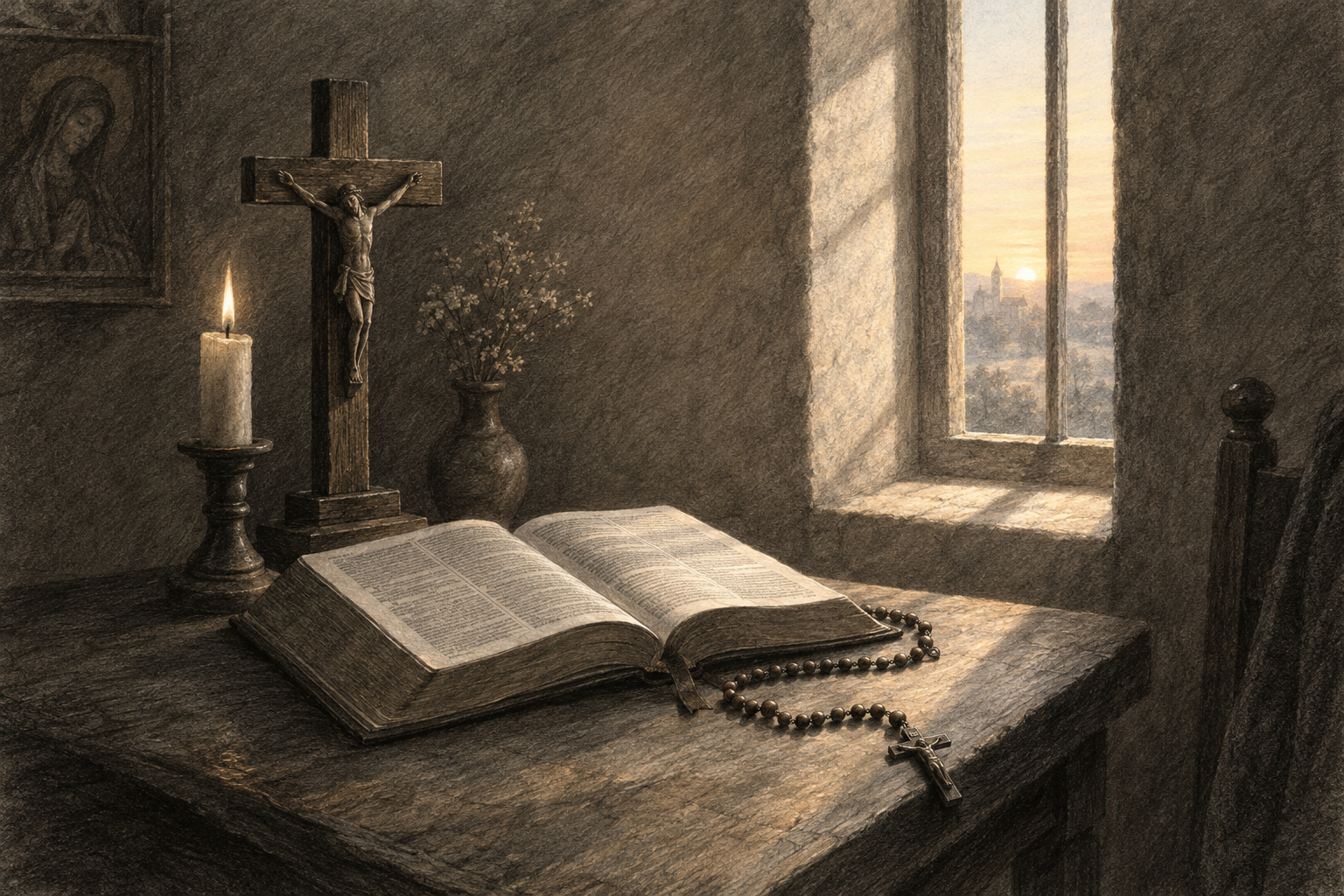
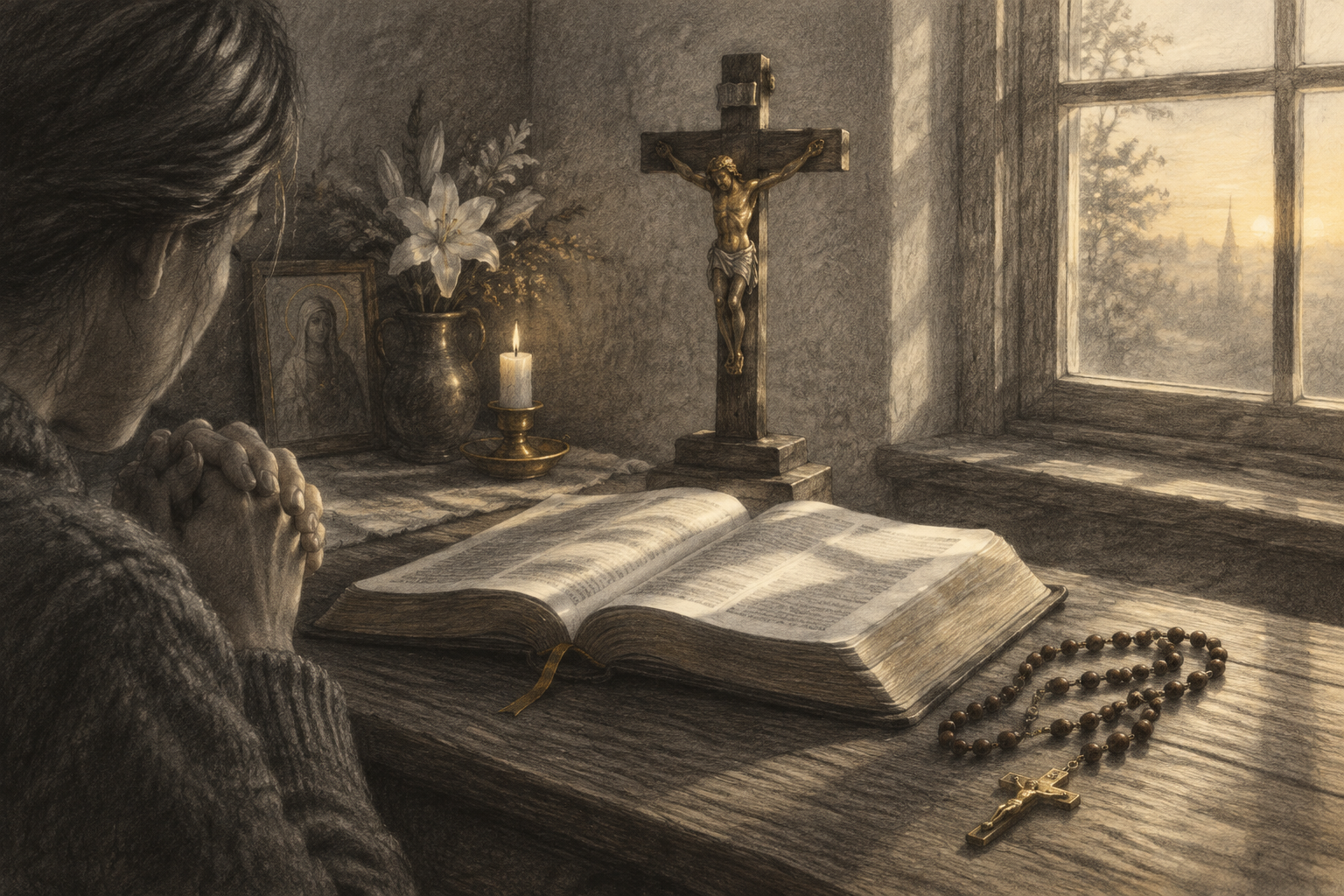
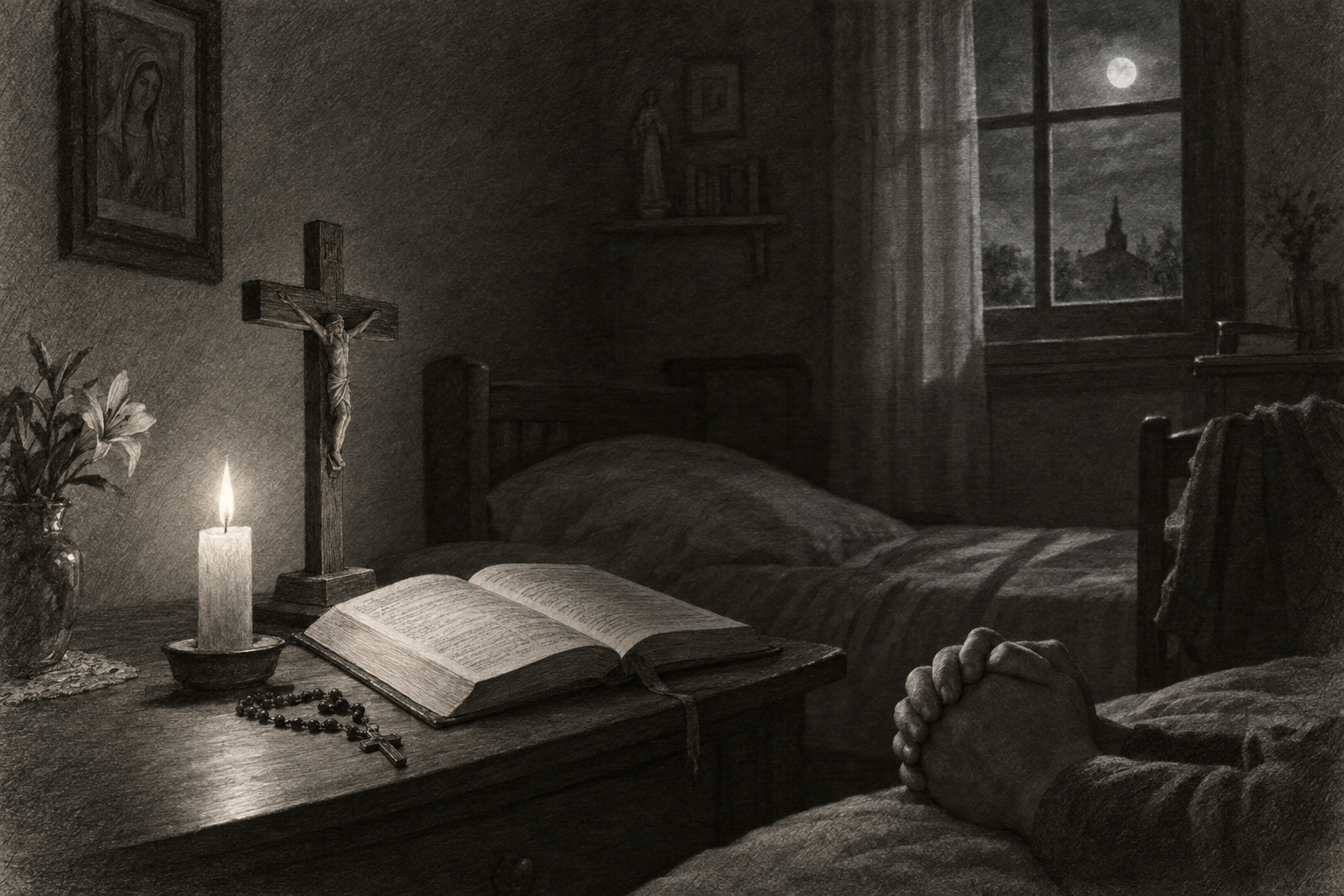
- Prepare a simple place. A crucifix, Bible, holy image, or small candle can help mark the transition from activity to prayer. Use a candle only when it can be attended safely.
- Silence unnecessary noise. Put away screens for a few minutes. This is not contempt for technology. It is a practical way to give God undivided attention.
- Keep the first commitment small. Five to ten minutes may be enough. You can make the Sign of the Cross, review the day, pray an Act of Contrition, offer intercessions, and finish with an Our Father.
- Use familiar prayers when tired. The Our Father, Hail Mary, Glory Be, and the prayer to a guardian angel can carry the heart when spontaneous words are difficult.
- Allow the practice to deepen gradually. Once a short routine is established, you may add a Psalm, spiritual reading, a decade of the Rosary, or Compline.
Parents can adapt night prayer for family life. A brief family examen might ask each person to name one blessing, one person who needs prayer, and one way to do better tomorrow. The prayer should not become a public interrogation of children's faults. Its atmosphere should be grateful, truthful, and secure in God's mercy.
Spouses may also pray together, even if only for a few minutes. Shared thanksgiving and intercession can soften resentments and restore a sense of common dependence upon God. Difficult matters may still require patient conversation, but prayer helps place that conversation under grace.
When prayer at night is difficult
Some nights are peaceful. Others arrive with exhaustion, grief, anger, distraction, or fear. A mature practice makes room for these realities rather than treating them as evidence of failure.
If you are exhausted, pray briefly and honestly. Make the Sign of the Cross and say, Jesus, I thank you for this day. Forgive my sins, protect those I love, and keep me through the night. A short prayer offered with sincerity is not spiritually inferior to a longer devotion performed without attention.
If you are anxious, begin with the body. Slow your breathing, unclench your hands, and place both feet on the floor. Then speak to God about the actual fear instead of trying to produce peaceful feelings. Christ invites the burdened to come to him for rest: Matthew 11:28. His invitation does not mean every distress will disappear immediately, but it assures us that suffering can be brought into his presence.
If you are grieving, do not force gratitude into cheerful language. Thanksgiving can be quiet and costly. You might thank God for the life of the person you miss, for one memory, or simply for remaining with you in sorrow. The Psalms teach us that lament and faith can inhabit the same prayer.
If you have failed seriously, resist the temptation to hide. Shame says to withdraw until you have repaired yourself. The Gospel calls us to return to the Father. The prodigal son begins his journey home while still aware of his unworthiness, and the father goes out to meet him: [[VERSE|luke|15|17-24|Luke 15:17-24]]. Honest contrition opens the heart to mercy and to the concrete steps of amendment.
A simple pattern for tonight
You can begin without waiting for the perfect prayer book, room, or schedule. Set aside a few quiet minutes and follow this pattern:
- Make the Sign of the Cross.
- Ask the Holy Spirit to help you see the day truthfully.
- Thank God for three particular gifts.
- Review one moment of grace and one moment that needs repentance.
- Make an Act of Contrition and resolve to seek confession when needed.
- Pray for your family, the suffering, the dead, and anyone entrusted to your care.
- Pray the Our Father slowly.
- Place yourself and the coming night in God's hands.
Over time, this small habit can change the way the whole day is lived. Gratitude becomes more attentive because you expect to give thanks. Temptation becomes easier to recognize because you regularly examine your choices. Intercession becomes less abstract because the faces and needs of others return in prayer. Even sleep takes on a different meaning, not as an escape from God's presence, but as rest received beneath his providence.
The day may end with work unfinished, apologies still needed, and questions still unanswered. Night prayer does not deny any of that. It teaches us to stop, repent where necessary, and trust that God's mercy is larger than one imperfect day. Then, like Simeon holding the promised Savior, we can release what we cannot control and lie down in peace.
Keep Reading on Lets Read The Bible
Frequently Asked Questions
What prayers should a Catholic say before bed?
A Catholic may make the Sign of the Cross, thank God for the day, examine his or her conscience, pray an Act of Contrition, offer intercessions, and finish with the Our Father, Hail Mary, or another familiar prayer. Compline from the Liturgy of the Hours is also especially suited to bedtime.
Is a nightly examen the same as confession?
No. A nightly examen or examination of conscience helps a person recognize grace, identify sins, make an act of contrition, and prepare to change. It does not replace the Sacrament of Penance, especially when a person is conscious of grave sin.
How long should Catholic night prayer take?
There is no required length for personal night prayer. Five to ten attentive minutes can establish a fruitful habit. Compline generally takes longer, but consistency and sincere attention matter more than making a private routine unnecessarily lengthy.