Family and Vocation
The Lamp Beside the Empty Chair
Grief after the death of a spouse can become a quiet place of prayer, fidelity, and renewed vocation.
Site Admin | November 11, 2026 | 8 views
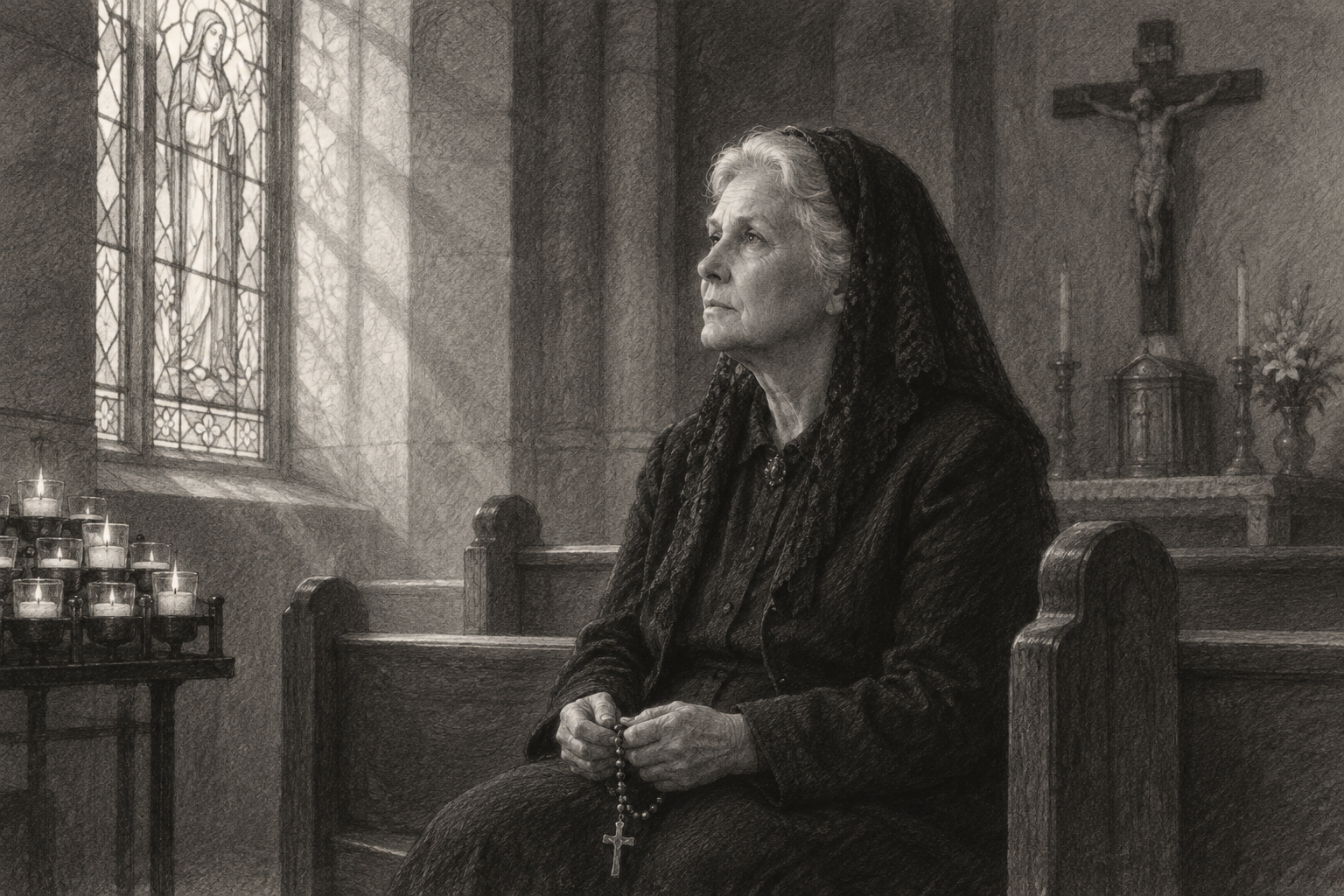
When a husband or wife dies, the loss reaches far beyond companionship. It enters the kitchen, the parish pew, the family calendar, and the quiet hour before sleep. A shared life that once gave shape to ordinary decisions is suddenly absent. Even familiar rooms can feel altered.
Christian hope does not ask a widow or widower to pretend that this rupture is small. It does not demand cheerful words before the heart is ready to speak them. The Church can look directly at death because she looks toward the risen Christ. She knows both that death is an enemy and that it will not have the final word.
This is the ground of a faithful widowhood and Christian hope reflection: grief deserves patience, love remains meaningful, prayer reaches beyond the grave, and the surviving spouse still has a vocation within the Body of Christ.
Grief is not a failure of faith
Deep sorrow after the death of a spouse is not evidence that faith has disappeared. It often reveals how deeply love entered the fabric of life. The habits of marriage are formed through thousands of ordinary acts: asking a question across the room, preparing a meal, sharing concerns about children, making plans, offering forgiveness, and praying together. When death interrupts those habits, the heart and body both register the absence.
Scripture never treats mourning as an embarrassment. The psalmist says that the Lord is near to the brokenhearted Psalm 34:18. Nearness is not the same as immediate relief. God may be truly present even when prayer feels dry, the house feels empty, and the future seems impossible to imagine.
Jesus himself wept at the tomb of Lazarus John 11:35. His tears did not contradict his knowledge of the resurrection. They showed the tenderness of God before human suffering. A grieving Christian may therefore weep without apology. Tears can coexist with trust, just as lament can coexist with worship.
There is no universal timetable for bereavement. Anniversaries, holidays, music, clothing, and simple household tasks may awaken sorrow long after the funeral. Some days will feel almost peaceful, while another day may bring grief with unexpected force. The Christian path is not measured by how quickly such feelings disappear. It is measured more quietly, through the willingness to keep turning toward God, even with very few words.
A marriage completed, not erased
Christian marriage is a covenantal vocation ordered toward the good of the spouses and the welcoming and formation of children. Husband and wife give themselves to one another for the whole of earthly life. When one spouse dies, the marriage bond has reached its earthly completion. The surviving spouse is no longer married in the canonical sense, yet the history of faithful love is not rendered meaningless.
This distinction matters. Widowhood does not require someone to behave as though the marriage never happened. Gratitude for a spouse, care for shared children, treasured memories, and the virtues learned through married life can continue to bear fruit. The past need not be discarded in order for a person to live faithfully in the present.
At the same time, Christian hope does not reduce eternal life to a continuation of earthly domestic arrangements. Jesus teaches that the resurrection surpasses marriage as we now know it Matthew 22:30. Heaven is not a private reconstruction of a former household. It is full communion with God and, in him, the communion of all the redeemed.
This does not make marital love unimportant. Grace perfects what is true and holy. Every act of patience, sacrifice, fidelity, and forgiveness offered within a marriage belongs to the work God has done in his children. Love is purified and brought into the greater life of the kingdom.
Hope is more honest than easy reassurance
After a death, well-meaning people may speak with more certainty than Christian humility permits. They may confidently describe the deceased person's present state or insist that everything happened for an easily understood reason. Such words can add confusion to grief.
Catholic hope is firmer and more reverent. It entrusts the dead to the mercy of God, whose judgment is perfectly just and perfectly loving. It does not canonize every deceased person by private assumption. Neither does it surrender to despair. Saint Paul tells Christians not to grieve as those who have no hope 1 Thessalonians 4:13. He does not say that Christians do not grieve. He says their grief is changed by hope.
Jesus said, "I am the resurrection and the life." John 11:25
Christian hope rests first in Christ, not in a particular emotional state. A widow may feel hopeful one morning and desolate that evening. The promise of Christ remains steady through both experiences. Hope is sometimes less like sunlight and more like a lamp kept burning through the night.
Prayer continues the work of love
The Church's prayer for the dead gives grief a concrete act of charity. Catholics pray for those who have died because love does not become useless at the grave. Scripture commends prayer offered on behalf of the dead 2 Maccabees 12:45. This practice is joined to the Church's faith in God's mercy and in the purification of those who die in his friendship but still need healing from the effects of sin.
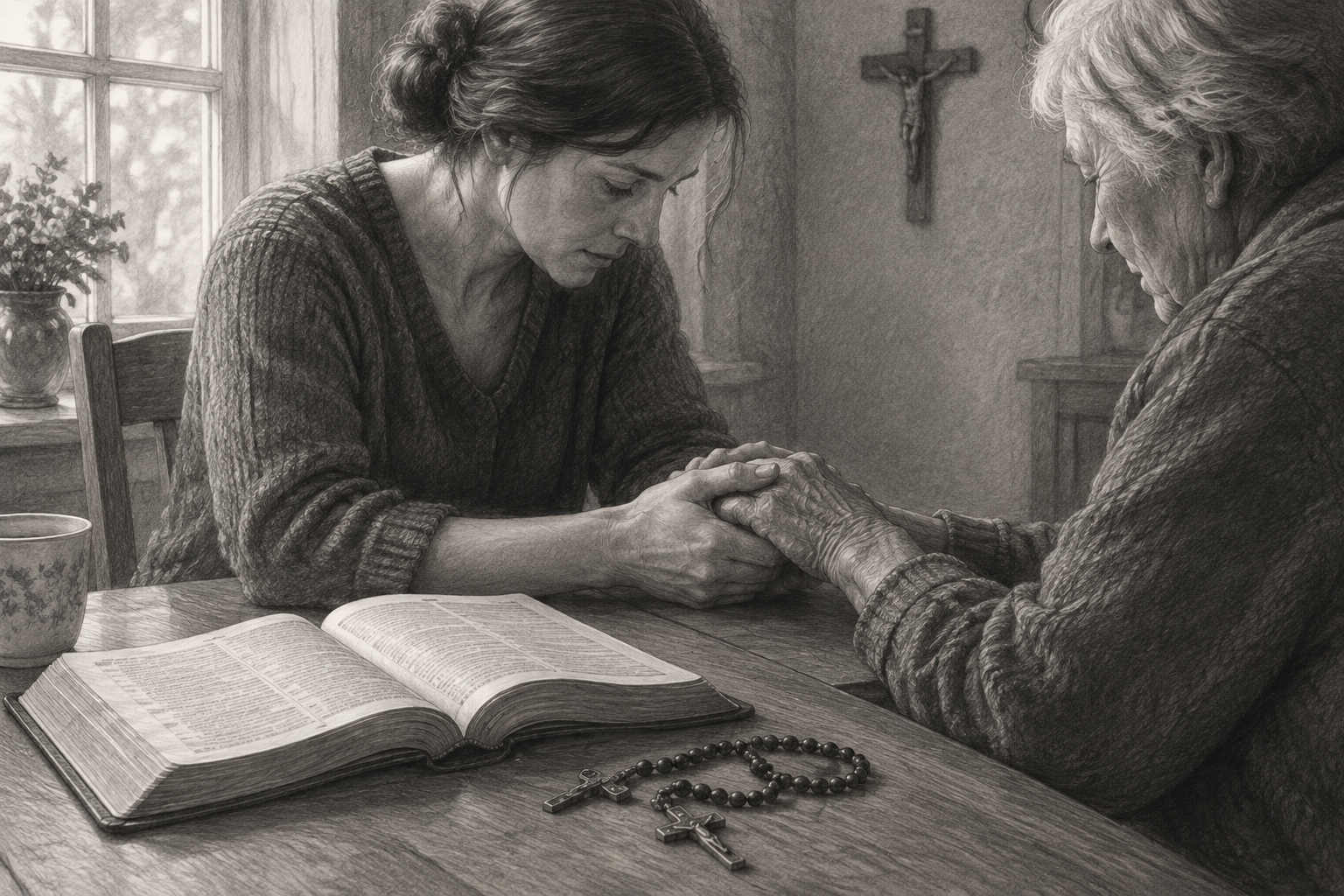
Having Mass offered for a deceased spouse is one of the most fitting gifts a surviving spouse can give. The Eucharistic sacrifice is not a symbolic attempt to keep the person nearby. It is the prayer of Christ and his Church, offered in trust to the Father. Visiting a cemetery, praying the Rosary, offering personal sacrifices, and remembering the deceased during ordinary prayer can also become steady expressions of love.
These practices guard against two opposite errors. One is the idea that death ends every bond of charity. The other is the attempt to seek hidden messages, signs, or forbidden forms of contact with the dead. Catholic prayer is simpler and safer. It entrusts the deceased to God and asks the saints to intercede, while leaving all unseen realities in the Lord's hands.
A short prayer may be enough: Lord Jesus, have mercy on your servant. Purify what needs healing, receive what was offered in love, and bring the departed into the joy of your presence.
Scripture notices those who live after loss
Widows appear throughout Scripture not as background figures but as people seen by God. Their circumstances also reveal whether a community is practicing justice. The Letter of James names care for widows in their affliction as part of religion that is pure before God James 1:27. Saint Paul likewise tells the Church to honor widows who are truly in need 1 Timothy 5:3.
Jesus noticed a poor widow placing two small coins into the Temple treasury. Others could see only the amount. He saw the depth of her offering Mark 12:43. In another scene, he encountered the widow of Nain as she accompanied the body of her only son. Before performing the miracle, Jesus was moved with compassion for her Luke 7:13.
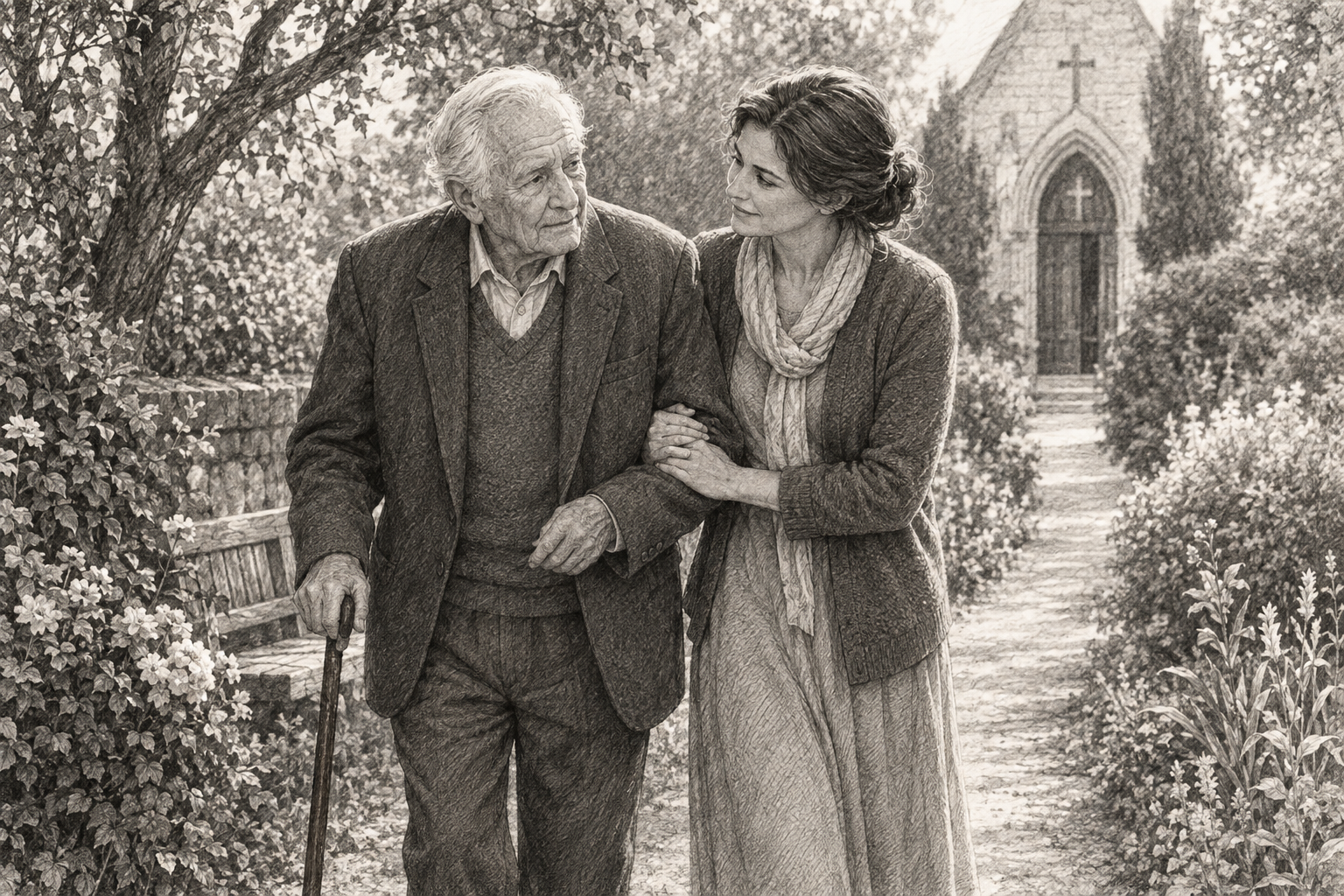
These passages do not sentimentalize widowhood. They show that God sees vulnerability, hidden sacrifice, and social isolation. They also place a responsibility upon Christian families and parishes. A grieving person should not have to become unusually outgoing in order to receive care.
How a parish can offer faithful companionship
Support is most helpful when it is concrete and sustained. Attention is often abundant around the funeral and scarce several months later. Parishioners, clergy, relatives, and friends can serve with simple consistency:
- Invite the grieving person to meals without demanding a cheerful response.
- Remember significant dates, including the anniversary of the death.
- Offer transportation, household help, or assistance with unfamiliar tasks.
- Make room for stories about the deceased spouse without changing the subject.
- Pray for both the deceased and the surviving spouse by name.
- Continue invitations even when several are declined.
Listening is often a greater work of mercy than explaining. Not every silence needs to be filled. Not every sorrow needs an answer. Sometimes Christian presence means sitting beside someone who cannot yet imagine the next season of life.
The small disciplines that carry a person forward
Grief can make ordinary decisions exhausting. A simple rule of life may help when motivation is unreliable. This is not a method for escaping sorrow. It is a way of giving the day enough structure to receive grace.
- Begin with a brief prayer. The Sign of the Cross, an Our Father, or one honest sentence can orient the day toward God.
- Remain close to the sacraments. Mass and confession place the grieving person within the worship and healing of the whole Church.
- Care for the body. Regular meals, sleep, movement, and medical attention are not distractions from spiritual life.
- Accept trustworthy help. Family, friends, a priest, a bereavement group, or a qualified counselor may each have a proper role.
- Choose one useful task. A small act, completed without haste, can restore a sense of order.
- Let prayer include lament. God does not require polished language. Anxiety and need can be brought before him Philippians 4:6.
Professional help may be especially important when grief is accompanied by persistent inability to function, severe depression, substance misuse, or thoughts of self-harm. Seeking such care is not a lack of trust in God. Human skill and compassionate treatment can be instruments of providence.
Widowhood can become a renewed vocation
The death of a spouse ends one form of shared earthly vocation, but it does not end the surviving spouse's call to holiness. Baptism remains. Membership in the Church remains. The gifts of the Holy Spirit remain. A person who has been widowed is not merely waiting for life to be over.
In time, new forms of service may become possible. Some widows and widowers offer deep wisdom to younger married couples. Some become especially attentive to the lonely, the sick, or the newly bereaved. Some discover a quieter apostolate of intercessory prayer. Others serve children and grandchildren with renewed availability. None of these activities should be forced as a way to prove that grief has ended. They are possible fruits of grace, not requirements for earning a place in the community.
The surviving spouse may also discern whether to remain single or to marry again. Since death ends the marital bond, remarriage can be a legitimate path when freely chosen and otherwise possible under Church law. Remaining unmarried can also be a generous and fruitful calling. Neither choice should be driven by embarrassment, pressure from relatives, fear of loneliness, or the judgment of others. Discernment deserves prayer, time, and honest counsel.
Ruth's words to Naomi, spoken within the bond of family loyalty after bereavement, reveal how faithful presence can open an unforeseen future: "Where you go I will go" Ruth 1:16. The path ahead was not clear when those words were spoken. Fidelity came before understanding.
Living toward the promised restoration
Christian hope does not require forgetting. It allows remembrance to be gradually freed from panic and possessed with gratitude. Photographs may remain. Stories may be told. A spouse's name may still be spoken in prayer. Yet the survivor is also permitted to laugh, travel, form friendships, change familiar routines, and receive unexpected joy. Such moments are not betrayals of the dead.
The final Christian promise is larger than reunion with one beloved person, though it certainly does not exclude the communion of those who belong to Christ. The promise is the renewal of creation, the defeat of death, and life with God. Revelation speaks of the day when God will wipe away every tear and death will be no more Revelation 21:4.
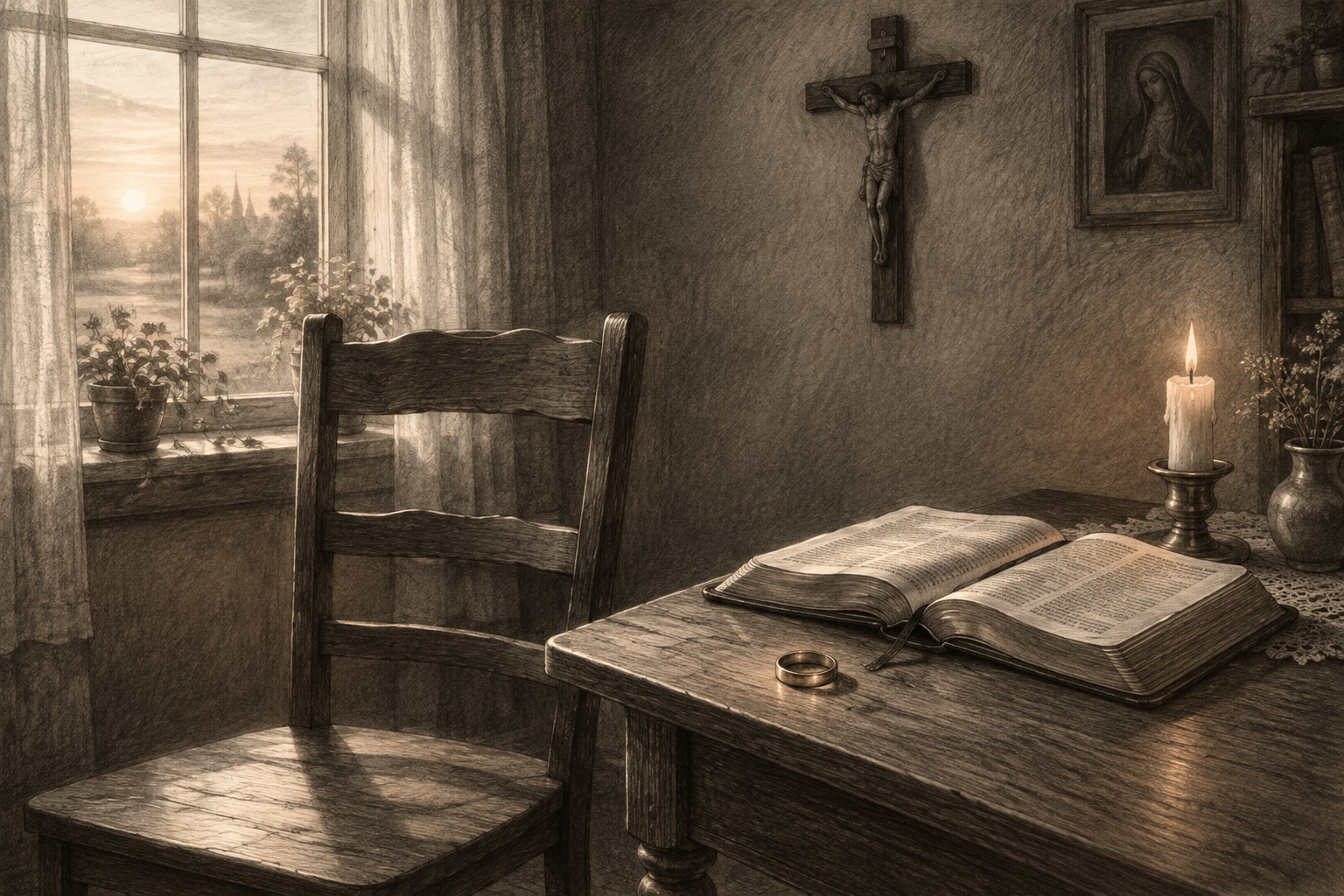
Until that day, widowhood may involve carrying both absence and love. The empty chair remains part of the room, but it does not stand outside the light of Christ. Grace often arrives quietly: in the Eucharist, in a friend's remembered call, in a prayer spoken at the cemetery, in work that still needs doing, and in the courage to rise for another morning. The lamp of hope need not blaze brightly every day. It is enough to keep placing it in the hands of the One who has passed through death and lives forever.
Keep Reading on Lets Read The Bible
Frequently Asked Questions
Is it normal for a Catholic widow or widower to continue grieving for many years?
Yes. Grief has no fixed timetable, and its return around anniversaries or family events is not a failure of faith. Christian hope permits honest mourning while trusting in Christ's resurrection.
Why do Catholics pray for a deceased spouse?
Catholics entrust the dead to God's mercy and pray for their purification and eternal rest. Having Mass offered, praying the Rosary, and making personal sacrifices are fitting acts of continuing charity.
May a Catholic widow or widower marry again?
Yes. Death ends the earthly marriage bond, so a surviving spouse is ordinarily free to marry again if there are no other impediments. Remaining single is also an honorable choice and may become a fruitful form of Christian vocation.