Family and Vocation
Where Sorrow Learns to Pray
Grief does not disappear in the presence of faith, but Christ meets us within it and teaches us to hope.
Site Admin | October 26, 2026 | 4 views
Grief changes the shape of ordinary life. A familiar room can suddenly feel empty. A family custom can become difficult to continue. A prayer once spoken easily may catch in the throat. Even small tasks can require unexpected effort.
For Christians, grief can also bring spiritual confusion. We believe in the resurrection of the dead and the life of the world to come. We trust that Christ has conquered death. Yet we still feel the pain of separation. We may wonder whether deep sorrow shows a lack of faith, or whether faithful people should recover more quickly.
The Catholic answer is both gentle and realistic. Faith does not require us to pretend that death is harmless. Death is an enemy, and the separation it brings is painful. At the same time, death does not have the final word. Christian mourning lives between these truths. We grieve honestly, and we hope because Jesus Christ has entered death and risen victorious.
Jesus Does Not Stand at a Distance from Grief
One of the shortest verses in Scripture offers one of its deepest consolations: John 11:35. Jesus weeps at the tomb of Lazarus. He knows that Lazarus will soon be called out of the tomb, yet he does not treat the sorrow of Martha and Mary as unnecessary or embarrassing.
Christ's tears reveal the tenderness of God. He does not rebuke the mourners for loving Lazarus. He enters their anguish. His presence does not immediately erase every tear. Instead, he shares their sorrow before revealing his power over death.
This scene helps correct the idea that grief and faith are opposites. The Lord who is the resurrection and the life also weeps. Christians do not honor him by becoming less human. We honor him by allowing our wounded humanity to remain open to his grace.
Jesus does not ask the grieving heart to deny its wound. He asks that heart to let him draw near.
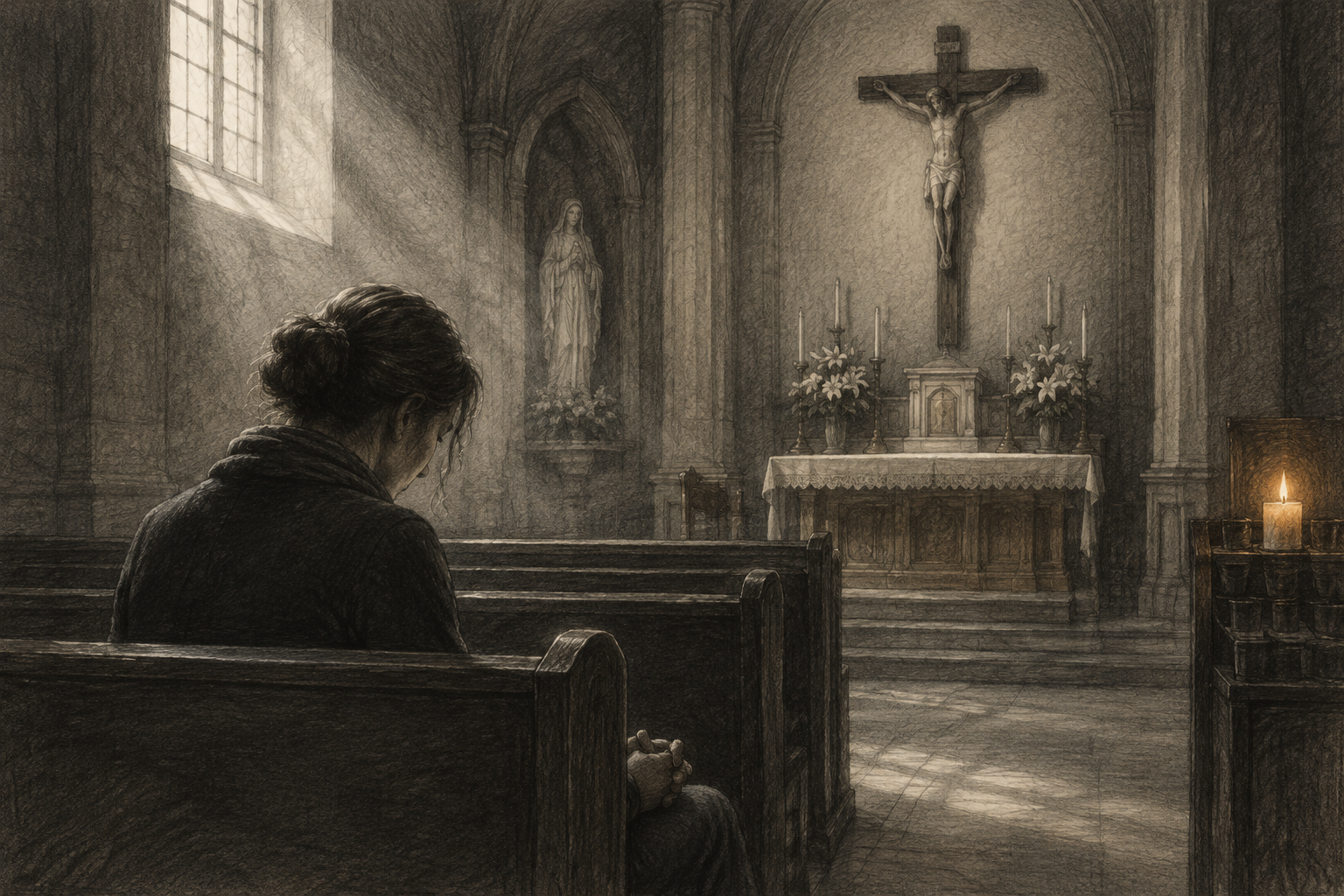
A Catholic grief reflection therefore begins not with a demand to feel better, but with the presence of Christ. Some days that presence may be felt with great peace. On other days it may be known only through an act of trust: a whispered prayer, a crucifix held in silence, or the decision to attend Mass when the heart feels numb.
Mourning Is an Expression of Love
Grief is painful because love has made us vulnerable. We mourn a spouse, parent, child, sibling, friend, or member of our community because that person's life was not interchangeable with another. The loss touches shared memories, duties, hopes, and habits. It can also affect a person's sense of vocation. A widow, widower, parent, or caregiver may ask who he or she is now that a familiar form of service has ended.
Scripture does not treat mourning as a failure. Ecclesiastes recognizes that there is a time to weep and a time to mourn: Ecclesiastes 3:4. Jesus calls those who mourn blessed and promises that they will be comforted: Matthew 5:4. This comfort is not shallow reassurance. It is the work of God, who remains faithful when human strength has been exhausted.
Grief can come in waves. A person may experience gratitude and sadness in the same hour. Laughter may return and then be followed by guilt. An anniversary, hymn, scent, or family celebration may reopen sorrow that seemed to have softened. None of this follows a universal schedule.
Patience is therefore a form of charity, both toward ourselves and toward others. The grieving should not be pressured to perform serenity. Nor should every tear be interpreted as a crisis. Some wounds become integrated slowly, through prayer, friendship, the sacraments, and the passage of time.
Christian Hope Is More Than Optimism
Ordinary optimism says that circumstances may improve. Christian hope rests on something firmer: the death and resurrection of Jesus. Saint Paul tells believers not to grieve as those who have no hope: 1 Thessalonians 4:13. He does not tell them not to grieve. He distinguishes Christian grief by the hope that accompanies it.
The Church proclaims the resurrection of the body, not merely the survival of a memory or influence. Human beings are created as a unity of body and soul. Death brings a real rupture, but God intends the final restoration of the whole person. Christ's own bodily resurrection is the foundation of this promise.
This is why Catholic funeral liturgy holds sorrow and hope together. The Church prays for the deceased, commends the person to God's mercy, and comforts those who mourn. The funeral is not a declaration that grief is finished. It is an act of worship in which death is placed within the saving mystery of Christ.
Hope also leaves room for humility. Catholics do not need to make confident claims about the hidden state of a particular soul. We entrust the dead to the mercy and justice of God. We pray because love continues to seek the good of the beloved, and because the communion of saints is stronger than the limits of earthly separation.
Prayer When Words Are Difficult
Grief often weakens concentration. Long prayers may feel impossible. A person may begin the Rosary and lose track after a few beads. Scripture may seem distant. At such times, simplicity is not spiritual failure.
The Psalms give believers language for sorrow, confusion, longing, and trust. The psalmist asks how long suffering will continue and then turns again toward God's steadfast care: Psalm 13:1. These prayers show that lament can be an act of faith. To bring anguish before God is to believe that he hears it.
When words are scarce, a grieving person might pray in one of these simple ways:
- Repeat the name of Jesus slowly and attentively.
- Offer an Our Father for the deceased.
- Pray a decade of the Rosary rather than forcing a longer devotion.
- Ask, "Lord, receive them into your mercy, and keep me close to you."
- Sit quietly before the tabernacle without trying to produce a particular feeling.
- Request a Mass intention for the deceased.
The Mass has a special place in Catholic mourning because it makes present the one sacrifice of Christ. At the altar, the Church is united in worship with Christ and his members. Bringing the name of a loved one to Mass can become a concrete expression of continuing love, trust, and intercession.
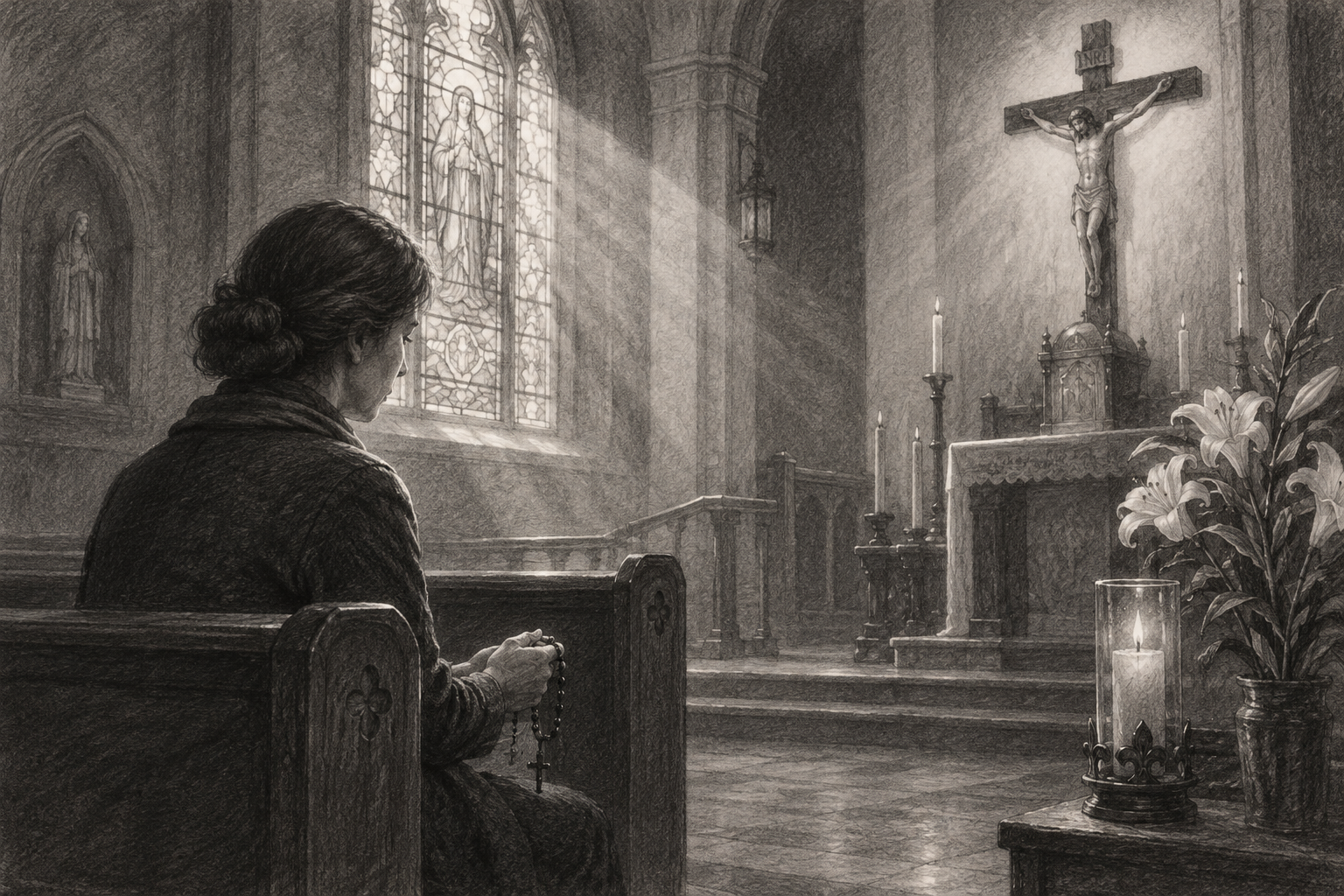
The Rosary can also be a companion in grief. Its repeated prayers steady the mind, while its mysteries keep the life, death, and resurrection of Jesus before us. Mary knows both the tenderness of family love and the sword of sorrow. At the foot of the cross, she remained with her Son when she could not remove his suffering. Her presence can teach mourners the holiness of remaining faithful when nothing can be fixed.
The Vocation of Those Who Accompany the Grieving
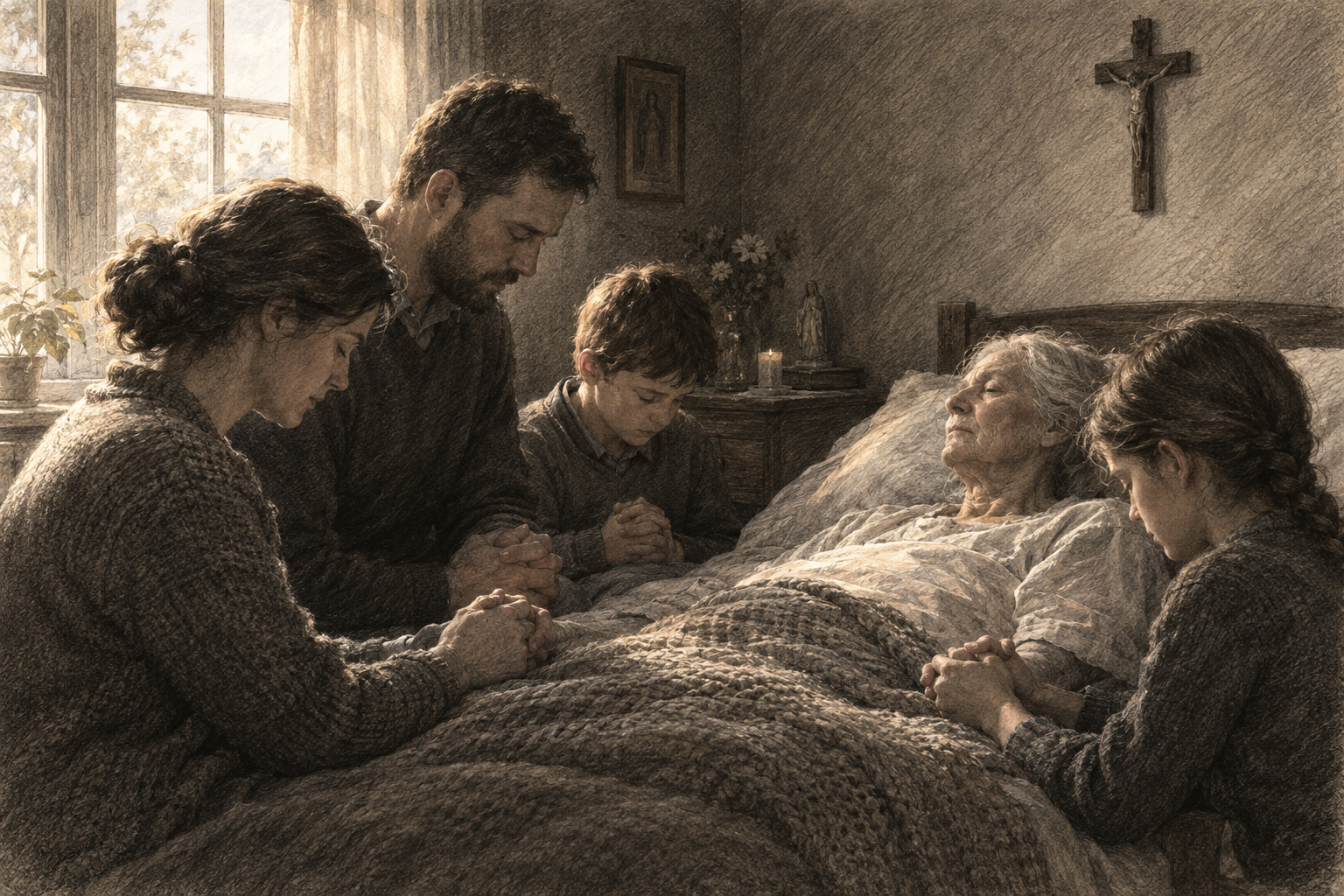
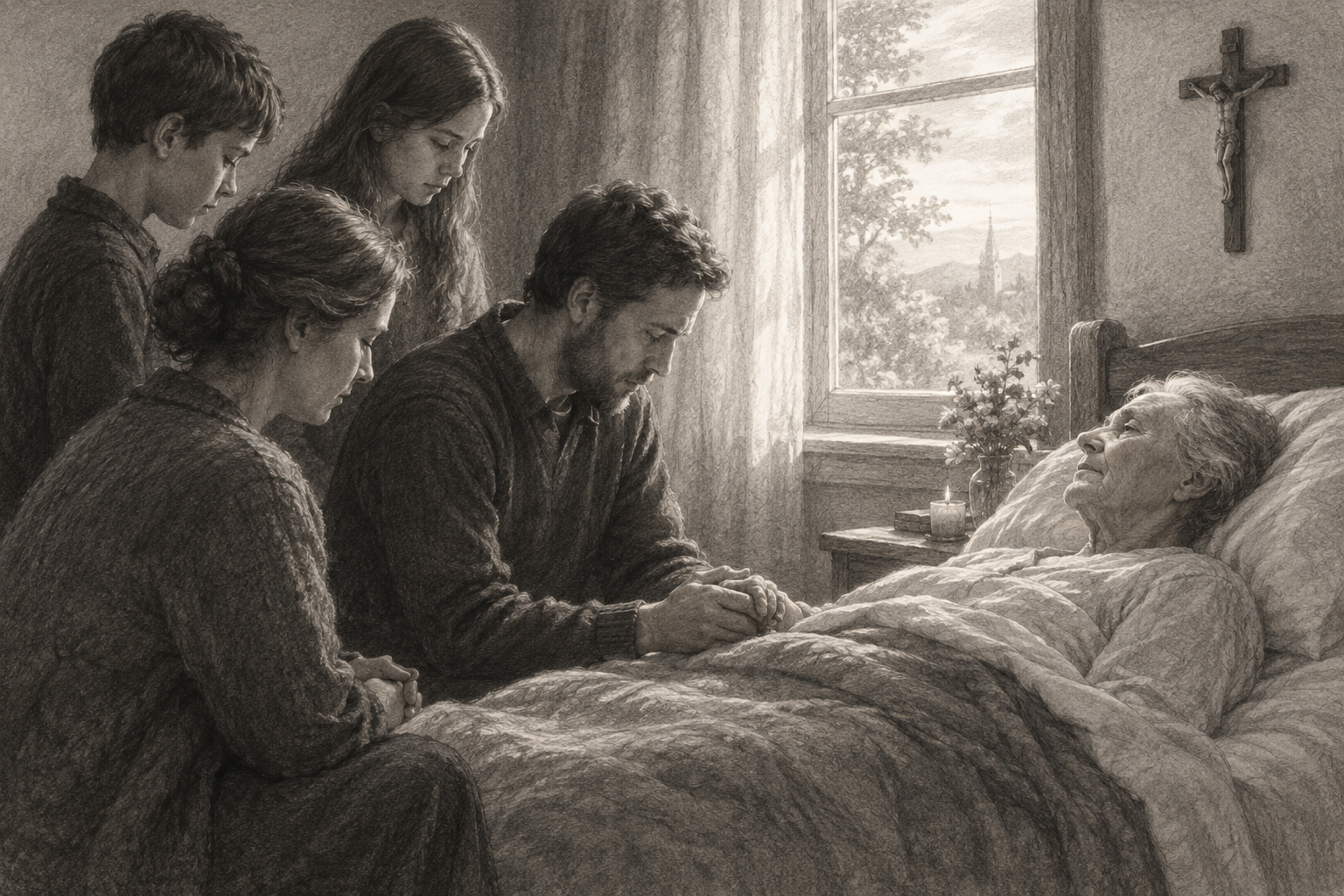
Grief is personal, but it should not always be private. Families, parishes, and friendships have a real vocation to accompany those who mourn. This usually requires less explanation and more presence.
Job's friends initially do something wise: they sit with him in silence. Their later attempts to explain his suffering become harmful. The contrast remains instructive. People in grief do not always need a theory. They often need someone willing to stay near without controlling the conversation.
Practical acts of mercy can speak with unusual clarity:
- Bring a meal without requiring a long visit.
- Offer transportation to Mass, appointments, or the cemetery.
- Remember the anniversary of the death.
- Speak the deceased person's name rather than avoiding it.
- Listen to a familiar story even if it has been told before.
- Continue checking in after the funeral, when public attention has faded.
It is usually better to avoid easy explanations such as saying that everything happens for a reason. God's providence is real, but suffering should not be reduced to a slogan. The mysteries of freedom, mortality, and divine providence are not resolved by a quick sentence. Compassion allows room for questions that may remain unanswered in this life.
It is also wise to recognize when grief has become entangled with serious depression, trauma, or an inability to function safely. Seeking help from a qualified mental health professional does not oppose faith. Pastoral support and professional care can work together. If someone may be in immediate danger, practical intervention should not be delayed.
Letting Grief Become an Offering
Christians sometimes speak of offering up suffering. Properly understood, this does not mean pretending that pain is good in itself. It means uniting unavoidable suffering with the love of Christ, especially with his self-offering on the cross. What feels useless can be placed into his hands as prayer.
A grieving parent may offer a sleepless night for another suffering family. A widow may bring loneliness to Mass and pray for those who die alone. A friend may transform remembrance into a work of mercy. These acts do not replace the person who has died, nor do they cancel sorrow. They allow love to keep bearing fruit.
In time, grief may also deepen compassion. Those who have mourned often notice the lonely person at church, the family facing a diagnosis, or the neighbor approaching an anniversary of loss. A wound entrusted to grace can become a place from which mercy flows.
This transformation cannot be hurried. There will be days for action and days for rest. There may be moments of peace followed by renewed tears. The task is not to master grief but to keep bringing it into relationship with Christ.
Remembering in the Light of the Resurrection
Catholic remembrance is active. We remember the dead in prayer, at Mass, during November, and in visits to cemeteries. We care for graves because the body is worthy of reverence and destined for resurrection. We may preserve photographs and family stories, practice virtues learned from the deceased, or continue a work of charity that mattered to them.
These practices help love mature from physical presence into faithful remembrance and intercession. They also resist two temptations: clinging as though death could be undone by memory alone, and forgetting as though healing required erasing the past.
Saint Paul proclaims that nothing, including death, can separate believers from the love of God in Christ: Romans 8:38. That promise does not make absence painless. It gives the grieving heart somewhere to stand.
When sorrow returns, we can place the person we love into God's care again. We can ask for the grace needed for this day rather than demanding strength for every future day. We can receive consolation when it comes without feeling that peace betrays the dead. And when consolation seems far away, we can remain beside Christ, trusting that the Lord who wept at a tomb is also the Lord who opened it.
Keep Reading on Lets Read The Bible
Frequently Asked Questions
Is deep grief a sign of weak Catholic faith?
No. Jesus wept at the tomb of Lazarus, and Scripture gives believers many prayers of lament. Faith does not eliminate sorrow. It allows sorrow to be brought honestly before Christ while remaining open to the hope of the resurrection.
How can Catholics pray for someone who has died?
Catholics may request a Mass intention, offer personal prayers, pray the Rosary, visit the cemetery, and perform works of mercy for the deceased. These practices entrust the person to God's mercy and express the communion of saints.
Should a grieving Catholic seek counseling?
Yes, when professional support would be helpful. Mental health care does not conflict with Catholic faith. A priest or trusted pastoral leader can offer spiritual support, while a qualified counselor can help address depression, trauma, or difficulties with daily functioning.