Family and Vocation
When Suffering Enters the Life We Were Called to Love
Christian hope does not deny pain. It receives suffering in the presence of Christ and learns how grace can shape the next faithful step.
Site Admin | October 23, 2026 | 2 views
Suffering can interrupt a family without warning. An illness changes the rhythm of a household. A miscarriage leaves parents grieving a child whom others never had the chance to know. Unemployment strains a marriage. An aging parent needs increasing care. A son or daughter walks away from the faith. Depression makes ordinary tasks feel impossibly heavy. Sometimes the suffering is visible to everyone. Sometimes it is carried quietly at the dinner table, at work, or in the sleepless hours of the night.
A serious suffering Catholic perspective cannot begin by pretending that pain is simple. It begins with Jesus Christ, who neither dismissed human anguish nor remained distant from it. Christian faith does not require us to call evil good, deny grief, or act as if every wound can be explained. It teaches that God can meet us within suffering, sustain love under pressure, and bring redemption from circumstances that we would never have chosen.
Faith Does Not Make Pain Unreal
The Bible gives suffering a remarkably honest voice. The psalms contain lament, confusion, pleading, and trust. Jesus Himself prayed the opening words of Psalm 22 from the cross: Psalm 22:1. This is not unbelief. It is prayer spoken from within desolation.
At the tomb of Lazarus, Jesus knew that death would not have the last word. Yet He did not respond to the mourners with a lecture. He entered their grief, and the Gospel tells us that Jesus wept: John 11:35. Those two words protect Christians from a shallow idea of hope. The promise of resurrection does not make present sorrow imaginary. Love grieves because a real person, relationship, ability, or hope has been wounded or lost.
Catholics may therefore name suffering truthfully. A person can be faithful and still feel afraid. A grieving parent can trust God and still weep. A caregiver can love generously and still become exhausted. Someone living with chronic pain may be grateful for life while also mourning what the illness has taken. Grace ordinarily works through our real humanity, not through the performance of constant cheerfulness.
Not Every Suffering Has a Simple Explanation
People in pain are often tempted to ask what they did to deserve it. Friends may unintentionally deepen the wound by searching for a quick spiritual cause. Scripture warns against such certainty. When the disciples asked whether a man's blindness resulted from his sin or his parents' sin, Jesus rejected their narrow alternatives: John 9:3.
Catholic teaching recognizes that suffering belongs to a world wounded by sin, but this does not mean every particular illness, accident, or loss is a direct punishment for a particular fault. Human choices have consequences, and some suffering is indeed caused by cruelty, neglect, addiction, or injustice. Other pain comes through disease, natural disaster, aging, or circumstances whose full meaning remains hidden from us.
We should be cautious about claiming to know why God permitted a particular tragedy. Providence is real, but it is not a code that we can always decipher. A faithful response may include repentance when repentance is needed, but it also includes lament, medical care, practical action, protection of the vulnerable, and patient trust when no explanation is available.
Christ Does Not Watch from a Distance
The heart of the Christian response to suffering is not an argument but a Person. In the Incarnation, the Son of God entered human weakness. He knew hunger, fatigue, rejection, betrayal, physical agony, and death. The Letter to the Hebrews says that Christ is able to sympathize with our weakness: Hebrews 4:15.
In Gethsemane, Jesus did not pretend that the cup before Him was easy. He prayed that it might pass, while surrendering Himself to the Father's will: Luke 22:42. His prayer shows that asking for relief is not opposed to trust. Catholics may pray for healing, seek treatment, appeal for justice, and ask that a burden be removed. Surrender does not mean preferring pain. It means placing ourselves in the Father's hands even when the answer is not what we hoped to receive.
Christian hope does not say that suffering is harmless. It says that suffering cannot separate the faithful from the love of Christ or prevent God from working toward their salvation.
The cross reveals the seriousness of evil and the greater power of divine love. Jesus does not redeem suffering by explaining it away. He takes suffering into His own obedient self-offering and defeats death through the Resurrection. Because of Him, pain is no longer a place from which God is absent.
What It Means to Offer Suffering to God
Catholics often speak of offering up suffering. Properly understood, this does not mean enjoying pain, refusing relief, or believing that misery is holy by itself. Suffering is not automatically virtuous. What can become holy is the act of love, trust, patience, or intercession made in the midst of it.
Saint Paul speaks of rejoicing in his sufferings for the sake of the Church and of filling up what is lacking in Christ's afflictions: Colossians 1:24. This does not suggest that Christ's saving sacrifice was incomplete. Rather, through baptism, believers are joined to Christ and invited to participate in the fruit of His one perfect offering. Our trials can be united to His cross and placed in His hands for the good of others.
This offering can be very simple. A patient undergoing treatment might pray for another person facing the same diagnosis. A parent awake with a sick child might entrust that night to Christ for families who have no support. Someone who feels lonely may offer a small act of kindness rather than allowing pain to harden into resentment. The value is not in the discomfort itself. The value comes from communion with Jesus and the love by which the burden is carried.
There will also be times when a person is too overwhelmed to form an offering. Even then, God has not withdrawn. Saint Paul assures us that the Holy Spirit helps us in our weakness and intercedes when we do not know how to pray: Romans 8:26. A sigh, a tear, or the simple name of Jesus can become prayer.
Suffering Within Family and Vocation
Vocation is often imagined through its joyful moments: a wedding, an ordination, a profession of vows, the birth of a child, or the discovery of meaningful work. Yet every vocation also includes seasons in which love becomes costly. Marriage asks spouses to remain present through weakness and disappointment. Parenthood requires sacrifices that may go unnoticed. Priests and religious carry the needs of people who may never know the extent of their prayer. Single Catholics may endure loneliness while still offering real service to family, parish, and community.
Suffering can tempt us to measure a vocation by visible success. A difficult marriage may feel like failure. Infertility may lead a couple to question the fruitfulness of their union. Illness may prevent someone from serving as before. A caregiver may wonder whether a hidden life has any significance.
The Gospel offers a different measure. Christian fruitfulness is rooted in faithful love, not merely in productivity. A bedridden person remains a member of the Body of Christ. A marriage enduring grief can still witness to covenantal love. A family that accepts help is not less faithful than one able to manage alone. When one member suffers, Saint Paul says, all suffer together: 1 Corinthians 12:26.
This is why suffering should not be treated only as a private spiritual test. The Church is a communion. Families, friends, parishes, and communities are called to help carry burdens, as Paul teaches in Galatians 6:2. Bringing a meal, driving someone to an appointment, sitting with the bereaved, helping with children, or making a careful phone call can become a work of mercy. Practical care is not less spiritual than spoken prayer.
Grace in the Next Faithful Step
Long periods of suffering can make large resolutions impossible. Grace often takes shape through the next faithful step rather than a dramatic feeling of strength. Helpful practices may include:
- Praying honestly. Speak to God without pretending. Lament, fear, and confusion can be brought into prayer.
- Receiving the sacraments. The Eucharist unites the faithful to Christ's self-giving love. Reconciliation restores communion when suffering has contributed to anger, withdrawal, or sin. The Anointing of the Sick gives grace, peace, and courage to those seriously burdened by illness or frailty.
- Accepting ordinary help. Medical treatment, counseling, rest, medication, and community support can be instruments of God's providence.
- Keeping prayer small when necessary. A decade of the Rosary, a brief psalm, or one slowly spoken Our Father may be enough for the day.
- Remaining connected. Isolation often increases anguish. A trusted relative, priest, physician, counselor, or friend can help a person discern what is needed.
- Serving within present limits. Even a brief note, patient listening, or hidden prayer can be an act of love.
These practices are not techniques for forcing God to remove pain. They are ways of remaining open to grace. Sometimes healing comes in the form earnestly requested. Sometimes the condition remains, but God provides endurance, companionship, reconciliation, or a deeper freedom from fear. We should neither demand miracles nor close our hearts to them.
When Endurance Is Not the Right Advice
Christian language about sacrifice must never be used to keep someone trapped in abuse or prevent a victim from seeking safety. Forgiveness does not require pretending that grave wrongdoing is acceptable. Patience does not mean allowing violence to continue. Preserving life, contacting appropriate authorities, seeking professional assistance, and establishing necessary boundaries can be morally responsible actions.
Similarly, a person experiencing suicidal thoughts, severe depression, or a mental health crisis needs immediate, competent support. Prayer matters deeply, but it should not be presented as a substitute for emergency help or clinical care. Family members and pastors serve suffering people best when spiritual accompaniment and appropriate professional treatment work together.
Even in less urgent situations, caregivers must recognize their limits. Rest and respite are not betrayals of love. Jesus invited His disciples to come away and rest after demanding ministry: Mark 6:31. Humility sometimes means allowing another person to share the task.
Hope Is More Than Improvement
Christians rightly hope for circumstances to improve, but theological hope reaches further. It rests in God Himself. If hope depends only on recovery, restored income, reconciliation, or the return of a previous way of life, it may collapse when those gifts do not come. Christian hope trusts that Christ has risen and that those who belong to Him are being led toward a life in which death will not have the final word.
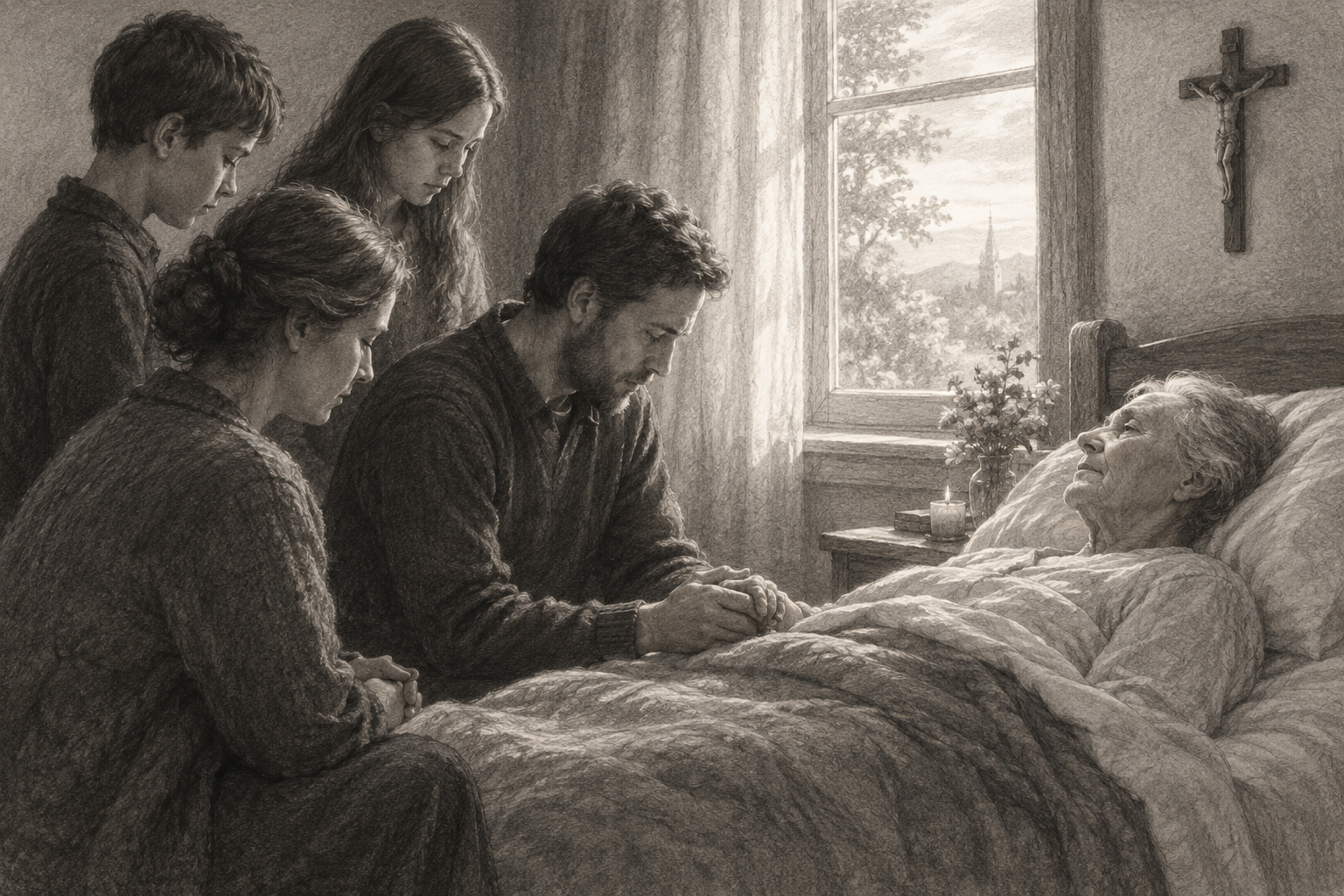
This hope does not hurry anyone through grief. It can sit quietly beside the hospital bed and remain present at the grave. It can admit that a family has been changed forever while still trusting that love offered in Christ is never wasted. The final promise of Scripture is not that faithful people will avoid tears, but that God Himself will wipe them away: Revelation 21:4.
Until that promise is fulfilled, Catholics live between the cross and the resurrection. We ask for healing, relieve suffering where we can, repent when we have caused it, and stay near those who carry heavy burdens. When strength is small, we offer God that smallness. When words fail, the Church prays with us. And when the road remains hidden, we take the next faithful step with Christ, who has already entered the darkness and will not abandon us there.
Keep Reading on Lets Read The Bible
Frequently Asked Questions
Does Catholic teaching say that suffering is always God's punishment?
No. Catholic teaching does not treat every illness, loss, or tragedy as a direct punishment for a particular sin. Some suffering results from sinful choices, but much arises from illness, human frailty, natural events, and circumstances whose full meaning is unknown. Catholics are called to avoid rash judgments and respond with truth, compassion, practical care, and prayer.
What does it mean to offer up suffering?
To offer up suffering means to unite an unavoidable burden with the sacrifice of Christ and entrust it to God in love, often for the needs of others. It does not mean seeking pain, refusing treatment, or calling evil good. The spiritual value comes from union with Christ and the love expressed within the trial.
Should Catholics seek medical or psychological help while praying for healing?
Yes. Seeking appropriate medical care, counseling, medication, emergency assistance, or other professional support is compatible with Catholic faith. Such help can be an instrument of God's providence. Prayer and the sacraments support the whole person, but they should not be used to discourage necessary care or immediate protection from harm.