Bible Stories
The Prodigal Son
Mercy, Repentance, and the Joy of Returning Home
Site Admin | May 1, 2026 | 378 views
The parable of the Prodigal Son is one of the most moving stories ever told. It is brief in the Gospel of Luke, yet it contains whole worlds of sorrow, rebellion, hunger, memory, mercy, and homecoming. Many Christians know its basic outline: a younger son asks for his inheritance, leaves home, squanders everything, and eventually returns to a father who welcomes him with surprising joy. But the story is richer than a simple moral lesson about making bad choices and trying again. In the Catholic tradition it is one of the clearest windows into the mercy of God, the reality of repentance, and the drama of conversion.
The parable appears in Luke 15 alongside the lost sheep and the lost coin. Jesus tells these stories because religious leaders are scandalized that he welcomes sinners and eats with them. That context matters. The Prodigal Son is not a detached literary exercise. It is Christ's answer to a complaint about mercy. The whole story explains why the heart of God rejoices when the lost are found.
The younger son's demand
The story begins with a shocking request. The younger son asks for the share of the estate that would fall to him. In effect, he wants the father's goods without the father's presence. In the ancient world this request carried a sting far sharper than many modern readers initially realize. It amounts to a refusal of relationship. The son wants independence, control, and immediate possession. He is not content to receive life within the order of the household. He wants to take and go.
That movement is the beginning of much sin. We often want the gifts of God without the authority of God. We want freedom detached from communion, inheritance detached from gratitude, pleasure detached from truth. The younger son is not evil in an abstract way. He is recognizably human. He believes distance from the father will make him more alive.
The father allows him to leave. This is significant. Love does not imprison. God does not force affection. The freedom given to human beings is real enough that it can be turned against the Giver. The pain of the father in the story is therefore not the pain of weakness, but of love that refuses coercion.
The far country and the exhaustion of false freedom
The son travels to a far country and squanders his substance in disordered living. The Gospel does not indulge in sensational details. It states the moral truth plainly: the inheritance is consumed, and with it the illusion that separation from the father would lead to fullness. Then famine strikes, and the deeper reality of the son's poverty becomes unavoidable.
He hires himself out and ends up feeding swine, an especially degrading circumstance for a Jewish audience. He becomes so hungry that he longs for the food given to the animals. This is one of the strongest images in the parable. Sin promises enlargement and delivers reduction. The son who wanted self-rule ends in dependency, hunger, and humiliation. The one who chased abundance finds emptiness.
Still, even this collapse is not wasted. The far country becomes the place where illusions die. Many conversions begin not in triumph but in exhaustion. The soul reaches the end of its own project and discovers that it cannot save itself. This is painful, but it can also be the first mercy.
Coming to himself
One of the most beautiful lines in the whole parable says that the younger son came to himself. Repentance begins here. He does not merely regret discomfort. He wakes up to truth. He remembers the goodness of the father's house, even toward servants, and he recognizes the depth of his fall. True repentance is never only emotional self-loathing. It is the return of sanity in the presence of grace.
The son forms a confession: he has sinned against heaven and before his father; he is no longer worthy to be called a son; he asks only to be treated like a hired servant. His plan is humble, but still not complete. He can imagine being tolerated. He cannot yet imagine being embraced. That is often how wounded sinners return to God. They hope for survival, perhaps for leniency, but have difficulty trusting in joy.
Yet the son's decision to rise and go is itself already grace-filled. Repentance has movement. He does not remain in the far country composing speeches forever. He turns his feet toward home. Catholic spiritual life places great weight on this concrete turning: examination of conscience, confession, amendment, return. Love acts.
The father runs
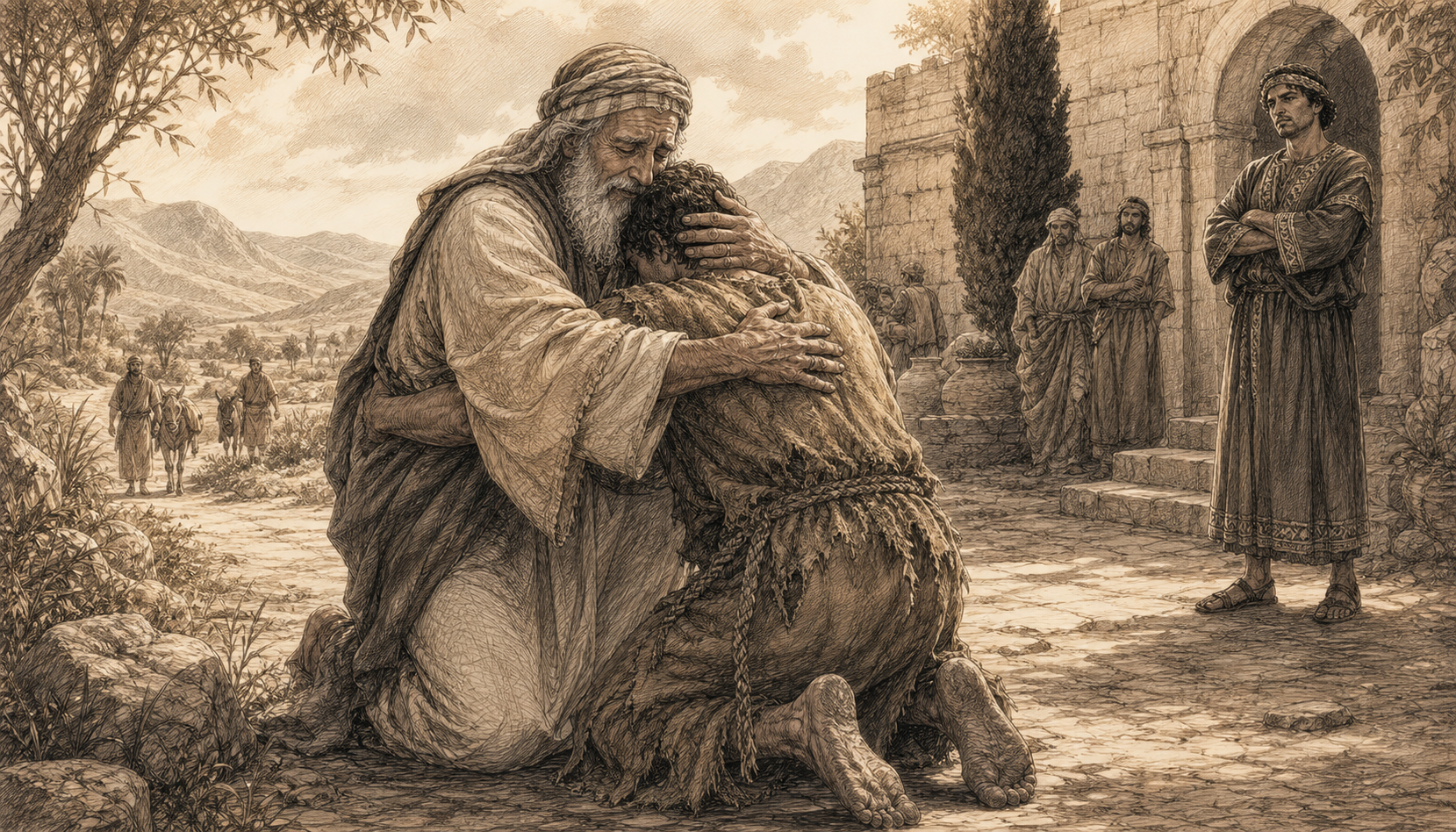
Before the son reaches the house, the father sees him while he is still far off. This detail reveals that the father has been waiting, watching, longing. His heart has not gone cold. He runs to meet the son, embraces him, and kisses him. In the ancient setting, a dignified patriarch running publicly would have been startling. Jesus chooses that image deliberately. Divine mercy is not slow reluctance. It moves toward the repentant sinner with astonishing eagerness.
The son begins his prepared confession, but the father interrupts the logic of mere damage control. He does not negotiate probation. He commands that the best robe be brought, a ring placed on the son's hand, sandals on his feet, and a feast prepared. These are signs of restored sonship. The mercy of the father does not simply spare the son from punishment. It restores him to communion.
This is why Catholics hear the parable so fruitfully in connection with the Sacrament of Reconciliation. Confession is not only a courtroom exchange. It is the return of a child to the Father's house through the mercy won by Christ. Absolution is not sentimental denial of sin. The son's sin is named clearly. But naming sin does not prevent rejoicing. It makes rejoicing truthful.
The elder brother and the danger of loveless obedience
The parable could have ended with the feast, but Jesus continues because another lost son remains in view. The elder brother returns from the field, hears the music, and becomes angry. He has stayed home, worked hard, and remained externally obedient. Yet he does not share the father's joy. He speaks of service in the language of resentment and describes his brother with contempt.
The elder brother is important because the parable is addressed in part to those who think they do not need mercy. His problem is not open rebellion but a heart that has become transactional. He sees himself less as a beloved son than as a laborer keeping score. His obedience lacks tenderness. He resents generosity shown to another because he has not learned to delight in the father's heart.
The father goes out to him too. This is crucial. Mercy extends toward both kinds of lostness - the lostness of obvious sin and the lostness of cold self-righteousness. The father reminds the elder son that all he has belongs to him, but also insists that rejoicing is fitting because the lost brother has returned alive. Love cannot treat resurrection like an inconvenience.
The Catholic meaning of mercy
The Prodigal Son helps Catholics understand mercy correctly. Mercy is not pretending evil is harmless. The younger son truly sins. He truly wastes what was entrusted to him. The elder brother truly suffers from hardness of heart. But mercy refuses to let sin define the whole future. It opens the door to return. This is why Christian preaching must never choose between truth and compassion. The father in the parable embodies both.
The story also shows that repentance involves more than vague spiritual optimism. The son confesses, returns, and accepts the father's judgment about reality. He does not say that nothing happened. He does not rename sin as self-discovery. He admits what he has done. Catholic spiritual life depends upon this honesty. Mercy becomes luminous when it falls upon what is real.
There is also a Eucharistic note in the feast. The father restores the son to the household table. Salvation is not only a private inner experience. It is communion. The Christian life reaches toward banquet, joy, and participation in the Father's house. Heaven itself is often described in such terms. The prodigal does not merely escape starvation. He is welcomed into celebration.
Why the story endures
This parable endures because almost everyone recognizes something of himself in it. Some know the younger son's restless desire to leave and reinvent life apart from God. Some know the elder brother's resentment, secret pride, or inability to rejoice in grace shown to others. Many know both at different times. The genius of Jesus in this story is that he does not flatten human hearts into one simple type. He reveals multiple forms of lostness and one radiant source of mercy.
It also endures because it tells the truth about home. The deepest human desire is not simply independence. It is belonging. Sin often masks that desire by promising freedom without dependence, but the promise cannot last. The heart remains hungry until it turns again toward the Father. This is why the parable continues to speak with such power to penitents, wanderers, converts, grieving parents, priests, and anyone who has ever wondered whether return is still possible.
The Prodigal Son is the story of a father whose mercy is greater than a son's ruin and greater than an elder brother's resentment. It tells us that repentance is never pointless, that home is still open, and that the joy of God over a sinner who returns is deeper than we usually dare to imagine.