Family and Vocation
The Quiet Honor of Walking With Aging Parents
How mercy, prudence, and grace shape the difficult vocation of caring for a mother or father in old age
Site Admin | November 8, 2026 | 27 views
There is rarely a single moment when a son or daughter becomes a caregiver. More often, the change arrives quietly. A parent stops driving at night. A familiar recipe becomes difficult to follow. A medical appointment needs another pair of ears. Bills begin to pile up, or a once orderly home shows signs of neglect. Gradually, the family roles that seemed fixed begin to shift.
Caring for an aging parent can be deeply loving, but it is not sentimental work. It may involve physical exhaustion, financial strain, old family wounds, disagreements among siblings, and grief over changes that cannot be reversed. A Catholic perspective does not deny any of this. It places these burdens within the larger truth that every person retains God given dignity, even when memory, strength, or independence fades.
The Christian response is not a demand for flawless caregiving. It is a call to faithful love shaped by mercy, prudence, justice, prayer, and an honest acceptance of human limits.
Honor Becomes Concrete
The Fourth Commandment tells us to honor father and mother: Exodus 20:12. This command is not limited to childhood obedience. As the Catechism of the Catholic Church explains in paragraphs 2214 through 2218, gratitude and respect toward parents continue into adulthood. When parents grow old, become ill, or face loneliness, that honor takes practical form.
My child, help your father in his old age, and do not grieve him as long as he lives. [[VERSE|sirach|3|12-14|Sirach 3:12-14]]
Honor may mean preparing meals, managing transportation, making regular phone calls, helping with paperwork, or ensuring that a parent is not abandoned. It can also mean listening patiently when stories are repeated, speaking gently when confusion creates frustration, and protecting a parent's privacy during increasingly personal forms of care.
Jesus strongly defended the duty to care for parents. He criticized those who used a religious pretext to avoid providing what their father or mother needed: [[VERSE|mark|7|9-13|Mark 7:9-13]]. Christian devotion cannot become an excuse for neglecting the person close at hand.
At the same time, honor does not mean pretending that every parental demand is reasonable. Nor does it require an adult child to remain in danger, submit to manipulation, or personally perform every task. In families marked by abuse, addiction, or severe dysfunction, love may require firm boundaries and help from trustworthy professionals. Respect for parents must be joined to respect for truth, safety, and the legitimate responsibilities of one's own vocation.
Caregiving Within a Larger Vocation
An adult child may also be a spouse, a parent, a priest, a religious, or a person carrying serious responsibilities at work and in the community. Caring for an aging parent is important, but it does not erase these other duties. The challenge is not to prove love by doing everything alone. It is to discern how several genuine obligations can be honored together.
Saint Paul writes that those who do not provide for their relatives, especially members of their own household, have denied the faith in practice: 1 Timothy 5:8. Provision, however, is broader than personally supplying every hour of care. It can include arranging safe housing, sharing costs, coordinating medical support, hiring qualified assistance, or finding a suitable care community.
A nursing home, assisted living residence, or home health service is not automatically a sign that a family has failed. The moral question is whether the parent is being treated with dignity and whether the family remains attentive and involved. Sometimes professional care is the most responsible way to protect both the parent and the caregiver.
Families should speak openly before a crisis whenever possible. Conversations about housing, finances, transportation, medical preferences, legal documents, and spiritual desires can be uncomfortable. Yet avoiding them often leaves everyone less prepared. These discussions should include the parent as fully as his or her abilities allow. Aging does not cancel adulthood, and receiving help does not make a person a child again.
The Burdens Families Do Not Always Name
Caregiving can awaken emotions that seem difficult to admit. A devoted daughter may feel resentment. A loving son may dread another phone call. Siblings may argue about money or accuse one another of doing too little. A caregiver may feel ashamed for wanting rest. Meanwhile, the aging parent may be frightened, embarrassed, angry, or determined to resist needed help.
These reactions do not necessarily reveal a lack of love. They often reveal fatigue, grief, and fear. Grace works with the truth, not with a polished version of family life. Honest prayer can begin with words as simple as, Lord, I love my parent, and I am tired. Help me do the next good thing.
Old wounds can also return. A parent who was distant, harsh, or neglectful may now depend on the child who was hurt. Forgiveness may be necessary, but forgiveness does not require denying the past or immediately restoring trust. It means refusing vengeance and asking God to free the heart from hatred. Reconciliation, when possible, involves truth, repentance, and prudence. A priest, counselor, or mature spiritual guide may help a family distinguish mercy from unhealthy submission.
Caregivers also experience a form of grief before death. They may mourn a parent's memory, personality, mobility, or ability to recognize loved ones. This sorrow deserves to be acknowledged. The person is still present and worthy of love, but something precious may truly have been lost.
Practices That Make Mercy Sustainable
Share the work clearly
Vague appeals for help often produce confusion. Concrete requests are better: one sibling can handle insurance calls, another can visit on Saturdays, and another can arrange grocery delivery. If some relatives live far away, they may still contribute through finances, research, paperwork, or regular calls.
Not every family will divide the work equally. Distance, health, employment, finances, and family obligations differ. Justice does not always mean identical tasks, but it does require honesty. The primary caregiver should not be left carrying an invisible burden while everyone assumes that things are fine.
Accept respite without guilt
Rest is not abandonment. Sleep, exercise, medical care, friendship, and time with one's spouse or children are not selfish luxuries. They help preserve the caregiver's ability to love patiently. Even Jesus invited the apostles to rest after their labors: Mark 6:31.
When help is available, receiving it can be an act of humility. A trusted relative, parish volunteer, respite program, or professional caregiver may give the family essential breathing room. The command to bear one another's burdens assumes that burdens can be shared: Galatians 6:2.
Protect the parent's voice
Whenever possible, speak with an aging parent rather than merely speaking about him or her. Offer choices that are real and manageable. Explain decisions calmly. Do not discuss intimate medical details casually or treat confusion as permission for disrespect.
When cognitive decline limits decision making, a legally authorized representative may need to act. Even then, the aim should be to honor the person's known values, good, dignity, and legitimate preferences rather than choosing what is merely easiest for others.
Make room for ordinary affection
Care can become a list of medications, appointments, and chores. Yet a parent is more than a set of needs. Look at photographs, listen to music, pray familiar prayers, take a short drive, or share a favorite meal. If conversation is difficult, quiet presence can still communicate love.
For a parent with dementia, an explanation may be forgotten while the gentleness of an encounter still matters. Success should not be measured only by memory, productivity, or visible gratitude. Christian love is given because the person is beloved by God.
Medical Decisions and the Dignity of Life
Aging often brings difficult questions about treatment. Catholic teaching rejects euthanasia and assisted suicide because intentionally causing death is never a legitimate form of compassion. At the same time, the Church does not require every possible medical intervention in every circumstance.
The Catechism, particularly paragraphs 2278 and 2279, teaches that burdensome, dangerous, extraordinary, or disproportionate treatments may sometimes be refused. This is not the same as intending death. It is an acceptance that earthly life is finite and that medicine has limits. Ordinary care, comfort, pain relief, human presence, and respect remain essential.
Such decisions should not be made from fear, convenience, or the false idea that a dependent life has less value. Families should seek clear medical information and, when moral questions are difficult, guidance from a priest, Catholic chaplain, or qualified Catholic ethicist. Palliative care can be especially helpful because it focuses on comfort, symptoms, communication, and support for the whole family.
The Sacramental Life at the Bedside
Spiritual care should not be postponed until a parent is unconscious or actively dying. The Anointing of the Sick is for Catholics who are seriously ill or weakened by old age, not only for the final minutes of life. A parish priest can also help arrange Confession and Holy Communion when appropriate.
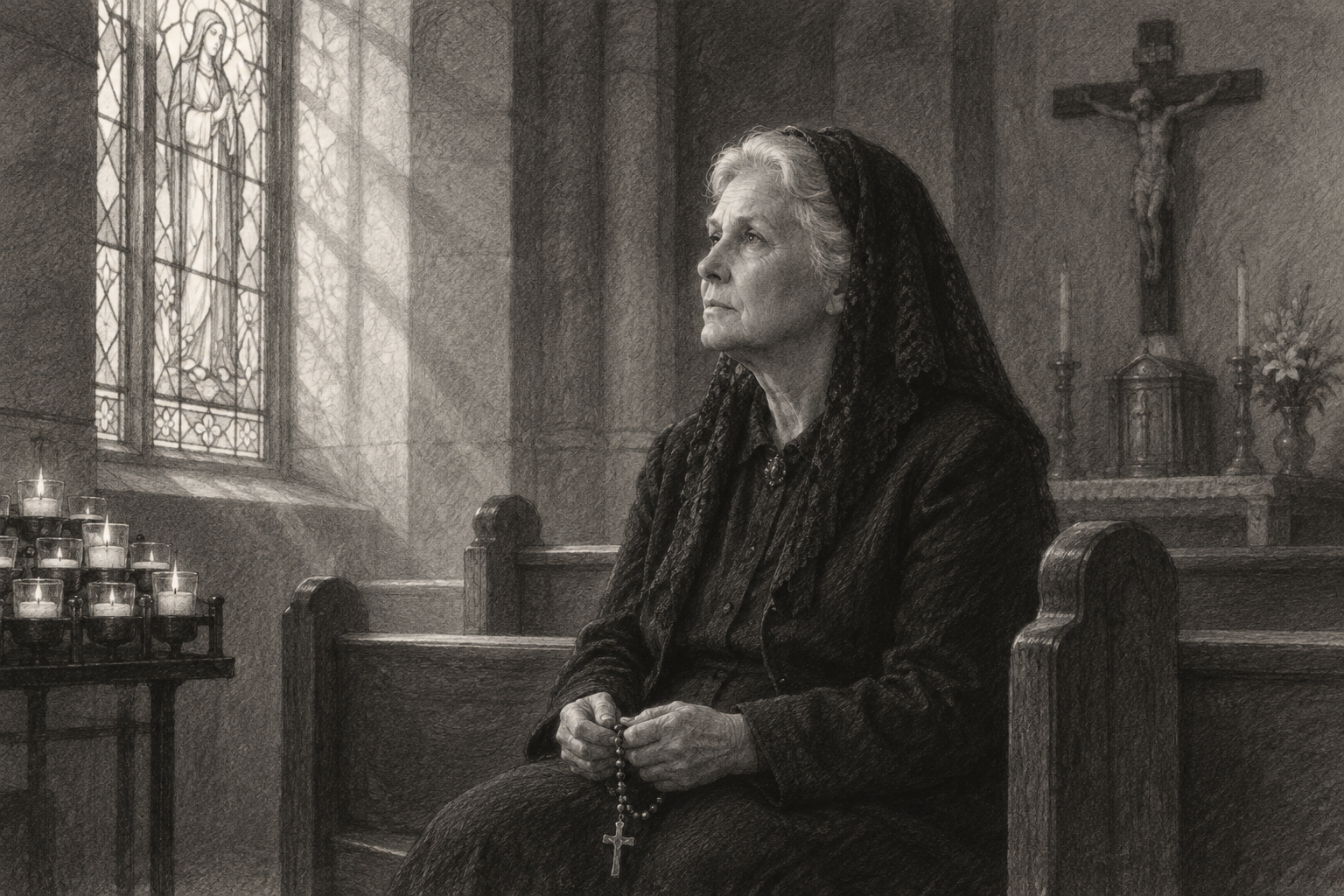
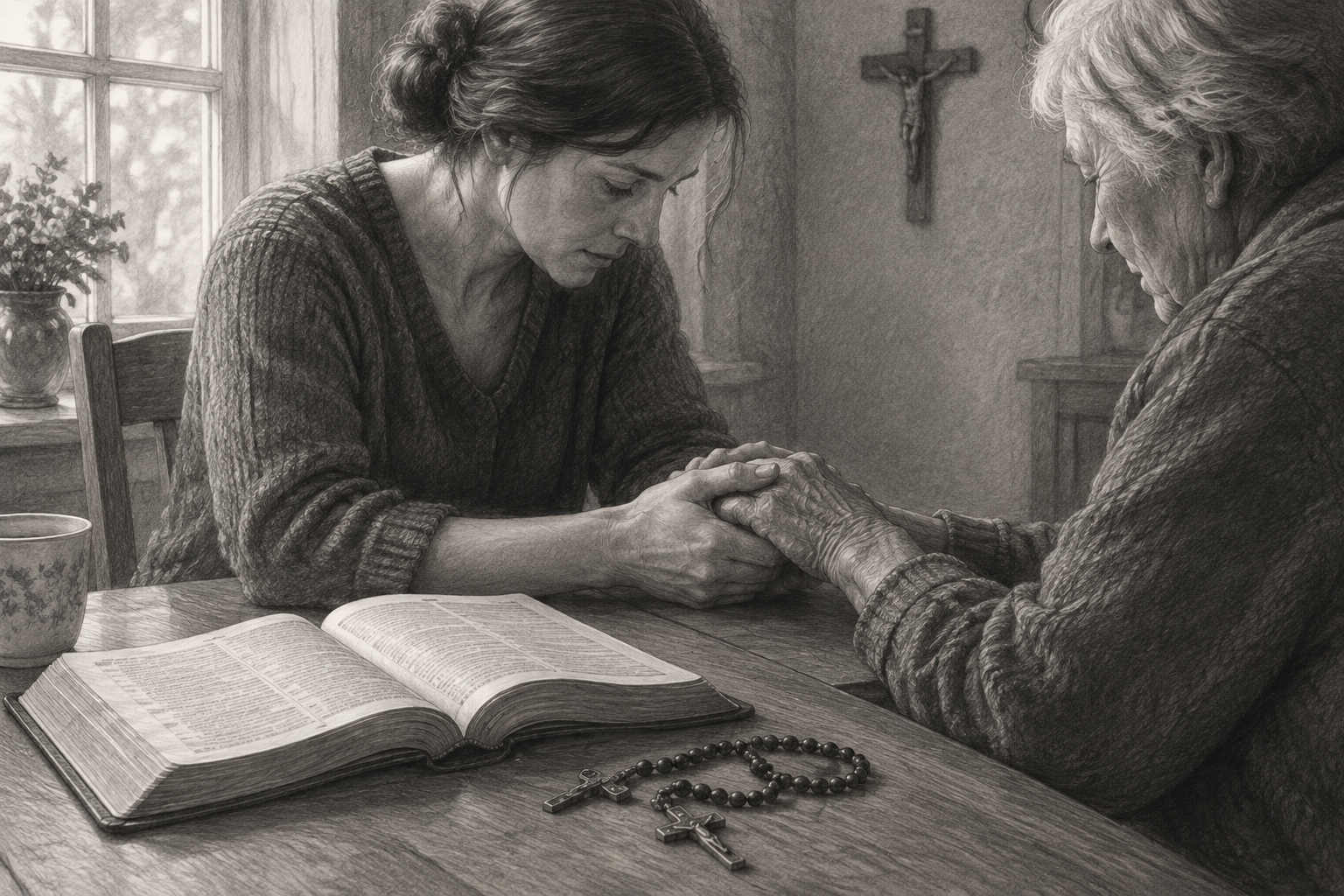
If death is approaching, the Eucharist received as Viaticum is a profound provision for the final journey. Families can ask the parish about these sacraments before an emergency. A small crucifix, a rosary, sacred music, or the reading of a psalm may also help make the home or hospital room a place of prayer.
At the Cross, Jesus entrusted Mary and the beloved disciple to one another: [[VERSE|john|19|26-27|John 19:26-27]]. This scene does not romanticize suffering. It shows Christ creating a bond of faithful care in the midst of sorrow. Catholic families stand within that same mystery whenever they remain present to one another in weakness.
Faithfulness in Small Acts
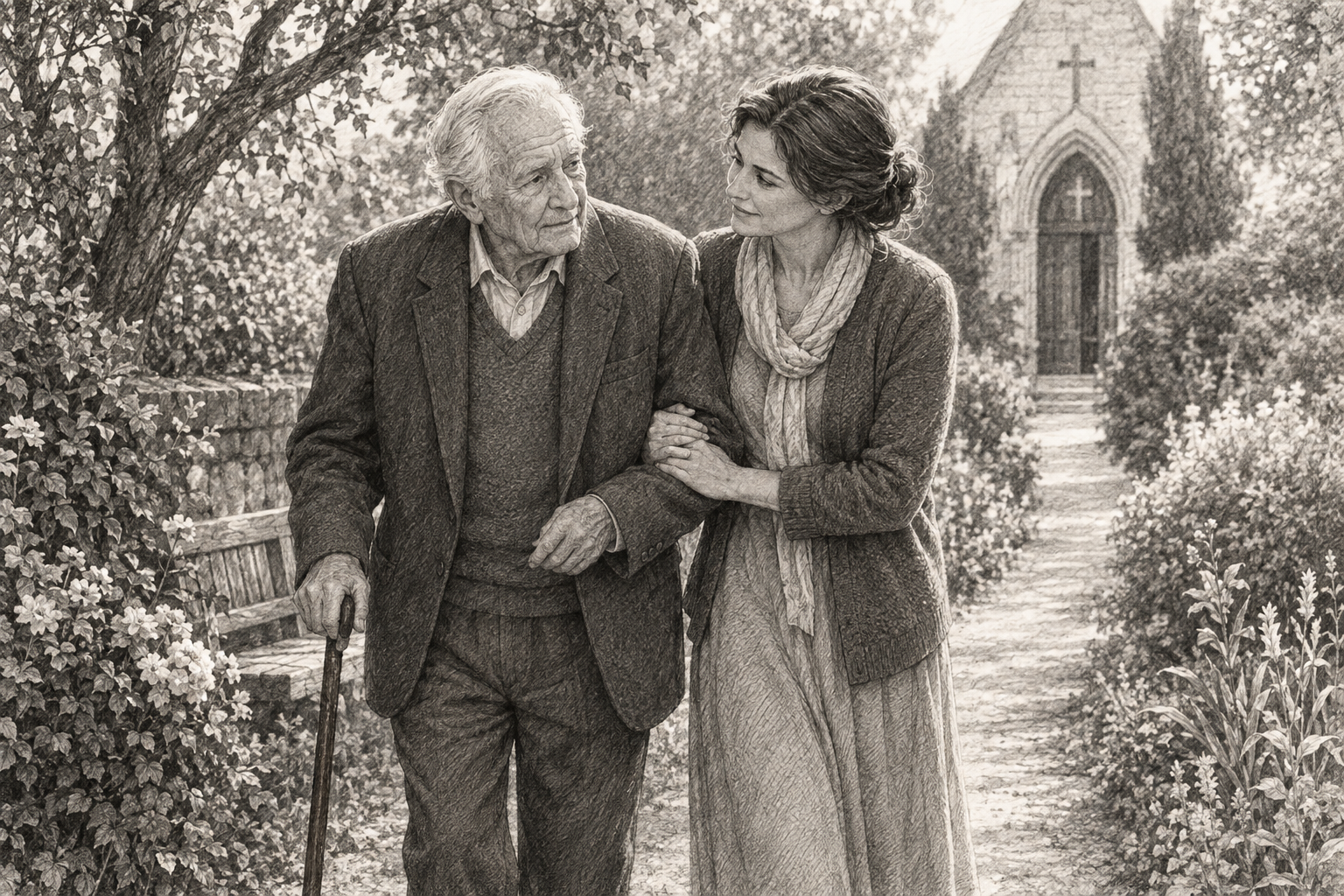
Most care for aging parents is not dramatic. It is a clean shirt, a patient answer, a ride to Mass, a glass of water, a difficult form completed, or a hand held in a quiet room. Some days will be tender. Others will feel repetitive and thankless.
Grace does not always remove the burden. Often it changes the way the next task is received. It gives courage to ask for help, humility to accept limits, wisdom to set boundaries, and patience to begin again after failure. When an apology is needed, it can be offered. When exhaustion becomes dangerous, rest can be sought. When no solution is perfect, a family can still choose the most loving and prudent path available.
Caring for an aging mother or father is one of the places where the commandment to honor becomes flesh. The work may remain hidden from nearly everyone, but it is not hidden from Christ. In each act of truthful, patient mercy, love accompanies a parent toward eternity and learns, little by little, how to receive everything from the Father.
Keep Reading on Lets Read The Bible
Frequently Asked Questions
Does honoring an aging parent mean an adult child must provide all care personally?
No. Honor requires genuine concern and responsible action, but it does not require one person to perform every task. Families may share duties and use professional home care, assisted living, or nursing care when these choices protect the parent's dignity and safety.
Can a Catholic set boundaries with an abusive or manipulative parent?
Yes. Respect for a parent does not require accepting abuse, serious manipulation, or unsafe conditions. Boundaries can be necessary and morally responsible. A priest, counselor, or trusted professional may help the family pursue mercy without ignoring truth and safety.
When should an aging Catholic receive the Anointing of the Sick?
The sacrament is appropriate when a Catholic is seriously ill or significantly weakened by old age. It is not reserved only for the final moments of life. Families should contact the parish early, especially before major surgery or when health noticeably declines.