Family and Vocation
At the Last Door, Love Waits in Hope
How Christ teaches families to face mortality with honesty, prayer, and confidence in the resurrection
Site Admin | October 28, 2026 | 23 views
Death enters every family, yet it never arrives as a merely abstract truth. It has a name, a face, a familiar voice, and a place at the table that becomes painfully empty. Even when death follows a long illness, its finality can feel shocking. Christian faith does not ask us to pretend otherwise. It gives us something deeper than denial: permission to grieve, a language for prayer, and a hope grounded in the death and resurrection of Jesus Christ.
A faithful death and Christian hope reflection must therefore hold two truths together. Death is an enemy and a wound. It is also a threshold that Christ has crossed before us. The Church does not call death good in itself, nor does she tell the bereaved to hurry past sorrow. She proclaims that death does not have the final word because the crucified Lord is risen.
Death is not natural to the heart
We often hear that death is simply part of life. Biologically, that is true in our fallen world. Every earthly life ends. Yet the human heart resists death because we were made for communion with God and with one another. Love naturally desires the good of the beloved, not the beloved's disappearance.
Scripture speaks honestly about this rupture. Saint Paul calls death an enemy, indeed, the last enemy to be destroyed: 1 Corinthians 15:26. That language matters. Christianity does not require us to admire the grave or treat bereavement as a minor interruption. Jesus himself wept at the tomb of Lazarus: John 11:35. His tears reveal neither helplessness nor lack of faith. They show the compassion of God before the suffering caused by death.
This gives grieving Christians room to breathe. Tears are not a betrayal of hope. A person may trust in eternal life and still feel disoriented, angry, lonely, or afraid. Faith does not erase the human cost of separation. It carries that cost into the presence of Christ.
Christian hope begins with an event
Christian hope is not optimism about human progress, a vague sense that the dead live on in our memories, or a refusal to think about mortality. It begins with what God has done in Jesus. Christ truly died, was buried, and rose bodily from the dead. His resurrection is not only an inspiring symbol. It is the decisive victory of God over sin and death.
At the tomb of Lazarus, Jesus does not merely promise a better feeling. He declares, I am the resurrection and the life: John 11:25. Hope rests in a person. Because the Son of God entered death and rose from it, those who belong to him can face death without treating it as annihilation.
Christian hope does not say that death is unreal. It says that death has met the risen Christ.
Saint Paul expresses this hope with pastoral tenderness when speaking to believers who mourn. Christians grieve, but not as those who have no hope: 1 Thessalonians 4:13. He does not say that Christians do not grieve. The difference lies in what grief expects. Christian sorrow looks toward reunion in Christ, the resurrection of the body, and the restoration of all things in God.
What the Church teaches about the last things
Catholic teaching about death is sober, personal, and full of hope. At death, the soul is separated from the body, and each person comes before Christ in the particular judgment. Our earthly choices matter. Grace does not make freedom meaningless, and mercy does not turn moral responsibility into an illusion.
Those who die in God's grace and friendship, and who are perfectly purified, enter the joy of heaven. Those who die in grace but still need purification undergo purgatory, a final cleansing ordered toward full communion with God. Those who freely and definitively reject God face the reality of hell. The Church teaches these truths not to encourage speculation about the destiny of particular people, but to call each of us to conversion, trust, and perseverance.
The Christian promise is not limited to the survival of the soul. We profess the resurrection of the body. At the end of time, Christ will raise the dead. The person whom God saves is not an interchangeable spirit but the whole human person, restored and transformed by divine power. Saint Paul describes the mortal body being raised imperishable: 1 Corinthians 15:42.
This is one reason the Church treats the body of the deceased with reverence. The funeral liturgy honors the body as a temple of the Holy Spirit and commends the deceased to God's mercy. The Church permits cremation, provided it is not chosen for reasons contrary to Christian faith. She also asks that cremated remains be treated reverently and laid to rest in a sacred place rather than scattered or kept as a casual possession.
Love continues through prayer
Death changes our relationship with those we love, but it does not make love useless. The communion of saints means that the baptized remain united in Christ. Those on earth, the souls being purified, and the saints in heaven belong to one communion under the Lord.
For this reason, Catholics pray for the dead. This practice is rooted in the conviction that prayer offered for the departed is good and holy: 2 Maccabees 12:45. We can request Masses, pray the Rosary, visit a cemetery, offer personal sacrifices, and include the names of the deceased in daily prayer. These acts are not attempts to control God's judgment. They are works of mercy entrusted to God's perfect justice and compassion.
Praying for the dead also protects remembrance from becoming merely sentimental. We do not only revisit old photographs or tell beloved stories, though both can be good. We place the person before God. We ask that every remaining effect of sin be healed and that the deceased be brought into the fullness of divine light.
Families need honest preparation
Because death is difficult to discuss, families sometimes postpone necessary conversations until a crisis removes the possibility of calm reflection. Christian hope allows greater honesty. Preparing for death does not invite it. It is an act of stewardship and charity.
Practical preparation may include several responsibilities:
- Receive the sacraments faithfully, rather than waiting until the final hours of life.
- Ask for a priest when a Catholic is seriously ill, so that the Anointing of the Sick, Confession when possible, and Holy Communion can be received.
- Discuss health care wishes in a manner consistent with Catholic moral teaching.
- Prepare a will and identify the people responsible for legal and practical decisions.
- Express the desire for a Catholic funeral and burial.
- Keep parish and sacramental information where family members can find it.
- Reconcile with relatives when possible, without assuming that more time is guaranteed.
Catholic teaching does not require every possible medical treatment to be used in every circumstance. Treatments that offer reasonable hope of benefit without excessive burden are ordinarily accepted. Treatments that are futile or disproportionately burdensome may be refused. This is not the same as intending death. Basic care, comfort, pain relief, human presence, and respect for the person's dignity remain essential. Proper palliative care can be a genuine work of mercy.
These decisions are often complicated. Families should seek guidance from faithful clergy, competent physicians, and Catholic health care ethicists rather than relying on slogans. Love must neither abandon the suffering person nor insist on medical intervention simply because technology makes it possible.
A vocation of presence at the end of life
Family vocation is revealed not only in weddings, births, celebrations, and daily work. It is also revealed in the long nights beside a hospital bed, the repeated questions of a confused parent, the preparation of meals, the management of medications, and the quiet decision not to leave someone alone.
Not everyone can provide hands-on care, and no family should be shamed for needing professional assistance. Caregivers have limits. Illness can expose old wounds and strained relationships. Yet every Christian can offer some form of presence. A phone call, a meal, respite for an exhausted caregiver, a ride to an appointment, or a promise of prayer can become part of the Church's care for the dying.
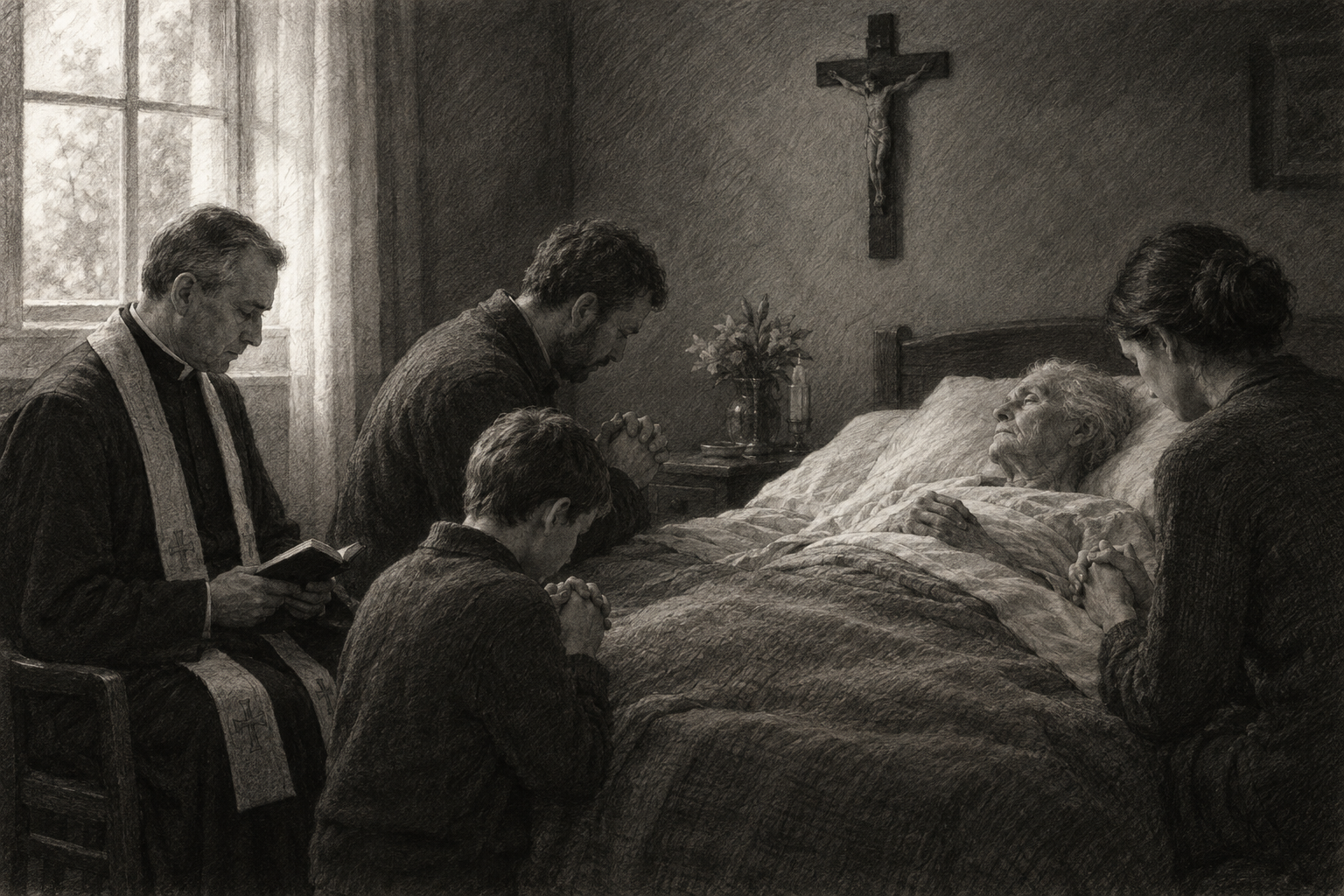
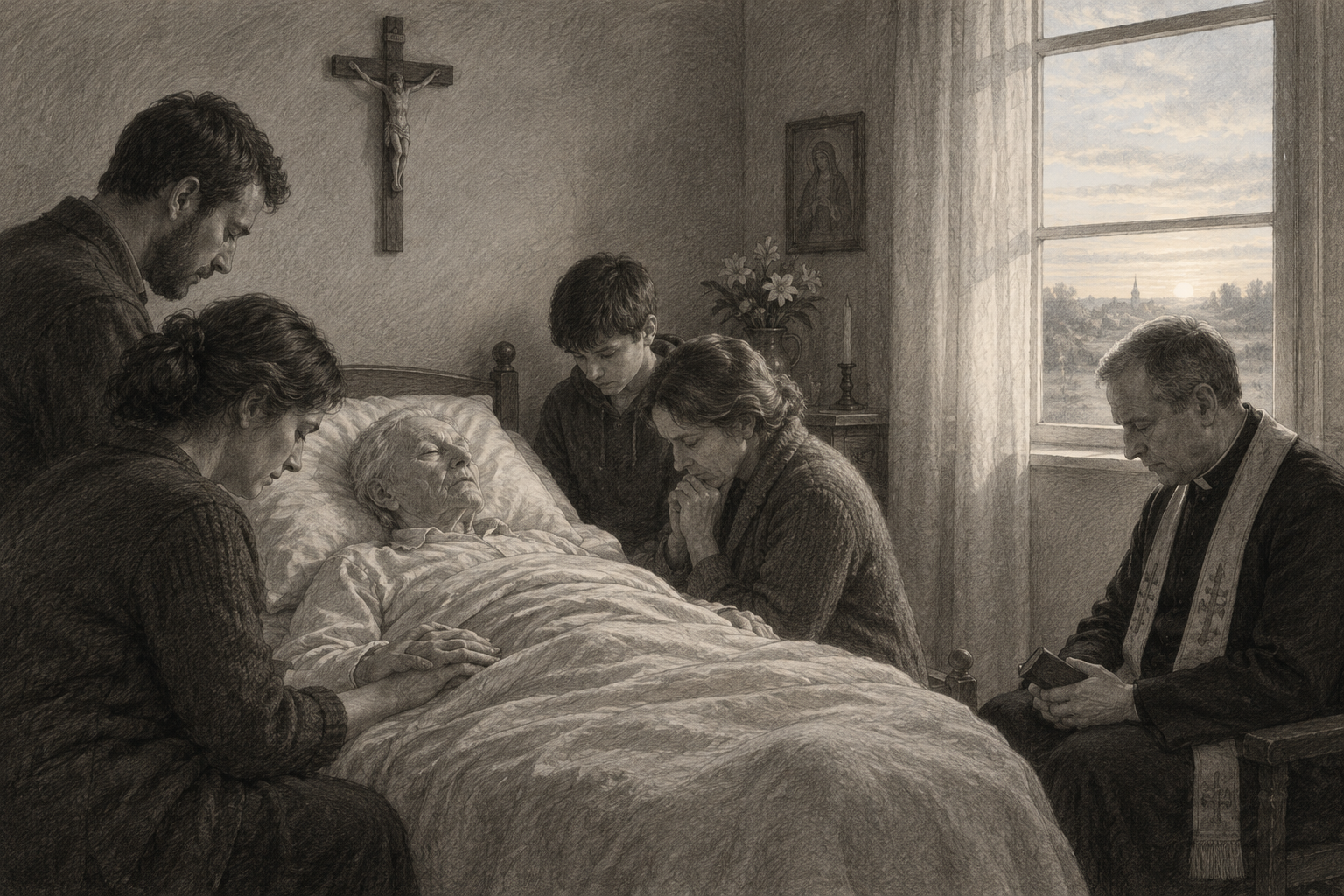
When someone is near death, simple prayer is often best. The family can pray familiar words, read a psalm, make the Sign of the Cross, or sit in silence. Hearing may remain when conversation is no longer possible, so words of love, forgiveness, gratitude, and trust can still be spoken. There is no need to manufacture a perfect final moment. The grace of God is not dependent on a family's emotional composure.
Living now in the light of eternity
Remembering death has long been part of Christian spiritual wisdom. This remembrance is not meant to make life bleak. It helps restore proportion. Resentments look different when time is recognized as a gift. Possessions lose some of their power. Delayed repentance becomes harder to justify. Ordinary affection becomes more precious.
Jesus warns his disciples to remain watchful because they do not know the hour: Matthew 24:42. Christian watchfulness is not anxious prediction. It is faithful attention to the duties of today. We prepare for eternity by loving God and neighbor now, receiving mercy, practicing mercy, and returning to Christ whenever we fall.
This perspective also guards against reducing salvation to a distant future. Eternal life begins as communion with God by grace. The Christian who prays, receives the sacraments, serves the poor, forgives an enemy, or keeps vigil with the sick is already being formed for the life of heaven.
Grief can remain while hope grows
Bereavement has no universal timetable. Anniversaries, songs, meals, and ordinary household objects can reopen sorrow years later. The Church's liturgical prayer gives mourners a steadier rhythm than the pressure to move on. Masses for the dead, visits to graves, and annual remembrance allow grief to be carried rather than hidden.
Hope may be strong one day and quiet the next. It does not need to feel triumphant in order to be real. Sometimes hope is simply the choice to whisper the name of Jesus when no other prayer can be found. Saint Paul assures us that nothing, not even death, can separate those in Christ from the love of God: [[VERSE|romans|8|38-39|Romans 8:38-39]].
The risen Lord still bears the wounds of his Passion. In him, suffering is neither forgotten nor allowed to reign forever. Every Christian funeral, every prayer for the departed, and every act of care for the dying quietly declares the same faith: the grave is real, love is costly, and Christ is faithful. We place our dead in his hands, and we place our own unfinished lives there too, trusting that the One who called us by name will not abandon his work.
Keep Reading on Lets Read The Bible
Frequently Asked Questions
Is it wrong for a Christian to be afraid of death?
No. Fear of death can be a natural human response, and even faithful Christians may experience it. Christian hope does not depend on feeling fearless. It rests on Christ's resurrection, God's mercy, and the grace given through prayer and the sacraments.
Why do Catholics pray for the dead?
Catholics pray for the dead because love and communion in Christ are not ended by death. Prayer for the departed entrusts them to God's mercy and can assist those undergoing final purification before heaven. The practice is supported by [[VERSE|2-maccabees|12|45|2 Maccabees 12:45]].
What sacraments should a seriously ill Catholic receive?
A seriously ill Catholic should be offered Confession when possible, the Anointing of the Sick, and Holy Communion. Communion received near death is traditionally called Viaticum. Families should contact a priest early rather than waiting until death appears imminent.