Family and Vocation
Faith at the Breakfast Table: Forming Children in the Life of Christ
Catholic parents hand on the faith through prayer, sacramental life, honest witness, and the ordinary habits of a loving home.
Site Admin | October 29, 2026 | 16 views
The home is more than a religious classroom
Parents who want to raise faithful children often begin with an anxious question: Are we doing enough? They may think about family prayer, Catholic schools, religious education, Sunday Mass, books, friendships, and the influence of a culture that rarely makes Christian discipleship easy. All of these concerns are real. Yet Catholic family life cannot be reduced to a list of religious tasks.
The faith is handed on through words, but also through a way of life. Children notice whether prayer is natural or forced, whether forgiveness is practiced, whether the poor are remembered, and whether Sunday worship truly shapes the week. They learn what Christians believe partly from what they are taught and partly from what they see loved.
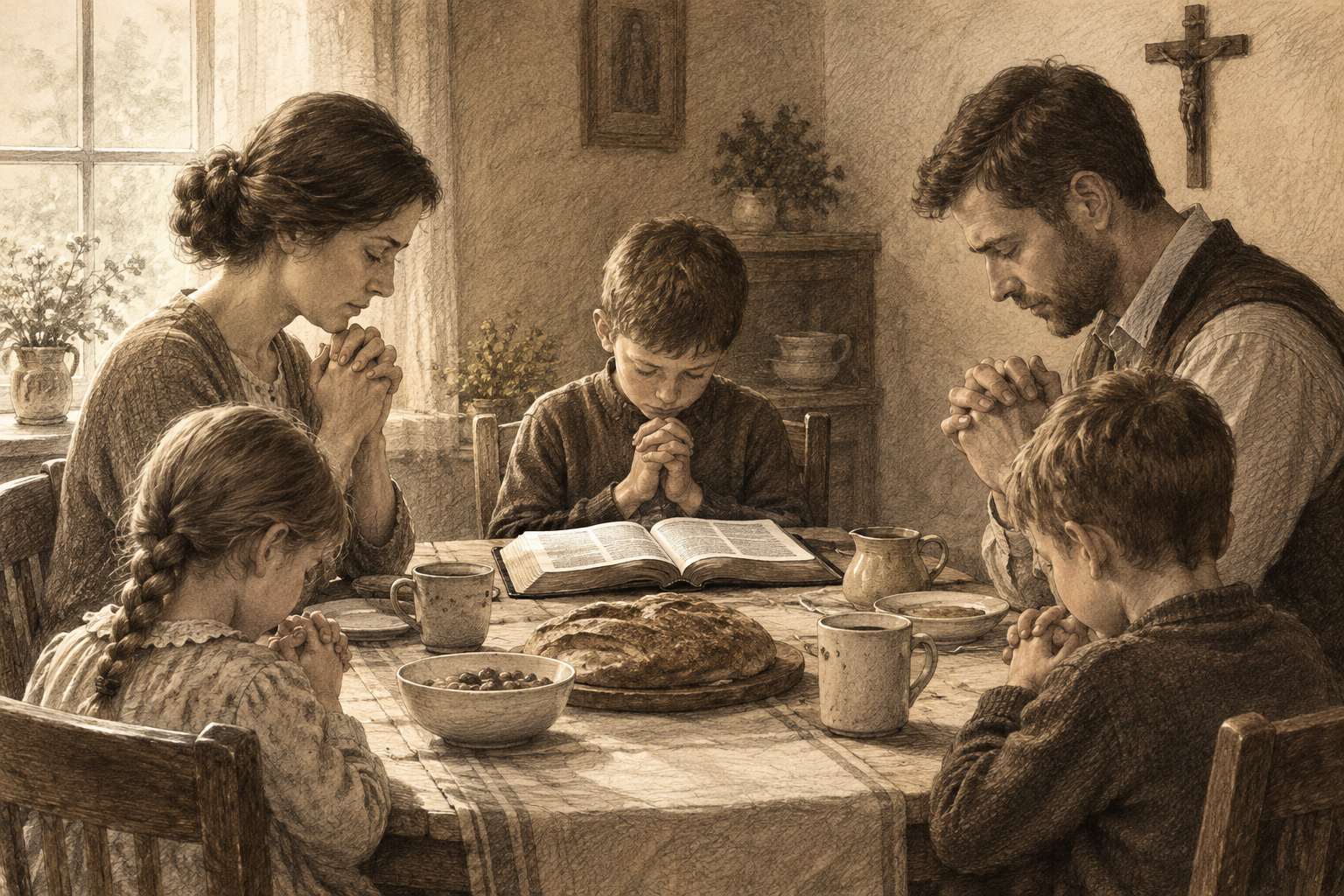
Scripture places this work within the daily life of the household. Israel is commanded to keep God's words in the heart and to teach them diligently at home, on the road, at bedtime, and upon rising: [[VERSE|deuteronomy|6|6-7|Deuteronomy 6:6-7]]. Faithful formation is not confined to formal lessons. It belongs at the breakfast table, in the car, beside a sickbed, during conflict, and in the quiet moments before sleep.
A vocation received with a child
The Catholic Church calls parents the first educators of their children. This is not merely a practical arrangement. It flows from the vocation of marriage and family life. At a child's Baptism, parents publicly accept the responsibility of raising the child in the practice of the faith. That promise is not a prediction that family life will be easy. It is a commitment to place the child within the life of Christ and his Church.
The Catechism of the Catholic Church teaches that education in faith begins in the earliest years and that parents evangelize especially through the witness of a Christian life shaped by the Gospel. The home is often called the domestic church because it is a real place of prayer, charity, repentance, and growth in holiness. It does not replace the parish or the sacramental life of the wider Church. Rather, it helps children receive that life as something living and familiar.
This vocation belongs to parents, but they are not asked to carry it alone. Godparents, grandparents, priests, deacons, religious sisters and brothers, catechists, teachers, and trustworthy Catholic friends can all strengthen a family. Asking for help is not an admission of failure. It is one way of allowing the communion of the Church to become visible.
Witness comes before perfect explanations
Children eventually ask difficult questions. They may wonder why God allows suffering, why Catholics go to confession, why the Church teaches particular moral truths, or why prayer sometimes seems unanswered. Parents should seek reliable answers and avoid pretending to know what they do not know. Still, a child does not need a parent who can answer every theological question immediately. A child needs an adult who takes truth seriously and is willing to keep learning.
Saint Paul remembers the sincere faith that first lived in Timothy's grandmother Lois and his mother Eunice: 2 Timothy 1:5. The passage does not describe an elaborate program. It points to faith embodied in persons. A parent's reverence at Mass, willingness to apologize, generosity toward a neighbor, and fidelity in hardship may remain in a child's memory long after a particular lesson has been forgotten.
This witness must include repentance. No Catholic home is free from impatience, selfishness, distraction, or sin. Parents can be tempted to hide weakness in order to preserve authority. Yet a sincere apology can teach something essential: authority is accountable to truth, mercy is real, and forgiveness is not only for children. Saying, I was wrong, and I am sorry, does not weaken a parent. It shows that every member of the family stands under the loving judgment of God.
Build a rhythm that can survive ordinary life
A family's spiritual practices should be substantial enough to form the heart and simple enough to continue during busy seasons. Grand plans that last three days are usually less helpful than modest habits practiced faithfully for years. The goal is not to make every moment explicitly religious. It is to let the love of God give the household its deepest orientation.
Keep Sunday at the center
Participation in Sunday Mass is the foundation of Catholic family worship. Children learn that the Eucharist is not one activity among many, but the heart of the Christian week. Parents can help by preparing calmly, arriving with enough time to settle, and speaking afterward about one part of the readings or homily. Young children will sometimes be restless. Their presence is not an interruption to the Church's life. Jesus welcomed children and told his disciples not to hinder them: Mark 10:14.
Pray briefly and consistently
Family prayer does not have to be lengthy to be real. A household might pray before meals, offer a decade of the Rosary, read a short Gospel passage, or make an examination of conscience at bedtime. Parents can also invite spontaneous intentions so that children learn to bring concrete joys and worries before God.
- Offer morning prayer before the day's demands begin.
- Bless children before school, travel, or sleep.
- Pray for relatives, enemies, the sick, the dead, and people in need.
- Mark Advent, Christmas, Lent, Easter, and family patronal feasts at home.
- Place a crucifix, Bible, or sacred image where it supports prayer rather than serving only as decoration.
When prayer feels awkward, it is still worth beginning. A simple Our Father prayed with attention is better than an impressive devotion carried out with constant resentment. Over time, familiar prayers give children words to use when their own words fail.
Let the sacraments shape family memory
Baptism anniversaries, First Confession, First Holy Communion, and Confirmation should not be treated only as social milestones. They are encounters with Christ in his Church. Regular confession can teach children that sin is serious without suggesting that God's mercy is scarce. Parents should present the sacrament as a place of truth, healing, and restored friendship with God, never as a threat or punishment.
Teach truth without forming children through fear
Catholic formation includes moral teaching. Children deserve clear guidance about honesty, human dignity, sexuality, justice, forgiveness, and care for the vulnerable. Such teaching should be suited to their age and grounded in the truth that every person is created and loved by God. Rules become distorted when detached from the good they protect.
Fear may secure outward compliance for a time, but it cannot produce mature faith. Parents should speak honestly about sin and judgment while giving equal attention to grace, conversion, and the mercy revealed in Jesus Christ. Christian obedience is not servile panic. It is the response of a person learning to trust the One who is good.
Discipline also belongs within this vision. Saint Paul tells fathers not to provoke their children, but to raise them with the discipline and instruction of the Lord: Ephesians 6:4. Discipline should be consistent, proportionate, and ordered toward growth. Humiliation, manipulation, and uncontrolled anger damage trust. A child should gradually learn not only that an action is forbidden, but why it harms communion with God and neighbor.
Make room for questions and gradual understanding
Children do not all mature spiritually at the same pace. One child may love ritual and memorized prayer, while another responds more readily to service, sacred music, Scripture, or quiet conversation. Parents need not manufacture identical religious personalities. The same faith can take root through different temperaments and gifts.
Questions should be welcomed rather than treated as disloyalty. A child who asks whether God exists, why the Church has authority, or why Mass matters is revealing an opportunity for deeper formation. Parents can answer what they know, consult the Catechism, ask a priest, or study alongside the child. Honest inquiry can strengthen faith when it is joined to humility and prayer.
It is also wise to distinguish doubt from indifference, and indifference from pain. Resistance to church may sometimes be connected to boredom, peer pressure, family tension, unanswered grief, or a harmful experience. Listening does not require parents to surrender conviction. It allows them to respond to the actual child rather than to an imagined problem.
When family circumstances are difficult
Many Catholic families carry burdens that do not appear in idealized pictures of family life. A parent may be raising children alone. Spouses may disagree about religion. Work schedules may be exhausting. A child may have disabilities or needs that make parish participation difficult. Some parents return to the faith only after their children are older. Others feel ashamed because their own knowledge of Catholic teaching is limited.
These circumstances call for practical wisdom, not despair. A single parent can build a holy home. A parent in a mixed-faith marriage can witness with charity and integrity while honoring legitimate family responsibilities. A parent who has been away from the Church can begin again through prayer, confession, Mass, and patient conversation. Grace does not depend on presenting an ideal image.
Families should also seek parishes in which children and parents are known, supported, and invited into service. The Christian community has a duty to assist family life, especially when isolation is heavy. Practical help, faithful friendships, and compassionate pastoral care can make religious formation possible in seasons when parents have little strength.
Parents are faithful servants, not controllers of grace
Perhaps the hardest lesson is that parents cannot force faith into another person's heart. Children grow into freedom. Some will question, wander, or reject what they were taught. Parents should continue to love them, pray for them, speak truth without cruelty, and keep the door open to honest conversation. Coercion and panic can make return more difficult.
Saint Paul describes ministry with a humility that also speaks to family life: one person plants, another waters, but God gives the growth: 1 Corinthians 3:6. Parents are responsible for planting and watering faithfully. They are not the source of divine life, nor can they guarantee another person's response.
This truth does not make their work unimportant. It frees them to serve without pretending to be the Savior. They can teach, pray, correct, celebrate, forgive, and begin again. They can entrust both their successes and failures to Christ. Raising children in the faith from a Catholic perspective is finally an act of hope: the daily offering of a home to God, with confidence that his grace is already at work in places a parent may not yet be able to see.
Keep Reading on Lets Read The Bible
Frequently Asked Questions
What is the most important practice for Catholic parents raising children in the faith?
Sunday Mass should remain at the center because the Eucharist is the heart of Catholic life. Family prayer, religious education, service, and moral formation all support that sacramental foundation. Just as important, children need to see faith expressed through forgiveness, honesty, charity, and a willingness to begin again after failure.
What should parents do when a child says they do not believe?
Parents should listen carefully, ask gentle questions, and avoid responding only with anger or panic. The child's concern may involve intellectual doubt, social pressure, grief, boredom, or a painful experience. Parents can offer clear Catholic teaching, seek sound pastoral help, continue praying, and preserve a loving relationship while respecting the child's growing freedom.
Can parents pass on the faith if they do not know much Catholic theology?
Yes. Parents should keep learning, but they do not need advanced theological training to begin. They can attend Mass, pray with their children, read Scripture, use the Catechism, prepare for the sacraments, and ask trustworthy clergy or catechists for help. Honest words such as, "I do not know, but let us find out," can model humility and a genuine love of truth.