Family and Vocation
A Covenant at the Kitchen Table: Marriage as a Life of Grace
The sacrament of matrimony is sealed at the altar, but its grace is received and lived through ordinary acts of fidelity, sacrifice, forgiveness, and love.
Site Admin | October 13, 2026 | 27 views
A wedding may last an afternoon, but a marriage unfolds across thousands of ordinary days. The vows spoken before God are carried into kitchens and hospital rooms, family celebrations and sleepless nights, financial decisions and quiet acts of forgiveness. From a marriage as a sacrament Catholic perspective, these daily realities are not separate from the sacred promise. They are where that promise takes flesh.
The Church does not pretend that sacramental marriage will always feel romantic or easy. She teaches something deeper and more hopeful: Christ enters the covenant of baptized spouses and gives them grace for their vocation. That grace does not eliminate weakness, disagreement, or suffering. It strengthens husband and wife to love beyond passing emotion, to repent when they fail, and to begin again.
Marriage begins with God's gift
The biblical vision of marriage begins in creation. Man and woman are made for communion, and Scripture describes the marital bond with words that remain central to Christian teaching: a man leaves his father and mother, clings to his wife, and the two become one flesh Genesis 2:24. Marriage is therefore not merely a social custom designed by human beings. It belongs to the order of creation and reflects the human need to give and receive faithful love.
Jesus confirms this vision when he teaches that husband and wife are no longer two but one flesh. He then adds a solemn command: what God has joined, human beings must not separate Matthew 19:6. The permanence of marriage can sound demanding, especially in a culture accustomed to temporary commitments. Yet Christ presents permanence not as a burden imposed from outside, but as the truth of the marital gift. A total gift of self cannot honestly include an unspoken expiration date.
The presence of Jesus at the wedding feast of Cana also holds a cherished place in Catholic reflection. Christ's first sign in the Gospel of John takes place within a wedding celebration, where he responds to a real human need and transforms water into wine [[VERSE|john|2|1-11|John 2:1-11]]. Cana does not provide a complete theology of matrimony by itself, but it reveals something beautiful: the Lord is not distant from married life. He enters it, blesses it, and brings abundance where human resources have run short.
What makes Christian marriage a sacrament
A sacrament is an effective sign of grace instituted by Christ and entrusted to the Church. In matrimony, a baptized man and a baptized woman freely enter a lifelong covenant ordered toward their mutual good and the procreation and education of children. Their consent is not a decorative part of the ceremony. It brings the marital covenant into being.
In the Latin Catholic tradition, the spouses confer the sacrament upon each other by expressing valid consent, while the priest or deacon ordinarily receives that consent in the name of the Church and gives the Church's blessing. The Eastern Catholic traditions emphasize the priestly blessing within their own sacramental discipline. In every Catholic tradition, marriage is an ecclesial reality rather than a merely private contract.
The sacrament does not turn two imperfect people into flawless spouses. It gives them a stable source of grace for the responsibilities they have accepted. Through matrimony, Christ strengthens them to live in unity, fidelity, permanence, and openness to life. The sacramental bond also becomes a public sign of God's faithful love.
Saint Paul compares marital love with the love between Christ and the Church. He calls husbands to love their wives as Christ loved the Church and gave himself for her Ephesians 5:25. This is not permission for domination. It is a command to self-emptying sacrifice. Paul ultimately describes the union of husband and wife as a profound mystery related to Christ and the Church Ephesians 5:32. Christian marriage is meant to make sacrificial, covenantal love visible.
Consent means a gift without conditions
For a marriage to be valid, consent must be free. A person cannot be forced into marriage or manipulated into making the vows. Each spouse must intend what marriage is: a faithful and lifelong union that is open to children. Serious defects in freedom, intention, or the capacity to assume the essential obligations of marriage may prevent a valid bond from arising.
This helps explain why the Church takes preparation for marriage seriously. Conversations about faith, children, money, sexuality, family relationships, health, and conflict are not unromantic obstacles. They help a couple approach the altar truthfully. Affection is important, but affection alone cannot carry the full weight of a vocation.
The Church also distinguishes between sacramental marriage and other valid marriages. A valid marriage between two baptized Christians is sacramental. A valid marriage in which one spouse is not baptized is not sacramental, though it can still be a true marriage and is treated with respect. Catholics also ordinarily must observe the Church's required form for marriage unless the proper authority grants a dispensation.
Grace enters ordinary married life
Sacramental grace is sometimes imagined as a spiritual feeling that should keep a couple constantly peaceful. That expectation can become discouraging. Grace is often quieter. It may appear as the strength to apologize without defending oneself, the patience to listen after a tiring day, or the courage to discuss a painful subject honestly.
In marriage, holiness is frequently hidden inside repeated acts of service. One spouse prepares a meal when the other is overwhelmed. A husband or wife keeps vigil beside a sick bed. Parents rise at night for a frightened child. A couple chooses fidelity when temptation promises an easier escape. These actions may receive little recognition, but they can become genuine offerings of love.
The famous description of love as patient and kind was written to the wider Christian community, not composed specifically for weddings. Even so, it offers married couples a valuable examination of conscience. Love is not jealous, inflated, or rude, and it does not brood over injury [[VERSE|1-corinthians|13|4-5|1 Corinthians 13:4-5]]. Such love is not sustained by sentiment alone. It requires virtue, prayer, and repeated cooperation with grace.
Prayer keeps the covenant turned toward God
Spouses do not need an elaborate household program before they can pray together. They might begin with an Our Father before bed, a decade of the Rosary, Sunday Mass, or a brief prayer for one another before leaving for work. Reading a short Gospel passage together can also help them hear Christ as disciples who share one home.
The sacraments remain essential. In the Eucharist, spouses receive the self-giving Christ whose love their marriage is called to reflect. In confession, they learn to name sin honestly and receive mercy. A husband or wife who regularly asks God for forgiveness is better prepared to seek forgiveness at home.
Conflict can become a place of conversion
Disagreement does not prove that a marriage lacks grace. Two people bring different histories, habits, fears, and expectations into one household. The important question is not whether conflict ever occurs, but how the spouses respond to it.
Contempt, humiliation, threats, and deliberate silence corrode communion. Humble speech makes repair possible. It can help spouses describe a specific problem rather than attack each other's character, listen before answering, and postpone a heated conversation until both can speak calmly. Seeking help from a wise priest, qualified counselor, or trusted Catholic marriage program can be an act of responsibility rather than an admission of defeat.
Openness to life and the shape of fruitfulness
The marital covenant is ordered toward the good of the spouses and the gift of children. Catholic teaching holds together the unitive and procreative meanings of marital intimacy. Spouses give themselves to one another in a way that is faithful, embodied, and open to life.
Openness to life does not mean ignoring health, serious family circumstances, or responsible discernment. It does mean receiving fertility as a gift rather than treating it as an enemy. When spouses have just reasons to postpone pregnancy, the Church permits morally responsible recourse to natural family planning, which respects the body's rhythms and calls for shared discernment and self-control.
Some couples bear the profound sorrow of infertility or pregnancy loss. Their grief should not be minimized by easy explanations. A marriage without children is not empty or without purpose. The mutual good of the spouses remains real, and their union can become fruitful through hospitality, service, spiritual parenthood, adoption when possible and prudently discerned, and generous participation in the life of the Church.
When marriage passes through suffering
No account of sacramental marriage should romanticize suffering or imply that grace makes every situation safe. Illness, addiction, betrayal, unemployment, and family strain can test a couple severely. Abuse is not a normal marital cross that a victim must silently accept. A person facing violence, coercion, or serious danger should seek safety and appropriate civil, professional, and pastoral help. In grave circumstances, physical separation can be legitimate.
The Church's belief in the permanence of marriage does not require pretending that every attempted marriage was valid. A declaration of nullity, commonly called an annulment, is not a Catholic divorce. It is a judgment, reached through a canonical process, that a valid marital bond was not established from the beginning. The process concerns the validity of consent and the marriage, not whether the wedding looked sincere or whether the relationship later became unhappy.
When a valid marriage suffers, the grace of the sacrament remains a real source of help, but grace does not bypass human cooperation. Couples may need medical treatment, counseling, recovery programs, financial guidance, or sustained pastoral care. Prayer and practical assistance belong together.
A vocation shared with the whole Church
Marriage is deeply personal, but it is never merely private. A faithful home can become a school of discipleship, mercy, and hospitality. Children first learn much about trust, forgiveness, and prayer by watching the adults who care for them. Friends and relatives may also encounter Christ through a couple's steady generosity.
Married people need the wider Church as well. They need parishes that welcome children, support struggling parents, accompany separated spouses with truth and compassion, and remember widows and widowers. They need friendships with other couples who can speak honestly about both joy and difficulty. No vocation thrives in isolation.
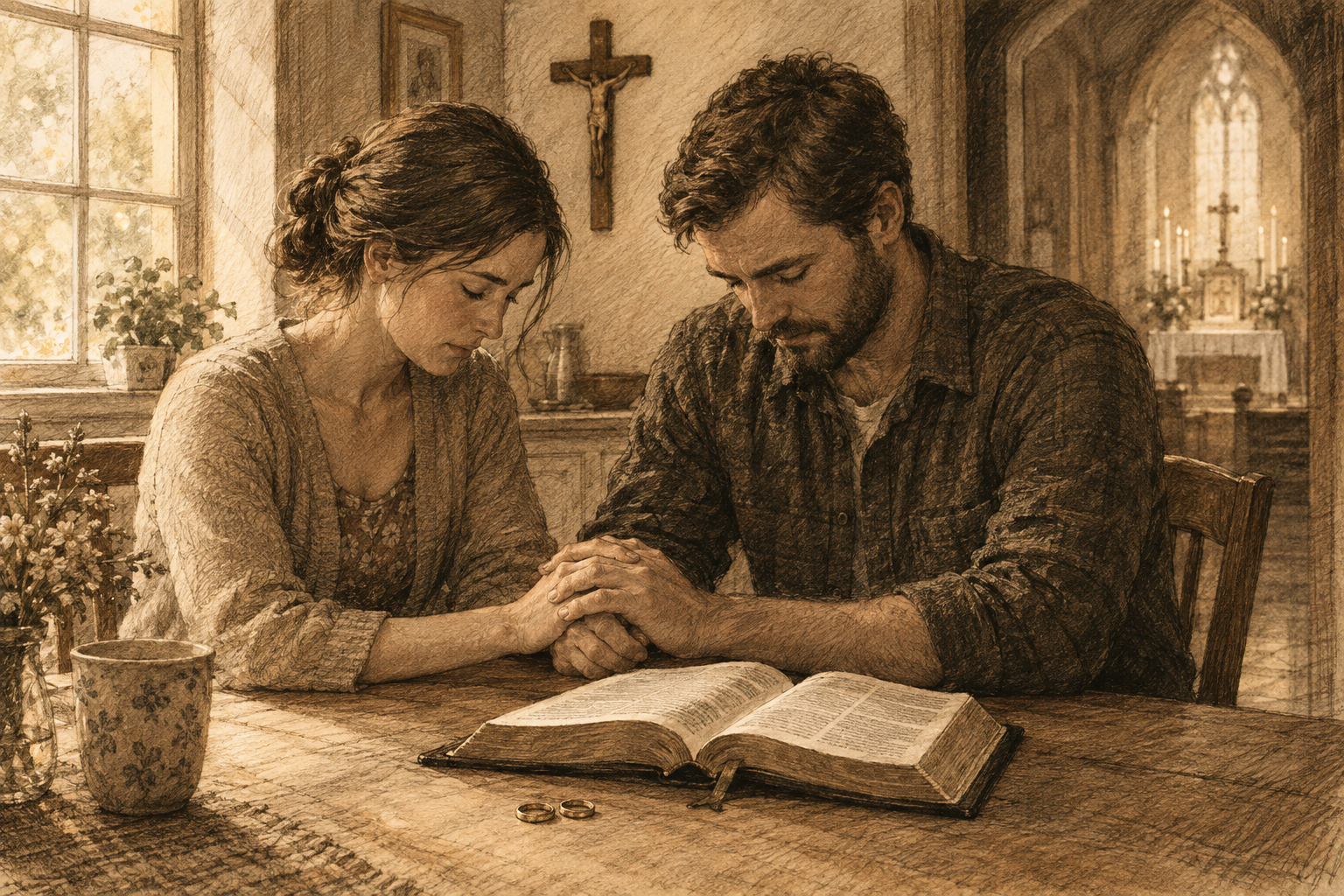
The vows made at the altar are fulfilled gradually, one decision at a time. Every shared prayer, honest apology, chaste act of love, and quiet sacrifice can renew the original gift. At the kitchen table, in the car, beside a child's bed, or during an uncertain season, Christ remains present to the covenant. Husband and wife are not asked to manufacture perfect love by their own strength. They are invited to receive grace, cooperate with it, and let their ordinary fidelity become a living sign of God's own faithfulness.
Keep Reading on Lets Read The Bible
Frequently Asked Questions
What does it mean to say that marriage is a sacrament?
It means that a valid marriage between two baptized Christians is an effective sign of grace. Christ strengthens the spouses to live a faithful, lifelong, and fruitful covenant and to help one another grow in holiness.
Does sacramental marriage guarantee that a couple will not struggle?
No. Sacramental grace does not remove human weakness, conflict, illness, or hardship. It gives spouses spiritual help to practice fidelity, forgiveness, sacrifice, and perseverance. Couples may also need pastoral care, counseling, medical help, or other practical support.
Is an annulment the same as a Catholic divorce?
No. Divorce civilly ends a recognized marital relationship. A declaration of nullity is a judgment by a Church tribunal that a valid marriage was not established from the beginning because something essential was lacking in consent, intention, capacity, or canonical form.