Sacraments and Liturgy
Mercy Has a Face: Entering the Divine Mercy Devotion
How the image, Chaplet, holy hour, and feast lead Catholics toward trust in Christ, the sacraments, and works of mercy
Site Admin | September 5, 2026 | 71 views
The Divine Mercy devotion is immediately recognizable. Many Catholics know the image of the risen Jesus with rays flowing from his heart. They have heard the words, Jesus, I trust in You, or joined a parish in praying the Chaplet of Divine Mercy. Yet familiar images and prayers can become distant unless we understand the faith they express.
At its heart, the devotion is a call to trust the mercy of Jesus Christ, receive that mercy through the life of the Church, and practice mercy toward others. It does not introduce a different Gospel. It directs us back to the saving mystery already proclaimed in Scripture and celebrated in the sacraments: the Son of God gave himself for sinners, conquered death, and opened the way home to the Father.
Mercy begins with God, not with us
Christian mercy is not based on the idea that human weakness does not matter. Nor is it a vague assurance that every choice is equally good. Mercy matters precisely because sin is real, wounds are deep, and we cannot save ourselves.
Scripture describes God as being rich in mercy Ephesians 2:4. His mercy is not reluctance finally overcome by our pleading. It flows from his own goodness. As Saint John teaches, love begins not with our love for God but with God's love for us and the sending of his Son for our sins 1 John 4:10.
Jesus reveals this mercy through his words, his welcome of sinners, his healing of the suffering, and above all through his death and resurrection. On Calvary, divine love enters the full reality of human sin and suffering. On Easter morning, mercy appears not as wishful thinking but as victory.
This is why authentic devotion to Divine Mercy remains centered on Christ. It is not fascination with extraordinary experiences. It is a response to the crucified and risen Lord, who still bears the wounds of his sacrifice and comes to his disciples with peace.
Saint Faustina and the spread of the devotion
The modern form of the Divine Mercy devotion is closely associated with Saint Maria Faustina Kowalska, a Polish religious sister of the Congregation of the Sisters of Our Lady of Mercy. During the 1930s, she recorded a series of interior experiences and reported encounters with Christ in a spiritual diary. These writings include requests connected with the Divine Mercy image, the Chaplet, the Hour of Great Mercy, and a feast honoring God's mercy.
Saint Faustina's life was outwardly simple. She performed ordinary work in her community while seeking holiness through prayer, obedience, humility, and trust. This matters because the devotion is sometimes presented as though it were mainly about dramatic visions. Faustina's deeper witness is the surrender of an ordinary life to God.
Her reported revelations belong to the category of private revelation. Catholics are not asked to treat them as another book of Scripture or as an addition to the faith handed down by the apostles. Public revelation was fulfilled in Christ and entrusted to the Church. An approved private revelation may help believers live that faith more fully in a particular time, but it does not replace the Gospel, the sacraments, or the teaching authority of the Church.
The Church eventually permitted and encouraged the devotion. Saint John Paul II canonized Faustina in 2000 and established the observance of Divine Mercy Sunday for the universal Church on the Second Sunday of Easter. This placement is deeply fitting. The feast belongs within the Easter octave, when the Church is already contemplating the risen Christ and the gift of forgiveness.
The image and its simple act of trust
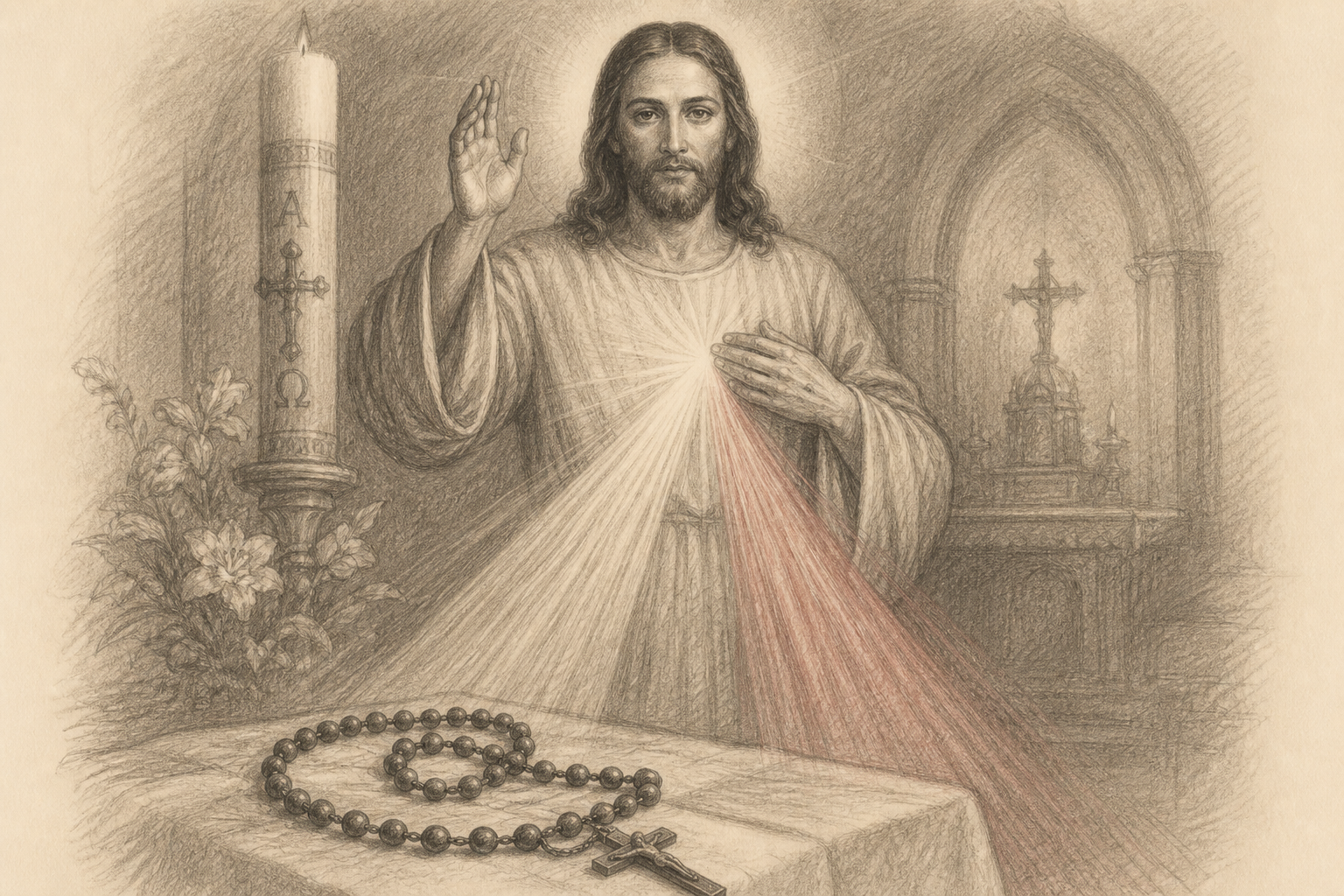
The Divine Mercy image depicts Jesus raising one hand in blessing while the other points toward his heart. Two rays, one pale and one red, flow from him. They recall the blood and water that came from the pierced side of Christ John 19:34. The image commonly bears the inscription, Jesus, I trust in You.
Those words are not a claim that life will unfold according to our plans. Christian trust is confidence in the person of Jesus, even when circumstances remain painful or confusing. It says that his goodness is greater than our sin, his wisdom exceeds our understanding, and his grace is sufficient for the next faithful step.
An image of Divine Mercy can have a worthy place in a home, church, or prayer corner. It should not be treated as a charm. Sacred art serves faith by directing the mind and heart toward the mystery it represents. Pausing before the image can become an opportunity to make a deliberate act of trust, especially during temptation, anxiety, grief, or discouragement.
How to pray the Chaplet of Divine Mercy
The Chaplet of Divine Mercy is usually prayed with ordinary Rosary beads. Its prayers are directed principally to God the Father, pleading the merits of Christ's Passion for mercy upon us and upon the whole world.
- Begin with the Sign of the Cross. The customary opening includes the Our Father, the Hail Mary, and the Apostles' Creed.
- On each large bead, pray the Eternal Father prayer, offering the Body and Blood, Soul and Divinity of Jesus Christ in atonement for sins.
- On each of the ten smaller beads, pray, For the sake of his sorrowful Passion, have mercy on us and on the whole world.
- After five decades, conclude by praying Holy God, Holy Mighty One, Holy Immortal One, have mercy on us and on the whole world three times.
The language of offering in the Chaplet should be understood in harmony with Catholic teaching. The prayer does not repeat Christ's sacrifice or take the place of the Mass. Jesus offered himself once for all. The Chaplet prayerfully appeals to that one saving sacrifice, much as the Church continually asks the Father to look upon the merits of his Son.
The Chaplet can be prayed alone, with a family, in a parish, at the bedside of someone who is ill, or for those approaching death. Its repeated appeal for mercy upon the whole world protects it from becoming narrowly private. We bring before God not only our own needs but also sinners, the suffering, the dying, divided families, wounded communities, and nations in conflict.
The three o'clock hour and the Divine Mercy novena
Many Catholics pause at three o'clock in the afternoon, traditionally associated with the hour of Christ's death. This practice is sometimes called the Hour of Great Mercy. It may include the Chaplet, meditation on the Passion, the Stations of the Cross, or a brief prayer of trust.
There is no requirement to complete a lengthy devotion every day at exactly three o'clock. A Catholic at work, caring for children, traveling, or attending to serious duties may simply turn inwardly to Christ for a moment. The purpose is not anxious precision. It is grateful remembrance of the cross.
The Divine Mercy novena is traditionally prayed from Good Friday through the Saturday before Divine Mercy Sunday. Its daily intentions embrace different groups of people and commend them to God's mercy. This novena can help extend the prayer of the Paschal Triduum into the Easter octave, but it remains a private devotion. It should support participation in the Church's liturgy rather than compete with it.
Divine Mercy Sunday belongs to Easter
The Gospel proclaimed on the Second Sunday of Easter presents the risen Jesus entering the locked room, offering peace, and entrusting the ministry of forgiveness to his apostles John 20:22 John 20:23. The liturgical setting shows why Divine Mercy and sacramental confession naturally belong together.
Confession is not a punishment imposed on people who have failed to be perfect. It is an encounter with the risen Christ, who knows the truth about sin and possesses the authority to forgive it. In the sacrament, honest repentance meets a mercy that is concrete, ecclesial, and personal.
The Eucharist is also central. The Lord who gave himself on Calvary feeds his people with his own life. Catholics should receive Holy Communion worthily, with reverence and proper preparation. Anyone conscious of mortal sin should ordinarily receive sacramental absolution before approaching Communion.
The Church also provides for a plenary indulgence connected with Divine Mercy Sunday under the usual conditions and with the prescribed spiritual dispositions and prayers. An indulgence is not permission to sin or a substitute for repentance. It concerns the temporal punishment due to sins whose guilt has already been forgiven. Catholics seeking the indulgence should follow current Church norms and any guidance provided by their parish or diocese.
Mercy received must become mercy practiced
Devotion becomes distorted if it asks God for compassion while making us less compassionate toward our neighbor. Jesus commands his disciples to be merciful as the Father is merciful Luke 6:36. He also declares the merciful blessed Matthew 5:7.
The Church traditionally speaks of corporal and spiritual works of mercy. These provide a practical examination of whether devotion is changing our lives.
- Feed the hungry, give drink to the thirsty, shelter those in need, visit the sick and imprisoned, clothe the poor, and bury the dead.
- Instruct those who need guidance, counsel the doubtful, comfort the sorrowful, bear wrongs patiently, forgive injuries, correct with charity, and pray for the living and the dead.
Not every person can perform every work in the same way. A parent may practice mercy through patient care at home. A parishioner may visit someone who is lonely. A worker may refuse to join cruel gossip. A person carrying an old injury may begin the difficult process of forgiveness while maintaining necessary boundaries. Someone with limited mobility may offer faithful intercession for the dying.
Mercy does not require us to deny justice, ignore danger, or remain in an abusive situation. Forgiveness releases vengeance to God and seeks freedom from hatred. Reconciliation, when possible, also requires truth, repentance, and restored trust. Divine Mercy is never an excuse to conceal wrongdoing.
A sustainable way to live the devotion
It is easy to collect devotions and difficult to remain faithful to them. A modest rule of life is usually better than an ambitious plan quickly abandoned. An ordinary Catholic might begin with these practices:
- Make a brief act of trust each morning: Jesus, I trust in You.
- Keep the Divine Mercy image in a place that encourages prayer rather than mere decoration.
- Pray the Chaplet once a week, then more often if it genuinely supports prayer.
- Pause briefly at three o'clock when duties permit and remember the Passion.
- Receive the sacrament of confession regularly and without unnecessary fear.
- Participate reverently in Sunday Mass, especially on Divine Mercy Sunday.
- Choose one concrete work of mercy each week.
- Pray for someone whose suffering or behavior makes mercy difficult.
These practices are not a technique for controlling God. They are ways of opening the heart to grace. Over time, the devotion should make a person more truthful in confession, more reverent at Mass, more hopeful after failure, and more attentive to suffering.
The simplest prayer associated with Divine Mercy may also be the most demanding: Jesus, I trust in You. To say it sincerely is to place our sins, fears, relationships, future, and final hour into the hands of Christ. His wounded hands are not closed against us. They remain open, inviting us to receive mercy and to carry it into the world.
Keep Reading on Lets Read The Bible
Frequently Asked Questions
Is the Divine Mercy devotion required for Catholics?
No. The Divine Mercy devotion is an approved private devotion, not an obligation for every Catholic. Divine Mercy Sunday, however, is the liturgical observance of the Second Sunday of Easter in the Roman Rite. Catholics are free to benefit from the image, Chaplet, novena, and three o'clock prayer while keeping the Mass and sacraments central.
Must the Chaplet of Divine Mercy be prayed at three o'clock?
No. The Chaplet may be prayed at any time. Three o'clock is traditionally associated with Christ's death and is a fitting time to remember his Passion, but work, family duties, illness, and other responsibilities may make another time more practical.
Do I have to go to confession on Divine Mercy Sunday itself?
Confession is not required on that exact day simply because it is Divine Mercy Sunday. Catholics should receive Communion worthily, and anyone conscious of mortal sin should ordinarily go to confession before receiving. Those seeking the Divine Mercy Sunday plenary indulgence should observe the Church's current conditions, but sacramental confession need not necessarily occur on the feast itself.