Sacraments and Liturgy
Confession with a Clear Heart: A Practical Catholic Way to Return to Mercy
A steady guide to examination, contrition, and the grace of the sacrament for those who want to confess well.
Site Admin | August 27, 2026 | 65 views
Coming to Confession with honesty
For many Catholics, the sacrament of Penance is both familiar and strangely difficult. We know we need it. We know it is a gift. Yet when the time comes, we may hesitate, forget what to say, or feel uneasy about admitting our sins out loud. Making a good confession explained in simple terms begins here: the sacrament is not a spiritual performance. It is a meeting with Christ, who already knows the soul and still asks us to come forward.
The Church teaches that in Confession we encounter the mercy won by the Death and Resurrection of Jesus. After the Resurrection, the Lord breathed on the apostles and said, "Receive the Holy Spirit. If you forgive the sins of any, they are forgiven" 23. That is why Confession is never merely private reflection. It is a sacramental act, given by Christ and entrusted to the Church. Through the priest, the penitent hears the good news in a concrete and personal way: God does not turn away from the repentant sinner.
Many people first approach the sacrament because they have fallen seriously, but the grace of Confession is not only for emergencies. It also forms the conscience, strengthens humility, and helps the Christian live more watchfully. A good confession is not measured by eloquence. It is measured by sincerity, contrition, and a true desire to turn again toward God.
The sacrament in the life of the Church
From the earliest centuries, Christians understood that grave sin required repentance, prayer, and reconciliation with the Church. Over time, the Church's discipline developed in different ways, but the central truth remained: baptism is the beginning of a new life, and when that life is wounded by sin, Christ provides a remedy. The sacrament of Penance is not an invention of human tenderness. It is part of the Lord's pastoral care for his people.
In the Catholic tradition, Confession has often been called by several names: Penance, Reconciliation, or Confession. Each name highlights a different aspect of the same sacrament. Penance points to conversion and satisfaction. Reconciliation points to restored friendship with God and the Church. Confession points to the honest naming of sins before God. Taken together, they show that mercy is not vague. It restores what sin has damaged.
The Church's liturgy gives this sacrament a quiet solemnity. The confessional, the prayer of the priest, the words of absolution, and the penance given afterward all help the penitent understand that something real has happened. Christ has acted. The soul has been touched by mercy. The person leaves not merely relieved but reconciled.
What a good confession includes
Making a good confession explained clearly means remembering the essential parts of the sacrament. They are simple, but they matter.
- Examine your conscience. Ask the Holy Spirit to show you your sins honestly and without excuses.
- Be sorry for your sins. True contrition includes sorrow for offending God and a real desire to change.
- Confess clearly. Name your sins plainly, including any mortal sins you remember.
- Accept the penance. Receive it humbly as part of the sacrament's healing.
- Make a firm purpose of amendment. Decide, with God's help, to avoid sin and the near occasions of sin.
The Catechism teaches that mortal sin requires grave matter, full knowledge, and deliberate consent. That distinction is important because not every wrong action has the same weight. Still, even venial sins belong in Confession and are worth bringing to the Lord. A good confession does not depend on dramatic feelings. Quiet sincerity is enough.
It can help to remember that Confession is not a courtroom where a person must defend himself. It is more like a hospital where the wound is uncovered so it can be treated. A person does not heal by pretending not to be sick. In the same way, the soul does not heal by hiding from the truth.
How to examine your conscience without anxiety
Many Catholics struggle most at the beginning, when they sit alone and try to remember their sins. Some feel overwhelmed because they fear missing something. Others rush because they feel ashamed. A good examination of conscience is prayerful, not frantic. Begin by asking the Holy Spirit for light. Then look calmly at the duties of your state in life, the Ten Commandments, the commandments of the Church, and the virtues opposite each sin.
It is often useful to ask very concrete questions:
- Have I put God first, or have I made lesser things my real priority?
- Have I missed Mass on Sundays or holy days without a serious reason?
- Have I used God's name carelessly or shown contempt for sacred things?
- Have I been honest in speech, work, and responsibilities?
- Have I harmed others by anger, impurity, envy, gossip, or refusal to forgive?
For some, it helps to keep a small written list during the week. That list need not be long or detailed. A few brief notes can prevent forgetfulness and make the sacrament easier. The point is not to build a case against oneself. The point is to come into the light with a truthful heart.
Scripture gives the shape of this movement. "If we confess our sins, he is faithful and just, and will forgive our sins and cleanse us from all unrighteousness" 1 John 1:9. The verse does not promise cleansing apart from confession. It promises cleansing through the humble confession of sin. That humility is not weakness. It is the beginning of wisdom.
Contrition, shame, and the freedom to begin again
Some people confuse contrition with shame. They are not the same. Shame can tell us we are worthless and should hide. Contrition tells us we have sinned against the God who loves us and therefore must return. Shame isolates. Contrition opens the door to mercy.
The parable of the prodigal son gives a vivid image of this return. The younger son does not first clean himself up. He comes back in poverty and regret, saying, "I have sinned against heaven and before you" 18. The father receives him before he can prove anything. That is the heart of the sacrament. God does not wait for us to become worthy by our own efforts. He welcomes the repentant sinner and restores him to the household.
Still, contrition is not only emotional regret. The Church distinguishes between perfect contrition, which arises from love of God, and imperfect contrition, which arises from fear of sin's consequences or sorrow for having offended God. Both can be part of a valid confession when joined to the sacrament. What matters is that the penitent truly wants to leave sin behind.
That is why a good confession is often marked by a kind of quiet freedom. A person may enter burdened and leave lighter, not because every struggle has vanished, but because the truth has been spoken before God. The soul is no longer hiding.
How to speak in the confessional
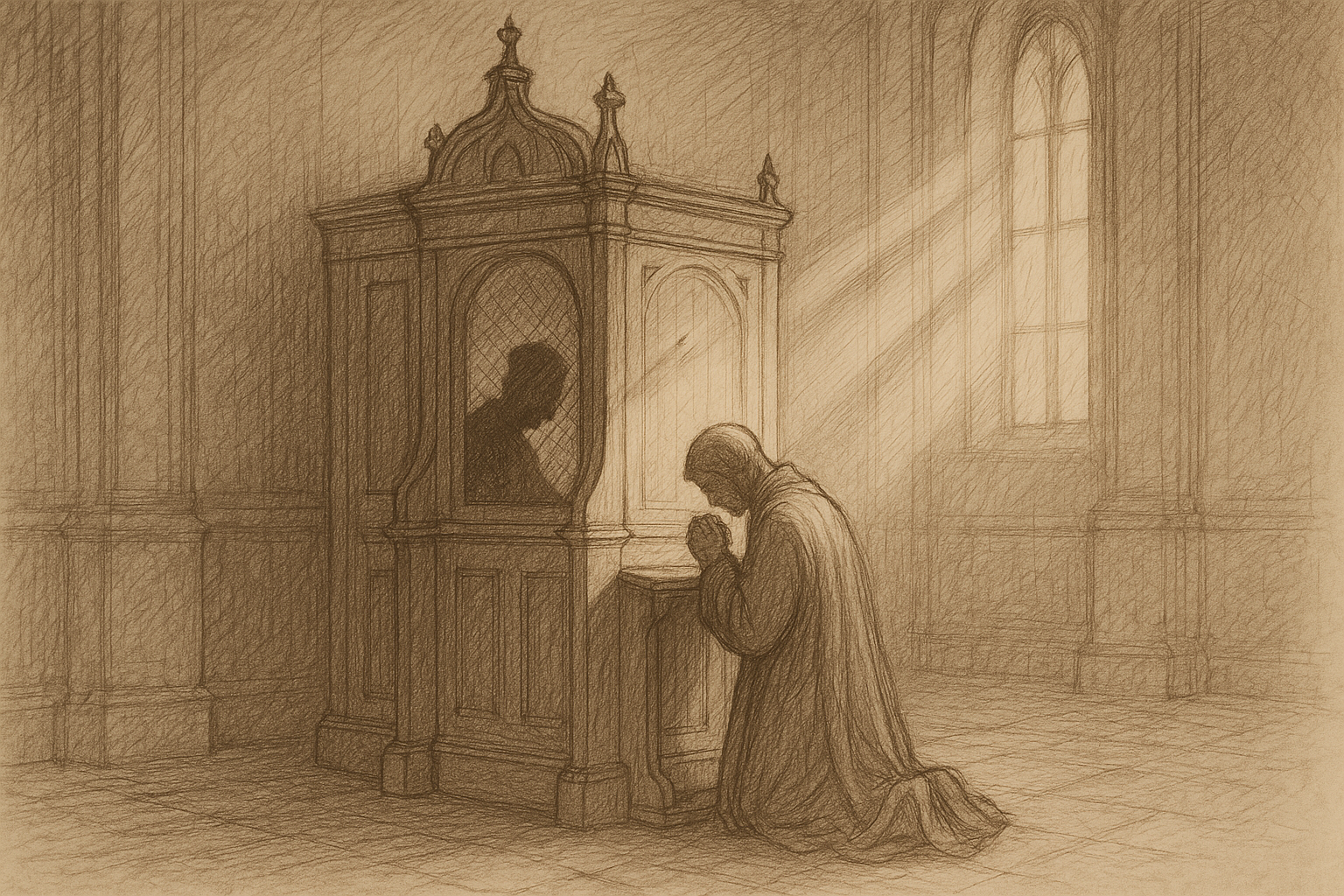
For someone returning after a long time, the practical details can feel intimidating. Yet the rite itself is mercifully simple. When you enter, you may begin by making the Sign of the Cross and saying how long it has been since your last confession. If needed, you can mention that you are nervous or that you need help remembering the order of things. Priests hear this often. They are there to help, not to test you.
When naming sins, be direct and brief. Say what the sin was and, when relevant, how often it happened. Do not tell long stories unless they are necessary to explain the matter. Avoid vague phrases when a clearer one is possible. The sacrament favors truth spoken plainly.
If you forget something accidentally, do not panic. Confession is not ruined by ordinary forgetfulness. If you remember a grave sin after the fact, mention it at your next confession. The point is honesty, not perfection of memory. If something is unclear, ask the priest for guidance. A good confessor will help you without embarrassment.
When the priest gives counsel, listen carefully, even if the advice is brief. The words of absolution are the sacrament's center. The Church hears there the voice of Christ, who alone has power to forgive sin, and the heart can rest in that mercy.
Practical confession rhythm: examine your conscience, stir up contrition, confess sins clearly, accept the penance, and thank God afterward.
After absolution: what to do next
Confession does not end when the words of absolution are spoken. The penance is part of the sacrament, and it should be fulfilled as soon as reasonably possible. Usually it is prayer, Scripture, or a concrete act of devotion. Do it with gratitude, not as a burden. The purpose is to unite your repentance to Christ's saving work.
It is also wise to give thanks after leaving the confessional. A few moments of silence can help the soul receive the grace more deeply. Some pray Psalm 51, the Miserere, which has long been one of the Church's great prayers of repentance: "Create in me a clean heart, O God" Psalm 51:10. That prayer captures what the sacrament is doing. God is not merely canceling a debt. He is renewing the heart.
After Confession, try not to return immediately to scrupulous self-accusation. If you have confessed sincerely, trust the sacrament. Gratitude should follow absolution. A person who has been washed should not keep staring at the mud. Instead, walk in the light, attend Mass faithfully, pray daily, and return to Confession when needed.
A sacrament for ordinary holiness
It is easy to think of Confession as a place for the spiritually failing, but the saints understood it as one of the ordinary means by which God forms holiness. A regular rhythm of Confession teaches self-knowledge. It trains the conscience. It makes sin less comfortable and mercy more cherished. Over time, a faithful penitent becomes more attentive to temptation before it grows strong.
This is especially important in a culture that often normalizes sin or reduces moral life to personal preference. Confession quietly says otherwise. It says that God is real, sin is real, grace is real, and conversion is possible. It also says that no one is beyond help. The door of mercy remains open because Christ opened it with his own blood.
For the Catholic who wants to participate more faithfully, the most useful attitude is not fear but readiness. Prepare honestly. Confess simply. Receive mercy reverently. Then live in a way that makes the next confession, if it comes, part of a steady journey rather than a crisis. In that way, the sacrament becomes what it was always meant to be: a path back to communion, and a school of humble trust in God's mercy.
Keep Reading on Lets Read The Bible
Frequently Asked Questions
How often should a Catholic go to Confession?
The Church requires confession of grave sins at least once a year, but many Catholics benefit from going more often, such as monthly or during seasons of particular spiritual effort.
What if I am embarrassed or have not been to Confession in years?
That is common, and priests are used to helping people return after a long absence. A simple, honest beginning is enough: say it has been a long time and ask for guidance.
Do I need to confess venial sins too?
No one is required to confess venial sins, but the Church strongly encourages it. Confessing venial sins helps form the conscience and supports growth in holiness.