Sacraments and Liturgy
Clothed in a Promise: Receiving the Brown Scapular with Faith
The brown scapular explained, from its Carmelite roots to the practical commitments of a Marian devotion.
Site Admin | September 16, 2026 | 21 views
A small piece of brown cloth can carry a surprising weight of questions. Does wearing it guarantee salvation? Must it be blessed? What prayers go with it? Someone may receive a scapular from a grandparent or find one in a parish shop long before anyone explains what it means.
The brown scapular belongs to a living Catholic tradition, not to a collection of religious good-luck objects. It expresses a relationship with the Blessed Virgin Mary and a share in the spiritual heritage of Carmel. Received faithfully, it can help a person remember something easily forgotten during a crowded day: we belong to Christ, and his grace calls for a response.
From a religious habit to a lay devotion
The word scapular comes from a Latin word associated with the shoulders. In religious life, a scapular is a garment worn over the shoulders, with panels hanging down the front and back. It forms part of the habit of several religious communities. The small brown scapular familiar to many Catholics developed as a devotional form of the Carmelite scapular.
The Carmelite tradition took shape among hermits living on Mount Carmel in the Holy Land. Their life centered on prayer, allegiance to Jesus Christ, and devotion to Mary. As the order spread, laypeople also sought a connection with its spiritual life. The small scapular became a visible sign of that connection.
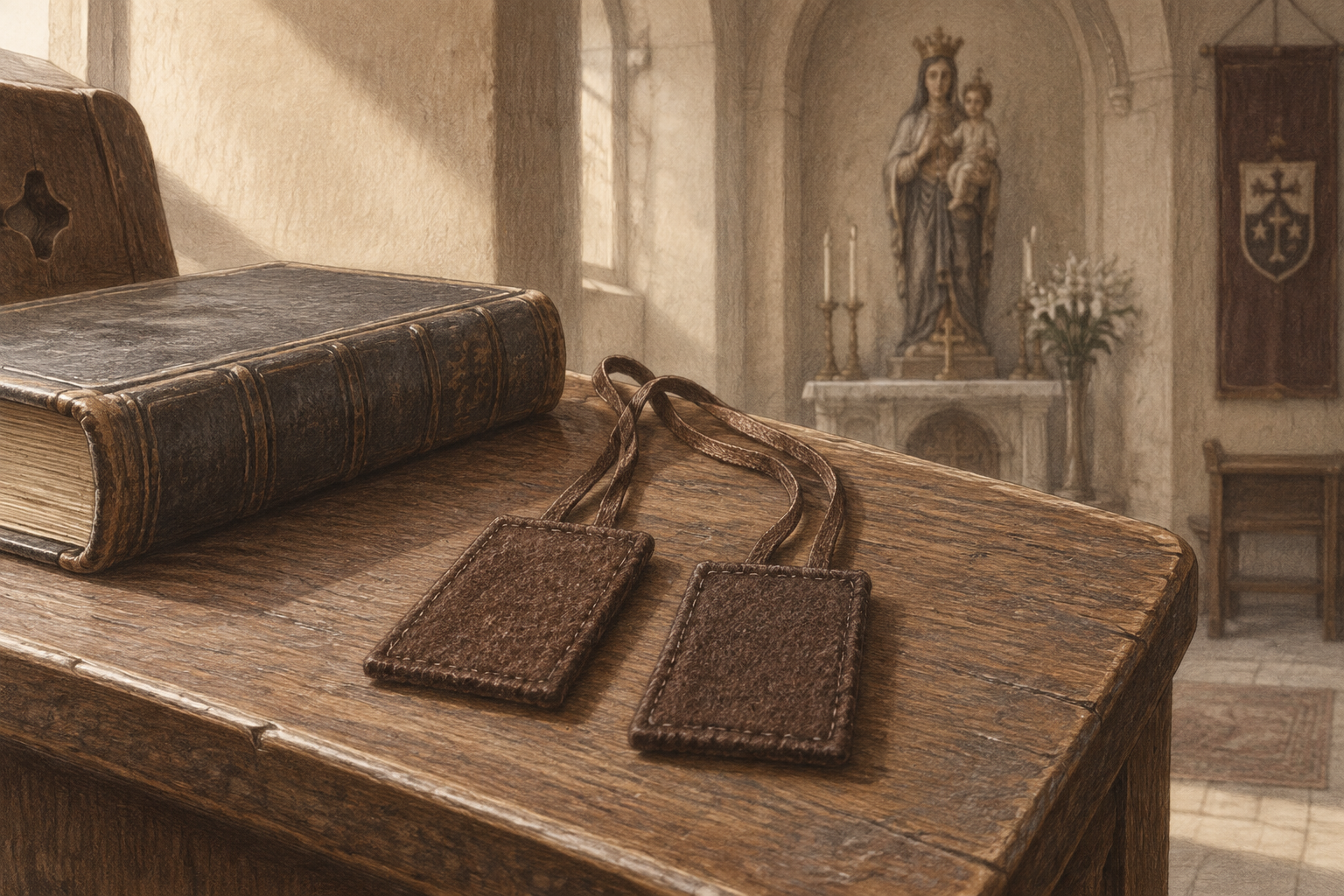
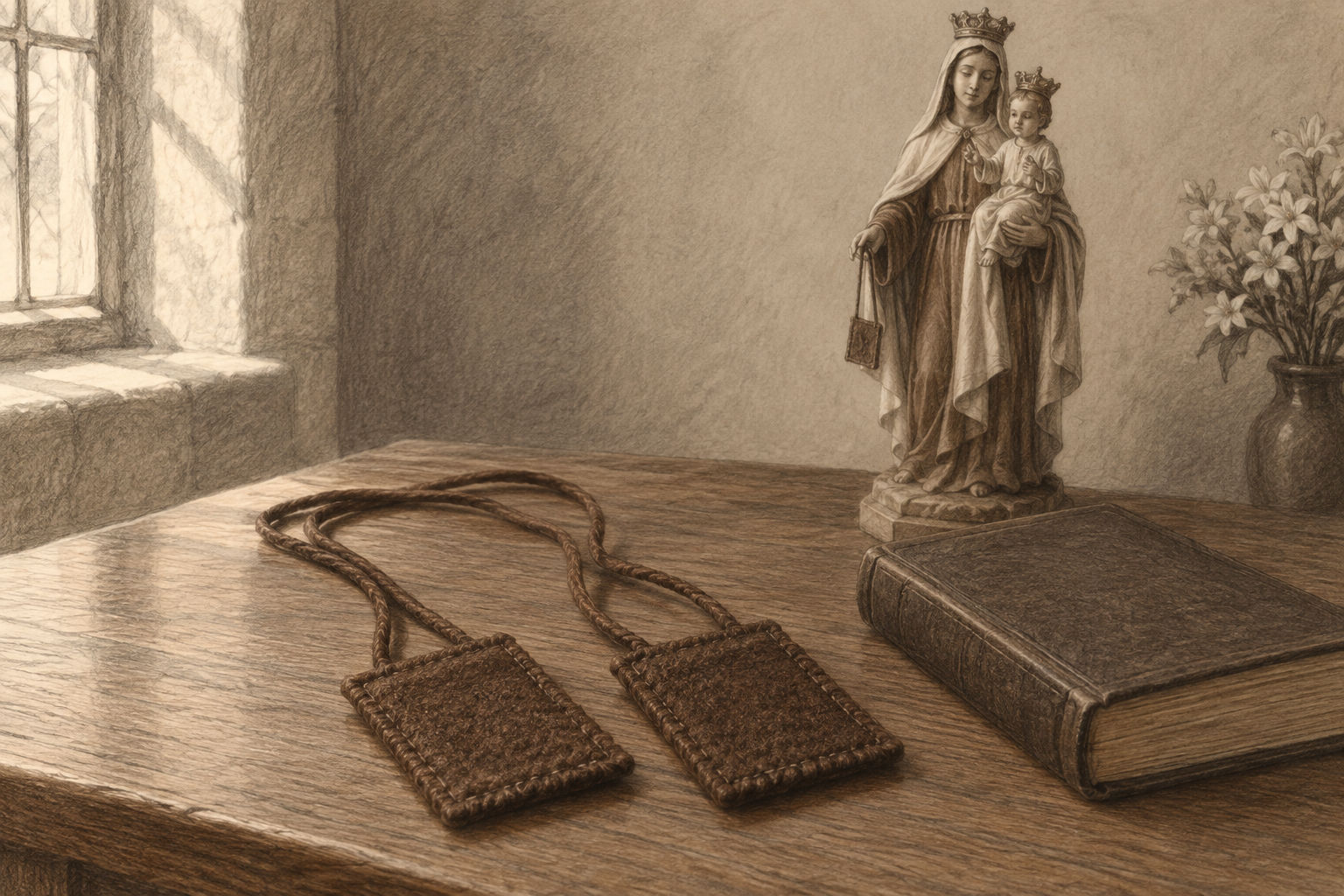
It is traditionally made from two small pieces of brown wool joined by cords, worn with one panel in front and the other behind. Religious pictures are often added, but the devotion does not depend on a particular printed image. Its meaning comes from the garment it represents and the Christian commitment it expresses.
Saint Simon Stock and the historical record
Carmelite tradition associates the scapular with an apparition of the Blessed Virgin Mary to Saint Simon Stock, a medieval Carmelite. In the familiar account, Mary offers the scapular as a sign of her protection and attaches a promise concerning salvation to those who die wearing it.
The historical evidence for the apparition and the precise wording of the promise is debated. It is important to distinguish an established Catholic devotion from the certainty of every detail in its popular retelling. Catholics are not required to accept this apparition as an article of faith.
That distinction need not diminish the devotion. Its sound spiritual foundation is the Church's recognition of the scapular as a sacramental and the Carmelite call to live in communion with Christ under Mary's maternal care. The scapular does not add a new Gospel or offer a private route around the demands of the one we have received.
A sacramental, not an eighth sacrament
The Church distinguishes the seven sacraments from sacramentals. Sacraments were instituted by Christ and confer the grace they signify. Sacramentals are sacred signs instituted by the Church that prepare us to receive grace and help sanctify the circumstances of life. The Catechism explains this distinction in paragraphs 1667-1670.
The brown scapular belongs to this second category. Like a blessed medal or a rosary, it can support a life of faith through the Church's prayer and the wearer's faithful response. It does not work by the material power of cloth, a picture, or a cord.
This matters because an otherwise good devotion can become superstitious when someone treats the external object as effective apart from repentance and trust in God. The Catechism warns against attributing a magical importance to religious practices merely because they have been performed, without the interior dispositions they require.
A scapular is therefore not a replacement for Baptism, Sunday Mass, confession, or the Eucharist. It should lead a Catholic more deeply into sacramental life. If wearing it becomes an excuse to neglect the sacraments or persist deliberately in serious sin, the sign has been separated from what it signifies.
What it means to belong to Mary
Marian devotion can be misunderstood as turning away from Jesus toward someone more approachable. Authentic Catholic devotion does the opposite. Mary is a creature redeemed by her Son, and her maternal intercession depends entirely on his saving work. She does not compete with him.
At Cana, Mary's instruction directs the servants to obey Jesus: John 2:5. That is a useful measure for every Marian practice. Does it make us more attentive to Christ's words? More willing to forgive? More faithful in prayer? More ready to do the difficult good that love requires?
The scapular expresses a desire to receive Mary's care and imitate her discipleship. Luke describes her keeping and pondering the events surrounding Jesus in her heart: Luke 2:19. This contemplative attention belongs naturally to the Carmelite tradition. It is not reserved for people with quiet houses or long hours available for prayer.
For a parent, a student, a caregiver, or a person working an exhausting shift, wearing the scapular can become a quiet reminder to turn toward God. The cloth does not perform that turning for us. It invites us to make it, again and again.
Reading the promises without superstition
The promise traditionally associated with the scapular is often repeated as though wearing it at death guarantees salvation regardless of how someone has lived. That interpretation is incompatible with Catholic teaching. No devotional object makes repentance unnecessary or gives a person permission to reject God's grace.
The promise should be understood within the whole Christian life: trust in Mary's intercession, perseverance in faith, conversion from sin, and dependence on Christ's mercy. Mary's protection is not a rival to the Gospel's call to holiness. Her help leads us to receive the salvation her Son offers.
This also means that someone should not panic if a scapular breaks, is removed for surgery, or is forgotten after bathing. God is not setting a trap around the accidental absence of a piece of cloth. Habitual wearing expresses devotion, but salvation is not determined by a wardrobe accident.
The so-called Sabbatine privilege
Some explanations also mention the Sabbatine privilege, commonly described as Mary's promise to release scapular wearers from purgatory on the first Saturday after death. The historical claims behind this account are disputed, and it should not be presented as a guaranteed timetable for deliverance.
Catholics may confidently ask Mary to intercede for the faithful departed. They may also pray for the grace of a holy death and practice the prayer and penance associated with Carmelite devotion. What they should not do is turn these hopes into a calculation that attempts to control God's judgment or the purification of souls.
How to begin wearing the scapular faithfully
You do not need an elaborate spiritual plan before approaching this devotion. You do need an honest intention to follow Christ and a willingness to learn what the sign means.
- Speak with a priest. Tell him that you would like to be enrolled in the Brown Scapular of Our Lady of Mount Carmel. Ask for the Church's approved rite of blessing and enrollment, rather than assuming that purchasing or wearing a scapular is the same as enrollment.
- Obtain a suitable scapular. A traditional brown wool scapular is a straightforward choice. A parish shop or Carmelite community may be able to help you find one. It need not be expensive or elaborate.
- Receive some instruction. Enrollment should include an understanding of the devotion's Marian and Carmelite character. Ask what daily prayer practice is recommended and whether any particular obligations accompany the form of association you are entering.
- Wear it as a sign of commitment. It is ordinarily worn over the shoulders, with one panel in front and one behind, often beneath clothing. There is no need to display it or draw attention to it.
- Let it support sacramental life. Be faithful to Sunday Mass, receive the sacraments with proper preparation, and return to confession when needed. A devotion bears fruit when it helps us respond to grace.
Enrollment is ordinarily received once, not repeated whenever the scapular wears out. Replacement scapulars do not require a new enrollment or a new blessing. If you are unsure whether you were enrolled as a child, explain that uncertainty to a priest rather than trying to reconstruct every detail yourself.
If cloth causes a skin problem or creates a practical difficulty, ask about the Church's provisions for a scapular medal. Do not assume that any Marian medal is automatically interchangeable with the scapular. A priest familiar with the devotion or a Carmelite community can help you apply the relevant guidance.
Give the outward sign an inward response
A daily prayer habit gives the devotion room to grow. The Rosary is a fitting choice, but it should not be advertised as a universal requirement attached to every brown scapular enrollment. Follow the guidance you receive, and choose a sustainable rhythm rather than making promises you cannot reasonably keep.
You might begin the morning with a brief offering to Jesus through Mary, spend a few minutes with the Gospel, and examine your conscience before bed. Some people will be drawn toward the Liturgy of the Hours or toward a deeper relationship with a Carmelite community. Wearing the scapular does not by itself make someone a member of a Carmelite secular order, which involves its own formation and commitments.
Charity is an equally important test. Saint Paul joins the image of putting on a new life to compassion, kindness, humility, gentleness, and patience: Colossians 3:12. A religious garment should not sit comfortably beside habitual cruelty, dishonesty, or contempt. Its presence can instead prompt the apology, the patient answer, or the act of service we would rather postpone.
The brown scapular is small enough to disappear beneath a shirt. Its purpose is not to make faith disappear with it, but to help faith take root where only God may see: in an honest confession, a resisted temptation, a prayer offered in weariness, or a kindness without recognition. Worn in that spirit, it becomes a modest and persistent reminder to remain close to Christ, with Mary teaching us to listen and respond.
Keep Reading on Lets Read The Bible
Frequently Asked Questions
Does wearing the brown scapular guarantee salvation?
No. The brown scapular is a sacramental, not a charm or an unconditional guarantee. Its traditional promise must be understood in harmony with Catholic teaching on grace, repentance, and perseverance. Trust in Mary's intercession should lead to greater faithfulness to Christ, not neglect of the sacraments or deliberate persistence in sin.
Do I need to be enrolled again when I replace my scapular?
No. Enrollment is ordinarily received once. When a scapular wears out, its replacement does not require another enrollment or another blessing. If you do not know whether you were ever enrolled, speak with a priest and explain your situation.
Must I pray the Rosary every day if I wear the brown scapular?
The Rosary is strongly suited to this Marian devotion, but it is not a universal requirement of every brown scapular enrollment. Ask about the prayer commitments associated with your enrollment or confraternity. A faithful daily prayer life, participation in the sacraments, and Christian charity should accompany wearing the scapular.