Family and Vocation
The Small Lamps We Tend: Raising Children Toward Christ
Christian formation begins not with a perfect household, but with parents who return to Christ and invite their children to walk beside them.
Site Admin | October 30, 2026 | 6 views
Raising a child in the faith can feel both beautiful and daunting. Parents receive a human life with wonder, yet they also know that love cannot control every outcome. A child has a mind, a conscience, a temperament, and eventually an adult freedom that belongs to God. No parent can force faith into another person's heart.
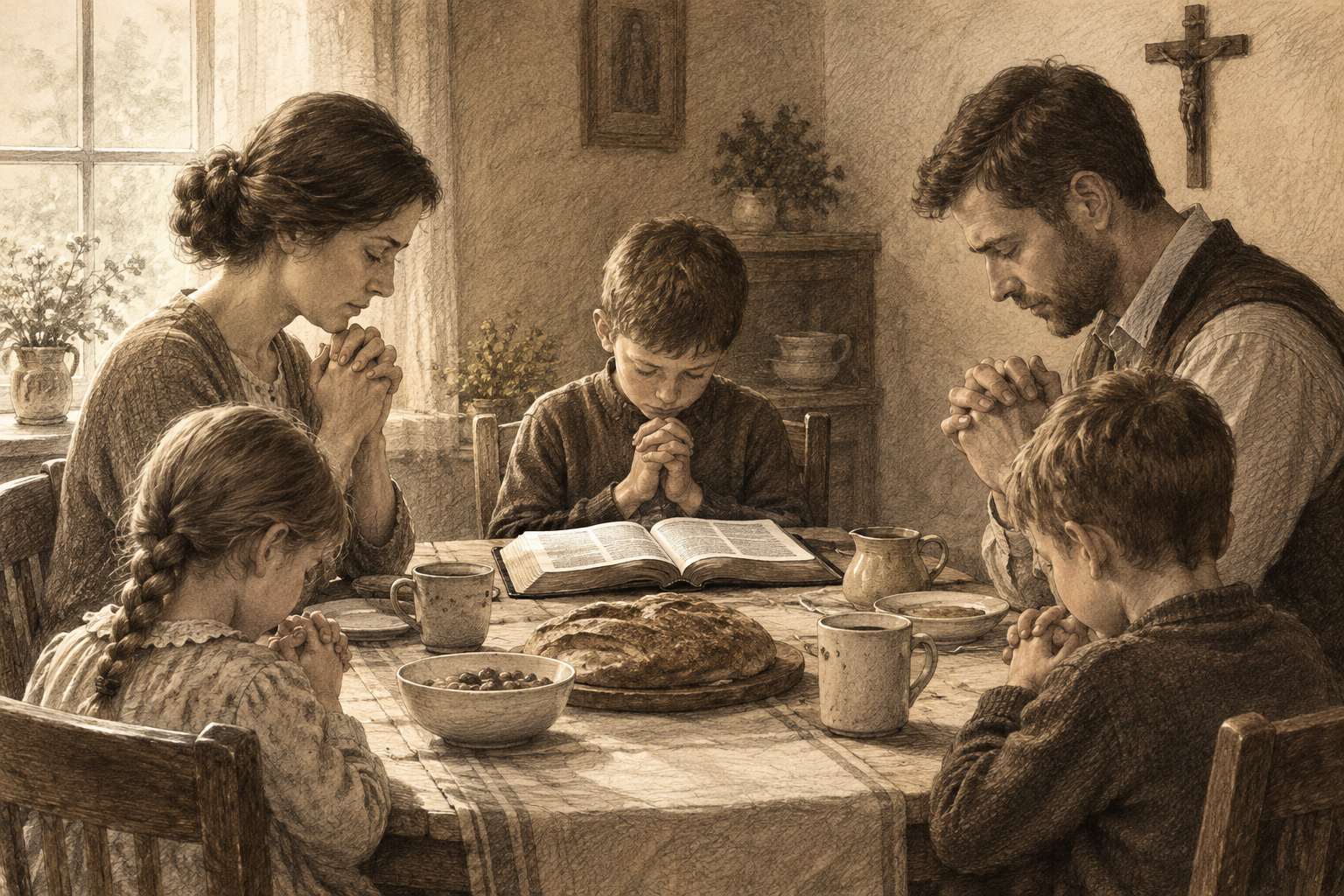
Still, parents are not helpless spectators. They are entrusted with a real vocation: to create a home in which God is loved, Christ is known, prayer is practiced, sin is forgiven, and the Church is encountered as a living mother. This work is usually quieter than parents imagine. It unfolds through repeated prayers, ordinary meals, difficult conversations, Sunday Mass, acts of mercy, and the humble willingness to begin again.
A raising children in the faith reflection must therefore start with grace rather than anxiety. Christian parents are not being asked to manufacture holiness through flawless technique. They are being asked to cooperate with God, who loves their children first and whose providence reaches farther than any parent's sight.
Faith is received through a living witness
In Deuteronomy, Israel is told to keep God's words in the heart and to teach them diligently to the next generation. The command belongs not only to formal instruction but to the whole rhythm of family life: sitting at home, walking along the way, lying down, and rising. [[VERSE|deuteronomy|6|6-7|Deuteronomy 6:6-7]]
The order matters. God's words are first to be held in the adult heart, then spoken to the child. Parents cannot hand on what they treat as unimportant. Children often recognize the difference between a faith that is merely required of them and a faith that genuinely gives their parents hope.
This does not mean parents must be experts in theology or models of uninterrupted devotion. It means they should be honest disciples. A father who asks forgiveness after speaking harshly teaches something true about repentance. A mother who prays in a season of fear shows that trust is possible even when life is uncertain. Parents who go to confession acknowledge that the Gospel is not a reward for the flawless but mercy for sinners.
The Catechism of the Catholic Church describes parents as the first educators of their children in faith and virtue. This responsibility begins before a child can read a Bible or explain a doctrine. A young child learns through gestures, habits, tone, and presence. The Sign of the Cross made gently before sleep, reverence at Mass, gratitude before a meal, and patience with an elderly relative all help give faith a visible form.
The home as a domestic church
Catholic tradition calls the family a domestic church. This does not mean that the household replaces the parish, the sacraments, or ordained ministry. It means that the grace received in the Church is meant to take flesh within the home. Family life becomes one of the first places where a child encounters self giving love, authority ordered toward service, mercy after failure, and prayer in times of joy or sorrow.
The Holy Family offers a pattern without making ordinary families feel unreal. Nazareth was holy because Jesus, Mary, and Joseph lived in faithful obedience to God, not because their life was free from hardship. They knew displacement, uncertainty, work, and the demands of daily care. When Joseph was warned to take the child and his mother into Egypt, he responded with protective obedience. [[VERSE|matthew|2|13-14|Matthew 2:13-14]] Mary, for her part, received mysteries she did not fully comprehend and kept them in her heart. Luke 2:19
Parents may recognize themselves in both responses. Some moments require decisive action. Others ask for patient pondering. Family discipleship needs both practical responsibility and contemplative trust.
Build a rhythm that the family can sustain
A family's spiritual practices should be substantial enough to shape life but realistic enough to endure. A complicated plan that collapses after a week may produce more discouragement than fruit. Simple practices, repeated faithfully, often form a stronger foundation.
- Attend Sunday Mass faithfully. Children learn that worship is not fitted into life only when convenient. It is part of the family's identity and response to God.
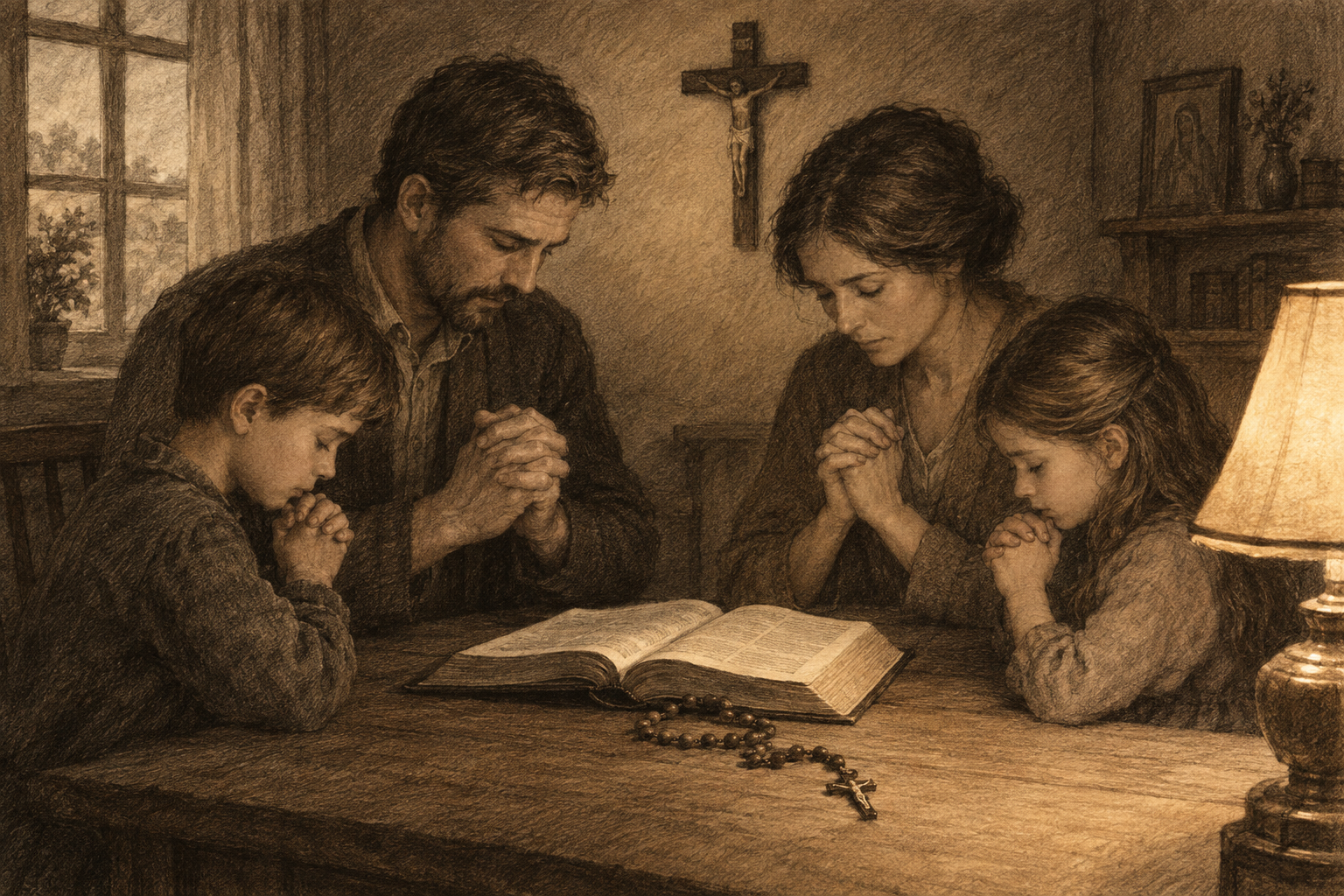
- Pray briefly and consistently. Morning offerings, grace before meals, a decade of the Rosary, bedtime prayers, and spontaneous intercession can become familiar paths toward God.
- Read Scripture together. Even a short Gospel passage gives families words and images that can return during the week.
- Celebrate the liturgical year. Advent, Christmas, Lent, Easter, saints' days, and baptism anniversaries help children experience sacred time.
- Practice mercy at home. Saying, "I was wrong," "Please forgive me," and "Let us begin again" teaches the moral life more deeply than lectures alone.
- Serve others. Concrete generosity helps children see that love of God cannot be separated from love of neighbor.
These habits should not become performances. Their purpose is communion with God. If family prayer becomes distracted or awkward, parents need not declare it a failure. Children are learning that prayer belongs in real life, including life with tired bodies, noisy rooms, and unfinished tasks.
Teaching truth with patience and clarity
Children deserve more than vague encouragement to be nice. The Christian faith makes definite claims: God created us, sin wounds us, Christ died and rose for us, grace makes holiness possible, and eternal life is our promised destiny. Parents should not fear doctrine. Truth, taught with love, gives children a framework for understanding worship, morality, suffering, forgiveness, and hope.
At the same time, formation should respect a child's age and questions. A simple answer may be right for a young child, while an adolescent may need a longer conversation and room to wrestle. When parents do not know an answer, it is better to say so and seek trustworthy help than to improvise. The Catechism, parish clergy, faithful religious education, and sound Catholic resources can assist parents in their own continuing formation.
Saint Paul praised the sincere faith that lived first in Timothy's grandmother Lois and his mother Eunice. 2 Timothy 1:5 Their example suggests that faith can be carried across generations through personal witness. Yet Paul also tells Timothy that Scripture is useful for teaching and for training in righteousness. [[VERSE|2-timothy|3|16-17|2 Timothy 3:16-17]] Warmth and instruction belong together. Affection without truth leaves children without roots, while truth presented without tenderness may appear detached from the love it proclaims.
Questions and doubts are not the enemy
Parents may become alarmed when a child questions the faith, especially if that child once accepted it easily. But a question is not always a rejection. It may be an attempt to move from borrowed belief toward personal conviction. A calm parent can make the home a place where serious questions are welcomed rather than hidden.
Listening should come before rebuttal. Parents can ask what the child means, what experience lies behind the question, and whether the difficulty is intellectual, moral, emotional, or connected to suffering. Sometimes a statement about God carries an unspoken wound. Sometimes it reflects confusion about what the Church actually teaches. Patient attention does not weaken truth. It helps truth be heard.
Jesus himself received people with questions. A father who struggled to trust cried out with both faith and unbelief, and Christ did not turn him away. Mark 9:24 Families can learn to pray with that same honesty. Faith is not pretending never to struggle. It is bringing the struggle to the Lord.
"I believe; help my unbelief!" Mark 9:24
Parents should also avoid treating every disagreement as an emergency requiring an immediate victory. Some conversations unfold over years. Continuing to love, pray, invite, and speak truth without manipulation may be a demanding form of spiritual fidelity.
Freedom, failure, and the limits of parents
One of the deepest pains in family life arises when an older child drifts from the Church. Parents may review every decision and wonder what they did wrong. Honest examination can be valuable, and parents should repent where repentance is needed. But not every struggle in a child's faith is proof of parental failure.
God grants human beings freedom. Even excellent formation does not eliminate that freedom, and imperfect formation does not place a person beyond grace. The parable of the prodigal son portrays a father who neither approves his son's departure nor ceases to love him. When the son returns, the father runs to meet him. Luke 15:20 His watchful mercy offers parents a pattern of hope: love remains truthful, the door remains open, and the returning child is received as a person rather than treated as a project.
Parents of adult children must also recognize that their role changes. They can witness, invite, answer, and pray, but they cannot govern an adult conscience as they guided a young child. Pressure may sometimes harden resistance. Respectful love, joined to quiet fidelity, can preserve the relationship through which future conversations may become possible.
Parents must remain children of God
The work of formation becomes distorted when parents believe everything depends on them. Anxiety can turn prayer into pressure, discipline into control, and concern into constant scrutiny. The remedy is not indifference but deeper surrender.
Jesus welcomed children and rebuked those who tried to prevent them from coming to him. [[VERSE|mark|10|13-16|Mark 10:13-16]] Parents serve that encounter, but Christ is the one who blesses. This distinction is liberating. A parent plants and waters, while God gives growth, as Paul teaches. [[VERSE|1-corinthians|3|6-7|1 Corinthians 3:6-7]]
For this reason, parents need a sacramental and prayerful life of their own. They need the Eucharist, confession, Scripture, friendship with other believers, and time to listen to God. Their children do not need a spiritual manager who never rests. They need mothers and fathers who know that they too are dependent on mercy.
There will be missed opportunities, impatient words, distracted prayers, and seasons when the household's spiritual life seems thin. Grace can work even there. The essential task is to return: return to Mass, return to prayer, return to one another, return to Christ. A child who sees that return learns that Christian life is not a straight display of success. It is a pilgrimage sustained by forgiveness.
The small lamp tended in a family may not always appear bright. Yet every sincere prayer, truthful conversation, sacramental encounter, and hidden act of love can help a child recognize the light of Christ. Parents may not see the full fruit of what they have offered. They can still place that offering in God's hands, trusting that the Lord who called their children by name is more faithful than their fears.
Keep Reading on Lets Read The Bible
Frequently Asked Questions
What is the most important first step in raising children in the Catholic faith?
Parents should begin by tending their own relationship with Christ. Regular Mass, confession, personal prayer, Scripture, and sincere repentance give credibility to what they teach. Children need instruction, but they also need to see that faith genuinely shapes the adults who love them.
How can families pray together when young children are restless?
Keep family prayer simple, consistent, and suited to the children's ages. Grace before meals, a brief bedtime prayer, one decade of the Rosary, or a short Gospel reading can establish a lasting rhythm. Restlessness does not make prayer worthless. Patient repetition teaches children that they belong before God even when prayer is imperfect.
What should Catholic parents do when an older child leaves the Church?
Parents can remain faithful without becoming coercive. They should listen carefully, keep communication open, answer questions honestly, invite without manipulating, and continue to pray. They may also examine their own failures and seek forgiveness where needed. An adult child's freedom must be respected, while hope in God's grace is never abandoned.