Family and Vocation
At the Bedside of Hope: Facing Death as a Christian Family
Christian hope does not deny grief. It receives death in the light of Christ's Cross, Resurrection, and promise of eternal life.
Site Admin | October 27, 2026 | 3 views
Death can arrive after years of decline, in the middle of an ordinary week, or through news no family was prepared to hear. Even when it is expected, it often feels unreal. Familiar rooms become places of vigil. Simple conversations become precious. Questions about suffering, forgiveness, faith, and eternity move from the edges of life to its center.
A death and Christian hope Catholic perspective begins by refusing two temptations. The first is despair, as if death has the final word. The second is denial, as if faith makes loss painless. Christianity offers something more honest and more consoling. Death is an enemy, grief is real, and Christ has entered both. By his Death and Resurrection, he has opened a path through the grave that his people could never open for themselves.
Christian hope does not pretend death is harmless
Scripture does not present death as a natural good that human beings should simply learn to welcome. Death belongs to the wounded condition of a world marked by sin. St. Paul writes that sin entered the world through one man, and death through sin: Romans 5:12. The Catechism likewise teaches that bodily death is a consequence of humanity's fallen state.
This helps explain why death feels like a rupture. A human person is a unity of body and soul. The separation of the soul from the body is not the completion of God's original gift. We were made for life with God, not for annihilation. Love naturally protests when someone is taken from our sight.
Jesus himself did not stand outside this sorrow. At the tomb of Lazarus, he wept: John 11:35. His tears reveal neither helpless unbelief nor empty sentiment. They show the compassion of the Son of God before the misery of death. A grieving Catholic does not dishonor Christ by weeping. Tears can be an act of love, and sometimes they are the only prayer a person can offer.
Yet Jesus did more than mourn. He declared, "I am the resurrection and the life": [[VERSE|john|11|25-26|John 11:25-26]]. Christian hope rests not on a vague sense that everything will somehow be all right, but on a person. The crucified Jesus truly died, and the risen Jesus truly lives. Because we belong to him, death no longer has absolute dominion over us.
The promises held together by Catholic faith
Catholic teaching about death holds several truths together. Each protects us from a distorted picture of hope.
The soul survives bodily death
At death, each person comes before God in what the Church calls the particular judgment. Our earthly life is not an endlessly repeatable experiment. It is a real history of freedom, grace, love, sin, repentance, and response to God. This truth gives seriousness to the present moment without making God seem cold or arbitrary. The judge we meet is the same Lord who gave himself for sinners and calls every person to conversion.
Heaven is communion with God
Heaven is not merely the continuation of pleasant earthly experiences. It is perfect life with the Holy Trinity, in communion with the Blessed Virgin Mary, the angels, and the saints. Every genuine human longing for truth, beauty, belonging, and love finds its fulfillment in God. St. Paul reminds Christians that they are called to be with the Lord: 1 Thessalonians 4:17.
Purification is a work of mercy
Those who die in God's friendship but still need purification are prepared for the fullness of heaven. The Church calls this final purification purgatory. It is not a second chance after rejecting God, nor is it a rival to Christ's saving work. It is the merciful application of that work to a soul being made ready for complete communion with him.
God takes freedom seriously
The Church also teaches the reality of hell, the definitive self-exclusion from communion with God. Catholics should neither treat this teaching lightly nor presume to declare the eternal fate of particular people. The proper response is conversion, prayer, evangelization, and trust in God's justice and mercy. God desires salvation, but he does not erase human freedom.
Our hope includes the body
Christian hope is not limited to the immortality of the soul. Catholics profess the resurrection of the body. At Christ's return, the dead will be raised, and the whole person will share in judgment and the final fulfillment of God's kingdom. St. Paul describes the resurrection with the image of what is sown perishable being raised imperishable: [[VERSE|1-corinthians|15|42-44|1 Corinthians 15:42-44]].
This is one reason the Church treats the human body with reverence after death. The body was washed in Baptism, nourished by the Eucharist, and made an instrument of love and service. Burial expresses hope that God will raise what has died. The Church permits cremation when it is not chosen to deny Christian teaching, while asking that cremated remains be treated reverently and laid to rest in a sacred place rather than scattered or kept casually.
Hope at the bedside
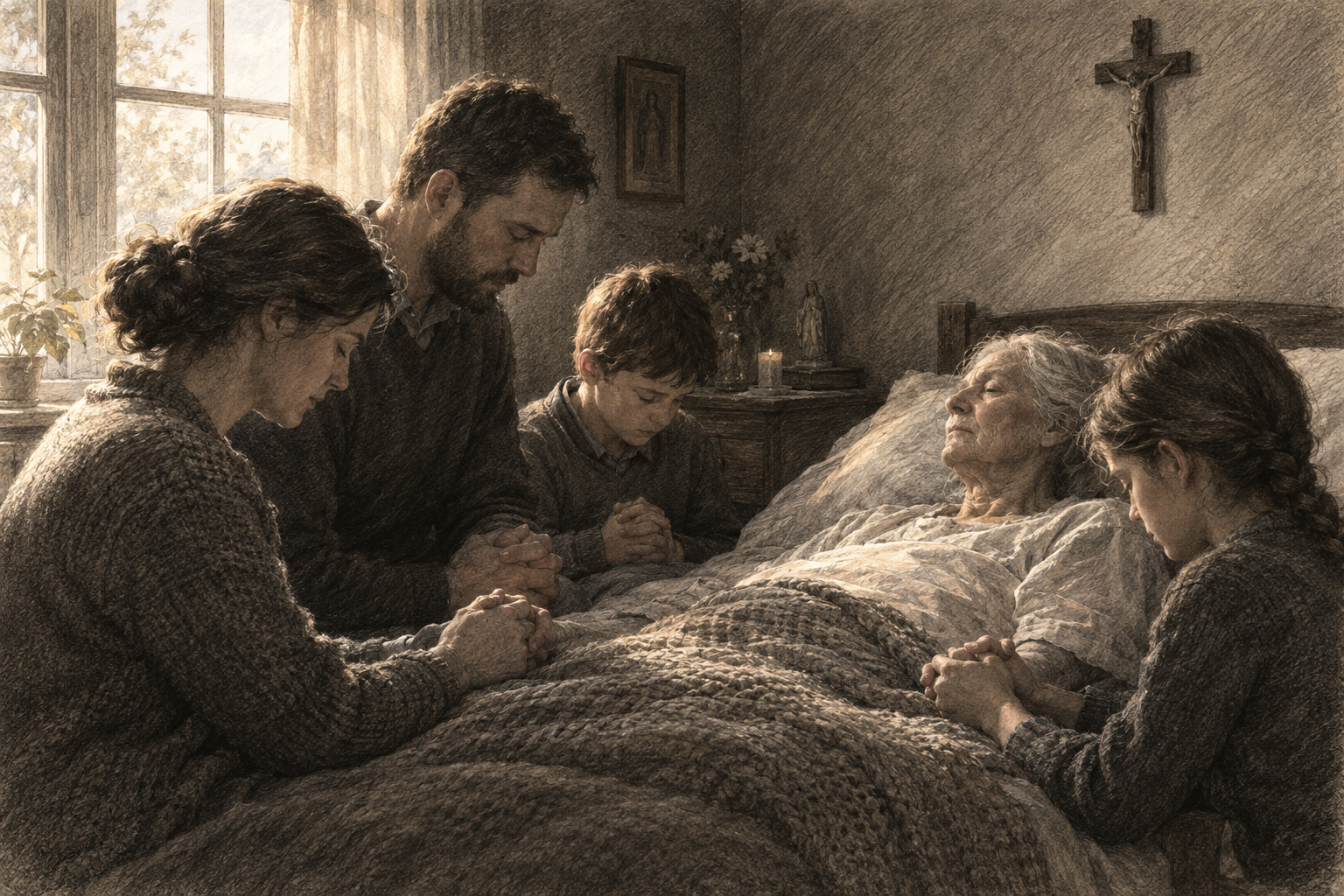
When a loved one is dying, family members often feel powerless. There may be medical decisions to make, old wounds to face, or long hours in which nothing seems to happen. Christian vocation becomes very concrete here. To remain present, to speak gently, to moisten dry lips, to call a priest, or to pray when the dying person cannot respond are acts of mercy.
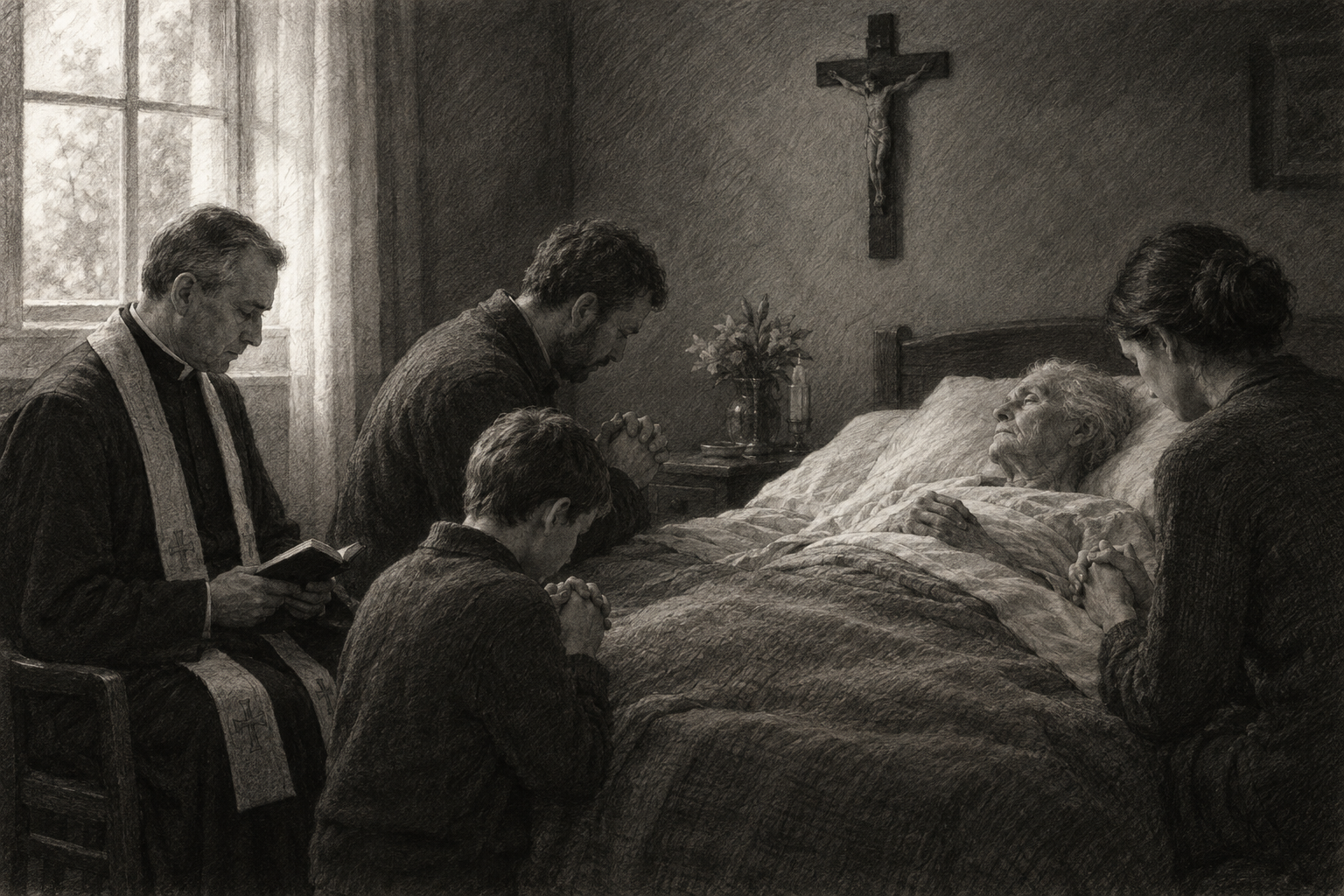
The sacraments are especially important. A seriously ill Catholic should be offered the Anointing of the Sick before the final moments whenever possible. This sacrament is not reserved only for the last breath. It gives grace, peace, strength, and, when God wills, physical healing. The dying may also receive Confession and Holy Communion. Communion given as food for the final journey is traditionally called Viaticum.
Families should not wait until death appears minutes away before contacting the parish. A priest may be able to hear a confession, offer the Anointing, bring Communion, and help everyone pray with greater peace. If death comes suddenly, the family can still call a priest and entrust the person to God's mercy.
Care for the dying also requires moral clarity. Catholic teaching rejects euthanasia and assisted suicide because intentionally causing death is not authentic mercy. At the same time, the Church does not require the use of every possible medical intervention. A person may refuse treatments that are excessively burdensome or offer no reasonable benefit, while continuing ordinary care and appropriate relief of pain. Decisions should be made with competent medical guidance, sound moral counsel when needed, and respect for the dignity of the person.
Good planning can itself be an act of love. Catholics may discuss health care wishes, identify a trustworthy decision maker, put important information in order, and express a desire for the sacraments and a Catholic funeral. Such preparation is not morbid. It can spare relatives confusion and allow them to focus more fully on prayer, presence, and farewell.
Praying for those who have died
One of the most tender Catholic responses to death is prayer for the departed. The practice is rooted in the biblical witness that it is holy to pray for the dead: [[VERSE|2-maccabees|12|44-46|2 Maccabees 12:44-46]]. We pray because love does not become useless at the grave. We ask God to forgive, purify, and welcome those who have died.
The Mass is the highest prayer the Church can offer for the dead because it makes present the one sacrifice of Christ. Families may request a Mass intention, attend the funeral liturgy, pray the Rosary, visit a cemetery, and include the departed in daily prayer. A simple prayer such as "Eternal rest grant unto them, O Lord, and let perpetual light shine upon them" can become part of family life.
Prayer for the dead avoids both presumption and despair. We do not need to pretend we know everything about a person's final encounter with God. Nor do we surrender them to hopelessness. We entrust them to a mercy deeper than our understanding and continue to love them through intercession.
Grief has no tidy timetable
After a funeral, support often fades while grief becomes more complicated. The bereaved may face silence at meals, practical responsibilities, financial strain, anniversaries, or the discovery that different family members mourn in very different ways. One person may need to talk. Another may become quiet. Some feel anger, guilt, relief, numbness, or exhaustion.
These reactions do not automatically indicate weak faith. Grief is not a problem to solve but a human response to a real loss. It can also uncover wounds that require patient care. Pastoral support, friendship, grief groups, and professional counseling can all be prudent gifts. Seeking help is compatible with trust in God.
Christian hope does not demand that sorrow disappear. St. Paul tells believers not to grieve as those who have no hope: [[VERSE|1-thessalonians|4|13-14|1 Thessalonians 4:13-14]]. He does not tell them not to grieve. The distinction matters. Christian mourning carries an ache, but not an empty one. It looks toward reunion in Christ, even when that promise feels distant.
Family members can support the grieving through steady, practical charity:
- Listen without trying to explain why the death happened.
- Remember significant dates and continue checking in after the funeral.
- Offer specific help with meals, transportation, child care, or paperwork.
- Speak the deceased person's name when it is welcome.
- Invite prayer without forcing religious language into every silence.
- Encourage professional or pastoral help when grief becomes overwhelming or dangerous.
Learning to die by learning to live
The Christian preparation for death is not chiefly a collection of end of life arrangements. It is a life of discipleship. Each honest confession, each worthy reception of the Eucharist, each act of forgiveness, and each work of mercy teaches the heart to surrender itself to God.
Remembering death can clarify vocation. Resentments begin to look less important. Time with children, spouses, relatives, friends, and those who are lonely appears more precious. Daily duties can be received not as interruptions but as the place where love is practiced. We cannot control the length of our lives, but grace can shape the manner in which we give them.
This does not mean living in fear. The Book of Revelation promises that God will wipe away every tear and that death shall be no more: Revelation 21:4. That promise permits Catholics to look at mortality without making an idol of safety. Our days are held by the Father, our sins can be forgiven in Christ, and the Holy Spirit is already preparing the faithful for eternal communion.
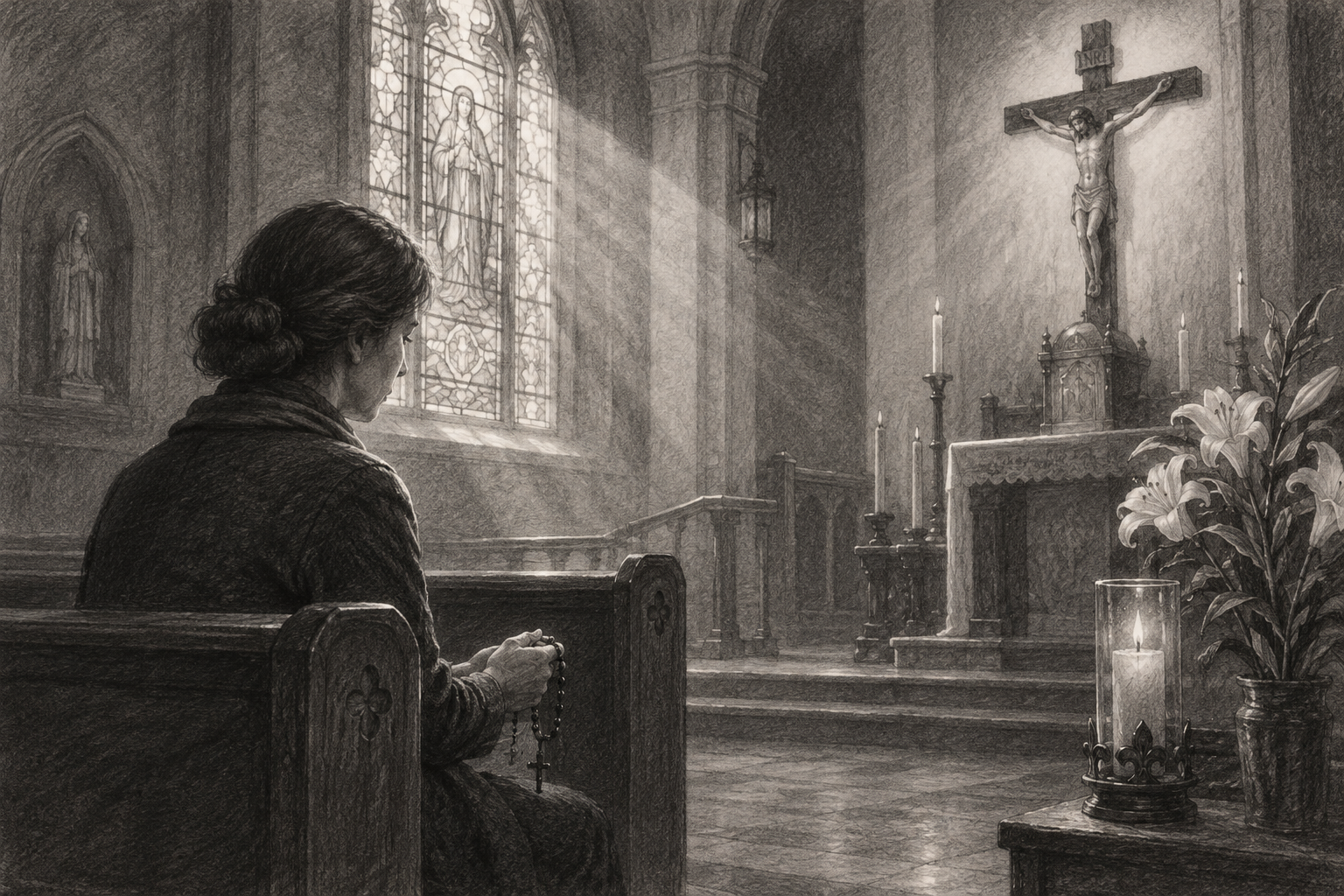
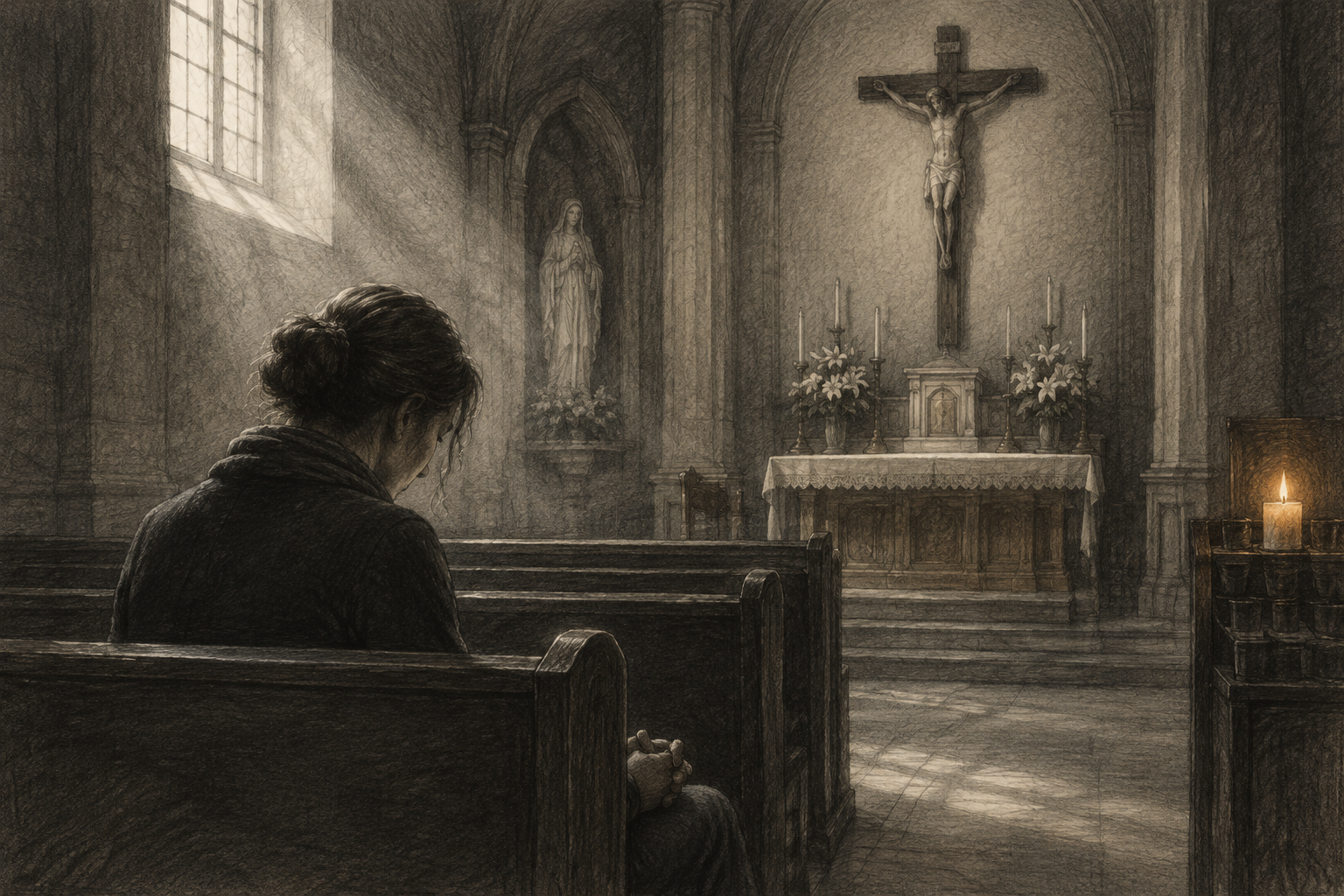
At the bedside, in the funeral church, beside the grave, and in the quiet months that follow, the Church continues to pray. She does not call death good. She proclaims that Christ is stronger. The person we love is entrusted not to darkness, but to the crucified and risen Lord, whose mercy is our hope and whose life is the home for which every faithful heart was made.
Keep Reading on Lets Read The Bible
Frequently Asked Questions
Is it wrong for a Catholic to fear death?
No. Fear of death can be a natural human response, and even faithful Christians may experience anxiety, sorrow, or uncertainty. Catholics can bring that fear to prayer, the sacraments, trusted loved ones, and pastoral care. Christian hope does not require emotional fearlessness. It rests on Christ, who died and rose again.
Why do Catholics pray for the dead?
Catholics pray for the dead because the bonds of charity continue in Christ and because those who die in God's friendship may still need purification. Scripture commends prayer for the departed in [[VERSE|2-maccabees|12|44-46|2 Maccabees 12:44-46]]. Prayer for the dead is an act of hope in God's mercy, not an attempt to replace Christ's saving work.
Can a Catholic refuse life prolonging medical treatment?
Yes, in some circumstances. Catholic teaching does not require treatments that offer no reasonable benefit or impose excessive burdens. Refusing such treatment is different from euthanasia, which intentionally causes death. Ordinary care, comfort, pain relief, and respect for the person's dignity should continue. Complex cases may require consultation with physicians, a priest, or a qualified Catholic ethicist.